
Homework Answers
Add Answer to:
Consider the fixed prices Keynesian macroeconomic model: What is the difference between planned expenditure and actual...
The aggregate demand curve shows an inverse relationship between prices and real planned expenditure. True False...
The aggregate demand curve shows an inverse relationship between prices and real planned expenditure. True False If real GDP is above its natural level, there will be downward pressure on wages and prices. True False
17. Consider the Keynesian model discussed in class. If Y>PAE, then the economy: a. Is in...
 17. Consider the Keynesian model discussed in class. If Y>PAE, then the economy: a. Is in equilibrium and experiencing a contractionary gap b. Is in equilibrium and inventories are lower than planned Is in disequilibrium and experiencing an expansionary gap c. d. Is in disequilibrium and inventories are higher than planned 18. Consider the Keynesian model discussed in class. If the re is a contractionary gap, then the economy: a. Is in equilibrium and inventories are higher than planned b....
4. “In a Short-run Keynesian model is used to explain the relationship between aggregate expenditure and...
 4. “In a Short-run Keynesian model is used to explain the relationship between aggregate expenditure and aggregate demand and how the multiplier gets smaller as the price level changes.” a) Discuss autonomous expenditure as a component of aggregate expenditure. b) State any three assumptions of a Keynesian model.
$10,0001 $8,000 Aggregate expenditure $6,000 Aggregate Expenditure $4,000 $2,000 $0 $0 $2,000 $4,000 $6,000 $8,000 $10,000...
 $10,0001 $8,000 Aggregate expenditure $6,000 Aggregate Expenditure $4,000 $2,000 $0 $0 $2,000 $4,000 $6,000 $8,000 $10,000 Real GDP (Y) 1. The premise of the Keynesian aggregate expenditure model is that the amount of goods and services produced, and therefore the level of employment, depends directly on the level of total expenditures Refer to the above graph and answer the following questions: a. For the GDP level of $5000, GDP (output from producers) is less than real domestic output desired by...
Question 26 2 Aggregate demand refers which of the following totals? ONominal actual expenditure Nominal planned...
 Question 26 2 Aggregate demand refers which of the following totals? ONominal actual expenditure Nominal planned expenditure Real planned expenditure Real actual expenditure What does the aggregate supply and demand model show? Supply and demand relationships for the economy as a whole Supply and demand relationships for every individual good Supply and demand relationships between private businesses and the government Aggregate results for all nations 2.5 pts Which of the following issues is the least likely to be a macroeconomic...
o Consider the figure to the right. This economy is in macroeconomic equilibrium at what level...
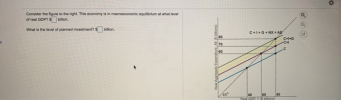 o Consider the figure to the right. This economy is in macroeconomic equilibrium at what level of real GDP? billion. What is the level of planned investment? $ billion. 80 C++ G + NK = AE CH10 CHI 70 c 60 Real Aggregate Expenditure, AE(5 bilions) 45° 40 60 ROD COPY BO
Problem 4 The income-expenditure model draws a distinction between actual aggregate expenditure (AE) which is what...
 Problem 4 The income-expenditure model draws a distinction between actual aggregate expenditure (AE) which is what is measured in the national accounts- and planned aggregate expenditure PAE). Use the following information to calculate AE and PAE Exports (X)20 Imports (M) 15 Consumption (C) 50 Planned Investment (IP) 25 Planned change in inventories-5 Unplanned change in inventories10 -Government spending (G) = 10 AE PAE
Q2. In the Keynesian cross model, equilibrium in the economy is obtained where planned spending equals...
Q2. In the Keynesian cross model, equilibrium in the economy is obtained where planned spending equals actual spending. (a) Explain what planned spending and actual spending are (b) Graphically present the equilibrium condition of the economy in the Keynesian cross model. (c) Explain how the economy adjusts to equilibrium if the economy finds itself with a level of planned spending which is less than actual spending (3 marks) (d) Explain why an increase in government spending leads to a greater...
3. Consider the following Keynesian model: C 100 + 0.8 (Y-T) Planned Investment (I) 100 Government...
 3. Consider the following Keynesian model: C 100 + 0.8 (Y-T) Planned Investment (I) 100 Government Purchase (G) 50 Taxes (T) = 50 a. Graph planned expenditure (PE) as a function of income (Y) b. What is equilibrium level of income (Y)? c. If government purchase (G) is increases to 50, what is new equilibrium income?
Consider a New Keynesian model where some prices are slow to adjust in the short-run: If...
Consider a New Keynesian model where some prices are slow to adjust in the short-run: If there is a temporary increase in consumer pessimism, we would likely see: I. A decrease in consumer spending and the aggregate demand to shift out to the left. II. An increase in the growth rate of real GDP in the short run. III. A reduction in inflation in the short run Group of answer choices Only answers I and III are correct. Only answer...
 17. Consider the Keynesian model discussed in class. If Y>PAE, then the economy: a. Is in equilibrium and experiencing a contractionary gap b. Is in equilibrium and inventories are lower than planned Is in disequilibrium and experiencing an expansionary gap c. d. Is in disequilibrium and inventories are higher than planned 18. Consider the Keynesian model discussed in class. If the re is a contractionary gap, then the economy: a. Is in equilibrium and inventories are higher than planned b....
 4. “In a Short-run Keynesian model is used to explain the relationship between aggregate expenditure and aggregate demand and how the multiplier gets smaller as the price level changes.” a) Discuss autonomous expenditure as a component of aggregate expenditure. b) State any three assumptions of a Keynesian model.
 $10,0001 $8,000 Aggregate expenditure $6,000 Aggregate Expenditure $4,000 $2,000 $0 $0 $2,000 $4,000 $6,000 $8,000 $10,000 Real GDP (Y) 1. The premise of the Keynesian aggregate expenditure model is that the amount of goods and services produced, and therefore the level of employment, depends directly on the level of total expenditures Refer to the above graph and answer the following questions: a. For the GDP level of $5000, GDP (output from producers) is less than real domestic output desired by...
 Question 26 2 Aggregate demand refers which of the following totals? ONominal actual expenditure Nominal planned expenditure Real planned expenditure Real actual expenditure What does the aggregate supply and demand model show? Supply and demand relationships for the economy as a whole Supply and demand relationships for every individual good Supply and demand relationships between private businesses and the government Aggregate results for all nations 2.5 pts Which of the following issues is the least likely to be a macroeconomic...
 o Consider the figure to the right. This economy is in macroeconomic equilibrium at what level of real GDP? billion. What is the level of planned investment? $ billion. 80 C++ G + NK = AE CH10 CHI 70 c 60 Real Aggregate Expenditure, AE(5 bilions) 45° 40 60 ROD COPY BO
 Problem 4 The income-expenditure model draws a distinction between actual aggregate expenditure (AE) which is what is measured in the national accounts- and planned aggregate expenditure PAE). Use the following information to calculate AE and PAE Exports (X)20 Imports (M) 15 Consumption (C) 50 Planned Investment (IP) 25 Planned change in inventories-5 Unplanned change in inventories10 -Government spending (G) = 10 AE PAE
 3. Consider the following Keynesian model: C 100 + 0.8 (Y-T) Planned Investment (I) 100 Government Purchase (G) 50 Taxes (T) = 50 a. Graph planned expenditure (PE) as a function of income (Y) b. What is equilibrium level of income (Y)? c. If government purchase (G) is increases to 50, what is new equilibrium income?
Most questions answered within 3 hours.
-
Where is the error in this code sequence?
String s1 = "Hello";
String s2 = "ello";...
asked 10 months ago -
Financial data for Joel de Paris, Inc., for last year
follow:
Joel de Paris, Inc.
Balance...
asked 10 months ago -
Consider this reaction:
Al2(SO4)3 (aq)+ BaCl3
(aq) Al2Cl6 (aq)- +
3BaSO4(s) . What is the...
asked 10 months ago -
Suppose that Savneet is considering increasing her
recent random sample from 20 car rentals to 40...
asked 10 months ago -
Trucks arrive at an unloading terminal at an average rate of 120
per hour.
Trucks arrive...
asked 10 months ago -
Why are methanol and ethanol completely soluble in water while
octanol is not very little soluble....
asked 10 months ago -
A facilities manager at a university reads in a research report
that the mean amount of...
asked 10 months ago -
When the CuSO4 is rehydrated by adding water to the anhydrous
compound, is this an endothermic...
asked 10 months ago -
A ray of sunlight is passing from diamond into crown glass; the
angle of incidence is...
asked 10 months ago -
A block of mass 0.249 kg is placed on top of a light, vertical
spring of...
asked 10 months ago -
how do the kidneys compensate in the presences of acidosis
a) trigger hyperventilate
b) reserve acid...
asked 10 months ago -
Question 501 pts
The rental rate of capital to the firm increases. Which of the
following...
asked 10 months ago