
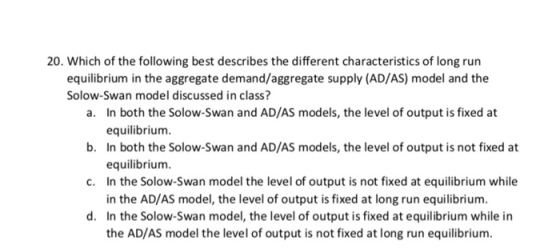
20. Which of the following best describes the different characteristics of long run equilibrium in the aggregate demand/aggregate supply (AD/AS) model and the Solow-Swan model discussed in class? a. In both the Solow-Swan and AD/AS models, the level of output is fixed at equilibrium. b. In both the Solow-Swan and AD/AS models, the level of output is not fixed at equilibrium c. In the Solow-Swan model the level of output is not fixed at equilibrium while in the AD/AS model, the level of output is fixed at long run equilibrium. d. In the Solow-Swan model, the level of output is fixed at equilibrium while in the AD/AS model the level of output is not fixed at long run equilibrium.
Homework Answers
17. The Aggregate Expenditure (AE) Keynesian model explains the output gap that exist times when the Planned Aggregate expenditure (PAE) does not equal Y or AE. Thus, there is a situation of disequilibrium. And in this situation (where, PAE>Y) then it would be said that there are too many products left and inventories are higher than planned. Thus, option D is correct.
Add Answer to:
17. Consider the Keynesian model discussed in class. If Y>PAE, then the economy: a. Is in...
1. Assume the economy is in long-run equilibrium and AD decreases. According to the Keynesian Model, what will happen to...
1. Assume the economy is in long-run equilibrium and AD decreases. According to the Keynesian Model, what will happen to the equilibrium level of GDP and the Price Level? Does the New (Modern) Keynesian Model say anything different will happen? 2. Assume the economy is in long-run equilibrium and AD decreases. According to the Classical Model, what will happen to the equilibrium level of GDP and the Price Level?
Monetary Policy in Keynesian Models of the Macroeconomy (a) The Keynesian consumption function is: C d...
Monetary Policy in Keynesian Models of the Macroeconomy (a) The Keynesian consumption function is: C d = C¯ + c(Y − T) − γcr. Provide an intuitive explanation for this equation. Define all terms. b) Consider the AD-AS model. Assume that an economy is initially in an equilibrium with output equal to potential output. Then suppose the central bank alters its policy reaction function so that for any given inflation rate and output gap it sets a lower real interest...
6.The Aggregate Demand (AD) curve is obtained by combining: (a) The consumption function, planned investment and...
6.The Aggregate Demand (AD) curve is obtained by combining: (a) The consumption function, planned investment and the central bank's policy reaction function. (b) The consumption function and the Taylor rule. (c) The equation for PAE, the central bank's policy reaction and Y = PAE. (d) Y=PAE and the consumption function. (e) The equation for planned investment and the central bank policy reaction function. 7.The AD curve is generally assumed to have a negative slope. However, which of the following would...
Which of the followings is not one of the assumption of the new Keynesian model? Please...
Which of the followings is not one of the assumption of the new Keynesian model? Please choose one: a. Prices are flexible. b. wages are sticky c. expectations are rational D. Prices are sticky 2. The IS curve traces out the combinations of the interest rate and aggregate output for which the money market is in equilibrium, and the LM curve traces out the combinations for which the market for goods and services are in equilibrium. Select one of them: Right...
B4. Closed economy Keynesian model: The aggregate demand-side of the economy Rigidia is well-described by a...
 B4. Closed economy Keynesian model: The aggregate demand-side of the economy Rigidia is well-described by a standard IS-LM-FE framework while the short-run aggregate supply side is characterized by (SRAS) aggregate output/income, Y is the full employment output level, P is the Here Y is realized aggregate realized price level, Pe is the expected price level and b is a constant that depends on the slope of the labour demand curve. Explain the effects of each of the following on the...
Macroeconomics Schools of Thought In Class Assignment 1. Assume the economy is currently in long and...
 Macroeconomics
Schools of Thought In Class Assignment 1. Assume the economy is currently in long and short run equilibrium. a. Suppose that the government in this economy goes to war. Holding everything else constant, what do you predict will happen to real GDP and the aggregate price level in the short run? What type of gap is created? Use the AS/AD model to illustrate. a. According to a Classical economist, how can the economy move back to its potential? Explain...
Macroeconomics
Schools of Thought In Class Assignment 1. Assume the economy is currently in long and short run equilibrium. a. Suppose that the government in this economy goes to war. Holding everything else constant, what do you predict will happen to real GDP and the aggregate price level in the short run? What type of gap is created? Use the AS/AD model to illustrate. a. According to a Classical economist, how can the economy move back to its potential? Explain...
8 (12-13 pts) Assume the economy is at its full-employment level of output (at the LRAS). engages in contractionary monetary policy, what will be the effect If the Federal Reserve on the interest...
 8 (12-13 pts) Assume the economy is at its full-employment level of output (at the LRAS). engages in contractionary monetary policy, what will be the effect If the Federal Reserve on the interest rate, planned investment, and output? Show the change using the money market, planned investment graph and the aggregate expenditure model Show the short-run change using AD-AS. (There is no need to show additional changes to the money market or aggregate expenditure model.) Indicate all changes in relevant...
[8] In Keynesian economics the most important factor determining whether the level of economic activity is...
[8] In Keynesian economics the most important factor determining whether the level of economic activity is growing or shrinking is: A) the multiplier effect. B) government expenditure and tax policies. C) the behavior of nonincome-determined spending. D) the relationship between leakages from and injections into the spending stream. [9] Using the Keynesian approach, if leakages from the spending stream are less than injections, the current level of output is: A) less than the equilibrium level of output, and will increase....
8] In Keynesian economics the most important factor determining whether the level of economic activity is...
8] In Keynesian economics the most important factor determining whether the level of economic activity is growing or shrinking is: A) the multiplier effect. B) government expenditure and tax policies. C) the behavior of nonincome-determined spending. D) the relationship between leakages from and injections into the spending stream. [9] Using the Keynesian approach, if leakages from the spending stream are less than injections, the current level of output is: A) less than the equilibrium level of output, and will increase....
Consider the aggregate demand – aggregate supply (AD-AS) model. Assume the economy is initially at its...
Consider the aggregate demand – aggregate supply (AD-AS) model. Assume the economy is initially at its long-run equilibrium. Produce a new graph, draw the aggregated demand curve, short-run aggregate supply curve, and the long-run aggregate supply curve and label the curves. Label both the horizonal and vertical axes clearly. Label the long-run equilibrium as A and its corresponding output level as Y1 Now assume a positive supply shock hits the economy. In the graph, show the short-run effects of this...
 B4. Closed economy Keynesian model: The aggregate demand-side of the economy Rigidia is well-described by a standard IS-LM-FE framework while the short-run aggregate supply side is characterized by (SRAS) aggregate output/income, Y is the full employment output level, P is the Here Y is realized aggregate realized price level, Pe is the expected price level and b is a constant that depends on the slope of the labour demand curve. Explain the effects of each of the following on the...
 Macroeconomics
Schools of Thought In Class Assignment 1. Assume the economy is currently in long and short run equilibrium. a. Suppose that the government in this economy goes to war. Holding everything else constant, what do you predict will happen to real GDP and the aggregate price level in the short run? What type of gap is created? Use the AS/AD model to illustrate. a. According to a Classical economist, how can the economy move back to its potential? Explain...
Macroeconomics
Schools of Thought In Class Assignment 1. Assume the economy is currently in long and short run equilibrium. a. Suppose that the government in this economy goes to war. Holding everything else constant, what do you predict will happen to real GDP and the aggregate price level in the short run? What type of gap is created? Use the AS/AD model to illustrate. a. According to a Classical economist, how can the economy move back to its potential? Explain...
 8 (12-13 pts) Assume the economy is at its full-employment level of output (at the LRAS). engages in contractionary monetary policy, what will be the effect If the Federal Reserve on the interest rate, planned investment, and output? Show the change using the money market, planned investment graph and the aggregate expenditure model Show the short-run change using AD-AS. (There is no need to show additional changes to the money market or aggregate expenditure model.) Indicate all changes in relevant...
Most questions answered within 3 hours.
-
Where is the error in this code sequence?
String s1 = "Hello";
String s2 = "ello";...
asked 11 months ago -
Financial data for Joel de Paris, Inc., for last year
follow:
Joel de Paris, Inc.
Balance...
asked 11 months ago -
Consider this reaction:
Al2(SO4)3 (aq)+ BaCl3
(aq) Al2Cl6 (aq)- +
3BaSO4(s) . What is the...
asked 11 months ago -
Suppose that Savneet is considering increasing her
recent random sample from 20 car rentals to 40...
asked 11 months ago -
Trucks arrive at an unloading terminal at an average rate of 120
per hour.
Trucks arrive...
asked 11 months ago -
Why are methanol and ethanol completely soluble in water while
octanol is not very little soluble....
asked 11 months ago -
A facilities manager at a university reads in a research report
that the mean amount of...
asked 11 months ago -
When the CuSO4 is rehydrated by adding water to the anhydrous
compound, is this an endothermic...
asked 11 months ago -
A ray of sunlight is passing from diamond into crown glass; the
angle of incidence is...
asked 11 months ago -
A block of mass 0.249 kg is placed on top of a light, vertical
spring of...
asked 11 months ago -
how do the kidneys compensate in the presences of acidosis
a) trigger hyperventilate
b) reserve acid...
asked 11 months ago -
Question 501 pts
The rental rate of capital to the firm increases. Which of the
following...
asked 11 months ago