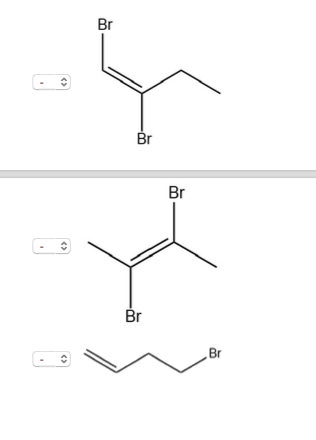
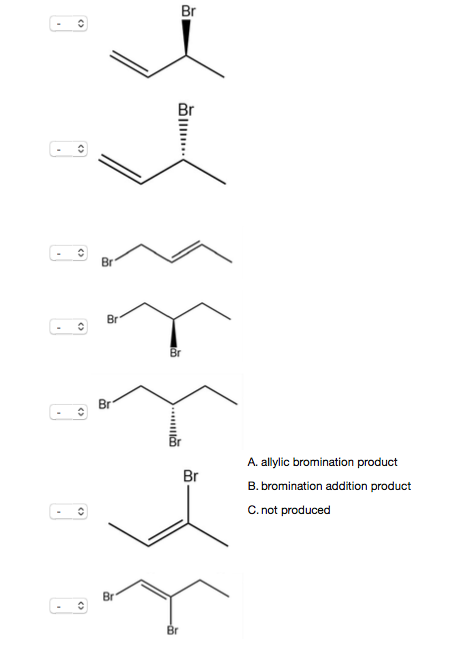
Categorize each of the compounds shown below as an [A] allylic bromination product, a [B] bromination addition product, or as [C] not produced by this reaction.
Categorize each of the compounds shown below as an [A] allylic bromination product, a [B] bromination addition product, or as [C] not produced by this reaction.

Homework Answers
*Allylic bromination is the addition of a bromine atom to the allylic position of a double bond rather than to the double bond itself. The most common reagent used for allylic bromination is N-bromosuccinimide (NBS). Bromine molecule usually adds across the double bond to form an adduct.
*An adduct is a product of the addition of 2 or more distinct molecules containing the atoms of all the added molecules.
*Here the order of the names of the 10 molecules given
is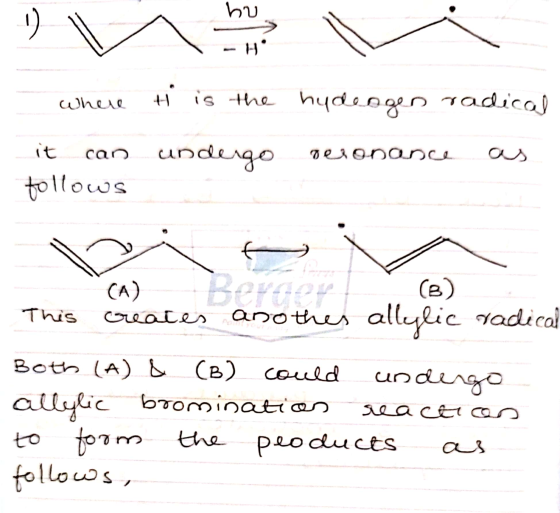
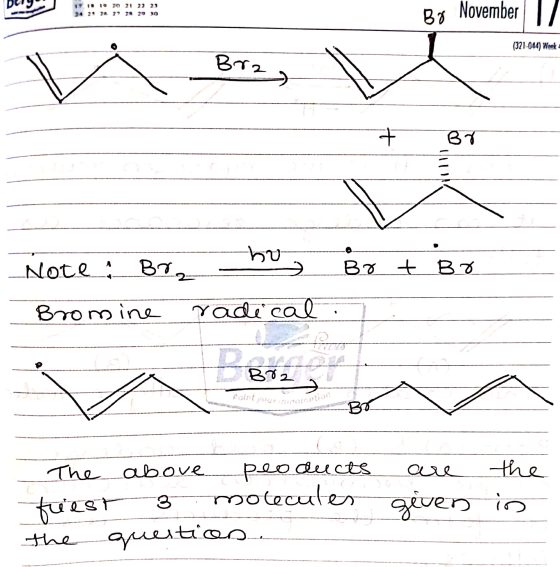
 ,
,
1. A
2. A
3. A
4. B
5. B
6. C
7. C
8. C
9. C
10. C
Add Answer to:
Categorize each of the compounds shown below as an [A] allylic bromination product, a [B] bromination addition product, or as [C] not produced by this reaction.
Answer the following questions about radical halogenation QUESTION 1 Performing allylic bromination of an asymmetric alkene...
 Answer the following questions about radical halogenation
QUESTION 1 Performing allylic bromination of an asymmetric alkene produces two regiochemical outcomes due to resonance, and two conformations (R) and (S) for each chirality center produced. This is further complicated if you make the mistake of using Br2 as your source of bromine radicals, as the addition reaction producing alkyl dibromides competes with the allylic bromination. Br2, hv ??? Categorize each of the compounds shown below as an [A] allylic bromination product,...
Answer the following questions about radical halogenation
QUESTION 1 Performing allylic bromination of an asymmetric alkene produces two regiochemical outcomes due to resonance, and two conformations (R) and (S) for each chirality center produced. This is further complicated if you make the mistake of using Br2 as your source of bromine radicals, as the addition reaction producing alkyl dibromides competes with the allylic bromination. Br2, hv ??? Categorize each of the compounds shown below as an [A] allylic bromination product,...
The electrophilic bromination or chlorination of benzene requires, in addition to the halogen: a hydroxide ion....
 The electrophilic bromination or chlorination of benzene requires, in addition to the halogen: a hydroxide ion. a Lewis base. a Lewis acid. peroxide. Aryl and vinyl halides cannot be used in the Friedel-Crafts alkylation because they do not form carbocautions readily. True False Which is not a characteristic of aromatic compounds? Aromatic compounds are non-cyclic. Aromatic compounds are conjugated. Aromatic compounds meet the Huckel's rule. Aromatic compounds are planar. Which of the compounds below is a product of this reaction?...
Consider the addition reaction shown. 2 Cl, → product H-C=C-H Draw the product for the addition...
 Consider the addition reaction shown. 2 Cl, → product H-C=C-H Draw the product for the addition reaction. Select Rings Draw More Erase cl
Which of the following compounds would be predicted to be produced in the reaction shown? There...
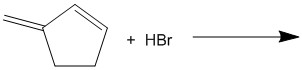 Which of the following compounds would be predicted to be
produced in the reaction shown? There may be more than 1
product.
+ HBr
Which of the following compounds would be predicted to be
produced in the reaction shown? There may be more than 1
product.
+ HBr
For the HCl-alkene addition reaction shown below
 a) For the HCl-alkene addition reaction shown below, draw the complete curved arrow mechanism to the major product shown below. b) For the HCl-alkene addition reaction, draw the reaction coordinate diagram with all intermediates and transition states. Label AA for each reaction step and AH for the overall addition. Next to the structures on your diagram, give approximate pK, values that are consistent with an endothermic first reaction step.
please help 10. Draw the major product for bromination of each diene below. The products are...
 please help
10. Draw the major product for bromination of each diene below. The products are dibromides. Br2 (no light) 1,4-addition Br2 (no light) 1,2-addition
please help
10. Draw the major product for bromination of each diene below. The products are dibromides. Br2 (no light) 1,4-addition Br2 (no light) 1,2-addition
Predict the major organic product formed when the compounds shown below undergo a reaction in the...
 Predict the major organic product formed when the compounds
shown below undergo a reaction in the presence of AlCl3.
Predict the major organic product formed when the compounds shown below undergo a reaction in the presence of AlCl3.
Predict the major organic product formed when the compounds
shown below undergo a reaction in the presence of AlCl3.
Predict the major organic product formed when the compounds shown below undergo a reaction in the presence of AlCl3.
7. Draw a molecular orbital energy diagram for the allylic carbocation (line-angle structure shown below). (6...
 7. Draw a molecular orbital energy diagram for the allylic carbocation (line-angle structure shown below). (6 points) a) According to MOT and based on your MO diagram, predict the product(s) of the reaction of the allylic carbocation with a bromide ion (Br"). (2 points)
7. Draw a molecular orbital energy diagram for the allylic carbocation (line-angle structure shown below). (6...
 7. Draw a molecular orbital energy diagram for the allylic carbocation (line-angle structure shown below). (6 points) a) According to MOT and based on your MO diagram, predict the product(s) of the reaction of the allylic carbocation with a bromide ion (Br).(2 points)
3. For the reaction sequence shown below, give the product of each reaction and show the...
 3. For the reaction sequence shown below, give the product of each reaction and show the mechanism of Its formation. 4. Propose a synthesis (make) for the compounds shown below. All carbon containing compounds, reagents, or reactants must be synthesized from the starting materials shown in the box. You may use any Inorganic compounds you wish. You may also use any solvents you wish, however, if a solvent participates in the reaction you must synthesize it.
 Answer the following questions about radical halogenation
QUESTION 1 Performing allylic bromination of an asymmetric alkene produces two regiochemical outcomes due to resonance, and two conformations (R) and (S) for each chirality center produced. This is further complicated if you make the mistake of using Br2 as your source of bromine radicals, as the addition reaction producing alkyl dibromides competes with the allylic bromination. Br2, hv ??? Categorize each of the compounds shown below as an [A] allylic bromination product,...
Answer the following questions about radical halogenation
QUESTION 1 Performing allylic bromination of an asymmetric alkene produces two regiochemical outcomes due to resonance, and two conformations (R) and (S) for each chirality center produced. This is further complicated if you make the mistake of using Br2 as your source of bromine radicals, as the addition reaction producing alkyl dibromides competes with the allylic bromination. Br2, hv ??? Categorize each of the compounds shown below as an [A] allylic bromination product,...
 The electrophilic bromination or chlorination of benzene requires, in addition to the halogen: a hydroxide ion. a Lewis base. a Lewis acid. peroxide. Aryl and vinyl halides cannot be used in the Friedel-Crafts alkylation because they do not form carbocautions readily. True False Which is not a characteristic of aromatic compounds? Aromatic compounds are non-cyclic. Aromatic compounds are conjugated. Aromatic compounds meet the Huckel's rule. Aromatic compounds are planar. Which of the compounds below is a product of this reaction?...
 Consider the addition reaction shown. 2 Cl, → product H-C=C-H Draw the product for the addition reaction. Select Rings Draw More Erase cl
 Which of the following compounds would be predicted to be
produced in the reaction shown? There may be more than 1
product.
+ HBr
Which of the following compounds would be predicted to be
produced in the reaction shown? There may be more than 1
product.
+ HBr
 please help
10. Draw the major product for bromination of each diene below. The products are dibromides. Br2 (no light) 1,4-addition Br2 (no light) 1,2-addition
please help
10. Draw the major product for bromination of each diene below. The products are dibromides. Br2 (no light) 1,4-addition Br2 (no light) 1,2-addition
 Predict the major organic product formed when the compounds
shown below undergo a reaction in the presence of AlCl3.
Predict the major organic product formed when the compounds shown below undergo a reaction in the presence of AlCl3.
Predict the major organic product formed when the compounds
shown below undergo a reaction in the presence of AlCl3.
Predict the major organic product formed when the compounds shown below undergo a reaction in the presence of AlCl3.
 7. Draw a molecular orbital energy diagram for the allylic carbocation (line-angle structure shown below). (6 points) a) According to MOT and based on your MO diagram, predict the product(s) of the reaction of the allylic carbocation with a bromide ion (Br"). (2 points)
 7. Draw a molecular orbital energy diagram for the allylic carbocation (line-angle structure shown below). (6 points) a) According to MOT and based on your MO diagram, predict the product(s) of the reaction of the allylic carbocation with a bromide ion (Br).(2 points)
 3. For the reaction sequence shown below, give the product of each reaction and show the mechanism of Its formation. 4. Propose a synthesis (make) for the compounds shown below. All carbon containing compounds, reagents, or reactants must be synthesized from the starting materials shown in the box. You may use any Inorganic compounds you wish. You may also use any solvents you wish, however, if a solvent participates in the reaction you must synthesize it.
Most questions answered within 3 hours.
-
Where is the error in this code sequence?
String s1 = "Hello";
String s2 = "ello";...
asked 11 months ago -
Financial data for Joel de Paris, Inc., for last year
follow:
Joel de Paris, Inc.
Balance...
asked 11 months ago -
Consider this reaction:
Al2(SO4)3 (aq)+ BaCl3
(aq) Al2Cl6 (aq)- +
3BaSO4(s) . What is the...
asked 11 months ago -
Suppose that Savneet is considering increasing her
recent random sample from 20 car rentals to 40...
asked 11 months ago -
Trucks arrive at an unloading terminal at an average rate of 120
per hour.
Trucks arrive...
asked 11 months ago -
Why are methanol and ethanol completely soluble in water while
octanol is not very little soluble....
asked 11 months ago -
A facilities manager at a university reads in a research report
that the mean amount of...
asked 11 months ago -
When the CuSO4 is rehydrated by adding water to the anhydrous
compound, is this an endothermic...
asked 11 months ago -
A ray of sunlight is passing from diamond into crown glass; the
angle of incidence is...
asked 11 months ago -
A block of mass 0.249 kg is placed on top of a light, vertical
spring of...
asked 11 months ago -
how do the kidneys compensate in the presences of acidosis
a) trigger hyperventilate
b) reserve acid...
asked 11 months ago -
Question 501 pts
The rental rate of capital to the firm increases. Which of the
following...
asked 11 months ago