For the HCl-alkene addition reaction shown below
a) For the HCl-alkene addition reaction shown below, draw the complete curved arrow mechanism to the major product shown below.
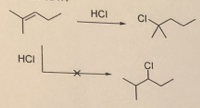
b) For the HCl-alkene addition reaction, draw the reaction coordinate diagram with all intermediates and transition states. Label AA for each reaction step and AH for the overall addition. Next to the structures on your diagram, give approximate pK, values that are consistent with an endothermic first reaction step.
Homework Answers
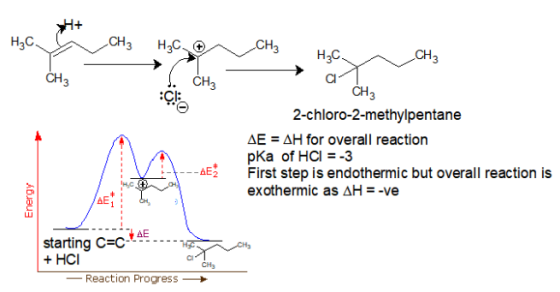
Addition Reaction (Ch. 8. primarily) Learning Outcomes: By successfully completing this assignment, the student will demonstrate...
 Addition Reaction (Ch. 8. primarily) Learning Outcomes: By successfully completing this assignment, the student will demonstrate the ability to: (A) Provide proper curved-arrow mechanisms for addition reactions involving alkene reactants. (B) Predict the correct structure of the products of addition reactions, including correct regiochemistry and stereochemistry. (C) Provide reasonable explanations for mechanistic steps in addition reactions based on energy considerations and the structures of reactants, intermediates, and transition states. 1. The following molecule will be the reactant for all reactions...
Shown below is the reaction of an alkene with an electrophile
 Shown below is the reaction of an alkene with an electrophile For the mechanism step below, draw curved arrows to show electron reorganization. Use the arrow tool to specify the origin and the destination of the reorganizing electrons. Consult the arrow-pushing instructions for the convention on regiospecific electrophilic attack on a double bond.
Justify Answers. Consider the energy diagram below showing the conversion of A to G a) How...
 Justify Answers.
Consider the energy diagram below showing the conversion of A to G a) How many steps are included in this overall reaction mechanism? b) Label each step as endothermic or exothermic. Is the overall reaction endothermid or exothermic? c) Label ΔE and Ea for each step. Label ΔEnn for the reaction overall. d) Which step is rate-determining? e) Which points correspond to transitions states? f) Which points correspond to intermediates? g) Indicate whether each transition state most resembles...
Justify Answers.
Consider the energy diagram below showing the conversion of A to G a) How many steps are included in this overall reaction mechanism? b) Label each step as endothermic or exothermic. Is the overall reaction endothermid or exothermic? c) Label ΔE and Ea for each step. Label ΔEnn for the reaction overall. d) Which step is rate-determining? e) Which points correspond to transitions states? f) Which points correspond to intermediates? g) Indicate whether each transition state most resembles...
Draw a labelled reaction coordinate diagram for the both SN reactions. Label the activation energy (free...
Draw a labelled reaction coordinate diagram for the both SN reactions. Label the activation energy (free energy of activation) and give the approximate structures of the intimal state, the transition states, the intermediate and product at the correct points along the reaction coordinate. Also, can you decide on the basis of the kinetic expression whether the t-butyl chloride-hydroxide ion reaction proceeds by a one-step or a two-step mechanism? Explain why observed kinetic expression is consistent with the mechanism you chose.
Give the product of the following reaction, indicate the mechanism type(s), state whether a solution of...
 Give the product of the following reaction, indicate the mechanism type(s), state whether a solution of the product would be optically active or not, give a BRIEF explanation Br: MeOH boil Give a full curved-arrow pushing mechanism fro the following reaction, label the Lewis and Bronsted acids/bases for all bimolecular reactions as appropriate. CHO: CH3OH heat Give a full curved arrow mechanism for the following reaction, indicate LB/LA/BB/BA for each bimolecular as appropriate, and give a reaction energy diagram. State...
4. Consider the reaction energy diagram below. Consider the "potential energy" to be equal to enthalpy....
 4. Consider the reaction energy diagram below. Consider the "potential energy" to be equal to enthalpy. Potential energy Reaction progress First, indicate on the diagram the activation energy, transition state, and the change of enthalpy for every step of this step-wise process, as well as the change in enthalpy for the overall reaction. Then, answer the following questions: (i) How many elementary steps are there in the mechanism of this reaction? (ii) Which of these steps is the rate-determining step?...
a) Give a full curved-arrow pushing mechanism, indicate the Lewis and Bronsted acids/bases for each intermoelcular...
 a) Give a full curved-arrow pushing mechanism, indicate the Lewis and Bronsted acids/bases for each intermoelcular step as appropriate, indicate the rate determining step. Give the number of sets of intermediates and the number of transition states included in your mechanism. HO: H20 HCI (catalytic) # of sets of intermediates # of transition states b) Draw a reaction energy diagram, do not draw the transition states for each step but indicate their positions on the diagram and also the positions...
Propose a detailed mechanism for the following transformation. Use curved arrows to show movement of electron...
 Propose a detailed mechanism for the following transformation. Use curved arrows to show movement of electron pairs and be sure to draw structures of all important reaction intexmediates, State the name of the reaction below. NaOH, EtOH, A OCH3 OCH (11 marks] Draw a reaction energy diagram, and label the product (P), reactant (R), transition states CTS. TS, etc), intermediates (INT1, INT2, etc.) and activation energies (AG', AG , etc.) for a reaction with the following criteria: i. A three-step,...
The electrophilic addition reaction shown below involves a carbocation rearrangement.
 The electrophilic addition reaction shown below involves a
carbocation rearrangement. For the mechanism step below, draw
curved arrows to show electron reorganization. use the arrow tool
to specify the origin and the destination of the reorganizing
electrons.Consult the arrow-pushing instructions for the convention on regiospecific electrophilic attack on a double bond
The electrophilic addition reaction shown below involves a
carbocation rearrangement. For the mechanism step below, draw
curved arrows to show electron reorganization. use the arrow tool
to specify the origin and the destination of the reorganizing
electrons.Consult the arrow-pushing instructions for the convention on regiospecific electrophilic attack on a double bond
Press Esc to exit full screen Consider the reaction below. 6. CH3OH Br a. Give a complete curved-arrow reaction mechanism b. Draw the reaction-coordinate diagram for this reaction Draw the transition...
 Press Esc to exit full screen Consider the reaction below. 6. CH3OH Br a. Give a complete curved-arrow reaction mechanism b. Draw the reaction-coordinate diagram for this reaction Draw the transition state for the carbocation rearrangement. c. d. What is the driving force for this carbocation rearrangement?
Press Esc to exit full screen Consider the reaction below. 6. CH3OH Br a. Give a complete curved-arrow reaction mechanism b. Draw the reaction-coordinate diagram for this reaction Draw the transition state for...
Press Esc to exit full screen Consider the reaction below. 6. CH3OH Br a. Give a complete curved-arrow reaction mechanism b. Draw the reaction-coordinate diagram for this reaction Draw the transition state for the carbocation rearrangement. c. d. What is the driving force for this carbocation rearrangement?
Press Esc to exit full screen Consider the reaction below. 6. CH3OH Br a. Give a complete curved-arrow reaction mechanism b. Draw the reaction-coordinate diagram for this reaction Draw the transition state for...
 Addition Reaction (Ch. 8. primarily) Learning Outcomes: By successfully completing this assignment, the student will demonstrate the ability to: (A) Provide proper curved-arrow mechanisms for addition reactions involving alkene reactants. (B) Predict the correct structure of the products of addition reactions, including correct regiochemistry and stereochemistry. (C) Provide reasonable explanations for mechanistic steps in addition reactions based on energy considerations and the structures of reactants, intermediates, and transition states. 1. The following molecule will be the reactant for all reactions...
 Justify Answers.
Consider the energy diagram below showing the conversion of A to G a) How many steps are included in this overall reaction mechanism? b) Label each step as endothermic or exothermic. Is the overall reaction endothermid or exothermic? c) Label ΔE and Ea for each step. Label ΔEnn for the reaction overall. d) Which step is rate-determining? e) Which points correspond to transitions states? f) Which points correspond to intermediates? g) Indicate whether each transition state most resembles...
Justify Answers.
Consider the energy diagram below showing the conversion of A to G a) How many steps are included in this overall reaction mechanism? b) Label each step as endothermic or exothermic. Is the overall reaction endothermid or exothermic? c) Label ΔE and Ea for each step. Label ΔEnn for the reaction overall. d) Which step is rate-determining? e) Which points correspond to transitions states? f) Which points correspond to intermediates? g) Indicate whether each transition state most resembles...
 Give the product of the following reaction, indicate the mechanism type(s), state whether a solution of the product would be optically active or not, give a BRIEF explanation Br: MeOH boil Give a full curved-arrow pushing mechanism fro the following reaction, label the Lewis and Bronsted acids/bases for all bimolecular reactions as appropriate. CHO: CH3OH heat Give a full curved arrow mechanism for the following reaction, indicate LB/LA/BB/BA for each bimolecular as appropriate, and give a reaction energy diagram. State...
 4. Consider the reaction energy diagram below. Consider the "potential energy" to be equal to enthalpy. Potential energy Reaction progress First, indicate on the diagram the activation energy, transition state, and the change of enthalpy for every step of this step-wise process, as well as the change in enthalpy for the overall reaction. Then, answer the following questions: (i) How many elementary steps are there in the mechanism of this reaction? (ii) Which of these steps is the rate-determining step?...
 a) Give a full curved-arrow pushing mechanism, indicate the Lewis and Bronsted acids/bases for each intermoelcular step as appropriate, indicate the rate determining step. Give the number of sets of intermediates and the number of transition states included in your mechanism. HO: H20 HCI (catalytic) # of sets of intermediates # of transition states b) Draw a reaction energy diagram, do not draw the transition states for each step but indicate their positions on the diagram and also the positions...
 Propose a detailed mechanism for the following transformation. Use curved arrows to show movement of electron pairs and be sure to draw structures of all important reaction intexmediates, State the name of the reaction below. NaOH, EtOH, A OCH3 OCH (11 marks] Draw a reaction energy diagram, and label the product (P), reactant (R), transition states CTS. TS, etc), intermediates (INT1, INT2, etc.) and activation energies (AG', AG , etc.) for a reaction with the following criteria: i. A three-step,...
 Press Esc to exit full screen Consider the reaction below. 6. CH3OH Br a. Give a complete curved-arrow reaction mechanism b. Draw the reaction-coordinate diagram for this reaction Draw the transition state for the carbocation rearrangement. c. d. What is the driving force for this carbocation rearrangement?
Press Esc to exit full screen Consider the reaction below. 6. CH3OH Br a. Give a complete curved-arrow reaction mechanism b. Draw the reaction-coordinate diagram for this reaction Draw the transition state for...
Press Esc to exit full screen Consider the reaction below. 6. CH3OH Br a. Give a complete curved-arrow reaction mechanism b. Draw the reaction-coordinate diagram for this reaction Draw the transition state for the carbocation rearrangement. c. d. What is the driving force for this carbocation rearrangement?
Press Esc to exit full screen Consider the reaction below. 6. CH3OH Br a. Give a complete curved-arrow reaction mechanism b. Draw the reaction-coordinate diagram for this reaction Draw the transition state for...
Most questions answered within 3 hours.
-
Where is the error in this code sequence?
String s1 = "Hello";
String s2 = "ello";...
asked 10 months ago -
Financial data for Joel de Paris, Inc., for last year
follow:
Joel de Paris, Inc.
Balance...
asked 10 months ago -
Consider this reaction:
Al2(SO4)3 (aq)+ BaCl3
(aq) Al2Cl6 (aq)- +
3BaSO4(s) . What is the...
asked 10 months ago -
Suppose that Savneet is considering increasing her
recent random sample from 20 car rentals to 40...
asked 10 months ago -
Trucks arrive at an unloading terminal at an average rate of 120
per hour.
Trucks arrive...
asked 10 months ago -
Why are methanol and ethanol completely soluble in water while
octanol is not very little soluble....
asked 10 months ago -
A facilities manager at a university reads in a research report
that the mean amount of...
asked 10 months ago -
When the CuSO4 is rehydrated by adding water to the anhydrous
compound, is this an endothermic...
asked 10 months ago -
A ray of sunlight is passing from diamond into crown glass; the
angle of incidence is...
asked 10 months ago -
A block of mass 0.249 kg is placed on top of a light, vertical
spring of...
asked 10 months ago -
how do the kidneys compensate in the presences of acidosis
a) trigger hyperventilate
b) reserve acid...
asked 10 months ago -
Question 501 pts
The rental rate of capital to the firm increases. Which of the
following...
asked 10 months ago