In mid-2017, the once high-flying BlackBerry stock was trad¬ing for less than $7 a share, a...
In mid-2017, the once high-flying BlackBerry stock was trad¬ing
for less than $7 a share, a drop of more than 94 percent from $139
in 2008. The competi¬tive landscape had shifted in recent years,
and BlackBerry lost its strong position in the mobile phone market.
BlackBerry’s stock peaked at $230.52 in July of 2007 as celebrities
and politicians all adopted the addictive phone design nicknamed
“CrackBerry.” However, consumer needs and wants shifted in the
following years, and BlackBerry lost its strong market position in
2010. Since then, the company was forced to deal with a severe
reduction in hardware revenues and mobile subscribers, a trend it
hasn’t yet been able to reverse.
By 2011, Apple and then Android operating systems began to dominate
the smartphone industry, and the two dominant manufacturers, Apple
and Samsung, held the bulk of the market share. There continued to
be growth in the industry, with a compounded annual global growth
rate of 9.8 percent through 2018, but this was much lower than
earlier trends due to saturated market conditions in Western Europe
and North America where replacement sales drove the majority of
revenues.
Although the BlackBerry had been extremely popular in corporate
environments, when “The Bring Your Own Device” (BYOD) trend emerged
in 2009 corporate IT departments lost much of their incentive to
procure the secure and reliable BlackBerry as companywide hardware.
After a decade of massive success, BlackBerry had failed to
understand that consumers would drive the next surge in demand, and
their corporate strategy to cater to the professionals would become
unsustainable. Further, BlackBerry did not believe the innovative
touchscreen capabilities of Apple and Android phones would succeed,
and therefore, did not develop this capability until 2013. When the
firm finally released the all-touchscreen version of BlackBerry 10,
they were far too late to market.
In 2013, BlackBerry Limited had hired John Chen, a turn¬around
specialist, as its new CEO to get the former domi¬nant smartphone
producer back to profitability. Soon after joining the company,
Chen formulated a turnaround plan that emphasized corporate and
government enterprises. This new plan would significantly reduce
the company’s operat¬ing costs; however, the sustain¬ability of his
strategy was still a big unknown. There were rumors regarding a
potential sale of the company to Samsung Group, privatization of
operations to reduce the risk of shareholder activism or hostile
takeovers, and a move to focus only on software and licensing
agreements.
The smartphone industry has for a while displayed significant
duopoly features, both with iOS and Android (software), but also
with the iPhone and Samsung Galaxy smartphones (hardware). The
global expansion from Chinese smartphone manufacturers Huawei and
Xiaomi is expected to fragment the market and drive down the
average price of devices in the years to come. The Android open
source software system has reduced entry barriers and creates an
incentive for increased market expenditures in order to build brand
loyalty. This creates uncertainty in the market for everyone,
necessitating astute strategic leadership.
At the end of the case, BlackBerry’s sales are yet to bottom out,
and the return route back to stable profits is uncertain. CEO Chen
restructured to focus on software and service, but there were still
difficult strategic choices to make. Chen intended to return
BlackBerry to its core strengths that catered to enterprises with
security and efficiencies by building on its commitment to
innovation and dedication to the customer. The major question for
BlackBerry is whether it can develop the momentum to make a big
comeback.
Discussion Questions:
1. What corporate strategy should BlackBerry Limited
deploy in order to maximize profitability in the years to
come?
2. What do you think about CEO John Chen’s turnaround
strategy options?
3. What are key forces in the general and industry
environments that affect BlackBerry’s choice of strategy?
4. What internal capabilities does BlackBerry have that
can be used to craft strategy? How should BlackBerry compete?
Homework Answers
1.
Corporate-Level Strategy:
When thinking about combining resources to achieve a competitive advantage, corporate strategy focuses discussion on the questions of what businesses a corporation should compete in, and how the businesses should be managed so they can create “synergy” – creating value through entering new markets or developing new technologies, either through related or unrelated diversification.
Diversification is the process of firms expanding their operations by entering new businesses. In related diversification, a firm enters a different business in which it can benefit from leveraging core competencies, sharing activities, or building market power. Some possibilities include:
- Mergers and acquisitions
- Strategic alliances
- Joint ventures
- Internal development
Growth strategies should create value for all stakeholders: employees, suppliers, distributors, strategic partners, and owners. The choice of growth strategy should create synergy so all parties gain something they would not have on their own. Corporations can achieve synergy by sharing tangible and value-creating activities across their business units; or through the use of common facilities, distribution channels, and sales forces; or through venture partnerships. Likewise, acquisitions must have shared value-creating activities. However, cultural issues can doom intended benefits.
Companies can achieve synergy through diversification in two ways:
Through related businesses (horizontal relationships):
- Sharing tangible resources
- Sharing intangible resources
- Leveraging core competencies
Or through unrelated businesses (hierarchical relationships)
- Value creation deriving from corporate office
- Leveraging support activities
Core competencies reflect the collective learning in organizations – how to coordinate diverse production skills, integrate multiple streams of technologies, and market diverse products and services to create value. Core competencies must create superior customer value, the different businesses must all have similar elements in the value chain that require similar skills, and these activities or skills must be difficult for competitors to imitate.
BlackBerry diversified through creating horizontal relationships in related businesses: starting with the device, the mobile phone, initial innovation through internal development, led to the breakthrough concept of “e-mail on a belt” and then the wireless data peer-to-peer messaging service. As a result of the device being adopted by first-responders such as law enforcement and firefighters, security and reliability became key features. These features then created software solutions such as the BBM messaging app that gave users the privacy they sought. An offshoot of that led to the enterprise security services product.
By 2017, the company had four distinct operating units: Enterprise Software, Secure Communications, Technology Solutions, and Secure Smartphones. BlackBerry was restructured to give each of its four divisions a chance to develop. While the revenue-producing software services division grew, it would make the smartphones unit more efficient. This would be an example of synergy.
Sharing activities means that value-chain elements are shared across business units, so that two or more activities are done by one of the businesses. This allows for cost savings, but businesses need to make sure to keep control over quality and customer perception. It doesn’t appear that BlackBerry had utilized sharing activities adequately, especially relative to the marketing of the BBM messaging service as an application beyond the phone. Although BBM had been released for Android and iOS users through their respective app stores, more reinvestment in this technology would be needed to update features and channels.
The BlackBerry case raises the question of vertical integration and the role of entrepreneurship in maintaining the pace of innovation in the face of a volatile product life cycle industry. Vertical integration implies that businesses benefit from expansion through the value chain, where suppliers and distribution channels to end users become part of the corporate entity. BlackBerry’s strategy originally included significant focus on internal development (see R&D expenditures), but it could also have benefited from well-planned strategic alliances to work with suppliers in order to develop and acquire technology, as well as doing a better job of finding distribution partners after the failed attempts with Verizon and AT&T.
In addition, BlackBerry had trouble attracting third-party software developers due to its choice to use the complex Java-based operating system. In order to enhance core competencies, BlackBerry did pursue some selective acquisitions, such as QNX software, which allowed it ultimately to pursue more attractive enterprise solutions. It also formed a joint venture with Foxconn to develop a consumer smartphone tailored for Indonesia and other growth markets.
Acquisition is the incorporation of one firm into another through purchase. It can be a means of obtaining valuable resources that can help an organization expand its product offerings and services. Acquisition can lead to consolidation within an industry and can force other players to merge. A corporation can also enter new market segments by way of acquisitions, or it can position itself as a takeover target, offering itself for sale, being acquired for its assets, increasing the core competencies of its acquirer. This may make certain stakeholders happy because it returns value to them.
Because any proposed merger should create value for all stakeholders – employees, suppliers, distributors, shareholders, and the company itself – it might be a difficult choice for CEO Chen to make. The choice of diversification strategy should create synergy so that all parties gain something they would not have had on their own. What would BlackBerry gain from an acquisition or joint venture, or from being acquired, and how could the value of resources and core competencies be enhanced in both companies? BlackBerry acquired QNX, and originally offered itself for sale to Fairfax Financial Holdings, but the board ultimately withdrew its offer. CEO Chen said he did not plan to sell the company. What else could he do?
Here’s also where advanced students can be asked their opinion of Mintzberg’s (1990) emergent strategy: does BlackBerry appear to be learning as it goes along, never “sure in advance whether an established competence will prove to be a strength or a weakness”? In the beginning, given the initial choices made by Lazaridis, it appeared risks were taken and lessons learned, but this learning did not appear to continue. After discussing this case, advanced students should have a greater sense of corporate-strategy diversification issues, including why firms may choose to diversify or not, and how to analyze this strategy in terms of relatedness and potential synergies (also see Harrigan, 1985). In addition, advanced students may benefit from a re-reading of Porter’s 1996 HBR article, “What is strategy?” – especially the section on trade-offs. What trade-offs did BlackBerry make, and were those decisions profitable? What trade-offs might be necessary in the future?
2.
CEO John Chen has vowed that BlackBerry is here to stay, and that the company will not divest out of hardware anytime soon. As a first step, Chen plans to focus on enterprises to rebuild the company’s reputation before the general consumer is targeted. To accomplish that, Chen has to stabilize the company and cut costs to return to positive profit margins.
To assess options it’s helpful to look at BlackBerry’s internal capabilities, analyzed with respect to the external environment. First of all, in a rapidly evolving technological market like smartphones, one of the key drivers is product innovation. Since Chen took over, funds allocated to R&D have been reduced from $711 million in 2015, to $306 million in 2017. Further, in an industry that is expected to become even more competitive and fragmented, it becomes all the more important to market successfully and build brand loyalty. Since 2015, selling, marketing, and administrative expenses have been reduced from $769 million to $553 million. This means that BlackBerry is running the risk of “cutting into the bone” of the company and eliminating vital core competences: innovation and creative marketing.
Further, the smartphone industry displays medium attractiveness due to its decreasing growth rate and saturated markets, and BlackBerry has a medium competitive strength due to its internal struggles and poor financial performance. Therefore, if BlackBerry is to stay in the smartphone hardware industry, a good amount of risk has to be taken on – either fully commit to smartphones or get out of the industry.
If Chen and BlackBerry are as committed as they proclaim, more funds should be allocated to R&D and marketing, not less. Even though it’s easy to understand the company’s incentive to cut costs, the strategy fails to properly address the industry’s key drivers. If smartphone hardware is the way to go, money should be raised for investments in R&D and marketing. If enterprise services are the focus, attention to customer needs, and communicating to the customer just how BlackBerry’s solutions are a differentiated advantage for users, will be key to winning and keeping that market. If the current cost-cutting strategy is ineffective in addressing these issues it leaves the company in a cost-cutting no man’s land.
Again, BlackBerry’s options were the following:
1.
Sell the company, which Chen has said he does not plan to do.
2.
Divest the hardware unit and focus on software, especially BMM, and security solutions for enterprise clients, which Chen appears to be doing, although he’s still holding onto the hardware piece that diverts assets to what might be a losing battle.
3.
Continue with hardware by truly innovating based on existing technological assets, seeking alliance partners or select acquisitions to gain additional competencies, which requires financial resources that Chen does not yet have. Blackberry did just receive an influx of cash from the Qualcomm settlement, so it’s hoped this might be put to appropriate use.
The case of BlackBerry displays a firm in a changing external environment where responding to the changes may require skills that are outside of the firm’s core and distinctive competences. At the end of the case, BlackBerry vowed to focus on security and reliability, which first and foremost caters to corporate users. The road back to steady profits is not an obvious one, and the question arises regarding which product line presents the most lucrative opportunity for BlackBerry. The firm can either continue to produce smartphone hardware, software, and services, or divest one or several of its product lines, or even sell the company.
To generate profits, corporate strategists must remember that the smartphone market is extremely intense, and the emergence of Chinese smartphone manufacturers in Huawei and Xiaomi are expected to reduce the selling price of hardware and fragment the market. This, coupled with the saturated market conditions in North America and Western Europe, makes it challenging for BlackBerry to increase their market share in hardware sales.
With limited amount of funds available for R&D and marketing, perhaps BlackBerry should divest its hardware-operating unit and only keep a few key items, namely, the highest-selling enterprise devices. With that unit gone, resources could be allocated to QNX businesses and other enterprise services. BlackBerry may benefit from having a more concentrated product portfolio where scarce resources can be put to use in the most effective way. Some risks will have to be taken, but it’s hard to determine just which ones might be profitable. This is the challenge for strategic leadership. Would CEO Chen be up to the task?
3.
Analyzing the External Environment of the Firm:
Organizational leaders must become aware of factors in the overall environment that might affect their ability to create a competitive advantage. So how do managers become environmentally aware? They do so by scanning, monitoring, and gathering competitive intelligence, and using these inputs to develop forecasts. This prepares the firm to do more extensive analysis of the forces in the general environment and the industry or competitive environment.
Environmental scanning involves surveillance of a firm’s external environment to predict environmental changes and detect changes already under way. It is a BIG PICTURE viewpoint of the industry/competition, looking for key indicators of emerging trends – what catches your eye? Alerts the firm to critical trends before changes have developed a discernible pattern and before competitors recognize them.
Environmental monitoring is a firm’s analysis of the external environment that tracks the evolution of environmental trends, sequences of events, or streams of activities. Leaders need to monitor the trends that have the potential to change the competitive landscape – what do you want to track? Firms need to CHOOSE the trends identified via the scanning activity, and regularly monitor or track these specific trends to evaluate the impact of these trends on their strategy process.
What factors or trends might be most important to BlackBerry? To assess how the external environment might affect BlackBerry’s strategy, it’s necessary to take a look at the factors in the general external environment. BlackBerry must consider the political/legal, economic and global, sociocultural and demographic, and technological forces that might affect the ability of the firm to deliver its products and sustain its business. See which factors in the general environment students might pick that have a significant impact on the smartphone/electronics business.
Demographic:
Certainly the demographics have changed over time. Baby boomers are getting older, while the younger generations are much more “wired.” Corporations are increasingly global, and global markets are growing increasingly more important, especially in Asia.
Sociocultural:
Customers are growing increasingly sophisticated. They know what they want and don’t want to pay a lot for it, but they could be seduced by a “sexy” design. Increasing globalization means borders don’t matter so much anymore – North American products don’t have any particular edge. As long as products are high performance and high service, the customer doesn’t know or care where they come from. The BYOD (Bring Your Own Device) movement means people might choose the device they prefer and use it everywhere – the corporate conformity where employees had to use company-provided communication devices no longer has appeal, except in those cases where security is critical.
Technological:
Technology, especially the growth of the Internet, has created new opportunities for delivery of content and for promotion. Companies like Intel and Samsung have made many advances in memory and display technology. The pace and direction of change requires considerable monitoring and possibly risk taking.
Political-Legal:
Political-legal issues, especially the issues around copyrights, monitoring of content distribution (digital rights management), environmental waste, and the possibility of global trade monopolies need to be considered. At this time, U.S. regulators from Federal Trade Commission and the Securities and Exchange Commission continue scrutiny of trade and stockholder issues. Issues regarding outsourcing to Asia and concern over labor abuses there, as at Foxconn, are more often in the news, requiring firms to more closely audit operations. Intellectual property disputes are more common (i.e. the patent trolls).
It’s also necessary to assess the segments of the external competitive environment that include competitors, customers, and suppliers, substitutes, and new entrants. Porter’s five forces model allows strategists to anticipate where an industry might be most vulnerable. Help students apply Porter’s Five Forces of Competition to the smartphone/electronics industry by drawing a diagram on the board similar to the following, and having students fill in the details.
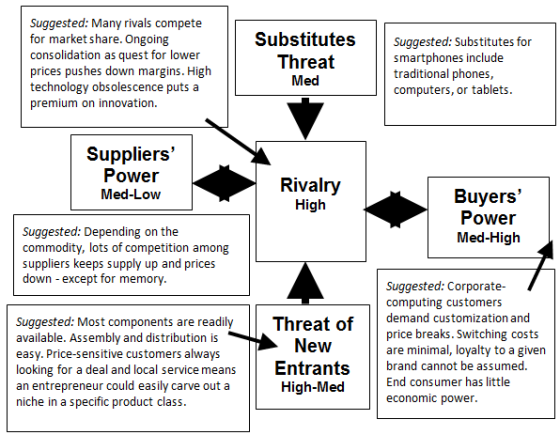
Based on the external environmental factor analysis, the smartphone/electronics business has many competitors trying to carve out a piece of the profit pie. BlackBerry does not yet have a well-diversified product line – able to compete in many product or service categories – which makes its prospects poor.
There are several key industry drivers in the smartphone/consumer electronics industry. First and foremost, industry incumbents have witnessed a change in consumer attitude towards devices that incorporate multiple facets of their life. This has increased demand for smartphones such as the iPhone, which provides the consumer with the ability to perform work-related tasks, instant messaging, camera and video, games, and a host of other applications. Devices such as the iPhone are therefore appealing to both the professionals and regular consumers. This coupled with the BOYD trend was the main culprit for the reduction in BlackBerry hardware sales and subscribers.
Another key driver in the industry is product innovation, which is evident by the emergence of smartphones with touchscreen capabilities. In the years to come, it’s expected that the entry of major firms such as Huawei and Xiaomi in the Western markets will have an impact. More competitors will lead to greater fragmentation, and the average price per smartphone is forecasted to shrink significantly and drop to $241 worldwide by 2018. What this means for BlackBerry is that competition will intensify and a decrease in the price of hardware will have a negative effect on revenues. BlackBerry needs to think about alternate products or services to offset this pressure.
4.
Analyzing the Internal Environment of the Firm:
If a firm wants to outperform others by a wide margin over a long period of time, it must arrange its activities and create unique bundles of resources that allow it to sustain a competitive advantage. Students should assess the relationships between the elements in BlackBerry’s value chain.
Remember, value-chain analysis is a strategic analysis of an organization that uses value-creating activities. Value is the amount that buyers are willing to pay for what a firm provides them and is measured by total revenue, a reflection of the price a firm’s product commands, and the quantity it can sell. A firm is profitable when the value it receives exceeds the total costs involved in creating its product or service. Creating value for buyers that exceeds the costs of production (i.e., margin) is a key concept used in analyzing a firm’s competitive position.
Every activity should add value. Based on the relationships between these elements, BlackBerry can make a choice of how to proceed to craft a competitive advantage.
BlackBerry’s value chain is captured visually in the diagram below:
| Value chain activity |
How does BlackBerry create value for the customer? What challenges does BlackBerry have in its value chain? |
|
Primary: |
|
|
Inbound logistics (distribution facilities, material control systems, warehouse layouts) |
Assumed adequate. |
|
Operations (efficient work flow design, quality control systems) |
Had traditionally been a strength. Co-CEO Balsillie’s area of expertise. |
|
Outbound logistics (consolidation of goods, efficient scheduling, finished goods processing) |
Assumed adequate. |
|
Marketing and Sales (motivated sales people, innovative advertising & promotion, effective pricing, proper ID of customer segments & distribution channels) |
Originally RIM used guerilla marketing, giving away devices to ground-level employees. This pressured corporate IT to make BlackBerry the official device. Recent campaigns, like for the Z10, were confusing, unsuccessful in communicating the device’s distinctive competencies. |
|
Service (ability to solicit customer feedback & respond) |
BlackBerry appeared unable or unwilling to adapt to user feedback. Some customers felt betrayed. |
|
Secondary (or support): |
|
|
Procurement (win-win relationships with suppliers, reduced dependence on single supplier) |
Assumed adequate. |
|
Technology development (state of the art hardware & software, innovative culture & qualified personnel) |
Originally one of BlackBerry’s strengths, especially under co-CEO Lazaridis. |
|
Human resource management (effective recruitment, incentive & retention mechanisms) |
Assumed adequate. CEO Chen commented on the commitment of BlackBerry innovators. |
|
General Administration (effective planning systems to establish goals & strategies, access to capital, effective top management communication, relationships with diverse stakeholders) |
Poor in the past, appears credibility is building for CEO Chen. |
Primary Activities:
In terms of primary activities, the key to BlackBerry’s ability to differentiate itself in the market resided in its operations. BlackBerry won its initial market by employing guerilla marketing, and then delivering on its promise of a secure and reliable communication device. Unfortunately, it lost touch with the needs and desires of its customer base, and stumbled badly when trying to recover.
Support Activities:
In regard to support activities, a competitive advantage is achieved by developing a strong general administration that is built around visionary leadership and a culture that pushes for technological innovation. In the beginning, technology and the combination of co-CEOs Balsillie and Lazaridis were real strengths, allowing BlackBerry to innovate and take risks that paid off in ease-of-use, reliability, and a secure communications system. However, as time went on, perhaps ego or tunnel vision prevented these two leaders from recognizing that the environment had changed and different risks needed to be taken. CEO Heins promised a strategic overhaul but mis-stepped badly with the BlackBerry 10. CEO Chen appears to have a vision of refocusing the company on software and services, especially for BlackBerry’s enterprise clients. Chen also hopes to maintain the existing employee commitment to innovation and dedication to service, needed in order to make this happen.
In addition, see the concept of the resource-based view of the firm, and the three key types of resources: tangible resources, intangible resources, and organizational capabilities. A firm’s strengths and capabilities – no matter how unique or impressive – do NOT necessarily lead to a competitive advantage. The resource-based view of the firm takes the perspective that firms’ competitive advantages are due to their endowment of strategic resources that are valuable, rare, costly to imitate, and costly to substitute. Without these unique resources, the firm can only attain competitive parity. RBV goes beyond a SWOT analysis to integrate internal and external perspectives in a broader competitive context. RBV can reveal how core competencies embedded in a firm can help it exploit new product and market opportunities.
An important issue to focus on here is the importance of intangible resources like innovation and reputation. Especially in mature brands, sustaining reputation is essential. Look at resources controlled by BlackBerry that might enable it to develop and implement value-creating strategies. Based on their reading of the case, students might identify those resources to include:
Tangible Resources:
Financial:
Difficult. Cash reserves may not be adequate to fund more R&D or acquisitions.
Physical:
Assumed adequate.
Technological:
Biggest asset here could be BlackBerry’s human resources – capable, motivated and highly technologically creative employees could insure BlackBerry will keep up with technology innovation.
Organizational:
CEO Chen’s restructuring plan might focus both human and financial resources further, yielding better results.
Intangible Resources:
Human:
Focus on innovation can continually revitalize the workforce.
Innovation and creativity:
Could be one of BlackBerry’s major strengths if leadership encourages this.
Reputation:
This was one of BlackBerry’s most significant strengths, the “Crackberry” legend. Now in doubt except among government and some corporate clients.
Determining whether the internal resources are valuable, rare, difficult to imitate, or difficult to substitute (VRIN) can help a firm sustain a competitive advantage. Applying the VRIN concept, BlackBerry’s internal resources (especially the intangible ones) could be both valuable and rare. It’s hard to come up with substitutes for intellectual and human capital, unless someone could steal away BlackBerry’s employees. CEO Chen should be aware of this and protect this resource!
Add Answer to:
In mid-2017, the once high-flying BlackBerry stock was trad¬ing
for less than $7 a share, a...
Read the case study "Google, Apple, and Facebook Struggle for Your Internet Experience" on page 255....
 Read the case study "Google, Apple, and Facebook Struggle for
Your Internet Experience" on page 255. Then discuss the advantages
and disadvantages for each company.
BUSINESS PROBLEM-SOLVING CASE Google, Apple, and Facebook Battle for Your Internet Experience Apple has a legacy of innovation on its side. In Three Internet titans Google, Apple, and 2011, it unveiled the potentially market disrupting Facebook are in an epic struggle to dominate your Siri (Speech Interpretation and Recognition Internet experience, and caught in the...
Read the case study "Google, Apple, and Facebook Struggle for
Your Internet Experience" on page 255. Then discuss the advantages
and disadvantages for each company.
BUSINESS PROBLEM-SOLVING CASE Google, Apple, and Facebook Battle for Your Internet Experience Apple has a legacy of innovation on its side. In Three Internet titans Google, Apple, and 2011, it unveiled the potentially market disrupting Facebook are in an epic struggle to dominate your Siri (Speech Interpretation and Recognition Internet experience, and caught in the...
Please use own words. Thank you. CASE QUESTIONS AND DISCUSSION > Analyze and discuss the questions...
 Please use own words. Thank you.
CASE QUESTIONS AND DISCUSSION > Analyze and discuss the questions listed below in specific detail. A minimum of 4 pages is required; ensure that you answer all questions completely Case Questions Who are the main players (name and position)? What business (es) and industry or industries is the company in? What are the issues and problems facing the company? (Sort them by importance and urgency.) What are the characteristics of the environment in which...
Please use own words. Thank you.
CASE QUESTIONS AND DISCUSSION > Analyze and discuss the questions listed below in specific detail. A minimum of 4 pages is required; ensure that you answer all questions completely Case Questions Who are the main players (name and position)? What business (es) and industry or industries is the company in? What are the issues and problems facing the company? (Sort them by importance and urgency.) What are the characteristics of the environment in which...
Case Study 1: Apple Merging Technology, Business, and Entertainment Why are data, information, business intelligence, and...
Case Study 1: Apple Merging Technology, Business, and Entertainment Why are data, information, business intelligence, and knowledge important to Apple? Give an example of each type in relation to the iPad. (1 Mark) Explain how Apple achieved business success through the use of information, information technology, and people. (1 Mark) Evaluate how Apple can gain business intelligence through the implementation of a customer relationship management system. (1 Mark) Case Study 1: Apple Merging Technology, Business, and Entertainment This might sound...
Nokia is a communications and information technology company included in the Fortune Global 500 ranking and...
Nokia is a communications and information technology company included in the Fortune Global 500 ranking and has a rich heritage that can be traced back to the 19th century. During the 1990’s Nokia became the world's leading mobile phone manufacturer, but the company did not anticipate the significant change that smartphones would bring to the market at the turn of the century. When smartphones rose to popularity Nokia's market share was significantly reduced and the company entered into a crisis....
How did Samsung overtake Panasonic and Philips? What core competencies (resources and capabilities) did the firm...
How did Samsung overtake Panasonic and Philips? What core competencies (resources and capabilities) did the firm possess that helped it to be successful? (Discuss the international strategy that Samsung executed.) Samsung Leadership Era: 2000–Present Samsung group was founded in 1938 by Byung-Chull Lee as a simple trading company in Taegu, Korea that exported basic goods such as dried fish, vegetables, and fruit before expanding into several business lines, including insurance, securities, and retail.43 In 1969, Lee decided to enter the...
1) analyze the following case 2) give a summary and suggest ways for the company ——————...
1) analyze the following case 2) give a summary and suggest ways for the company —————— Salesforce.com, one of the most disruptive technology companies of the past few years, has single-handedly shaken up the software industry with its innovative business model and resounding success. Salesforce provides customer relationship management (CRM) and other application software solutions in the form of software as a service leased over the Internet, as opposed to software bought and installed on machines locally. The company was...
CASE 8 Unlocking the Secrets of the Apple iPhone in the Name of access the male...
 CASE 8 Unlocking the Secrets of the Apple iPhone in the Name of access the male San Bernardino suspect's iPhone 5c. Cook stated: Antiterrorism We are challenging the FBI's demands with the deepes respect for American democracy and a love of our country. We believe it would be in the best interest of everyone to step back and consider the implications While we believe the FBI's intentions are good, if would be wrong for the w e nt to force...
Required: 1. What is the amount of Apple’s accounts receivable as of September 30, 2017? 2....
 Required:
1. What is the amount of Apple’s accounts
receivable as of September 30, 2017?
2. Compute Apple’s accounts receivable turnover as
of September 30, 2017.
3. How long does it take, on average, for
the company to collect receivables for fiscal year ended September
30, 2017?
4. Apple’s most liquid assets include (a)
cash and cash equivalents, (b) short-term marketable
securities, (c) accounts receivable, and (d)
inventory. Compute the percentage that these liquid assets (in
total) make up of...
Required:
1. What is the amount of Apple’s accounts
receivable as of September 30, 2017?
2. Compute Apple’s accounts receivable turnover as
of September 30, 2017.
3. How long does it take, on average, for
the company to collect receivables for fiscal year ended September
30, 2017?
4. Apple’s most liquid assets include (a)
cash and cash equivalents, (b) short-term marketable
securities, (c) accounts receivable, and (d)
inventory. Compute the percentage that these liquid assets (in
total) make up of...
Starbucks after Schultz This activity is important because, as a manager, you must be able to...
Starbucks after Schultz This activity is important because, as a manager, you must be able to identify your company’s core competency and select an appropriate business-level strategy to optimize its competitive value. The goal of this exercise is to demonstrate your understanding of core competency and business-level strategies by applying these concepts to Starbucks’ recent experience in identifying and regaining its competitive advantage. Read the case below and answer the questions that follow. Case Inspired by Italian coffee bars, Starbucks...
4. Perform a SWOT analysis for Fitbit. Based on your assessment of these, what are some strategic options for Fitbit go...
 4. Perform a SWOT analysis for Fitbit. Based on your
assessment of these, what are some strategic options for Fitbit
going forward?
5. Analyze the company’s financial performance. Do trends
suggest that Fitbit’s strategy is working?
6.What recommendations would you make to Fitbit management to
address the most important strategic issues facing the
company?
Fitbit, Inc., in 2017: Can Revive Its Strategy and It Reverse Mounting Losses? connect ROCHELLE R. BRUNSON Baylor University MARLENE M. REED Baylor University in the...
4. Perform a SWOT analysis for Fitbit. Based on your
assessment of these, what are some strategic options for Fitbit
going forward?
5. Analyze the company’s financial performance. Do trends
suggest that Fitbit’s strategy is working?
6.What recommendations would you make to Fitbit management to
address the most important strategic issues facing the
company?
Fitbit, Inc., in 2017: Can Revive Its Strategy and It Reverse Mounting Losses? connect ROCHELLE R. BRUNSON Baylor University MARLENE M. REED Baylor University in the...
 Read the case study "Google, Apple, and Facebook Struggle for
Your Internet Experience" on page 255. Then discuss the advantages
and disadvantages for each company.
BUSINESS PROBLEM-SOLVING CASE Google, Apple, and Facebook Battle for Your Internet Experience Apple has a legacy of innovation on its side. In Three Internet titans Google, Apple, and 2011, it unveiled the potentially market disrupting Facebook are in an epic struggle to dominate your Siri (Speech Interpretation and Recognition Internet experience, and caught in the...
Read the case study "Google, Apple, and Facebook Struggle for
Your Internet Experience" on page 255. Then discuss the advantages
and disadvantages for each company.
BUSINESS PROBLEM-SOLVING CASE Google, Apple, and Facebook Battle for Your Internet Experience Apple has a legacy of innovation on its side. In Three Internet titans Google, Apple, and 2011, it unveiled the potentially market disrupting Facebook are in an epic struggle to dominate your Siri (Speech Interpretation and Recognition Internet experience, and caught in the...
 Please use own words. Thank you.
CASE QUESTIONS AND DISCUSSION > Analyze and discuss the questions listed below in specific detail. A minimum of 4 pages is required; ensure that you answer all questions completely Case Questions Who are the main players (name and position)? What business (es) and industry or industries is the company in? What are the issues and problems facing the company? (Sort them by importance and urgency.) What are the characteristics of the environment in which...
Please use own words. Thank you.
CASE QUESTIONS AND DISCUSSION > Analyze and discuss the questions listed below in specific detail. A minimum of 4 pages is required; ensure that you answer all questions completely Case Questions Who are the main players (name and position)? What business (es) and industry or industries is the company in? What are the issues and problems facing the company? (Sort them by importance and urgency.) What are the characteristics of the environment in which...
 CASE 8 Unlocking the Secrets of the Apple iPhone in the Name of access the male San Bernardino suspect's iPhone 5c. Cook stated: Antiterrorism We are challenging the FBI's demands with the deepes respect for American democracy and a love of our country. We believe it would be in the best interest of everyone to step back and consider the implications While we believe the FBI's intentions are good, if would be wrong for the w e nt to force...
 Required:
1. What is the amount of Apple’s accounts
receivable as of September 30, 2017?
2. Compute Apple’s accounts receivable turnover as
of September 30, 2017.
3. How long does it take, on average, for
the company to collect receivables for fiscal year ended September
30, 2017?
4. Apple’s most liquid assets include (a)
cash and cash equivalents, (b) short-term marketable
securities, (c) accounts receivable, and (d)
inventory. Compute the percentage that these liquid assets (in
total) make up of...
Required:
1. What is the amount of Apple’s accounts
receivable as of September 30, 2017?
2. Compute Apple’s accounts receivable turnover as
of September 30, 2017.
3. How long does it take, on average, for
the company to collect receivables for fiscal year ended September
30, 2017?
4. Apple’s most liquid assets include (a)
cash and cash equivalents, (b) short-term marketable
securities, (c) accounts receivable, and (d)
inventory. Compute the percentage that these liquid assets (in
total) make up of...
 4. Perform a SWOT analysis for Fitbit. Based on your
assessment of these, what are some strategic options for Fitbit
going forward?
5. Analyze the company’s financial performance. Do trends
suggest that Fitbit’s strategy is working?
6.What recommendations would you make to Fitbit management to
address the most important strategic issues facing the
company?
Fitbit, Inc., in 2017: Can Revive Its Strategy and It Reverse Mounting Losses? connect ROCHELLE R. BRUNSON Baylor University MARLENE M. REED Baylor University in the...
4. Perform a SWOT analysis for Fitbit. Based on your
assessment of these, what are some strategic options for Fitbit
going forward?
5. Analyze the company’s financial performance. Do trends
suggest that Fitbit’s strategy is working?
6.What recommendations would you make to Fitbit management to
address the most important strategic issues facing the
company?
Fitbit, Inc., in 2017: Can Revive Its Strategy and It Reverse Mounting Losses? connect ROCHELLE R. BRUNSON Baylor University MARLENE M. REED Baylor University in the...
Most questions answered within 3 hours.
-
Where is the error in this code sequence?
String s1 = "Hello";
String s2 = "ello";...
asked 11 months ago -
Financial data for Joel de Paris, Inc., for last year
follow:
Joel de Paris, Inc.
Balance...
asked 11 months ago -
Consider this reaction:
Al2(SO4)3 (aq)+ BaCl3
(aq) Al2Cl6 (aq)- +
3BaSO4(s) . What is the...
asked 11 months ago -
Suppose that Savneet is considering increasing her
recent random sample from 20 car rentals to 40...
asked 11 months ago -
Trucks arrive at an unloading terminal at an average rate of 120
per hour.
Trucks arrive...
asked 11 months ago -
Why are methanol and ethanol completely soluble in water while
octanol is not very little soluble....
asked 11 months ago -
A facilities manager at a university reads in a research report
that the mean amount of...
asked 11 months ago -
When the CuSO4 is rehydrated by adding water to the anhydrous
compound, is this an endothermic...
asked 11 months ago -
A ray of sunlight is passing from diamond into crown glass; the
angle of incidence is...
asked 11 months ago -
A block of mass 0.249 kg is placed on top of a light, vertical
spring of...
asked 11 months ago -
how do the kidneys compensate in the presences of acidosis
a) trigger hyperventilate
b) reserve acid...
asked 11 months ago -
Question 501 pts
The rental rate of capital to the firm increases. Which of the
following...
asked 11 months ago