1. Consider two countries, U.S. and Thailand. In 2019, the U.S. experienced an output growth of...
1. Consider two countries, U.S. and Thailand. In 2019, the U.S.
experienced an output growth of 2%, whereas Thailand had an output
growth of 4.5%. Suppose the U.S. Federal Reserve allowed the money
supply to grow by 4.5% each year, whereas the Bank of Thailand
chose to maintain relatively high money supply growth of 6% per
year. For the following questions, use the simple monetary model.
Treat the U.S. as the home country and Thailand as the foreign
country.
(a) What is the inflation rate in the U.S.? In Thailand? (5
points)
(b) What is the rate of change in the U.S. dollar relative to the
Thai baht? Does the dollar appreciate or depreciate over time? (5
points)
(c) Suppose that the world economy experiences an economic
slowdown. In particular, both countries have GDP growth rates of
0.5%. What is the new inflation rate in the U.S.? In Thailand? (5
points)
(d) Using time series diagrams, illustrate how this decline in the
output growth rates a⁄ect (i) the money supply in the U.S., MUS;
(ii) price level, PUS; (iii) real money balances, MUS=PUS and (iv)
E$=baht over time. (Plot each variable on the vertical axis and
time on the horizontal axis. Use the space allocated for each
variable below. (12 points)
(i) (ii)
(iii) (iv)
(e) Suppose that the U.S. aims to keep the inflation rate at 2%
during the economic slowdown. What money growth rate would help
achieve this target?(Hint: Use the simple monetary model.) (8
points)
Homework Answers
| (A) Inflation Rate | US | Thailand | |
| Old Rate | 2.0% | 4.5% | |
| Growth | 4.5% | 6.0% | |
| New Rate | 6.5% | 10.5% | |
| Inflation | |||
| New Rate- Old Rate | 2.3% | 1.3% | |
| Old Rate | |||
| (B) Rate of change in the U.S. dollar relative to the Thai baht | |||
| Growth of US Dollar |
4.5 6 |
0.75% | |
| Growth of Thai Bhat | |||
| Note: This is calculated with respect to the growth of the two currencies | |||
| Dollar is depreciated over time because of lower growth rate | |||
| (c) Inflation Rate | US | Thailand | |
| Old Rate | 2.0% | 4.5% | |
| Growth | 0.5% | 0.5% | |
| New Rate | 2.5% | 5.0% | |
| Inflation | |||
| New Rate- Old Rate | 0.3% | 0.1% | |
| Old Rate | |||
| (e) Growth Rate | |||
| Growth rate(g)= inflation *old rate | |||
| 2*2 | |||
| =4 |
Add Answer to:
1. Consider two countries, U.S. and Thailand. In 2019, the U.S.
experienced an output growth of...
3. Consider two countries, Japan and Korea. In 1996, Japan experienced relatively slow output growth (1%),...
 3. Consider two countries, Japan and Korea. In 1996, Japan experienced relatively slow output growth (1%), whereas Korea had relatively robust output growth (6%). Suppose the Bank of Japan allowed the money supply to grow by 2% each year, whereas the Bank of Korea chose to maintain relatively high money growth of 12% per year. For the following questions, you will find it easiest to treat Korea as the home country and Japan as the foreign country A. What is...
7. Assume that output growth in the U.S. is 2%, money demand (L) is constant and...
 7. Assume that output growth in the U.S. is 2%, money demand (L) is constant and money supply growth is 4%. Assume that output growth in China is 58, L is constant and money supply growth is 98. a. Assume that relative PPP and the quantity theory of money holds. What is the growth rate of the dollar-China exchange rate (AES/China)? b. What should money supply growth be in China if China wants to fix its currency to the dollar?...
7. Assume that output growth in the U.S. is 2%, money demand (L) is constant and money supply growth is 4%. Assume that...
7. Assume that output growth in the U.S. is 2%, money demand (L) is constant and money supply growth is 4%. Assume that output growth in China is 5%, L is constant and money supply growth is 9%. a. Assume that relative PPP and the quantity theory of money holds. What is the growth rate of the dollar-China exchange rate (%∆E$/China)? b. What should money supply growth be in China if China wants to fix its currency to the dollar?...
4.* NOT To BE SUBMITTED (BUT GOOD PRACTICE FOR MIDTERM 1) Slightly modified version of Feenstra...
 4.* NOT To BE SUBMITTED (BUT GOOD PRACTICE FOR MIDTERM 1) Slightly modified version of Feenstra and Taylor (2018), International Macroeconomics, Ch.3, question 8. This question uses the general (long-run) monetary model, where money demand is inversely related to the nominal interest rate Consider two countries, Japan (J) and Korea (K), where the currencies used are the Japanese yen (JPY) and the Korean won (KRW). In 1996, Japan experienced relatively slow output growth (1%), while Korea had relatively robust output...
pls answer part "d" specifically. Thanks! Q2. This question uses the general monetary model, where L...
pls answer part "d" specifically. Thanks! Q2. This question uses the general monetary model, where L is no longer assumed constant, and money demand is inversely related to the nominal interest rate. Consider two countries: Japan and South Korea. In 1996 Japan experienced relatively slow output growth (1%), while Korea had relatively robust output growth (6%). Suppose the Bank of Japan allowed the money supply to grow by 2% each year, while the Bank of Korea chose to maintain relatively...
• Consider two countries, Tanzania and Italy. Further assume output in both countries can be defined...
• Consider two countries, Tanzania and Italy. Further assume output in both countries can be defined by the same production function and each country has the same savings rate. The only difference is that Italy currently has a higher level of capital stock k. If each country received a gift from a wealthy ally that increased capital stock by the same amount, what is an expected outcome? A) Tanzanian output would increase at a slower rate B) Italian output would...
Chinese economic growth is the outstanding feature of the world economic scene over the past two...
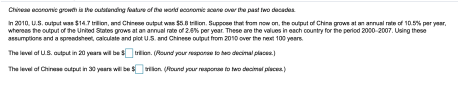 Chinese economic growth is the outstanding feature of the world economic scene over the past two decades. In 2010, U.S. output was $14.7 trillion, and Chinese output was $5.8 trillion. Suppose that from now on, the output of China grows at an annual rate of 10.5% per year, whereas the output of the United States grows at an annual rate of 2.6% per year. These are the values in each country for the period 2000–2007. Using these assumptions and a...
Chinese economic growth is the outstanding feature of the world economic scene over the past two...
Chinese economic growth is the outstanding feature of the world economic scene over the past two decades. a. In 2014, U.S. output was $17.4 trillion, and Chinese output was $10.4 trillion. Suppose that from now on, the output of China grows at an annual rate of 6.5% per year, whereas the output of the United States grows at an annual rate of 2.2% per year. These are the values in each country for the period 2010–2014 as stated in the...
4)- Suppose for a given economy, the Phillips Curve is given by itthen 0.25 ut +...
 4)- Suppose for a given economy, the Phillips Curve is given by itthen 0.25 ut + 1.25%, and the Okun's law: ut - Ut-1=-0.5gyt + 4%. Also assume that Teen Tt-1, and the growth rate of money supply has been 18% for a long time. (Total 19 points) a)- What are the inflation rate, unemployment rate, and growth rate of output at the medium run equilibrium. (4.5) b)- Calculate the natural rate of unemployment and NAIRU. (2) c)- Starting from...
I need Summary of this Paper i dont need long summary i need What methodology they used , what is the purpose of this...
 I need Summary of this Paper i dont need long summary i need
What methodology they used , what is the purpose of this paper and
some conclusions and contributes of this paper. I need this for my
Finishing Project so i need this ASAP please ( IN 1-2-3 HOURS
PLEASE !!!)
SPECIAL ARTICLES tole of Monetary Policy C Rangarajan What should be the objectives of monetary policy? Does the objective of price stability conflict with the goal of achieving...
I need Summary of this Paper i dont need long summary i need
What methodology they used , what is the purpose of this paper and
some conclusions and contributes of this paper. I need this for my
Finishing Project so i need this ASAP please ( IN 1-2-3 HOURS
PLEASE !!!)
SPECIAL ARTICLES tole of Monetary Policy C Rangarajan What should be the objectives of monetary policy? Does the objective of price stability conflict with the goal of achieving...
 3. Consider two countries, Japan and Korea. In 1996, Japan experienced relatively slow output growth (1%), whereas Korea had relatively robust output growth (6%). Suppose the Bank of Japan allowed the money supply to grow by 2% each year, whereas the Bank of Korea chose to maintain relatively high money growth of 12% per year. For the following questions, you will find it easiest to treat Korea as the home country and Japan as the foreign country A. What is...
 7. Assume that output growth in the U.S. is 2%, money demand (L) is constant and money supply growth is 4%. Assume that output growth in China is 58, L is constant and money supply growth is 98. a. Assume that relative PPP and the quantity theory of money holds. What is the growth rate of the dollar-China exchange rate (AES/China)? b. What should money supply growth be in China if China wants to fix its currency to the dollar?...
 4.* NOT To BE SUBMITTED (BUT GOOD PRACTICE FOR MIDTERM 1) Slightly modified version of Feenstra and Taylor (2018), International Macroeconomics, Ch.3, question 8. This question uses the general (long-run) monetary model, where money demand is inversely related to the nominal interest rate Consider two countries, Japan (J) and Korea (K), where the currencies used are the Japanese yen (JPY) and the Korean won (KRW). In 1996, Japan experienced relatively slow output growth (1%), while Korea had relatively robust output...
 Chinese economic growth is the outstanding feature of the world economic scene over the past two decades. In 2010, U.S. output was $14.7 trillion, and Chinese output was $5.8 trillion. Suppose that from now on, the output of China grows at an annual rate of 10.5% per year, whereas the output of the United States grows at an annual rate of 2.6% per year. These are the values in each country for the period 2000–2007. Using these assumptions and a...
 4)- Suppose for a given economy, the Phillips Curve is given by itthen 0.25 ut + 1.25%, and the Okun's law: ut - Ut-1=-0.5gyt + 4%. Also assume that Teen Tt-1, and the growth rate of money supply has been 18% for a long time. (Total 19 points) a)- What are the inflation rate, unemployment rate, and growth rate of output at the medium run equilibrium. (4.5) b)- Calculate the natural rate of unemployment and NAIRU. (2) c)- Starting from...
 I need Summary of this Paper i dont need long summary i need
What methodology they used , what is the purpose of this paper and
some conclusions and contributes of this paper. I need this for my
Finishing Project so i need this ASAP please ( IN 1-2-3 HOURS
PLEASE !!!)
SPECIAL ARTICLES tole of Monetary Policy C Rangarajan What should be the objectives of monetary policy? Does the objective of price stability conflict with the goal of achieving...
I need Summary of this Paper i dont need long summary i need
What methodology they used , what is the purpose of this paper and
some conclusions and contributes of this paper. I need this for my
Finishing Project so i need this ASAP please ( IN 1-2-3 HOURS
PLEASE !!!)
SPECIAL ARTICLES tole of Monetary Policy C Rangarajan What should be the objectives of monetary policy? Does the objective of price stability conflict with the goal of achieving...
Most questions answered within 3 hours.
-
Where is the error in this code sequence?
String s1 = "Hello";
String s2 = "ello";...
asked 10 months ago -
Financial data for Joel de Paris, Inc., for last year
follow:
Joel de Paris, Inc.
Balance...
asked 10 months ago -
Consider this reaction:
Al2(SO4)3 (aq)+ BaCl3
(aq) Al2Cl6 (aq)- +
3BaSO4(s) . What is the...
asked 10 months ago -
Suppose that Savneet is considering increasing her
recent random sample from 20 car rentals to 40...
asked 10 months ago -
Trucks arrive at an unloading terminal at an average rate of 120
per hour.
Trucks arrive...
asked 10 months ago -
Why are methanol and ethanol completely soluble in water while
octanol is not very little soluble....
asked 10 months ago -
A facilities manager at a university reads in a research report
that the mean amount of...
asked 10 months ago -
When the CuSO4 is rehydrated by adding water to the anhydrous
compound, is this an endothermic...
asked 10 months ago -
A ray of sunlight is passing from diamond into crown glass; the
angle of incidence is...
asked 10 months ago -
A block of mass 0.249 kg is placed on top of a light, vertical
spring of...
asked 10 months ago -
how do the kidneys compensate in the presences of acidosis
a) trigger hyperventilate
b) reserve acid...
asked 10 months ago -
Question 501 pts
The rental rate of capital to the firm increases. Which of the
following...
asked 10 months ago