Design of Wood Structures - Bolt Connections
Find:
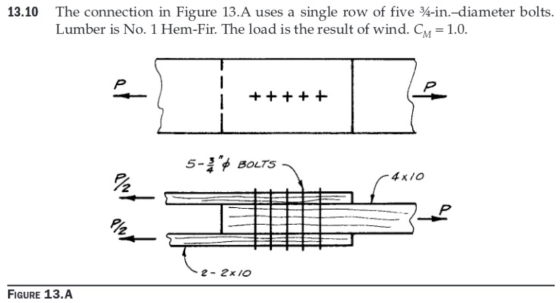
a. adjusted LRFD design values for the bolt connection.
b. Adjusted LRFD tension capacity of the wood members.
c. Indicate the base spacing requirements for the bolts.
d. Adjusted LRFD row-tear-out capacity for the connection.
Homework Answers
Request Answer!
We need at least 10 more requests to produce the answer.
0 / 10 have requested this problem solution
The more requests, the faster the answer.
All information is given. The connection in the Figure below uses two rows of 7/8-in.-diameter bolts...
 All information is given.
The connection in the Figure below uses two rows of 7/8-in.-diameter bolts with three fasteners in each row. The load carried by the connection is (1.2D + 1.6L). The wood member is a 6% 16.5 DF 20F-V3 glulam with G=0.50. It is initially dry (at or near the EMC) and remains dry in service. SPLICE NOOD MEMBER {"STEEL SIDE'S + + + + + + + + + 6-1" BALTS EACH SIDE OF SPLICE Find: a....
All information is given.
The connection in the Figure below uses two rows of 7/8-in.-diameter bolts with three fasteners in each row. The load carried by the connection is (1.2D + 1.6L). The wood member is a 6% 16.5 DF 20F-V3 glulam with G=0.50. It is initially dry (at or near the EMC) and remains dry in service. SPLICE NOOD MEMBER {"STEEL SIDE'S + + + + + + + + + 6-1" BALTS EACH SIDE OF SPLICE Find: a....
5. Using AISC Steel Construction Manual, find the following design strengths of 1-inch Group A bolts on A36 gusset plates, type N, with STD holes, 3" bolt spacing and 2" edge distance: (5...
 5. Using AISC Steel Construction Manual, find the following design strengths of 1-inch Group A bolts on A36 gusset plates, type N, with STD holes, 3" bolt spacing and 2" edge distance: (5 points) a. Shear Strength of Bolts in Single Shear Connections b. Shear Strength of Bolts in Double Shear Connections c. Tensile Strength of Bolts d. Bearing Strength at Bolt Holes for Inner Bolts e. Bearing Strength at Bolt Holes for Edge Bolts
5. Using AISC Steel Construction...
5. Using AISC Steel Construction Manual, find the following design strengths of 1-inch Group A bolts on A36 gusset plates, type N, with STD holes, 3" bolt spacing and 2" edge distance: (5 points) a. Shear Strength of Bolts in Single Shear Connections b. Shear Strength of Bolts in Double Shear Connections c. Tensile Strength of Bolts d. Bearing Strength at Bolt Holes for Inner Bolts e. Bearing Strength at Bolt Holes for Edge Bolts
5. Using AISC Steel Construction...
Standard design practice, as exhibited by the solutions to Probs. 8-66 to 8-70, is to assume that...
 Standard design practice, as exhibited by the solutions to Probs. 8-66 to 8-70, is to assume that the bolts, or rivets, share the shear equally. For many situations, such an assumption may lead to an unsafe design. Consider the yoke bracket of Prob. 8-61, for example. Suppose this bracket is bolted to a wide-flange column with the centerline through the two bolts in the vertical direction. A vertical load through the yoke-pin hole at distance B from the column flange...
can i have this one solved by using AISC steel manual plzzzz? Problem 1. A lap...
 can i have this one solved by using AISC steel manual
plzzzz?
Problem 1. A lap connection shown below should carry the factored axial load of 120 kips. The plates 3/8 x 7 and 5/16 x 7 are made of A36 (Fu=58 ksi) steel. Design the bolted connection: (a) Select bolt material and diameter: (b) Determine number of bolts using shear capacity of bolt; (c) Place the bolts with min/max requirements; (d) Calculate the bearing strength of bolts and determine...
can i have this one solved by using AISC steel manual
plzzzz?
Problem 1. A lap connection shown below should carry the factored axial load of 120 kips. The plates 3/8 x 7 and 5/16 x 7 are made of A36 (Fu=58 ksi) steel. Design the bolted connection: (a) Select bolt material and diameter: (b) Determine number of bolts using shear capacity of bolt; (c) Place the bolts with min/max requirements; (d) Calculate the bearing strength of bolts and determine...
E21 ASSIGNMENT 9-ARCHITECTURE +CIVIL DESIGN WORKSHEET Name: Select the answer which best fits the question. This...
 E21 ASSIGNMENT 9-ARCHITECTURE +CIVIL DESIGN WORKSHEET Name: Select the answer which best fits the question. This part of the exam is closed book with no AUTOCAD. Once you complete the written exam, turn in to receive AUTOCAD section. 1 Hour Maximum. 1. What is typically used to attach the first wood member of the structure to the foundation? A. Steel reinforcement B. Mortar C. Toe nails nchor bolts 2. The vertical structural members, which provide the framing height for the...
How long of a 3/8" weld is required for to support the yield load of an L5x5x1/2 if it is applied...
 How long of a 3/8" weld is required for to support the yield load of an L5x5x1/2 if it is applied to: 1) Only the side with the outstanding leg Onlythe side of the attached leg a. b. What is the available tensile capacity a connection with 3/4" A325 bolt with threads not excluded from the shear plane when used in a 2x4 bolt pattern (horizontal and vertical) with gage and spacing of 3 in supporting a 150 kip load...
ints) The connection below is a slip-critical connection. Calculate the design strength of the n assuming...
 ints) The connection below is a slip-critical connection. Calculate the design strength of the n assuming 7/8-in A325 bolts (threads excluded) with a factor for fillers, hf -1.0 Assume A36 steel tes, Class 8 faying surface and standard size holes. Check a. Gross section yielding of plates b. Tensile rupture of plates c. Slip-critical strength of bolts d. Bearing strength of bolts e. Shearing strength of the bolts f. Block Shear (Draw how the block 3 in 3 in o...
The joint shown in Figure 1 is made from steel Grade 350 (AS/NZS 3678). Four bolts...
 The joint shown in Figure 1 is made from steel Grade 350 (AS/NZS
3678). Four bolts are used. Diameters of all holes are 5 mm. Note
that the middle hole on both Plates A is just a hole with no bolt.
The shear design capacity (reduced nominal capacity) of the bolts
in single shear is 10 kN. Dimensions given below are in
mm.
Determinre the maximum tension design force:
a) * N2PlatesA that the double plate A can support.
b)...
The joint shown in Figure 1 is made from steel Grade 350 (AS/NZS
3678). Four bolts are used. Diameters of all holes are 5 mm. Note
that the middle hole on both Plates A is just a hole with no bolt.
The shear design capacity (reduced nominal capacity) of the bolts
in single shear is 10 kN. Dimensions given below are in
mm.
Determinre the maximum tension design force:
a) * N2PlatesA that the double plate A can support.
b)...
For each of the problems listed, the following information is to be used, unless otherwise indicated...
 For each of the problems listed, the following information is to be used, unless otherwise indicated (a) AISC Specification; (b) standard-size holes; (c) members have clean mill-scale surfaces (Class A), (d) Fy 36 ksi and Fu 58 and unless otherwise noted, (e) deformation at service loads is a design consideration. Do not consider block shear, unless specifically requested Determine the LRFD design tensile strength and the ASD allowable tensile strength for the member shown, assuming a bearing-type connection. 2 in...
The first requirement is that a template operate correctly (i.e,, calculate correct values). Another major consideration...
 The first requirement is that a template operate correctly (i.e,, calculate correct values). Another major consideration is that the input and output be structured in an orderly manner. A sufficient number of intermediate answers should be displayed and labeled so that the solution can be verified by hand. 6.1 Given: The roof beam in Fig. 6.A with the following information: Load: -400 lb Pg = 1600 lb D +L, (ASD) 1.2D 1.6L, (LRFD) Load combination: Span: Member size: Stress grade...
 All information is given.
The connection in the Figure below uses two rows of 7/8-in.-diameter bolts with three fasteners in each row. The load carried by the connection is (1.2D + 1.6L). The wood member is a 6% 16.5 DF 20F-V3 glulam with G=0.50. It is initially dry (at or near the EMC) and remains dry in service. SPLICE NOOD MEMBER {"STEEL SIDE'S + + + + + + + + + 6-1" BALTS EACH SIDE OF SPLICE Find: a....
All information is given.
The connection in the Figure below uses two rows of 7/8-in.-diameter bolts with three fasteners in each row. The load carried by the connection is (1.2D + 1.6L). The wood member is a 6% 16.5 DF 20F-V3 glulam with G=0.50. It is initially dry (at or near the EMC) and remains dry in service. SPLICE NOOD MEMBER {"STEEL SIDE'S + + + + + + + + + 6-1" BALTS EACH SIDE OF SPLICE Find: a....
 5. Using AISC Steel Construction Manual, find the following design strengths of 1-inch Group A bolts on A36 gusset plates, type N, with STD holes, 3" bolt spacing and 2" edge distance: (5 points) a. Shear Strength of Bolts in Single Shear Connections b. Shear Strength of Bolts in Double Shear Connections c. Tensile Strength of Bolts d. Bearing Strength at Bolt Holes for Inner Bolts e. Bearing Strength at Bolt Holes for Edge Bolts
5. Using AISC Steel Construction...
5. Using AISC Steel Construction Manual, find the following design strengths of 1-inch Group A bolts on A36 gusset plates, type N, with STD holes, 3" bolt spacing and 2" edge distance: (5 points) a. Shear Strength of Bolts in Single Shear Connections b. Shear Strength of Bolts in Double Shear Connections c. Tensile Strength of Bolts d. Bearing Strength at Bolt Holes for Inner Bolts e. Bearing Strength at Bolt Holes for Edge Bolts
5. Using AISC Steel Construction...
 Standard design practice, as exhibited by the solutions to Probs. 8-66 to 8-70, is to assume that the bolts, or rivets, share the shear equally. For many situations, such an assumption may lead to an unsafe design. Consider the yoke bracket of Prob. 8-61, for example. Suppose this bracket is bolted to a wide-flange column with the centerline through the two bolts in the vertical direction. A vertical load through the yoke-pin hole at distance B from the column flange...
 can i have this one solved by using AISC steel manual
plzzzz?
Problem 1. A lap connection shown below should carry the factored axial load of 120 kips. The plates 3/8 x 7 and 5/16 x 7 are made of A36 (Fu=58 ksi) steel. Design the bolted connection: (a) Select bolt material and diameter: (b) Determine number of bolts using shear capacity of bolt; (c) Place the bolts with min/max requirements; (d) Calculate the bearing strength of bolts and determine...
can i have this one solved by using AISC steel manual
plzzzz?
Problem 1. A lap connection shown below should carry the factored axial load of 120 kips. The plates 3/8 x 7 and 5/16 x 7 are made of A36 (Fu=58 ksi) steel. Design the bolted connection: (a) Select bolt material and diameter: (b) Determine number of bolts using shear capacity of bolt; (c) Place the bolts with min/max requirements; (d) Calculate the bearing strength of bolts and determine...
 E21 ASSIGNMENT 9-ARCHITECTURE +CIVIL DESIGN WORKSHEET Name: Select the answer which best fits the question. This part of the exam is closed book with no AUTOCAD. Once you complete the written exam, turn in to receive AUTOCAD section. 1 Hour Maximum. 1. What is typically used to attach the first wood member of the structure to the foundation? A. Steel reinforcement B. Mortar C. Toe nails nchor bolts 2. The vertical structural members, which provide the framing height for the...
 How long of a 3/8" weld is required for to support the yield load of an L5x5x1/2 if it is applied to: 1) Only the side with the outstanding leg Onlythe side of the attached leg a. b. What is the available tensile capacity a connection with 3/4" A325 bolt with threads not excluded from the shear plane when used in a 2x4 bolt pattern (horizontal and vertical) with gage and spacing of 3 in supporting a 150 kip load...
 ints) The connection below is a slip-critical connection. Calculate the design strength of the n assuming 7/8-in A325 bolts (threads excluded) with a factor for fillers, hf -1.0 Assume A36 steel tes, Class 8 faying surface and standard size holes. Check a. Gross section yielding of plates b. Tensile rupture of plates c. Slip-critical strength of bolts d. Bearing strength of bolts e. Shearing strength of the bolts f. Block Shear (Draw how the block 3 in 3 in o...
 The joint shown in Figure 1 is made from steel Grade 350 (AS/NZS
3678). Four bolts are used. Diameters of all holes are 5 mm. Note
that the middle hole on both Plates A is just a hole with no bolt.
The shear design capacity (reduced nominal capacity) of the bolts
in single shear is 10 kN. Dimensions given below are in
mm.
Determinre the maximum tension design force:
a) * N2PlatesA that the double plate A can support.
b)...
The joint shown in Figure 1 is made from steel Grade 350 (AS/NZS
3678). Four bolts are used. Diameters of all holes are 5 mm. Note
that the middle hole on both Plates A is just a hole with no bolt.
The shear design capacity (reduced nominal capacity) of the bolts
in single shear is 10 kN. Dimensions given below are in
mm.
Determinre the maximum tension design force:
a) * N2PlatesA that the double plate A can support.
b)...
 For each of the problems listed, the following information is to be used, unless otherwise indicated (a) AISC Specification; (b) standard-size holes; (c) members have clean mill-scale surfaces (Class A), (d) Fy 36 ksi and Fu 58 and unless otherwise noted, (e) deformation at service loads is a design consideration. Do not consider block shear, unless specifically requested Determine the LRFD design tensile strength and the ASD allowable tensile strength for the member shown, assuming a bearing-type connection. 2 in...
 The first requirement is that a template operate correctly (i.e,, calculate correct values). Another major consideration is that the input and output be structured in an orderly manner. A sufficient number of intermediate answers should be displayed and labeled so that the solution can be verified by hand. 6.1 Given: The roof beam in Fig. 6.A with the following information: Load: -400 lb Pg = 1600 lb D +L, (ASD) 1.2D 1.6L, (LRFD) Load combination: Span: Member size: Stress grade...
Most questions answered within 3 hours.
-
Where is the error in this code sequence?
String s1 = "Hello";
String s2 = "ello";...
asked 11 months ago -
Financial data for Joel de Paris, Inc., for last year
follow:
Joel de Paris, Inc.
Balance...
asked 11 months ago -
Consider this reaction:
Al2(SO4)3 (aq)+ BaCl3
(aq) Al2Cl6 (aq)- +
3BaSO4(s) . What is the...
asked 11 months ago -
Suppose that Savneet is considering increasing her
recent random sample from 20 car rentals to 40...
asked 11 months ago -
Trucks arrive at an unloading terminal at an average rate of 120
per hour.
Trucks arrive...
asked 11 months ago -
Why are methanol and ethanol completely soluble in water while
octanol is not very little soluble....
asked 11 months ago -
A facilities manager at a university reads in a research report
that the mean amount of...
asked 11 months ago -
When the CuSO4 is rehydrated by adding water to the anhydrous
compound, is this an endothermic...
asked 11 months ago -
A ray of sunlight is passing from diamond into crown glass; the
angle of incidence is...
asked 11 months ago -
A block of mass 0.249 kg is placed on top of a light, vertical
spring of...
asked 11 months ago -
how do the kidneys compensate in the presences of acidosis
a) trigger hyperventilate
b) reserve acid...
asked 11 months ago -
Question 501 pts
The rental rate of capital to the firm increases. Which of the
following...
asked 11 months ago