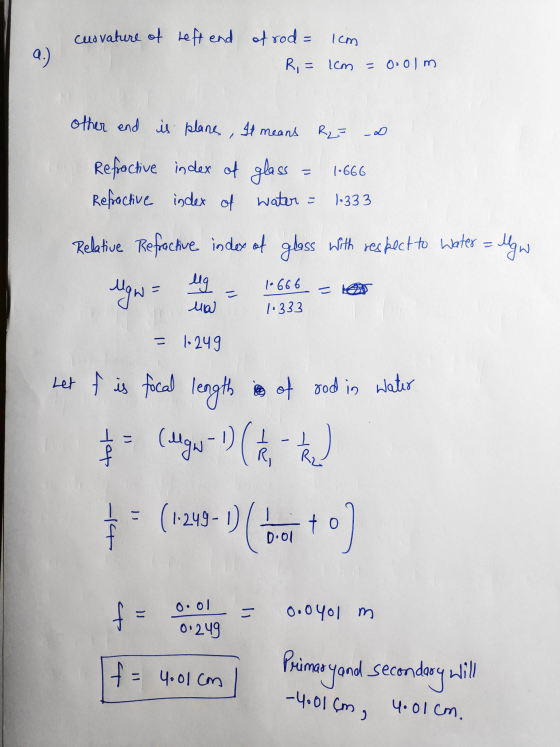
Please note that the glass rod is submerged in water, thus changing the focal length. 3....
Please note that the glass rod is submerged in water, thus changing the focal length.
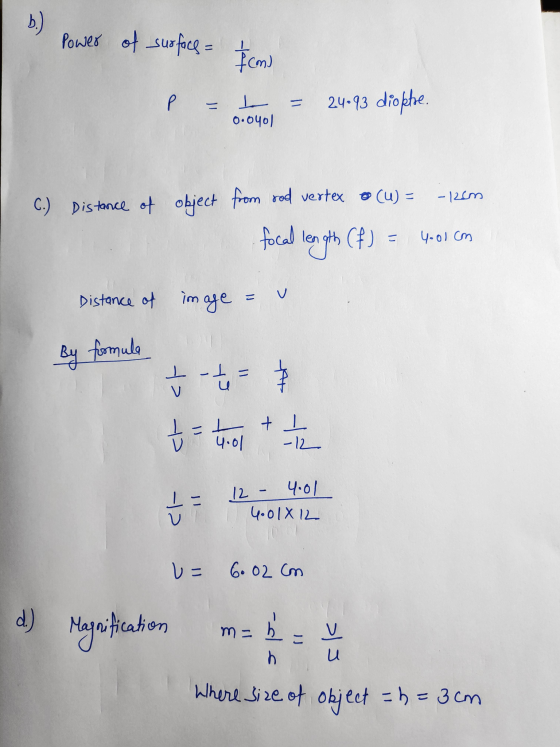
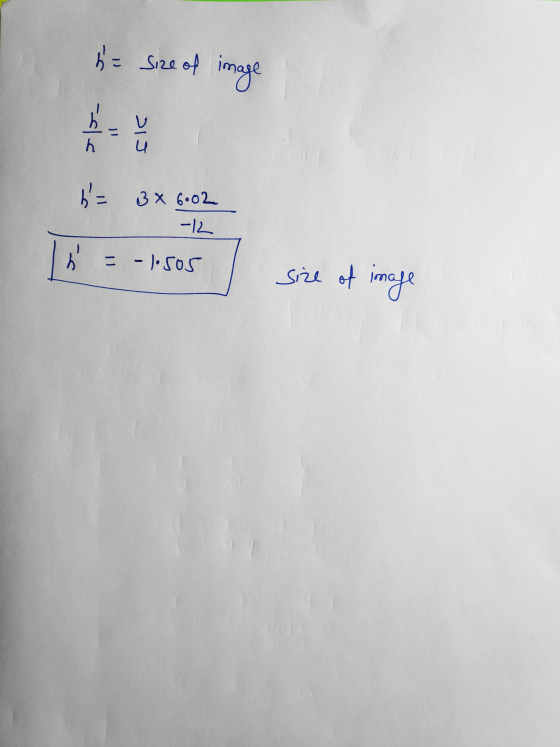
3. The left end of a long glass rod of index 1.666 is polished to a convex surface of radius 1.0 cm and then submerged in water (n = 1.333). A small object 3.0 cm high is located in the water and on the axis 12.0 cm from the vertex. Calculate (a) the primary and secondary focal lengths, (b) the power of the surface, (c) the image distance, and (d) the size of the image. [30 points]
Homework Answers
Add Answer to:
Please note that the glass rod is submerged in water, thus
changing the focal length.
3....
The left end of a long glass rod 8.20 cm in diameter, with an index of...
The left end of a long glass rod 8.20 cm in diameter, with an index of refraction 1.58, is ground and polished to a convex hemispherical surface with a radius of 4.10 cm . An object in the form of an arrow 1.50 mm tall, at right angles to the axis of the rod, is located on the axis 24.0 cmto the left of the vertex of the convex surface. 1) Part C Is the image erect or inverted?
The left end of a long glass rod 8.00 cm in diameter and with an index...
The left end of a long glass rod 8.00 cm in diameter and with an index of refraction of 1.60 is ground and polished to a convex hemispherical surface with a radius of 4.00 cm . An object in the form of an arrow 1.00 mmmm tall, at right angles to the axis of the rod, is located on the axis 22.5 cm to the left of the vertex of the convex surface. Part A: Find the position of the...
The left end of a long glass rod 8.00 cm in diameter and with an index...
The left end of a long glass rod 8.00 cm in diameter and with an index of refraction of 1.60 is ground and polished to a convex hemispherical surface with a radius of 4.00 cm . An object in the form of an arrow 1.90 mm tall, at right angles to the axis of the rod, is located on the axis 24.5 cm to the left of the vertex of the convex surface. 1)Find the position of the image of...
The left end of a long glass rod 8.00 cm in diameter, with an index of...
 The left end of a long glass rod 8.00 cm in diameter, with an index of refraction 1.60, is ground and polished to a concave hemispherical surface with a radius of 4.15 cm. An object in the form of an arrow 1.50 mm tall, at right angles to the axis of the rod. is located on the axis 25.0 cm to the left of the vertex of the concave surface. Find the position of the image of the arrow formed...
the answer is 14.8 cm and -.578 mm What I require is a neat diagram to...
 the answer is 14.8 cm and -.578 mm
What I require is a neat diagram to understand the problem along
with the steps of how you got the answer from the diagram.
34.22 The left end of a long glass rod 8.00 cm in diameter, with an index of refraction of 1.60, is ground and polished to a convex hemispherical surface with a radius of 4.00 cm. An object in the form of an arrow 1.50 mm tall, at right...
the answer is 14.8 cm and -.578 mm
What I require is a neat diagram to understand the problem along
with the steps of how you got the answer from the diagram.
34.22 The left end of a long glass rod 8.00 cm in diameter, with an index of refraction of 1.60, is ground and polished to a convex hemispherical surface with a radius of 4.00 cm. An object in the form of an arrow 1.50 mm tall, at right...
One end of a long glass rod (n = 1.50) is formed into a convex surface...
One end of a long glass rod (n = 1.50) is formed into a convex surface with a radius of curvature of magnitude 6.40 cm. An object is located in air along the axis of the rod. (a) Find the image position corresponding to object distance of 21.0 cm from the convex end of the rod. _____cm (b) Find the image position corresponding to object distance of 11.0 cm from the convex end of the rod. _____cm (c) Find the...
One end of a long glass rod (n = 1.50) is formed into a convex surface with a radius...
One end of a long glass rod (n = 1.50) is formed into a convex surface with a radius of curvature of magnitude 7.40 cm. An object is located in air along the axis of the rod. (a) Find the image position corresponding to object distance of 22.5 cm from the convex end of the rod. cm (b) Find the image position corresponding to object distance of 9.3 cm from the convex end of the rod. cm (c) Find the image position corresponding to object distance of 3.7 cm from the...
The left end of a long glass rod, 10.0 cm in diameter, has a convex hemispherical...
 The left end of a long glass rod, 10.0 cm in diameter, has a convex hemispherical surface 5.00 cm in radius. The refractive index of the glass is 1.60. Determine the position Sy of the image if an object is placed in air on the axis of the rod 4.00 cm from the left end of the rod. Express your answer in centimeters to three significant figures. Pa] ΑΣΦ ? cm 85 = 870 Submit Previous Answers Request Answer X...
2. A convex lens of focal length 24 cm and refractive index of glass is 1.5....
 2. A convex lens of focal length 24 cm and refractive index of glass is 1.5. Find the foca length of this lens if it is totally submerged into water of refractive index 1.33. A far sighted person cannot see objects clearly that are closer to the eye than 73 cm Determine the focal length of contact lenses that will enable this person to read a magazine at a distance of 25 cm. 4.
1.) A lens is constructed using glass for which the index of refraction is 1.50 and...
1.) A lens is constructed using glass for which the index of refraction is 1.50 and when placed in air it has a focal length of 48 mm. Suppose the lens is placed in water. Does the focal length remain the same or change? If it changes, describe whether it is larger than or smaller than 48 mm. Explain your answer. 2.) A projector uses a convex lens to form an image of an object that is 4.0 cm tall....
 The left end of a long glass rod 8.00 cm in diameter, with an index of refraction 1.60, is ground and polished to a concave hemispherical surface with a radius of 4.15 cm. An object in the form of an arrow 1.50 mm tall, at right angles to the axis of the rod. is located on the axis 25.0 cm to the left of the vertex of the concave surface. Find the position of the image of the arrow formed...
 the answer is 14.8 cm and -.578 mm
What I require is a neat diagram to understand the problem along
with the steps of how you got the answer from the diagram.
34.22 The left end of a long glass rod 8.00 cm in diameter, with an index of refraction of 1.60, is ground and polished to a convex hemispherical surface with a radius of 4.00 cm. An object in the form of an arrow 1.50 mm tall, at right...
the answer is 14.8 cm and -.578 mm
What I require is a neat diagram to understand the problem along
with the steps of how you got the answer from the diagram.
34.22 The left end of a long glass rod 8.00 cm in diameter, with an index of refraction of 1.60, is ground and polished to a convex hemispherical surface with a radius of 4.00 cm. An object in the form of an arrow 1.50 mm tall, at right...
 The left end of a long glass rod, 10.0 cm in diameter, has a convex hemispherical surface 5.00 cm in radius. The refractive index of the glass is 1.60. Determine the position Sy of the image if an object is placed in air on the axis of the rod 4.00 cm from the left end of the rod. Express your answer in centimeters to three significant figures. Pa] ΑΣΦ ? cm 85 = 870 Submit Previous Answers Request Answer X...
 2. A convex lens of focal length 24 cm and refractive index of glass is 1.5. Find the foca length of this lens if it is totally submerged into water of refractive index 1.33. A far sighted person cannot see objects clearly that are closer to the eye than 73 cm Determine the focal length of contact lenses that will enable this person to read a magazine at a distance of 25 cm. 4.
Most questions answered within 3 hours.
-
Where is the error in this code sequence?
String s1 = "Hello";
String s2 = "ello";...
asked 10 months ago -
Financial data for Joel de Paris, Inc., for last year
follow:
Joel de Paris, Inc.
Balance...
asked 10 months ago -
Consider this reaction:
Al2(SO4)3 (aq)+ BaCl3
(aq) Al2Cl6 (aq)- +
3BaSO4(s) . What is the...
asked 10 months ago -
Suppose that Savneet is considering increasing her
recent random sample from 20 car rentals to 40...
asked 10 months ago -
Trucks arrive at an unloading terminal at an average rate of 120
per hour.
Trucks arrive...
asked 10 months ago -
Why are methanol and ethanol completely soluble in water while
octanol is not very little soluble....
asked 10 months ago -
A facilities manager at a university reads in a research report
that the mean amount of...
asked 10 months ago -
When the CuSO4 is rehydrated by adding water to the anhydrous
compound, is this an endothermic...
asked 10 months ago -
A ray of sunlight is passing from diamond into crown glass; the
angle of incidence is...
asked 10 months ago -
A block of mass 0.249 kg is placed on top of a light, vertical
spring of...
asked 10 months ago -
how do the kidneys compensate in the presences of acidosis
a) trigger hyperventilate
b) reserve acid...
asked 10 months ago -
Question 501 pts
The rental rate of capital to the firm increases. Which of the
following...
asked 10 months ago