
Homework Answers
Add Answer to:
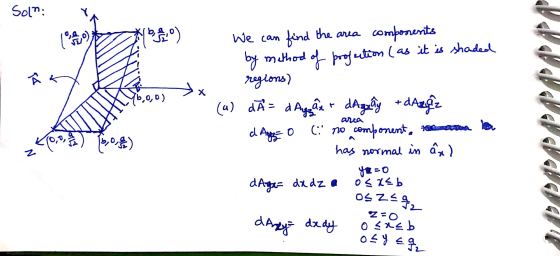
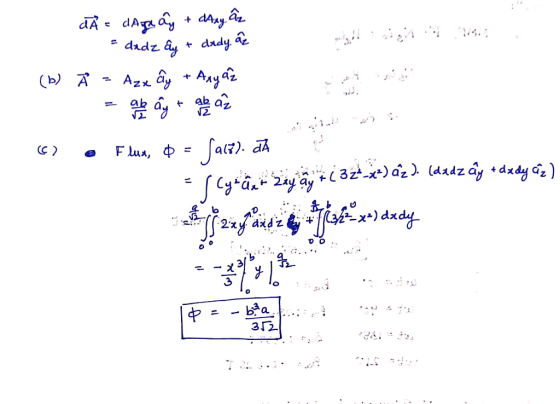
Calculate for the rectangular area which is defined by its corner points (b, a/V2,0), (0, a/V2,0),...
(10 points) Un uniforme magnetic field B has constante strength b teslas in the z-direction [i.e., B-(0,0, b) ] (a) Verity that A-Bx r is a vector potential for B, where r (x,y,0) (b) Calculate the f...
 (10 points) Un uniforme magnetic field B has constante strength b teslas in the z-direction [i.e., B-(0,0, b) ] (a) Verity that A-Bx r is a vector potential for B, where r (x,y,0) (b) Calculate the flux of B through the rectangle with vertices A, B, C, and D in Figure 17. FIGURE 17 A-(7, 0, 6) , B-(7, 3, 0) , C-(0, 3, 0) , D- (0,0,6), F-(7,0,0) Flux(B)
(10 points) Un uniforme magnetic field B has constante strength...
(10 points) Un uniforme magnetic field B has constante strength b teslas in the z-direction [i.e., B-(0,0, b) ] (a) Verity that A-Bx r is a vector potential for B, where r (x,y,0) (b) Calculate the flux of B through the rectangle with vertices A, B, C, and D in Figure 17. FIGURE 17 A-(7, 0, 6) , B-(7, 3, 0) , C-(0, 3, 0) , D- (0,0,6), F-(7,0,0) Flux(B)
(10 points) Un uniforme magnetic field B has constante strength...
4. Consider the surface (cone) S given by (a) Calculate the surface area of S (b) Equipping S wit...
 4. Consider the surface (cone) S given by (a) Calculate the surface area of S (b) Equipping S with an upwards pointing unit normal (one where the z-component of the normal vwctor is positive), calculate the flux of the vector field Fla,,) (x, y, 0) through S , y, z)
4. Consider the surface (cone) S given by (a) Calculate the surface area of S (b) Equipping S with an upwards pointing unit normal (one where the z-component of the...
4. Consider the surface (cone) S given by (a) Calculate the surface area of S (b) Equipping S with an upwards pointing unit normal (one where the z-component of the normal vwctor is positive), calculate the flux of the vector field Fla,,) (x, y, 0) through S , y, z)
4. Consider the surface (cone) S given by (a) Calculate the surface area of S (b) Equipping S with an upwards pointing unit normal (one where the z-component of the...
(1 point) A uniform magnetic field B has constant strength b teslas in the 2-direction [ie., B = (0,0, b) ] (a) Verify that A Bx r is a vector potential for B, where r (x,y,0) (b) Calculate the flux...
 (1 point) A uniform magnetic field B has constant strength b teslas in the 2-direction [ie., B = (0,0, b) ] (a) Verify that A Bx r is a vector potential for B, where r (x,y,0) (b) Calculate the flux of B through the rectangle with vertices A, B, C, and D in Figure 17. FIGURE 17 A= (4,0,4), С=(0,3,0), В= (4,3,0), D (0,0, 4), F (4,0, 0) Flux(B)
(1 point) A uniform magnetic field B has constant strength b...
(1 point) A uniform magnetic field B has constant strength b teslas in the 2-direction [ie., B = (0,0, b) ] (a) Verify that A Bx r is a vector potential for B, where r (x,y,0) (b) Calculate the flux of B through the rectangle with vertices A, B, C, and D in Figure 17. FIGURE 17 A= (4,0,4), С=(0,3,0), В= (4,3,0), D (0,0, 4), F (4,0, 0) Flux(B)
(1 point) A uniform magnetic field B has constant strength b...
MARK WHICH STATEMENTS BELOW ARE TRUE, USING THE FOLLOWING, Consider Vf(x, y, z) in terms of...
 MARK WHICH STATEMENTS BELOW ARE TRUE, USING THE FOLLOWING, Consider Vf(x, y, z) in terms of a new coordinate system, x= x(u, v, w), y=y(u, v, w), z=z(u, v, w). Let r(s) = x(s) i+y(s) + z(s) k be the position vector defining some continuous path as a function of the arc length. Similarly for the other partial derivatives in v and w. For spherical coordinates the following must also be true for any points, x = Rsin o cose,...
Consider the vector field F(x, y, z) = 8x^2 + 3y, −5x^2y − 4y^2, 6x^2 + 7y − 8 which is defined on all of double-struck R3, and let F be the rectangular solid region F = {(x, y, z) | 0 ≤ x ≤ a, 0 ≤ y...
Consider the vector field F(x, y, z) = 8x^2 + 3y, −5x^2y − 4y^2, 6x^2 + 7y − 8 which is defined on all of double-struck R3, and let F be the rectangular solid region F = {(x, y, z) | 0 ≤ x ≤ a, 0 ≤ y ≤ b, −1 ≤ z ≤ 1} where a > 0 and b > 0 are constants. Determine the values of a and b that will make the flux of F...
Figure 2 shows a wedge-shaped closed surface, defined by x + z = 1 and the planes x 0, y 0, y 1, ...
 Figure 2 shows a wedge-shaped closed surface, defined by x + z = 1 and the planes x 0, y 0, y 1, and z 0. For the vector field 1 V xi+yzi+ zk, find the overall flux out of the wedge's surface using Gauss theorem. a) b) According to whether your answer to (a) was positive, negative, or K zero, provide an interpretation of the result.
Figure 2 shows a wedge-shaped closed surface, defined by x + z =...
Figure 2 shows a wedge-shaped closed surface, defined by x + z = 1 and the planes x 0, y 0, y 1, and z 0. For the vector field 1 V xi+yzi+ zk, find the overall flux out of the wedge's surface using Gauss theorem. a) b) According to whether your answer to (a) was positive, negative, or K zero, provide an interpretation of the result.
Figure 2 shows a wedge-shaped closed surface, defined by x + z =...
te tt 9 Let S be the surface defined by r2 y-22= 1 and 0 15...
 te tt 9 Let S be the surface defined by r2 y-22= 1 and 0 15 points by the normal direction toward the z-axis. Find the flux of the velocity field V 1and oriented (z2-ry2)i+(2.2y -yz2)j+ (y2z- 2r2)k across S Solution. To use Gauss Theorem, define C and C2 such that C1 {(a, y, z ) | a + y? < 2, z = 1} C2={(r,y,)| +y1.0} 11 TALK X W P S ww F6 & # 2 3 4...
(8) 2 points Let f be a function defined and continuous, with continuous first partial derivative at the origin (0,...
 (8) 2 points Let f be a function defined and continuous, with continuous first partial derivative at the origin (0,0). A unit vector u for which D.f (0,0) is the maximum is: maximum a 1 (0,0)), A. /(0,0)x,0),y (0 af B. (0,0) 8x0,0),(0,0)), af 1 ((0,0),-y C. (0,0), /(0,0) D. None of the above.
(8) 2 points Let f be a function defined and continuous, with continuous first partial derivative at the origin (0,0). A unit vector u for which...
(8) 2 points Let f be a function defined and continuous, with continuous first partial derivative at the origin (0,0). A unit vector u for which D.f (0,0) is the maximum is: maximum a 1 (0,0)), A. /(0,0)x,0),y (0 af B. (0,0) 8x0,0),(0,0)), af 1 ((0,0),-y C. (0,0), /(0,0) D. None of the above.
(8) 2 points Let f be a function defined and continuous, with continuous first partial derivative at the origin (0,0). A unit vector u for which...
6. Find the center of mass of the rectangular lamina with vertices (0,0), (6,0), (0, 24)...
 6. Find the center of mass of the rectangular lamina with vertices (0,0), (6,0), (0, 24) and (6, 24) for the density p = kxy. 7. Find the area of the surface given by z =f(x,y) over the region R. f(x,y) = 3 – 2x + 5y R: square with vertices (0,0), (4,0),(4,4),(0,4)
(a) Use surface integral(s) to calculate the flux of the vector field or through the given surface.
(a) Use surface integral(s) to calculate the flux of the vector field or through the given surface. (b) Use the divergence theorem to calculate the flux of the vector field through the given surface. 4. F(x, y, z) =x2yi - 2yzj + x2y2k; S is the surface of the rectangular solid in the first octant bounded by the planes x= 1,y=2, and z=3. Show your work and give an exact answer.
 (10 points) Un uniforme magnetic field B has constante strength b teslas in the z-direction [i.e., B-(0,0, b) ] (a) Verity that A-Bx r is a vector potential for B, where r (x,y,0) (b) Calculate the flux of B through the rectangle with vertices A, B, C, and D in Figure 17. FIGURE 17 A-(7, 0, 6) , B-(7, 3, 0) , C-(0, 3, 0) , D- (0,0,6), F-(7,0,0) Flux(B)
(10 points) Un uniforme magnetic field B has constante strength...
(10 points) Un uniforme magnetic field B has constante strength b teslas in the z-direction [i.e., B-(0,0, b) ] (a) Verity that A-Bx r is a vector potential for B, where r (x,y,0) (b) Calculate the flux of B through the rectangle with vertices A, B, C, and D in Figure 17. FIGURE 17 A-(7, 0, 6) , B-(7, 3, 0) , C-(0, 3, 0) , D- (0,0,6), F-(7,0,0) Flux(B)
(10 points) Un uniforme magnetic field B has constante strength...
 4. Consider the surface (cone) S given by (a) Calculate the surface area of S (b) Equipping S with an upwards pointing unit normal (one where the z-component of the normal vwctor is positive), calculate the flux of the vector field Fla,,) (x, y, 0) through S , y, z)
4. Consider the surface (cone) S given by (a) Calculate the surface area of S (b) Equipping S with an upwards pointing unit normal (one where the z-component of the...
4. Consider the surface (cone) S given by (a) Calculate the surface area of S (b) Equipping S with an upwards pointing unit normal (one where the z-component of the normal vwctor is positive), calculate the flux of the vector field Fla,,) (x, y, 0) through S , y, z)
4. Consider the surface (cone) S given by (a) Calculate the surface area of S (b) Equipping S with an upwards pointing unit normal (one where the z-component of the...
 (1 point) A uniform magnetic field B has constant strength b teslas in the 2-direction [ie., B = (0,0, b) ] (a) Verify that A Bx r is a vector potential for B, where r (x,y,0) (b) Calculate the flux of B through the rectangle with vertices A, B, C, and D in Figure 17. FIGURE 17 A= (4,0,4), С=(0,3,0), В= (4,3,0), D (0,0, 4), F (4,0, 0) Flux(B)
(1 point) A uniform magnetic field B has constant strength b...
(1 point) A uniform magnetic field B has constant strength b teslas in the 2-direction [ie., B = (0,0, b) ] (a) Verify that A Bx r is a vector potential for B, where r (x,y,0) (b) Calculate the flux of B through the rectangle with vertices A, B, C, and D in Figure 17. FIGURE 17 A= (4,0,4), С=(0,3,0), В= (4,3,0), D (0,0, 4), F (4,0, 0) Flux(B)
(1 point) A uniform magnetic field B has constant strength b...
 MARK WHICH STATEMENTS BELOW ARE TRUE, USING THE FOLLOWING, Consider Vf(x, y, z) in terms of a new coordinate system, x= x(u, v, w), y=y(u, v, w), z=z(u, v, w). Let r(s) = x(s) i+y(s) + z(s) k be the position vector defining some continuous path as a function of the arc length. Similarly for the other partial derivatives in v and w. For spherical coordinates the following must also be true for any points, x = Rsin o cose,...
 Figure 2 shows a wedge-shaped closed surface, defined by x + z = 1 and the planes x 0, y 0, y 1, and z 0. For the vector field 1 V xi+yzi+ zk, find the overall flux out of the wedge's surface using Gauss theorem. a) b) According to whether your answer to (a) was positive, negative, or K zero, provide an interpretation of the result.
Figure 2 shows a wedge-shaped closed surface, defined by x + z =...
Figure 2 shows a wedge-shaped closed surface, defined by x + z = 1 and the planes x 0, y 0, y 1, and z 0. For the vector field 1 V xi+yzi+ zk, find the overall flux out of the wedge's surface using Gauss theorem. a) b) According to whether your answer to (a) was positive, negative, or K zero, provide an interpretation of the result.
Figure 2 shows a wedge-shaped closed surface, defined by x + z =...
 te tt 9 Let S be the surface defined by r2 y-22= 1 and 0 15 points by the normal direction toward the z-axis. Find the flux of the velocity field V 1and oriented (z2-ry2)i+(2.2y -yz2)j+ (y2z- 2r2)k across S Solution. To use Gauss Theorem, define C and C2 such that C1 {(a, y, z ) | a + y? < 2, z = 1} C2={(r,y,)| +y1.0} 11 TALK X W P S ww F6 & # 2 3 4...
 (8) 2 points Let f be a function defined and continuous, with continuous first partial derivative at the origin (0,0). A unit vector u for which D.f (0,0) is the maximum is: maximum a 1 (0,0)), A. /(0,0)x,0),y (0 af B. (0,0) 8x0,0),(0,0)), af 1 ((0,0),-y C. (0,0), /(0,0) D. None of the above.
(8) 2 points Let f be a function defined and continuous, with continuous first partial derivative at the origin (0,0). A unit vector u for which...
(8) 2 points Let f be a function defined and continuous, with continuous first partial derivative at the origin (0,0). A unit vector u for which D.f (0,0) is the maximum is: maximum a 1 (0,0)), A. /(0,0)x,0),y (0 af B. (0,0) 8x0,0),(0,0)), af 1 ((0,0),-y C. (0,0), /(0,0) D. None of the above.
(8) 2 points Let f be a function defined and continuous, with continuous first partial derivative at the origin (0,0). A unit vector u for which...
 6. Find the center of mass of the rectangular lamina with vertices (0,0), (6,0), (0, 24) and (6, 24) for the density p = kxy. 7. Find the area of the surface given by z =f(x,y) over the region R. f(x,y) = 3 – 2x + 5y R: square with vertices (0,0), (4,0),(4,4),(0,4)
Most questions answered within 3 hours.
-
Where is the error in this code sequence?
String s1 = "Hello";
String s2 = "ello";...
asked 10 months ago -
Financial data for Joel de Paris, Inc., for last year
follow:
Joel de Paris, Inc.
Balance...
asked 10 months ago -
Consider this reaction:
Al2(SO4)3 (aq)+ BaCl3
(aq) Al2Cl6 (aq)- +
3BaSO4(s) . What is the...
asked 10 months ago -
Suppose that Savneet is considering increasing her
recent random sample from 20 car rentals to 40...
asked 10 months ago -
Trucks arrive at an unloading terminal at an average rate of 120
per hour.
Trucks arrive...
asked 10 months ago -
Why are methanol and ethanol completely soluble in water while
octanol is not very little soluble....
asked 10 months ago -
A facilities manager at a university reads in a research report
that the mean amount of...
asked 10 months ago -
When the CuSO4 is rehydrated by adding water to the anhydrous
compound, is this an endothermic...
asked 10 months ago -
A ray of sunlight is passing from diamond into crown glass; the
angle of incidence is...
asked 10 months ago -
A block of mass 0.249 kg is placed on top of a light, vertical
spring of...
asked 10 months ago -
how do the kidneys compensate in the presences of acidosis
a) trigger hyperventilate
b) reserve acid...
asked 10 months ago -
Question 501 pts
The rental rate of capital to the firm increases. Which of the
following...
asked 10 months ago