consider two vectors A= -10i+20j, and B has a length of 15 and angle of +45...
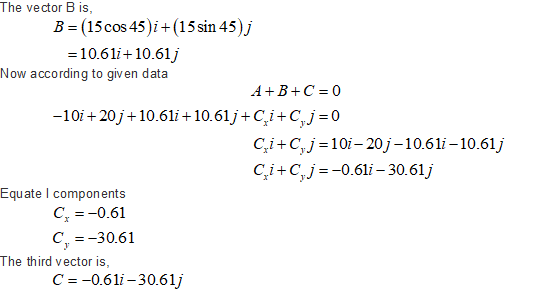
consider two vectors A= -10i+20j, and B has a length of 15 and angle of +45 with respect to the positive x axis. What third vector C must be added to these two such that A+B+C=0?
Homework Answers
Add Answer to:
consider two vectors A= -10i+20j, and B has a length of 15 and
angle of +45...
Consider the two vectors, A and B, for which the length and angle are given below....
Consider the two vectors, A and B, for which the length and angle are given below. What would be the x and y components of the the vector sum C = A + B? length of A = 4.472, angle A makes with respect to x-axis = 153.435 degrees length of B = 3.606, angle C makes with respect to x-axis = 56.310 degrees Cx = Cy=
There are two unitless vectors: F1-8.92 i + 17.37; F2 - 12.44 i+7.11j A third vector...
 There are two unitless vectors: F1-8.92 i + 17.37; F2 - 12.44 i+7.11j A third vector is added to them such that they add up to to the null vector: Fq+F2+F3 - 0 What is the angle of the third vector with respect to the +x-axis? Answer in degrees, and to the fourth decimal place. Question 9 There are two unitless vectors: Fq - 8.92 i + 17.37) F2 - 8.311 - 10.971 A third vector is added to them...
Learning Goal: To use geometric and component addition of vectors. Four vectors A, B, C, and...
 Learning Goal:
To use geometric and component addition of vectors.
Four vectors A, B,
C, and D are shown (not to
scale). Vector A has magnitude 18.9 and acts at an
angle of 13.3 degrees with respect to the positive x axis.
Vector B has magnitude 14.1 and acts at an angle
of 71.3 degrees with respect to the positive x axis.
Vector C has magnitude 46.1 and acts at an angle
of 147.5 degrees with respect to the positive...
Learning Goal:
To use geometric and component addition of vectors.
Four vectors A, B,
C, and D are shown (not to
scale). Vector A has magnitude 18.9 and acts at an
angle of 13.3 degrees with respect to the positive x axis.
Vector B has magnitude 14.1 and acts at an angle
of 71.3 degrees with respect to the positive x axis.
Vector C has magnitude 46.1 and acts at an angle
of 147.5 degrees with respect to the positive...
You are given three vectors: A has a magnitude of 14.6 and is at an angle...
 You are given three vectors: A has a magnitude of 14.6 and is at an angle of 40° counterclockwise from the positive x -axis. B has a magnitude of 4.3 and makes an angle 200 counterclockwise of the positive y-axis. C has a magnitude of 7.2 and makes an angle of 15° clockwise from the positive x -axis. 5. a. Get the x and y components of A , B, and C. Write the three vectors with unit vector notation....
You are given three vectors: A has a magnitude of 14.6 and is at an angle...
 You are given three vectors: A has a magnitude of 14.6 and is at an angle of 40° counterclockwise from the positive x -axis. B has a magnitude of 4.3 and makes an angle 20° counterclockwise of the positive y-axis. C has a magnitude of 7.2 and makes an angle of 15° clockwise from the positive x -axis. 5. a. b. c. Get the x and y components of A , B, and C. Write the three vectors with unit...
Consider the two vectors, A and B. A = 4 + 2] B = -2 +...
 Consider the two vectors, A and B. A = 4 + 2] B = -2 + 4 Answer the two questions below, using three significant figures. Part A: What angle (0) does the vector A make with the x-axis? 0 = deg Part B: If the vector C is such that C = A + B, what is the magnitude of C? C=
There are two unitless vectors: F1 = 8.92 i + 17.37 j F2 = 12.44 i...
There are two unitless vectors: F1 = 8.92 i + 17.37 j F2 = 12.44 i + 7.11 j A third vector is added to them such that they add up to to the null vector: F1 + F2 + F3 = 0 What is the angle of the third vector with respect to the +x-axis? Answer in degrees, and to the fourth decimal place.
There are two unitless vectors: F1 = 8.92 i + 17.37 j F2 = 8.31 i...
There are two unitless vectors: F1 = 8.92 i + 17.37 j F2 = 8.31 i - 10.97 j A third vector is added to them such that they add up to to the null vector: F1 + F2 + F3 = 0 What is the angle of the third vector with respect to the +x-axis? Answer in degrees, and to the fourth decimal place.
Consider the two vectors, A and B. A = 4î + - 3 B = -2î...
 Consider the two vectors, A and B. A = 4î + - 3 B = -2î + 4 Answer the two questions below, using three significant figures. Part A: What angle (0) does the vector A make with the x-axis? = 36.8 deg Part B: If the vector C is such that C = A + B, what is the magnitude of C? C=
Consider the three displacement vectors shown in the figure: Vector A→ has a magnitude of 7.90 km and a direction that makes an angle θ = 31.0° to the left of the positive y-axis, vector → B has a magnitude of 6.20 km and a direction that makes an angle o
 Consider the three displacement vectors shown in the figure: Vector A→ has a magnitude of 7.90 km and a direction that makes an angle θ = 31.0° to theleft of the positive y-axis, vector → B has a magnitude of 6.20 km and a direction that makes an angle of α =28.0° above the positive x-axis, and vector →C has a magnitude of 4.10 km and a direction that makes an angle β = 57.0° below the negative x-axis. Determine...
 There are two unitless vectors: F1-8.92 i + 17.37; F2 - 12.44 i+7.11j A third vector is added to them such that they add up to to the null vector: Fq+F2+F3 - 0 What is the angle of the third vector with respect to the +x-axis? Answer in degrees, and to the fourth decimal place. Question 9 There are two unitless vectors: Fq - 8.92 i + 17.37) F2 - 8.311 - 10.971 A third vector is added to them...
 Learning Goal:
To use geometric and component addition of vectors.
Four vectors A, B,
C, and D are shown (not to
scale). Vector A has magnitude 18.9 and acts at an
angle of 13.3 degrees with respect to the positive x axis.
Vector B has magnitude 14.1 and acts at an angle
of 71.3 degrees with respect to the positive x axis.
Vector C has magnitude 46.1 and acts at an angle
of 147.5 degrees with respect to the positive...
Learning Goal:
To use geometric and component addition of vectors.
Four vectors A, B,
C, and D are shown (not to
scale). Vector A has magnitude 18.9 and acts at an
angle of 13.3 degrees with respect to the positive x axis.
Vector B has magnitude 14.1 and acts at an angle
of 71.3 degrees with respect to the positive x axis.
Vector C has magnitude 46.1 and acts at an angle
of 147.5 degrees with respect to the positive...
 You are given three vectors: A has a magnitude of 14.6 and is at an angle of 40° counterclockwise from the positive x -axis. B has a magnitude of 4.3 and makes an angle 200 counterclockwise of the positive y-axis. C has a magnitude of 7.2 and makes an angle of 15° clockwise from the positive x -axis. 5. a. Get the x and y components of A , B, and C. Write the three vectors with unit vector notation....
 You are given three vectors: A has a magnitude of 14.6 and is at an angle of 40° counterclockwise from the positive x -axis. B has a magnitude of 4.3 and makes an angle 20° counterclockwise of the positive y-axis. C has a magnitude of 7.2 and makes an angle of 15° clockwise from the positive x -axis. 5. a. b. c. Get the x and y components of A , B, and C. Write the three vectors with unit...
 Consider the two vectors, A and B. A = 4 + 2] B = -2 + 4 Answer the two questions below, using three significant figures. Part A: What angle (0) does the vector A make with the x-axis? 0 = deg Part B: If the vector C is such that C = A + B, what is the magnitude of C? C=
 Consider the two vectors, A and B. A = 4î + - 3 B = -2î + 4 Answer the two questions below, using three significant figures. Part A: What angle (0) does the vector A make with the x-axis? = 36.8 deg Part B: If the vector C is such that C = A + B, what is the magnitude of C? C=
Most questions answered within 3 hours.
-
Where is the error in this code sequence?
String s1 = "Hello";
String s2 = "ello";...
asked 10 months ago -
Financial data for Joel de Paris, Inc., for last year
follow:
Joel de Paris, Inc.
Balance...
asked 10 months ago -
Consider this reaction:
Al2(SO4)3 (aq)+ BaCl3
(aq) Al2Cl6 (aq)- +
3BaSO4(s) . What is the...
asked 10 months ago -
Suppose that Savneet is considering increasing her
recent random sample from 20 car rentals to 40...
asked 10 months ago -
Trucks arrive at an unloading terminal at an average rate of 120
per hour.
Trucks arrive...
asked 10 months ago -
Why are methanol and ethanol completely soluble in water while
octanol is not very little soluble....
asked 10 months ago -
A facilities manager at a university reads in a research report
that the mean amount of...
asked 10 months ago -
When the CuSO4 is rehydrated by adding water to the anhydrous
compound, is this an endothermic...
asked 10 months ago -
A ray of sunlight is passing from diamond into crown glass; the
angle of incidence is...
asked 10 months ago -
A block of mass 0.249 kg is placed on top of a light, vertical
spring of...
asked 10 months ago -
how do the kidneys compensate in the presences of acidosis
a) trigger hyperventilate
b) reserve acid...
asked 10 months ago -
Question 501 pts
The rental rate of capital to the firm increases. Which of the
following...
asked 10 months ago