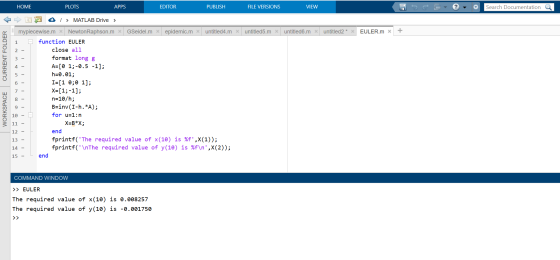
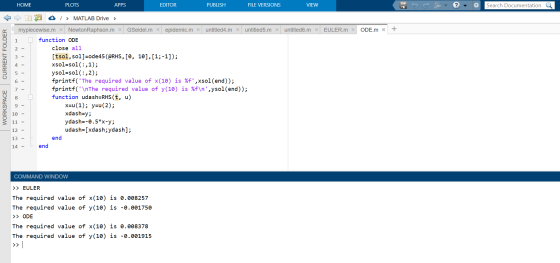
![To illu • The initial value problem | |-0.5 -1][g x(0) = 1, y(0) = -1 is to be solved on the interval t € (0, 10] using the b](http://img.homeworklib.com/questions/f4a28f50-1e0b-11eb-b394-5b20574b683c.png?x-oss-process=image/resize,w_560)
Homework Answers
Add Answer to:
To illu • The initial value problem | |-0.5 -1][g x(0) = 1, y(0) = -1...
MATLAB help please!!!!! 1. Use the forward Euler method Vi+,-Vi + (ti+1-tinti , yi) for i=0.1, 2, , taking yo-y(to) to be the initial condition, to approximate the solution at 2 of the IVP y'=y-t...
 MATLAB help please!!!!!
1. Use the forward Euler method Vi+,-Vi + (ti+1-tinti , yi) for i=0.1, 2, , taking yo-y(to) to be the initial condition, to approximate the solution at 2 of the IVP y'=y-t2 + 1, 0 2, y(0) = 0.5. t Use N 2k, k2,...,20 equispaced timesteps so to 0 and t-1 2) Make a convergence plot computing the error by comparing with the exact solution, y: t (t+1)2 exp(t)/2, and plotting the error as a function of...
MATLAB help please!!!!!
1. Use the forward Euler method Vi+,-Vi + (ti+1-tinti , yi) for i=0.1, 2, , taking yo-y(to) to be the initial condition, to approximate the solution at 2 of the IVP y'=y-t2 + 1, 0 2, y(0) = 0.5. t Use N 2k, k2,...,20 equispaced timesteps so to 0 and t-1 2) Make a convergence plot computing the error by comparing with the exact solution, y: t (t+1)2 exp(t)/2, and plotting the error as a function of...
Find an approximate solution to the pendulum problem such that d2 theta /dt2 +g/l theta =...
Find an approximate solution to the pendulum problem such that d2 theta /dt2 +g/l theta = 0. Use an approximate solver in matlab to find the solution to the exact equation d2 theta/dt2 +g/l * sin( theta) = 0. Compare the two solutions when the initial angle is 10, 30, and 90. Find a way to quantify the difference. One approximate method for solving differential equations is Runge-Kutta, which in Matlab goes by the name ode45. I have made a...
[7] 1. Consider the initial value problem (IVP) y′(t) = −y(t), y(0) = 1 The solution to this IVP ...
[7] 1. Consider the initial value problem (IVP) y′(t) = −y(t), y(0) = 1 The solution to this IVP is y(t) = e−t [1] i) Implement Euler’s method and generate an approximate solution of this IVP over the interval [0,2], using stepsize h = 0.1. (The Google sheet posted on LEARN is set up to carry out precisely this task.) Report the resulting approximation of the value y(2). [1] ii) Repeat part (ii), but use stepsize h = 0.05. Describe...
The Program for the code should be matlab 5. [25 pointsl Given the initial value problem...
 The Program for the code should be matlab
5. [25 pointsl Given the initial value problem with the initial conditions y(0) 2 and y'(0)10, (a) Solve analytically to obtain the exact solution y(x) (b) Solve numerically using the forward Euler, backward Euler, and fourth-order Runge Kutta methods. Please implement all three methods yourselves do not use any built- in integrators (i.e., ode45)). Integrate over 0 3 r < 4, and compare the methods with the exact solution. (For example, using...
The Program for the code should be matlab
5. [25 pointsl Given the initial value problem with the initial conditions y(0) 2 and y'(0)10, (a) Solve analytically to obtain the exact solution y(x) (b) Solve numerically using the forward Euler, backward Euler, and fourth-order Runge Kutta methods. Please implement all three methods yourselves do not use any built- in integrators (i.e., ode45)). Integrate over 0 3 r < 4, and compare the methods with the exact solution. (For example, using...
Question 1: Given the initial-value problem 12-21 0 <1 <1, y(0) = 1, 12+10 with exact...
 Question 1: Given the initial-value problem 12-21 0 <1 <1, y(0) = 1, 12+10 with exact solution v(t) = 2t +1 t2 + 1 a. Use Euler's method with h = 0.1 to approximate the solution of y b. Calculate the error bound and compare the actual error at each step to the error bound. c. Use the answers generated in part (a) and linear interpolation to approximate the following values of y, and compare them to the actual value...
Need Help with solving for answers in Part C and Part D! Find approximate values of the solution of the given initial value problem at t = 0.1, 0.2, 0,3, and 0.4, (A COmputer algebra system is recomm...
 Need Help with solving for answers in Part C and Part D!
Find approximate values of the solution of the given initial value problem at t = 0.1, 0.2, 0,3, and 0.4, (A COmputer algebra system is recommended. Round your answers to five decimal places.) (a) Use the Euler method with0.05 (0.11.5875 y(0.2)2.12747 y(0.3)2.62455 y(0.4)3.0829 (b) Use the Euler method with h0.025 y(0.1)1.58156 y(0.2)2.11675 (o.3)261 y(0.4)3.0654 (c) Use the backward Euler method with h 0.05 (0.2) y(0.3) y(0.4) (d) Use...
Need Help with solving for answers in Part C and Part D!
Find approximate values of the solution of the given initial value problem at t = 0.1, 0.2, 0,3, and 0.4, (A COmputer algebra system is recommended. Round your answers to five decimal places.) (a) Use the Euler method with0.05 (0.11.5875 y(0.2)2.12747 y(0.3)2.62455 y(0.4)3.0829 (b) Use the Euler method with h0.025 y(0.1)1.58156 y(0.2)2.11675 (o.3)261 y(0.4)3.0654 (c) Use the backward Euler method with h 0.05 (0.2) y(0.3) y(0.4) (d) Use...
3. Consider the initial value problem y(0) 0-105z(t Clearly, the solution to the system is y(t) e...
 Ignore crossed out questions, thanks
3. Consider the initial value problem y(0) 0-105z(t Clearly, the solution to the system is y(t) e and(t) e-10t. Suppose we tried solving the system using forward Euler. This would give us with to- 0, y(to) 1, and z(to) 1. 2.10-5 c. In general, why would you expect forward Euler to require smaller time-steps than backward Euler?
3. Consider the initial value problem y(0) 0-105z(t Clearly, the solution to the system is y(t) e and(t)...
Ignore crossed out questions, thanks
3. Consider the initial value problem y(0) 0-105z(t Clearly, the solution to the system is y(t) e and(t) e-10t. Suppose we tried solving the system using forward Euler. This would give us with to- 0, y(to) 1, and z(to) 1. 2.10-5 c. In general, why would you expect forward Euler to require smaller time-steps than backward Euler?
3. Consider the initial value problem y(0) 0-105z(t Clearly, the solution to the system is y(t) e and(t)...
Consider the initial value problem y' +y=e-, with y(0) = 0. PROJECT 1.) Find the exact...
 Consider the initial value problem y' +y=e-, with y(0) = 0. PROJECT 1.) Find the exact solution to this equation, say 0(x). 2.) Use MATLAB to plot 6(x) in the interval [0.0, 4.0] . Use sufficient points to obtain a smooth curve. 3.) Now create a MATLAB program that uses Euler's Method to approximate the values of $(2) at N = 10 equally spaced points in (0,4). Plot these points on the same plot that was generated in part 2....
1. Consider the IVP y = 1 - 100(y-t), y(0) = 0.5. (a) Find the exact...
 1. Consider the IVP y = 1 - 100(y-t), y(0) = 0.5. (a) Find the exact solution. (b) Use the Forward Euler, Heun, and Backward Euler methods to find approximate solu- tions ont € 0, 0.5], using h = 0.25. Plot all four solutions (exact and three approxima- tions) on the same graph. (c) Maple's approximation is plotted, along with the direction field, in Figure 1. Use it, and the exact solution, to explain the behaviours observed in your numerical...
YOUR TEACHER Consider the initial-value problem y = (x + y - 1)?.Y(0) - 2. Use...
 YOUR TEACHER Consider the initial-value problem y = (x + y - 1)?.Y(0) - 2. Use the improved Euler's method with h = 0.1 and h = 0.05 to obtain approximate values of the solution at x = 0.5. At each step compare the approximate value with the actual value of the analytic solution (Round your answers to four decimal places.) h 0.1 Y(0.5) h 0.05 Y(0.5) actual value Y(0.5) = Need Help? Tuto Tutor
 MATLAB help please!!!!!
1. Use the forward Euler method Vi+,-Vi + (ti+1-tinti , yi) for i=0.1, 2, , taking yo-y(to) to be the initial condition, to approximate the solution at 2 of the IVP y'=y-t2 + 1, 0 2, y(0) = 0.5. t Use N 2k, k2,...,20 equispaced timesteps so to 0 and t-1 2) Make a convergence plot computing the error by comparing with the exact solution, y: t (t+1)2 exp(t)/2, and plotting the error as a function of...
MATLAB help please!!!!!
1. Use the forward Euler method Vi+,-Vi + (ti+1-tinti , yi) for i=0.1, 2, , taking yo-y(to) to be the initial condition, to approximate the solution at 2 of the IVP y'=y-t2 + 1, 0 2, y(0) = 0.5. t Use N 2k, k2,...,20 equispaced timesteps so to 0 and t-1 2) Make a convergence plot computing the error by comparing with the exact solution, y: t (t+1)2 exp(t)/2, and plotting the error as a function of...
 The Program for the code should be matlab
5. [25 pointsl Given the initial value problem with the initial conditions y(0) 2 and y'(0)10, (a) Solve analytically to obtain the exact solution y(x) (b) Solve numerically using the forward Euler, backward Euler, and fourth-order Runge Kutta methods. Please implement all three methods yourselves do not use any built- in integrators (i.e., ode45)). Integrate over 0 3 r < 4, and compare the methods with the exact solution. (For example, using...
The Program for the code should be matlab
5. [25 pointsl Given the initial value problem with the initial conditions y(0) 2 and y'(0)10, (a) Solve analytically to obtain the exact solution y(x) (b) Solve numerically using the forward Euler, backward Euler, and fourth-order Runge Kutta methods. Please implement all three methods yourselves do not use any built- in integrators (i.e., ode45)). Integrate over 0 3 r < 4, and compare the methods with the exact solution. (For example, using...
 Question 1: Given the initial-value problem 12-21 0 <1 <1, y(0) = 1, 12+10 with exact solution v(t) = 2t +1 t2 + 1 a. Use Euler's method with h = 0.1 to approximate the solution of y b. Calculate the error bound and compare the actual error at each step to the error bound. c. Use the answers generated in part (a) and linear interpolation to approximate the following values of y, and compare them to the actual value...
 Need Help with solving for answers in Part C and Part D!
Find approximate values of the solution of the given initial value problem at t = 0.1, 0.2, 0,3, and 0.4, (A COmputer algebra system is recommended. Round your answers to five decimal places.) (a) Use the Euler method with0.05 (0.11.5875 y(0.2)2.12747 y(0.3)2.62455 y(0.4)3.0829 (b) Use the Euler method with h0.025 y(0.1)1.58156 y(0.2)2.11675 (o.3)261 y(0.4)3.0654 (c) Use the backward Euler method with h 0.05 (0.2) y(0.3) y(0.4) (d) Use...
Need Help with solving for answers in Part C and Part D!
Find approximate values of the solution of the given initial value problem at t = 0.1, 0.2, 0,3, and 0.4, (A COmputer algebra system is recommended. Round your answers to five decimal places.) (a) Use the Euler method with0.05 (0.11.5875 y(0.2)2.12747 y(0.3)2.62455 y(0.4)3.0829 (b) Use the Euler method with h0.025 y(0.1)1.58156 y(0.2)2.11675 (o.3)261 y(0.4)3.0654 (c) Use the backward Euler method with h 0.05 (0.2) y(0.3) y(0.4) (d) Use...
 Ignore crossed out questions, thanks
3. Consider the initial value problem y(0) 0-105z(t Clearly, the solution to the system is y(t) e and(t) e-10t. Suppose we tried solving the system using forward Euler. This would give us with to- 0, y(to) 1, and z(to) 1. 2.10-5 c. In general, why would you expect forward Euler to require smaller time-steps than backward Euler?
3. Consider the initial value problem y(0) 0-105z(t Clearly, the solution to the system is y(t) e and(t)...
Ignore crossed out questions, thanks
3. Consider the initial value problem y(0) 0-105z(t Clearly, the solution to the system is y(t) e and(t) e-10t. Suppose we tried solving the system using forward Euler. This would give us with to- 0, y(to) 1, and z(to) 1. 2.10-5 c. In general, why would you expect forward Euler to require smaller time-steps than backward Euler?
3. Consider the initial value problem y(0) 0-105z(t Clearly, the solution to the system is y(t) e and(t)...
 Consider the initial value problem y' +y=e-, with y(0) = 0. PROJECT 1.) Find the exact solution to this equation, say 0(x). 2.) Use MATLAB to plot 6(x) in the interval [0.0, 4.0] . Use sufficient points to obtain a smooth curve. 3.) Now create a MATLAB program that uses Euler's Method to approximate the values of $(2) at N = 10 equally spaced points in (0,4). Plot these points on the same plot that was generated in part 2....
 1. Consider the IVP y = 1 - 100(y-t), y(0) = 0.5. (a) Find the exact solution. (b) Use the Forward Euler, Heun, and Backward Euler methods to find approximate solu- tions ont € 0, 0.5], using h = 0.25. Plot all four solutions (exact and three approxima- tions) on the same graph. (c) Maple's approximation is plotted, along with the direction field, in Figure 1. Use it, and the exact solution, to explain the behaviours observed in your numerical...
 YOUR TEACHER Consider the initial-value problem y = (x + y - 1)?.Y(0) - 2. Use the improved Euler's method with h = 0.1 and h = 0.05 to obtain approximate values of the solution at x = 0.5. At each step compare the approximate value with the actual value of the analytic solution (Round your answers to four decimal places.) h 0.1 Y(0.5) h 0.05 Y(0.5) actual value Y(0.5) = Need Help? Tuto Tutor
Most questions answered within 3 hours.
-
Where is the error in this code sequence?
String s1 = "Hello";
String s2 = "ello";...
asked 10 months ago -
Financial data for Joel de Paris, Inc., for last year
follow:
Joel de Paris, Inc.
Balance...
asked 10 months ago -
Consider this reaction:
Al2(SO4)3 (aq)+ BaCl3
(aq) Al2Cl6 (aq)- +
3BaSO4(s) . What is the...
asked 10 months ago -
Suppose that Savneet is considering increasing her
recent random sample from 20 car rentals to 40...
asked 10 months ago -
Trucks arrive at an unloading terminal at an average rate of 120
per hour.
Trucks arrive...
asked 10 months ago -
Why are methanol and ethanol completely soluble in water while
octanol is not very little soluble....
asked 10 months ago -
A facilities manager at a university reads in a research report
that the mean amount of...
asked 10 months ago -
When the CuSO4 is rehydrated by adding water to the anhydrous
compound, is this an endothermic...
asked 10 months ago -
A ray of sunlight is passing from diamond into crown glass; the
angle of incidence is...
asked 10 months ago -
A block of mass 0.249 kg is placed on top of a light, vertical
spring of...
asked 10 months ago -
how do the kidneys compensate in the presences of acidosis
a) trigger hyperventilate
b) reserve acid...
asked 10 months ago -
Question 501 pts
The rental rate of capital to the firm increases. Which of the
following...
asked 10 months ago