
Homework Answers
Add Answer to:
Heat Transfer Problem:
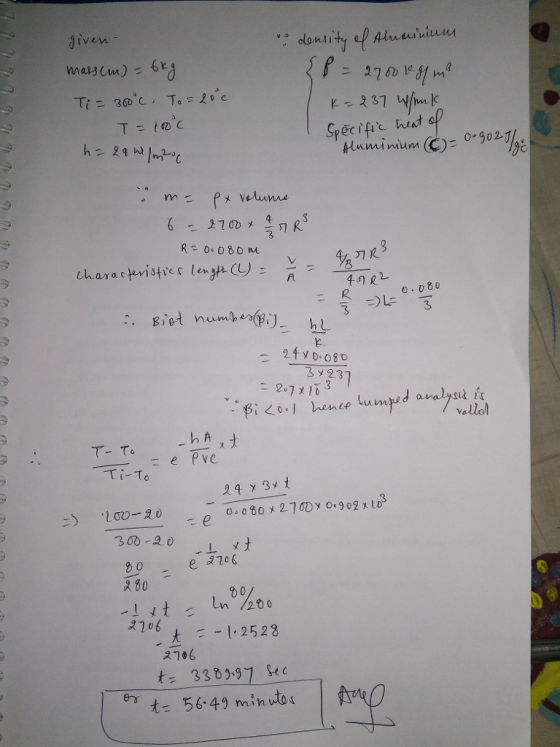
A sphere of pure aluminum weighing 6 kg and initially at a temperature...
an aluminum sphere with an 8 cm diameter is exposed to 60C air with convection heat...
an aluminum sphere with an 8 cm diameter is exposed to 60C air with convection heat transfer coefficient of 35 W/m^2 K. the initial temperature of the phsere is 5 C. a. computer the biot number. b. computer the temperature at the center of the sphere after 5.5 min exposure to the hot air. c. confirm that the lump application is valid.
3. A large, 5-cm thick plate of pure aluminum initially at a uniform temperature of 200°C...
 3. A large, 5-cm thick plate of pure aluminum initially at a uniform temperature of 200°C is suddenly exposed to a convection environment in which the fluid temperature is 50°C and the heat- transfer coefficient is 1200 W/ m K. Calculate the temperature of the plate at a depth of 1.5 cm from one of the surfaces after 3 min. How much heat is lost from the plate during this time? Ans: Tplate = plane
4-79 White potatoes (k0.50 W/m-K and 0.13 X 10⁻⁶ m/s) that are initially at a uniform temperature of 25°C and have an a...
 4-79 White potatoes (k0.50 W/m-K and 0.13 X 10⁻⁶ m/s) that are initially at a uniform temperature of 25°C and have an average diameter of 6 cm are to be cooled by refrigerated air at 2°C flowing at a velocity of 4 m/s. The average heat transfer coefficient between the potatoes and the air is experimentally determined to be 19 W/m2.K Determine how long t wl take for the center temperature of the potatoes to drop to 6°C. Also, determine...
The heat transfer coefficient for hydrogen flowing over a sphere is to be determined by observing...
The heat transfer coefficient for hydrogen flowing over a sphere is to be determined by observing the temperature–time history of a sphere fabricated from pure copper. The sphere, which is 20.0 mm in diameter, is at 70°C before it is inserted into the gas stream having a temperature of 27°C. A thermocouple on the outer surface of the sphere indicates 50°C 97 s after the sphere is inserted into the hydrogen. Find a) What is the value of the specific...
The heat transfer coefficient for hydrogen flowing over a sphere is to be determined by observing...
The heat transfer coefficient for hydrogen flowing over a sphere is to be determined by observing the temperature–time history of a sphere fabricated from pure copper. The sphere, which is 20.0 mm in diameter, is at 90°C before it is inserted into the gas stream having a temperature of 27°C. A thermocouple on the outer surface of the sphere indicates 40°C 97 s after the sphere is inserted into the hydrogen. Step 1 What is the value of the specific...
B4: The steel sphere from the unsteady heat transfer experiment is initially at 20 °C. The...
 B4: The steel sphere from the unsteady heat transfer experiment is initially at 20 °C. The sphere is placed in a water bath at 80 °C. After one minute the centerline temperature is 70 °C. Estimate the Biot number for this sphere and determine the convection coefficient, h.
Problem 2: A hot metal ball 0.00245 W/m°C; α-0151* 10-s m2/s; d 18 cm) initially at...
 Problem 2: A hot metal ball 0.00245 W/m°C; α-0151* 10-s m2/s; d 18 cm) initially at a unifom temperature of 310°C is cooled by placing it in air at 29 C is flowing at a constant 4 m/s. In order to continue on in the manufacturing process, the temperature at the center of the ball must be 70°C. (μ. = 1.872*10-5 kg m-s). The air You mav assume that the properties of air may bem odeled as V = 1.608...
A lumped sphere has an initial temperature Ti = 0 oC and the following properties: A...
A lumped sphere has an initial temperature Ti = 0 oC and the following properties: A = 1 m2 , m = 0.1 kg, c = 100 J/(kg oC). Suddenly, the sphere surface has been exposed to a uniform heat flux qw = 30000 W/m2 and also exposed to convection to a cold air that has h = 50 (W/m2 oC) and Tꝏ = 0 oC. If the sphere behavior is described by dT/dt + β T = λ ;...
7. (20 pts) A sphere with 30 mm in diameter initially at 800 K is quenched...
 7. (20 pts) A sphere with 30 mm in diameter initially at 800 K is quenched in a large bath having a constant temperature of 320 K with a convection heat transfer of 75 W/m2.K. The thermophysical properties of the sphere material are: p=400 kg/mº, c=1600 J/kg-K, and k=1.7 W/mK. (Use characteristic length Lc=VIA to determine applicability of lumped method; Use radius of the sphere for one term approximation) a) Calculate the time required for the surface of the sphere...
 3. A large, 5-cm thick plate of pure aluminum initially at a uniform temperature of 200°C is suddenly exposed to a convection environment in which the fluid temperature is 50°C and the heat- transfer coefficient is 1200 W/ m K. Calculate the temperature of the plate at a depth of 1.5 cm from one of the surfaces after 3 min. How much heat is lost from the plate during this time? Ans: Tplate = plane
 4-79 White potatoes (k0.50 W/m-K and 0.13 X 10⁻⁶ m/s) that are initially at a uniform temperature of 25°C and have an average diameter of 6 cm are to be cooled by refrigerated air at 2°C flowing at a velocity of 4 m/s. The average heat transfer coefficient between the potatoes and the air is experimentally determined to be 19 W/m2.K Determine how long t wl take for the center temperature of the potatoes to drop to 6°C. Also, determine...
 B4: The steel sphere from the unsteady heat transfer experiment is initially at 20 °C. The sphere is placed in a water bath at 80 °C. After one minute the centerline temperature is 70 °C. Estimate the Biot number for this sphere and determine the convection coefficient, h.
 Problem 2: A hot metal ball 0.00245 W/m°C; α-0151* 10-s m2/s; d 18 cm) initially at a unifom temperature of 310°C is cooled by placing it in air at 29 C is flowing at a constant 4 m/s. In order to continue on in the manufacturing process, the temperature at the center of the ball must be 70°C. (μ. = 1.872*10-5 kg m-s). The air You mav assume that the properties of air may bem odeled as V = 1.608...
 7. (20 pts) A sphere with 30 mm in diameter initially at 800 K is quenched in a large bath having a constant temperature of 320 K with a convection heat transfer of 75 W/m2.K. The thermophysical properties of the sphere material are: p=400 kg/mº, c=1600 J/kg-K, and k=1.7 W/mK. (Use characteristic length Lc=VIA to determine applicability of lumped method; Use radius of the sphere for one term approximation) a) Calculate the time required for the surface of the sphere...
Most questions answered within 3 hours.
-
Where is the error in this code sequence?
String s1 = "Hello";
String s2 = "ello";...
asked 11 months ago -
Financial data for Joel de Paris, Inc., for last year
follow:
Joel de Paris, Inc.
Balance...
asked 11 months ago -
Consider this reaction:
Al2(SO4)3 (aq)+ BaCl3
(aq) Al2Cl6 (aq)- +
3BaSO4(s) . What is the...
asked 11 months ago -
Suppose that Savneet is considering increasing her
recent random sample from 20 car rentals to 40...
asked 11 months ago -
Trucks arrive at an unloading terminal at an average rate of 120
per hour.
Trucks arrive...
asked 11 months ago -
Why are methanol and ethanol completely soluble in water while
octanol is not very little soluble....
asked 11 months ago -
A facilities manager at a university reads in a research report
that the mean amount of...
asked 11 months ago -
When the CuSO4 is rehydrated by adding water to the anhydrous
compound, is this an endothermic...
asked 11 months ago -
A ray of sunlight is passing from diamond into crown glass; the
angle of incidence is...
asked 11 months ago -
A block of mass 0.249 kg is placed on top of a light, vertical
spring of...
asked 11 months ago -
how do the kidneys compensate in the presences of acidosis
a) trigger hyperventilate
b) reserve acid...
asked 11 months ago -
Question 501 pts
The rental rate of capital to the firm increases. Which of the
following...
asked 11 months ago