In a 1985 study of a lake in Minnesota, 400 gallons of 15 M nitric acid...
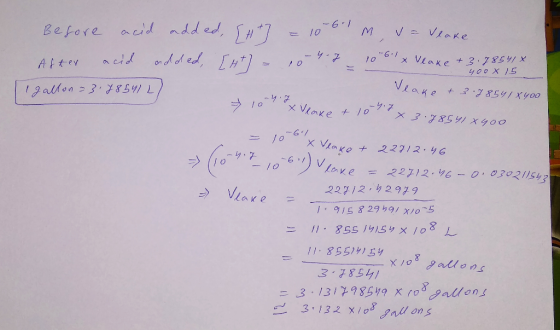
In a 1985 study of a lake in Minnesota, 400 gallons of 15 M nitric acid were added to the lake over 6 years. The initial pH (before acid added) was 6.1 and the final pH was 4.7. Assuming none of the acid was consumed in chemical reactions, estimate the volume of the lake (in gallons).
Homework Answers
Add Answer to:
In a 1985 study of a lake in Minnesota, 400 gallons of 15 M
nitric acid...
Analyte: Acetic Acid 0.1M (15 mL) & water (100 mL) Titrant: ammonia 0.1 M (15 mL)...
 Analyte: Acetic Acid 0.1M (15 mL) & water (100 mL) Titrant: ammonia 0.1 M (15 mL) Weak Acid: Initial Volume [ml] of itan 50 mL of ammonia Final Volume [mll of Titrant: A volume [ml] Elapsed time [s] Volume titrant/second Amount titrant added [ml] pH (measured) Weak Base: 0 mL of ammonia 50 mL of ammonia 180 seconds 0.28 mL/sec pH (calculated) 0.0 7.5 12 15 20 3.2 8.9 9.4 9.5 9.6 2 Volume at which indicator changed color: None
culate the molarity (M) of an unknown solution of hydrochlorie acid (HCT). This experiment similar to the one as done in the lab session.. The acid solution was titrated in a flask with a solutio...
 culate the molarity (M) of an unknown solution of hydrochlorie acid (HCT). This experiment similar to the one as done in the lab session.. The acid solution was titrated in a flask with a solution of NaOH added from the buret until the end point (light pink color in the flask) was seen. Followings are the data measured by a student. (3 points) Molarity (M) of NaOH (given) Volume of acid ( measured) in the flask Volume of NaOH required...
7) For the chemical reaction NH(aq) + HCl(aq) → NH"(aq) + Cl(aq) the acid and conjugate...
 7) For the chemical reaction NH(aq) + HCl(aq) → NH"(aq) + Cl(aq) the acid and conjugate base are a)NH(acid): NH" (conjugate base) b) NH, (acid), CT (conjugate base) c) HCl(acid); NH (conjugate base) d) HCl(acid), NH, (conjugate base) c) HCI (acid) Conjugate base) 8) A buffer solution is formed by adding 0.0100 moles of potassium dihydrogen phosphate (KH-PO.) and 0.0100 moles of potassium hydrogen phosphate (K_HPO) into 1.000 liters of water. When 0.0010 moles of NaOH is added to this...
A buffer solution is able to maintain a constant pH when small amounts of acid or...
 A buffer solution is able to maintain a constant pH when small amounts of acid or base are added to the buffer. Consider what happens when 1 mL of a 5 M solution is added or 0.005 mol of HCl are added to a 100.0 mL solution acetic acid buffer that contains 0.0100 mol of Acetic acid, HC,H,O,, and 0.0100 mol of sodium acetate, NaC,H,O,. The initial concentration of both the acid and the base are 0.0100 mol/ 0.1000 L...
It's a weak acid strong base titration Experiment 4: Identification of an unknown acid by titration...
 It's a weak acid strong base titration
Experiment 4: Identification of an unknown acid by titration Page 2 of 15 Background In this experiment, you will use both qualitative and quantitative properties to determine an unknown acid's identity and concentration. To do this analysis, you will perform a titration of your unknown acid sample-specifically a potentiometric titration where you use a pH meter and record pH values during the titration, combined with a visual titration using a color indi- cator...
It's a weak acid strong base titration
Experiment 4: Identification of an unknown acid by titration Page 2 of 15 Background In this experiment, you will use both qualitative and quantitative properties to determine an unknown acid's identity and concentration. To do this analysis, you will perform a titration of your unknown acid sample-specifically a potentiometric titration where you use a pH meter and record pH values during the titration, combined with a visual titration using a color indi- cator...
3. If 15.0 mL of 0.125 M phosphoric acid is titrated with 0.100 M NaOH, what...
 3. If 15.0 mL of 0.125 M phosphoric acid is titrated with 0.100 M NaOH, what volume of the titrant (in mL) must be added to completely neutralize the acid? Show all of your work (including the chemical equation). (1 point) Post-lab Questions: Experiment #9: Acid-Base Titrations Student Learning Objectives : Students will gain practice with the accurate preparation of solutions. Students will perform acid-base titrations and prepare titration curves. Students will identify strong and weak acids by the shapes...
7) A buffer solution is formed by adding 0.0100 moles of potassium dihydrogen phosphate (KH2PO4) and...
 7) A buffer solution is formed by adding 0.0100 moles of potassium dihydrogen phosphate (KH2PO4) and 0.0100 moles of potassium hydrogen phosphate (K_HPO4) into 1.000 liters of water. When 0.0010 moles of NaOH is added to this solution, what will happen? a) The pH of the solution will increase by a small amount (< 0.10 pH units) b) The pH of the solution will increase by a large amount > 0.10 pH units) c) The pH of the solution will...
Titration: Acids and Bases 2. How can you determine which acid is diprotic? 3. using the...
 Titration: Acids and Bases
2. How can you determine which acid is diprotic?
3. using the answers to questions one and two, which acid is
diprotic?
4. Which base has more hydroxide ions per molecule?
Acid Volume Base Base Initial Volume (mL) Base Final Volume (mL) Volume of Base Used (mL) Acid: Base Ratio Acid 1 20 mL Base 1 50 mL 34.5 15.5 4:3 Acid 2 20 mL Base 1 Acid 1 20 mL Base 2 Acid 2 20...
Titration: Acids and Bases
2. How can you determine which acid is diprotic?
3. using the answers to questions one and two, which acid is
diprotic?
4. Which base has more hydroxide ions per molecule?
Acid Volume Base Base Initial Volume (mL) Base Final Volume (mL) Volume of Base Used (mL) Acid: Base Ratio Acid 1 20 mL Base 1 50 mL 34.5 15.5 4:3 Acid 2 20 mL Base 1 Acid 1 20 mL Base 2 Acid 2 20...
15. The mixing of which pair of reactants will result in a precipitation reaction? CsI(aq)...
15. The mixing of which pair of reactants will result in a precipitation reaction? CsI(aq) + NaOH(aq) HCl(aq) + Ca(OH)2(aq) K2SO4(aq) + Hg2(NO3)2(aq) NaNO3(aq) + NH4Cl(aq) 16. Which of the following is a precipitation reaction? Zn(s) + 2 AgNO3(aq) 2 Ag(s) + Zn(NO3)2(aq) NaCl(aq) + LiI(aq) NaI(aq) + LiCl(aq) 2 KI(aq) + Hg2(NO3)2(aq) Hg2I2(s) + 2 KNO3(aq) HI(aq) + NaOH(aq) NaI(aq) + H2O(l) None of these are precipitation reactions. 17. Which...
EXP. 5 BUFFERS, TITRATION CURVES, AND INDICATORS STUDENT COPY DATA SHEET RECORD YOUR DATA HERE AS...
 EXP. 5 BUFFERS, TITRATION CURVES, AND INDICATORS STUDENT COPY DATA SHEET RECORD YOUR DATA HERE AS YOU DO THE EXPERIMENT You must record measurements to the correct number of decimal places, and with the appropriate units, for each piece of equipment used. Name of Partner: Not applicable Concentration of stock NaOH (from Exp. 3 Brown Bottle): 0.1135 M Part 1 - Titration Curves Make sure all pH readings have the appropriate number of decimal points pH of acetic acid: 3.29...
 Analyte: Acetic Acid 0.1M (15 mL) & water (100 mL) Titrant: ammonia 0.1 M (15 mL) Weak Acid: Initial Volume [ml] of itan 50 mL of ammonia Final Volume [mll of Titrant: A volume [ml] Elapsed time [s] Volume titrant/second Amount titrant added [ml] pH (measured) Weak Base: 0 mL of ammonia 50 mL of ammonia 180 seconds 0.28 mL/sec pH (calculated) 0.0 7.5 12 15 20 3.2 8.9 9.4 9.5 9.6 2 Volume at which indicator changed color: None
 culate the molarity (M) of an unknown solution of hydrochlorie acid (HCT). This experiment similar to the one as done in the lab session.. The acid solution was titrated in a flask with a solution of NaOH added from the buret until the end point (light pink color in the flask) was seen. Followings are the data measured by a student. (3 points) Molarity (M) of NaOH (given) Volume of acid ( measured) in the flask Volume of NaOH required...
 7) For the chemical reaction NH(aq) + HCl(aq) → NH"(aq) + Cl(aq) the acid and conjugate base are a)NH(acid): NH" (conjugate base) b) NH, (acid), CT (conjugate base) c) HCl(acid); NH (conjugate base) d) HCl(acid), NH, (conjugate base) c) HCI (acid) Conjugate base) 8) A buffer solution is formed by adding 0.0100 moles of potassium dihydrogen phosphate (KH-PO.) and 0.0100 moles of potassium hydrogen phosphate (K_HPO) into 1.000 liters of water. When 0.0010 moles of NaOH is added to this...
 A buffer solution is able to maintain a constant pH when small amounts of acid or base are added to the buffer. Consider what happens when 1 mL of a 5 M solution is added or 0.005 mol of HCl are added to a 100.0 mL solution acetic acid buffer that contains 0.0100 mol of Acetic acid, HC,H,O,, and 0.0100 mol of sodium acetate, NaC,H,O,. The initial concentration of both the acid and the base are 0.0100 mol/ 0.1000 L...
 It's a weak acid strong base titration
Experiment 4: Identification of an unknown acid by titration Page 2 of 15 Background In this experiment, you will use both qualitative and quantitative properties to determine an unknown acid's identity and concentration. To do this analysis, you will perform a titration of your unknown acid sample-specifically a potentiometric titration where you use a pH meter and record pH values during the titration, combined with a visual titration using a color indi- cator...
It's a weak acid strong base titration
Experiment 4: Identification of an unknown acid by titration Page 2 of 15 Background In this experiment, you will use both qualitative and quantitative properties to determine an unknown acid's identity and concentration. To do this analysis, you will perform a titration of your unknown acid sample-specifically a potentiometric titration where you use a pH meter and record pH values during the titration, combined with a visual titration using a color indi- cator...
 3. If 15.0 mL of 0.125 M phosphoric acid is titrated with 0.100 M NaOH, what volume of the titrant (in mL) must be added to completely neutralize the acid? Show all of your work (including the chemical equation). (1 point) Post-lab Questions: Experiment #9: Acid-Base Titrations Student Learning Objectives : Students will gain practice with the accurate preparation of solutions. Students will perform acid-base titrations and prepare titration curves. Students will identify strong and weak acids by the shapes...
 7) A buffer solution is formed by adding 0.0100 moles of potassium dihydrogen phosphate (KH2PO4) and 0.0100 moles of potassium hydrogen phosphate (K_HPO4) into 1.000 liters of water. When 0.0010 moles of NaOH is added to this solution, what will happen? a) The pH of the solution will increase by a small amount (< 0.10 pH units) b) The pH of the solution will increase by a large amount > 0.10 pH units) c) The pH of the solution will...
 Titration: Acids and Bases
2. How can you determine which acid is diprotic?
3. using the answers to questions one and two, which acid is
diprotic?
4. Which base has more hydroxide ions per molecule?
Acid Volume Base Base Initial Volume (mL) Base Final Volume (mL) Volume of Base Used (mL) Acid: Base Ratio Acid 1 20 mL Base 1 50 mL 34.5 15.5 4:3 Acid 2 20 mL Base 1 Acid 1 20 mL Base 2 Acid 2 20...
Titration: Acids and Bases
2. How can you determine which acid is diprotic?
3. using the answers to questions one and two, which acid is
diprotic?
4. Which base has more hydroxide ions per molecule?
Acid Volume Base Base Initial Volume (mL) Base Final Volume (mL) Volume of Base Used (mL) Acid: Base Ratio Acid 1 20 mL Base 1 50 mL 34.5 15.5 4:3 Acid 2 20 mL Base 1 Acid 1 20 mL Base 2 Acid 2 20...
 EXP. 5 BUFFERS, TITRATION CURVES, AND INDICATORS STUDENT COPY DATA SHEET RECORD YOUR DATA HERE AS YOU DO THE EXPERIMENT You must record measurements to the correct number of decimal places, and with the appropriate units, for each piece of equipment used. Name of Partner: Not applicable Concentration of stock NaOH (from Exp. 3 Brown Bottle): 0.1135 M Part 1 - Titration Curves Make sure all pH readings have the appropriate number of decimal points pH of acetic acid: 3.29...
Most questions answered within 3 hours.
-
Where is the error in this code sequence?
String s1 = "Hello";
String s2 = "ello";...
asked 11 months ago -
Financial data for Joel de Paris, Inc., for last year
follow:
Joel de Paris, Inc.
Balance...
asked 11 months ago -
Consider this reaction:
Al2(SO4)3 (aq)+ BaCl3
(aq) Al2Cl6 (aq)- +
3BaSO4(s) . What is the...
asked 11 months ago -
Suppose that Savneet is considering increasing her
recent random sample from 20 car rentals to 40...
asked 11 months ago -
Trucks arrive at an unloading terminal at an average rate of 120
per hour.
Trucks arrive...
asked 11 months ago -
Why are methanol and ethanol completely soluble in water while
octanol is not very little soluble....
asked 11 months ago -
A facilities manager at a university reads in a research report
that the mean amount of...
asked 11 months ago -
When the CuSO4 is rehydrated by adding water to the anhydrous
compound, is this an endothermic...
asked 11 months ago -
A ray of sunlight is passing from diamond into crown glass; the
angle of incidence is...
asked 11 months ago -
A block of mass 0.249 kg is placed on top of a light, vertical
spring of...
asked 11 months ago -
how do the kidneys compensate in the presences of acidosis
a) trigger hyperventilate
b) reserve acid...
asked 11 months ago -
Question 501 pts
The rental rate of capital to the firm increases. Which of the
following...
asked 11 months ago