Determine the sequence of a tetra peptide: 1)The second amino acid has a phenol in the...
Determine the sequence of a tetra peptide:
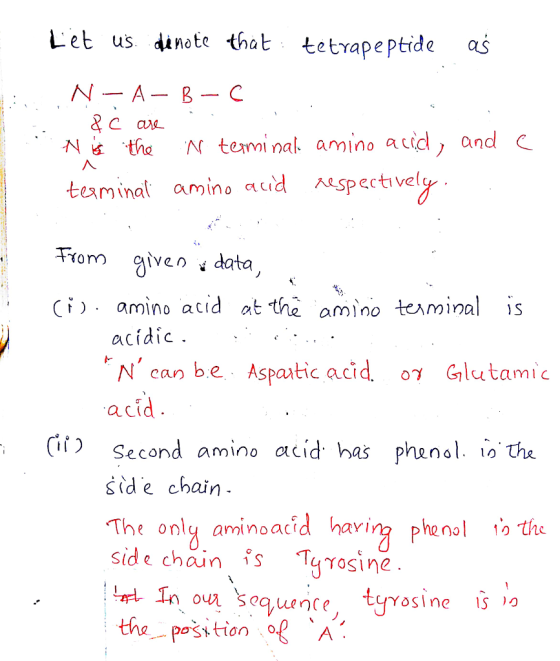
1)The second amino acid has a phenol in the side chain.
2)The amino acid at the amino terminal is acidic and the only acidic amino acid present.
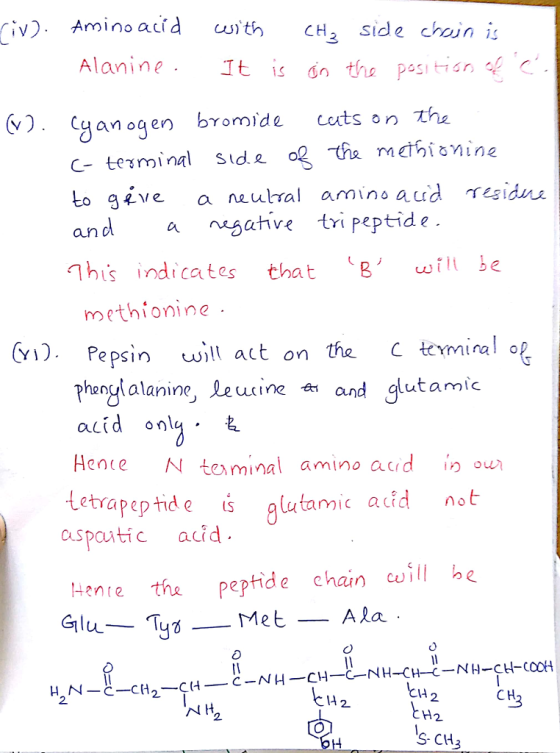
3)Amino acid with CH3 side chain at C terminal.
2)Pepsin - cuts on the C-terminal side of phenylalanine, leucine, and glutamic acid. When digested with the pepsin the peptide gives a negative amino acid residue and neutral tripeptide
3)Cyanogen bromide- cuts on the C-terminal side of the methionine.
When digested by cyanogen bromide it gives a neutral amino acid residue, and negative tripeptide.
Homework Answers
Add Answer to:
Determine the sequence of a tetra peptide:
1)The second amino acid has a phenol in the...
Sanger's reagent is used A) to determine the amino acid sequence of a peptide. B) to...
 Sanger's reagent is used A) to determine the amino acid sequence of a peptide. B) to determine the C-terminal amino acid of a peptide. C) to determine the isoelectric point of a peptide. D) to determine the number of amino acids in a peptide. E) to determine the N-terminal amino acid of a peptide. Ninhydrin is used A) to determine the N-terminal amino acid of a peptide. B) to sequence amino acids in a peptide. C) to detect amino acids...
1. Partial hydrolysis of lysozyme yielded an octapeptide that was later identified as the N-terminal segment of...
1. Partial hydrolysis of lysozyme yielded an octapeptide that was later identified as the N-terminal segment of the protein. From the following information, determine the sequence of this octapeptide. a. The following amino acids were identified after complete hydrolysis of the octapeptide: Arginine (Arg) Glycine (Gly) Phenylalanine (Phe) Cysteine (Cys) Leucine (Leu) Valine (Val) Glutamic Acid (Glu) Lysine (Lys) b. Treatment of the octapeptide with dinitroflurobenzene (Sanger reagent) followed by complete hydrolysis gave lysine (Lys) labeled with two dinitrophenyl (DNP) groups. c. Treatment of the octapeptide with trypsin gave lysine...
1. Partial hydrolysis of lysozyme yielded an octapeptide that was later identified as the N-terminal segment of...
1. Partial hydrolysis of lysozyme yielded an octapeptide that was later identified as the N-terminal segment of the protein. From the following information, determine the sequence of this octapeptide. a. The following amino acids were identified after complete hydrolysis of the octapeptide: Arginine (Arg) Glycine (Gly) Phenylalanine (Phe) Cysteine (Cys) Leucine (Leu) Valine (Val) Glutamic Acid (Glu) Lysine (Lys) b. Treatment of the octapeptide with dinitroflurobenzene (Sanger reagent) followed by complete hydrolysis gave lysine (Lys) labeled with two dinitrophenyl (DNP) groups. c. Treatment of the octapeptide with trypsin gave lysine...
Question 13 of 19 > Suppose Kara has isolated a peptide and must determine the amino...
 Question 13 of 19 > Suppose Kara has isolated a peptide and must determine the amino acid sequence. After one cycle of Edman degradation on a sample of the peptide, she produces a phenylthiohydantoin (PTH) derivative, OH Treatment with cyanogen bromide on another sample of her peptide gives her the fragments • Lys-Pro-Ala-Met, • Pro-Asp. • Leu-Ile-Cys-Trp-Met, and • Thr-Arg.Met. She also digested a sample of her peptide with the enzyme chymotrpsin. One of the fragments produced after treatment with...
A protein biochemist attempted to determine the amino acid sequence of a decapeptide. Use the results...
A protein biochemist attempted to determine the amino acid sequence of a decapeptide. Use the results from the trypsin, chymotrypsin, and cyanogen bromide treatments to suggest the amino acid sequence of this decapeptide. Trypsin digestion gave two fragments with the following residues (not in order): T1: Ala, Arg, Phe, Pro, Thr, Trp, Tyr T2: Lys, Met, Val Chymotrypsin digestion gave three fragments with the following residues (not in order): CT1: Ala, Phe CT2: Pro, Arg CT3: Thr, Trp CT4: Lys,...
1)Match the name of each amino acid with one of its characteristics. 2)has a hydroxy group...
1)Match the name of each amino acid with one of its characteristics. 2)has a hydroxy group its aromatic side chain 3)has a sulfur atom in its side chain that can form disulfide bonds its side chain is a nonpolar isopropyl group 4)it has the smallest acidic side chain 5)this amino acid has the smallest side chain of all, a hydrogen atom 6)its side chain is a methyl group its side chain of 3 carbons forms a 5-membered ring with the...
QUESTION 64 Which is the C-terminal amino acid in the following peptide? hranoud CHỊCH,, Hà A....
 QUESTION 64 Which is the C-terminal amino acid in the following peptide? hranoud CHỊCH,, Hà A. Glycine B. Phenylalanine C. Leucine OD. Valine
The one-letter sequence is: WATER a) Draw the peptide (R-groups trans), indicating charges, in pr...
 The one-letter sequence is: WATER
a) Draw the peptide (R-groups trans), indicating charges, in
predominant form found at pH = 0.
b) What is the isoelectric point?
c) What is the average charge on the population of peptide
macromolecules at pH = 2.2?
d) What is the average charge on the population of peptide
macromolecules at pH = 12.5?
TABLE 4.1 Amino Acid Alanine Arginine Asparagine Aspartic acid Cysteine....« Glutamic acid Glutamine Glycine Histidine Isoleucine Leucine Lysine … Methionine Phenylalanine...
The one-letter sequence is: WATER
a) Draw the peptide (R-groups trans), indicating charges, in
predominant form found at pH = 0.
b) What is the isoelectric point?
c) What is the average charge on the population of peptide
macromolecules at pH = 2.2?
d) What is the average charge on the population of peptide
macromolecules at pH = 12.5?
TABLE 4.1 Amino Acid Alanine Arginine Asparagine Aspartic acid Cysteine....« Glutamic acid Glutamine Glycine Histidine Isoleucine Leucine Lysine … Methionine Phenylalanine...
options There are peptide bonds in the molecule below. The N-terminal amino acid is Choose... The...
 options
There are peptide bonds in the molecule below. The N-terminal amino acid is Choose... The C-terminal amino acid is Choose... V NH3 NHE ОН 90- NH Choose... glycine alanine valine leucine isoleucine serine threonine cysteine methonine aspartate glutamate asparagine glutamine lysine arginine phenylalanine tyrosine proline histidine
options
There are peptide bonds in the molecule below. The N-terminal amino acid is Choose... The C-terminal amino acid is Choose... V NH3 NHE ОН 90- NH Choose... glycine alanine valine leucine isoleucine serine threonine cysteine methonine aspartate glutamate asparagine glutamine lysine arginine phenylalanine tyrosine proline histidine
There are peptide bonds in the molecule below. The N-terminal amino acid is Choose... The C-terminal...
 There are peptide bonds in the molecule below. The N-terminal amino acid is Choose... The C-terminal amino acid is Choose... V NH₃ NH₃ Air ОН 90- NH Choose... glycine alanine valine leucine isoleucine serine threonine cysteine methonine aspartate glutamate asparagine glutamine lysine arginine phenylalanine tyrosine proline histidine
 Sanger's reagent is used A) to determine the amino acid sequence of a peptide. B) to determine the C-terminal amino acid of a peptide. C) to determine the isoelectric point of a peptide. D) to determine the number of amino acids in a peptide. E) to determine the N-terminal amino acid of a peptide. Ninhydrin is used A) to determine the N-terminal amino acid of a peptide. B) to sequence amino acids in a peptide. C) to detect amino acids...
 Question 13 of 19 > Suppose Kara has isolated a peptide and must determine the amino acid sequence. After one cycle of Edman degradation on a sample of the peptide, she produces a phenylthiohydantoin (PTH) derivative, OH Treatment with cyanogen bromide on another sample of her peptide gives her the fragments • Lys-Pro-Ala-Met, • Pro-Asp. • Leu-Ile-Cys-Trp-Met, and • Thr-Arg.Met. She also digested a sample of her peptide with the enzyme chymotrpsin. One of the fragments produced after treatment with...
 QUESTION 64 Which is the C-terminal amino acid in the following peptide? hranoud CHỊCH,, Hà A. Glycine B. Phenylalanine C. Leucine OD. Valine
 The one-letter sequence is: WATER
a) Draw the peptide (R-groups trans), indicating charges, in
predominant form found at pH = 0.
b) What is the isoelectric point?
c) What is the average charge on the population of peptide
macromolecules at pH = 2.2?
d) What is the average charge on the population of peptide
macromolecules at pH = 12.5?
TABLE 4.1 Amino Acid Alanine Arginine Asparagine Aspartic acid Cysteine....« Glutamic acid Glutamine Glycine Histidine Isoleucine Leucine Lysine … Methionine Phenylalanine...
The one-letter sequence is: WATER
a) Draw the peptide (R-groups trans), indicating charges, in
predominant form found at pH = 0.
b) What is the isoelectric point?
c) What is the average charge on the population of peptide
macromolecules at pH = 2.2?
d) What is the average charge on the population of peptide
macromolecules at pH = 12.5?
TABLE 4.1 Amino Acid Alanine Arginine Asparagine Aspartic acid Cysteine....« Glutamic acid Glutamine Glycine Histidine Isoleucine Leucine Lysine … Methionine Phenylalanine...
 options
There are peptide bonds in the molecule below. The N-terminal amino acid is Choose... The C-terminal amino acid is Choose... V NH3 NHE ОН 90- NH Choose... glycine alanine valine leucine isoleucine serine threonine cysteine methonine aspartate glutamate asparagine glutamine lysine arginine phenylalanine tyrosine proline histidine
options
There are peptide bonds in the molecule below. The N-terminal amino acid is Choose... The C-terminal amino acid is Choose... V NH3 NHE ОН 90- NH Choose... glycine alanine valine leucine isoleucine serine threonine cysteine methonine aspartate glutamate asparagine glutamine lysine arginine phenylalanine tyrosine proline histidine
 There are peptide bonds in the molecule below. The N-terminal amino acid is Choose... The C-terminal amino acid is Choose... V NH₃ NH₃ Air ОН 90- NH Choose... glycine alanine valine leucine isoleucine serine threonine cysteine methonine aspartate glutamate asparagine glutamine lysine arginine phenylalanine tyrosine proline histidine
Most questions answered within 3 hours.
-
Where is the error in this code sequence?
String s1 = "Hello";
String s2 = "ello";...
asked 11 months ago -
Financial data for Joel de Paris, Inc., for last year
follow:
Joel de Paris, Inc.
Balance...
asked 11 months ago -
Consider this reaction:
Al2(SO4)3 (aq)+ BaCl3
(aq) Al2Cl6 (aq)- +
3BaSO4(s) . What is the...
asked 11 months ago -
Suppose that Savneet is considering increasing her
recent random sample from 20 car rentals to 40...
asked 11 months ago -
Trucks arrive at an unloading terminal at an average rate of 120
per hour.
Trucks arrive...
asked 11 months ago -
Why are methanol and ethanol completely soluble in water while
octanol is not very little soluble....
asked 11 months ago -
A facilities manager at a university reads in a research report
that the mean amount of...
asked 11 months ago -
When the CuSO4 is rehydrated by adding water to the anhydrous
compound, is this an endothermic...
asked 11 months ago -
A ray of sunlight is passing from diamond into crown glass; the
angle of incidence is...
asked 11 months ago -
A block of mass 0.249 kg is placed on top of a light, vertical
spring of...
asked 11 months ago -
how do the kidneys compensate in the presences of acidosis
a) trigger hyperventilate
b) reserve acid...
asked 11 months ago -
Question 501 pts
The rental rate of capital to the firm increases. Which of the
following...
asked 11 months ago