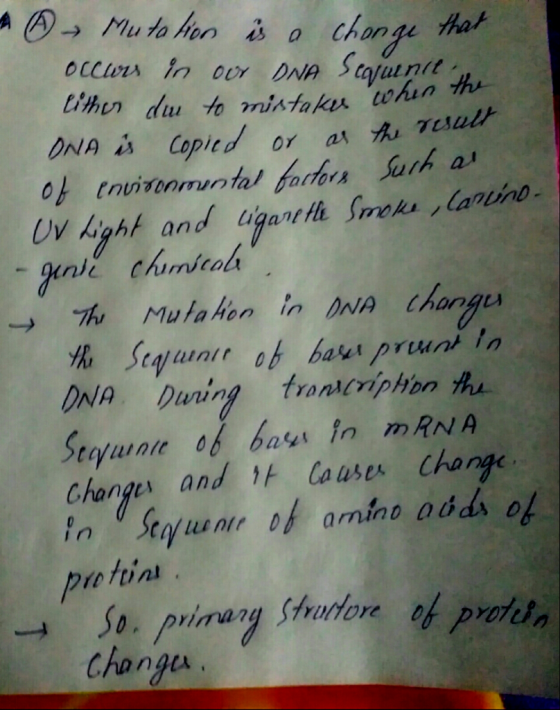
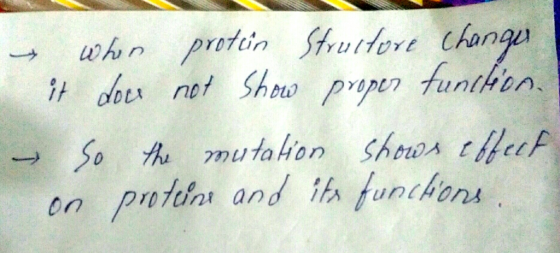
what is a mutation and why mutations can affect protein structure and function. Be very specific.
what is a mutation and why mutations can affect protein structure and function. Be very specific.
Homework Answers
Add Answer to:
what is a mutation and why mutations
can affect protein structure and
function. Be very specific.
(15 pts cach) Propose a specific hypothesis to predict whether the mutation will affect protein function....
 (15 pts cach) Propose a specific hypothesis to predict whether the mutation will affect protein function. Identify at least two things you know and two assumptions you are making that leads to that hypothesis. (Hint, don't use the phrase "protein function," in your hypotheses for A and B, be more specific) 2. A. Myoglobin has a conserved valine residue that helps to bind to the heme. A mutant myoglobin has an isoleucine in place of the valine. What effect will...
1. How can protein folding affect protein function? 2. How can amino acid sequence affect protein...
1. How can protein folding affect protein function? 2. How can amino acid sequence affect protein function? 3. How can an amino acid sequence (primary sequence) dictate 3D protein structure?
One way mutations can affect the phenotype is by altering the coding sequence of a gene...
One way mutations can affect the phenotype is by altering the coding sequence of a gene and therefore changing protein structure. Please describe two ways that mutations can affect the phenotype that does not include alteration of the protein coding sequence
If a population evolves a higher mutation rate, how will this affect evolution? A. More mutations...
If a population evolves a higher mutation rate, how will this affect evolution? A. More mutations will be available faster B. Selective sweeps will occur more quickly C.this will have no effect on evolution D. If the population size is very large, the mutation rate has no effect on mutation supply
Mutations in the exons of eukaryotic genes can result in changes in the translated protein. Nonexonic...
 Mutations in the exons of eukaryotic genes can result in changes in the translated protein. Nonexonic mutations, mutations in regions of a gene outside of the exons, can also alter the rate of transcription and the final protein. In which of the following situations would nonexonic mutations either affect expression of the gene or alter the structure of the final protein? Select all of the statements that apply.
please help 6. How can a missense mutation-such as in sickle cell disease-result in a protein...
 please help
6. How can a missense mutation-such as in sickle cell disease-result in a protein that has an abnormal structure? Some of these mutations are lethal or cause serious disease, such as cystic fibrosis and sickle cell disease. Many of these point mutations that cause genetic disorders occur as a result of errors in DNA replication or crossing over. 7. What will be the consequence if a single base is deleted from the coding region of a gene?
please help
6. How can a missense mutation-such as in sickle cell disease-result in a protein that has an abnormal structure? Some of these mutations are lethal or cause serious disease, such as cystic fibrosis and sickle cell disease. Many of these point mutations that cause genetic disorders occur as a result of errors in DNA replication or crossing over. 7. What will be the consequence if a single base is deleted from the coding region of a gene?
3. Mutations in bacteria that affect gene regulation may have a cis- or trans-effect on the...
3. Mutations in bacteria that affect gene regulation may have a cis- or trans-effect on the expression of the protein-encoding genes in an operon? How would the following mutations affect the expression of the lac operon? Assume there could be more than one lac operon in the cell and that no glucose is present. A. A mutation in the operator site that prevents the lac repressor from binding. B. A mutation in the lacI gene that prevents allolactose from binding,...
A mutation in the gene for a particular protein gives rise to the disease osteogenesis imperfecta....
A mutation in the gene for a particular protein gives rise to the disease osteogenesis imperfecta. Answer (and explain) the following five questions in one sentence each. What is the name of the protein? What is the mutation in this protein? Describe the structure of this protein. Why does this mutation disrupt the structure of the protein? Will taking extra Vitamin C help cure osteogeneis imperfect? Why or why not?
1. How would a mutation in the poly(A)-binding protein gene affect translation? How would an electron...
1. How would a mutation in the poly(A)-binding protein gene affect translation? How would an electron micrograph of polyribosomes from such a mutant differ from the normal pattern? 2. Eukaryotes have repair systems that prevent mutations due to copying errors and exposure to mutagens. What are the three excision-repair systems found in eukaryotes, and which one is responsible for correcting thymine-thymine dimers that form as a result of UV light damage to DNA? 3. What is the name given to...
Student A believes that a missense mutation would lead to a nonfunctioning protein. Student B believes...
Student A believes that a missense mutation would lead to a nonfunctioning protein. Student B believes that the insertion of 3 nucleotides would be more likely to lead to a nonfunctioning protein. Student C disagrees with both student A and B claiming that such mutations would not alter the function of the protein. WHos perspective is the most correct and why?
 (15 pts cach) Propose a specific hypothesis to predict whether the mutation will affect protein function. Identify at least two things you know and two assumptions you are making that leads to that hypothesis. (Hint, don't use the phrase "protein function," in your hypotheses for A and B, be more specific) 2. A. Myoglobin has a conserved valine residue that helps to bind to the heme. A mutant myoglobin has an isoleucine in place of the valine. What effect will...
 Mutations in the exons of eukaryotic genes can result in changes in the translated protein. Nonexonic mutations, mutations in regions of a gene outside of the exons, can also alter the rate of transcription and the final protein. In which of the following situations would nonexonic mutations either affect expression of the gene or alter the structure of the final protein? Select all of the statements that apply.
 please help
6. How can a missense mutation-such as in sickle cell disease-result in a protein that has an abnormal structure? Some of these mutations are lethal or cause serious disease, such as cystic fibrosis and sickle cell disease. Many of these point mutations that cause genetic disorders occur as a result of errors in DNA replication or crossing over. 7. What will be the consequence if a single base is deleted from the coding region of a gene?
please help
6. How can a missense mutation-such as in sickle cell disease-result in a protein that has an abnormal structure? Some of these mutations are lethal or cause serious disease, such as cystic fibrosis and sickle cell disease. Many of these point mutations that cause genetic disorders occur as a result of errors in DNA replication or crossing over. 7. What will be the consequence if a single base is deleted from the coding region of a gene?
Most questions answered within 3 hours.
-
Where is the error in this code sequence?
String s1 = "Hello";
String s2 = "ello";...
asked 10 months ago -
Financial data for Joel de Paris, Inc., for last year
follow:
Joel de Paris, Inc.
Balance...
asked 10 months ago -
Consider this reaction:
Al2(SO4)3 (aq)+ BaCl3
(aq) Al2Cl6 (aq)- +
3BaSO4(s) . What is the...
asked 10 months ago -
Suppose that Savneet is considering increasing her
recent random sample from 20 car rentals to 40...
asked 10 months ago -
Trucks arrive at an unloading terminal at an average rate of 120
per hour.
Trucks arrive...
asked 10 months ago -
Why are methanol and ethanol completely soluble in water while
octanol is not very little soluble....
asked 10 months ago -
A facilities manager at a university reads in a research report
that the mean amount of...
asked 10 months ago -
When the CuSO4 is rehydrated by adding water to the anhydrous
compound, is this an endothermic...
asked 10 months ago -
A ray of sunlight is passing from diamond into crown glass; the
angle of incidence is...
asked 10 months ago -
A block of mass 0.249 kg is placed on top of a light, vertical
spring of...
asked 10 months ago -
how do the kidneys compensate in the presences of acidosis
a) trigger hyperventilate
b) reserve acid...
asked 10 months ago -
Question 501 pts
The rental rate of capital to the firm increases. Which of the
following...
asked 10 months ago