
Homework Answers
ans)
The reaction is
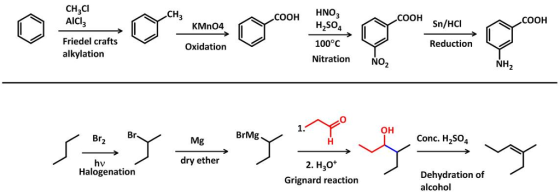
Add Answer to:
alcohols and phenol be present
(g) Friedel-Craft's acylation esis: 5. Outline the steps for the following...
Outline all steps in a possible laboratory synthesis of each of the following from bromobenzene and...
 Outline all steps in a possible laboratory synthesis of each
of the following from bromobenzene and alcohols of four carbons or
less...
Outline all steps in a possible laboratory synthesis of each of the following from bromobenzene and alcohols of four carbons or less 2,3-dimethyl-2-butanol 2-phenyl-2-propanol
Outline all steps in a possible laboratory synthesis of each
of the following from bromobenzene and alcohols of four carbons or
less...
Outline all steps in a possible laboratory synthesis of each of the following from bromobenzene and alcohols of four carbons or less 2,3-dimethyl-2-butanol 2-phenyl-2-propanol
3) Draw resonance diagrams to explain why phenol has a pka pf 10 whereas aliphatic alcohols...
 3) Draw resonance diagrams to explain why phenol has a pka pf 10 whereas aliphatic alcohols like ethanol have a pka of 16. 4) Why are aldehydes generally more reactive towards nucleophilic attack than ketones? 5) Suggest possible steps involved in the synthesis of the following compound starting propene. Note for each step involved your desired product must be a major product. Also note the two arrows indicate an unknown number of steps are involved.
Show how you would synthesize each compound from benzene, toluene, or phenol using the following reactions:...
 Show how you would synthesize each compound from benzene, toluene, or phenol using the following reactions: Reactions 1. Halogenation 2. Nitration 3. Sulfonation 4. Friedel-Crafts acylation 5. Friedel-Crafts alkylation 6. Oxidation of methyl group 7. Reduction of nitro group • Choose the starting material from the drop-down list • Enter the number(s) of the desired reactions in the order that you wish to use them without commas between • If a reaction is used more than once, enter its number...
Chern 204-PSI, 6 . Friedel Crafts Acylation of an Unknown Benzene Compound (One weck lab The...
 Chern 204-PSI, 6 . Friedel Crafts Acylation of an Unknown Benzene Compound (One weck lab The Intent of this Lab To acetylate an unknown benzene compound via a Friedel-Crafts acylation and use spectroscopic techniques to determine the acetophenone derivative's identity Introduction The Friedel-Crafts reaction dates back to before 1900 and it is still widely used today. The active electrophilic agent (an acylium ion) is classically prepared and reacts very quickly. Another appealing feature of this reaction is that the acylated...
Use the following data construct a phase diagram of the phenol-water systen Phenol layer 5. t/oc...
 Use the following data construct a phase diagram of the phenol-water systen Phenol layer 5. t/oc 20 25 30 35 40 45 50 Aq. Layer 8.4 8.71 8.92 9.34 9.78 10.62 12.08 13.88 17.10 22.26 35.90 72.24 71.38 69.95 68.28 66.81 65.02 62.83 60.18 56.10 49.34 35.90 60 65 68.8 a) b) c) What will be the compositions of the layers formed from a solution of 30 g phenol and 70 g water maintained at 30°C A solution of 20...
1.Friedel-Crafts acylation of ortho-nitrotoluene with acetyl chloride and aluminum trichloride gives: A.a mixture of acetophenones with...
1.Friedel-Crafts acylation of ortho-nitrotoluene with acetyl chloride and aluminum trichloride gives: A.a mixture of acetophenones with the nitro group always ortho or para to the carbonyl. B.almost exclusively a single product, 3-nitro-4-methyl-acetophenone. C.2-methyl-acetophenone by nitro group displacement. D.no reaction since the nitro group is so deactivating. 2.You decide to make meta-nitrophenol by doing which of the following steps? A.Reacting phenol with fuming nitric acid in an ice bath. B.Reacting benzene with fuming nitric acid, then reacting the product with chlorine/iron,...
Please show steps and explain (8) 5. Prepare the following compounds using nucleophilic substitution and eliminations....
 Please show steps and explain
(8) 5. Prepare the following compounds using nucleophilic substitution and eliminations. Start with alkyl halides, alcohols, thiols, etc., and inorganics. Any common solvent is allowed. a) CH NH2 b) CH, CHCH 0-CH, CH
Please show steps and explain
(8) 5. Prepare the following compounds using nucleophilic substitution and eliminations. Start with alkyl halides, alcohols, thiols, etc., and inorganics. Any common solvent is allowed. a) CH NH2 b) CH, CHCH 0-CH, CH
in FRIEDEL-CRAFTS ACYLATION AND COLUMN CHROMATOGRAPHY lab (2 pts) Amount of acetyl chloride used ____4______(drops) (each...
 in FRIEDEL-CRAFTS ACYLATION AND COLUMN CHROMATOGRAPHY lab
(2 pts) Amount of acetyl chloride used ____4______(drops) (each
drop is 0.01 mL) _____2______(equivalents) Based on the amount of
ferrocene you began the Friedel-Crafts reaction with, determine the
percent yield of acetylferrocene, diacetylferrocene, and the
percent recovery of unreacted ferrocene (show work)
react by 0.100 g of ferrocene at beginning
got 0 g of ferrocene, 0.012g of diacetylferrocene , 0.017g of
acetylferrocene
REACTION PROCEDURE: To a 5 mL conical vial, add a spin...
in FRIEDEL-CRAFTS ACYLATION AND COLUMN CHROMATOGRAPHY lab
(2 pts) Amount of acetyl chloride used ____4______(drops) (each
drop is 0.01 mL) _____2______(equivalents) Based on the amount of
ferrocene you began the Friedel-Crafts reaction with, determine the
percent yield of acetylferrocene, diacetylferrocene, and the
percent recovery of unreacted ferrocene (show work)
react by 0.100 g of ferrocene at beginning
got 0 g of ferrocene, 0.012g of diacetylferrocene , 0.017g of
acetylferrocene
REACTION PROCEDURE: To a 5 mL conical vial, add a spin...
The following synthesis is done in 3 steps. 1. The selective oxidation of alcohols. 2. Aromatic...
 The following synthesis is done in 3 steps.
1. The selective oxidation of alcohols.
2. Aromatic Grignard
3. Carbon-Carbon coupling.
Perform stoichiometric calculations to obtain 1 ml of
the final product, using the concept of limit reagent in the
synthesis of geranial and phenylmagnesium bromide. assuming 100%
yield.
The complete equations of the synthesis of geranial and
grignard reagent are shown below. (They are needed to calculate the
final 1 ml of product of the reaction above)
Density of Final...
The following synthesis is done in 3 steps.
1. The selective oxidation of alcohols.
2. Aromatic Grignard
3. Carbon-Carbon coupling.
Perform stoichiometric calculations to obtain 1 ml of
the final product, using the concept of limit reagent in the
synthesis of geranial and phenylmagnesium bromide. assuming 100%
yield.
The complete equations of the synthesis of geranial and
grignard reagent are shown below. (They are needed to calculate the
final 1 ml of product of the reaction above)
Density of Final...
The following synthesis is done in 3 steps. 1. The selective oxidation of alcohols. 2. Aromatic...
 The following synthesis is done in 3 steps.
1. The selective oxidation of alcohols.
2. Aromatic Grignard
3. Carbon-Carbon coupling.
Perform stoichiometric calculations to obtain 1 ml of
the final product, using the concept of limit reagent in the
synthesis of geranial and phenylmagnesium bromide. assuming 100%
yield.
The complete equations of the synthesis of geranial and
grignard reagent are shown below. (They are needed to calculate the
final 1 ml of product of the reaction above)
Density of Final...
The following synthesis is done in 3 steps.
1. The selective oxidation of alcohols.
2. Aromatic Grignard
3. Carbon-Carbon coupling.
Perform stoichiometric calculations to obtain 1 ml of
the final product, using the concept of limit reagent in the
synthesis of geranial and phenylmagnesium bromide. assuming 100%
yield.
The complete equations of the synthesis of geranial and
grignard reagent are shown below. (They are needed to calculate the
final 1 ml of product of the reaction above)
Density of Final...
 Outline all steps in a possible laboratory synthesis of each
of the following from bromobenzene and alcohols of four carbons or
less...
Outline all steps in a possible laboratory synthesis of each of the following from bromobenzene and alcohols of four carbons or less 2,3-dimethyl-2-butanol 2-phenyl-2-propanol
Outline all steps in a possible laboratory synthesis of each
of the following from bromobenzene and alcohols of four carbons or
less...
Outline all steps in a possible laboratory synthesis of each of the following from bromobenzene and alcohols of four carbons or less 2,3-dimethyl-2-butanol 2-phenyl-2-propanol
 3) Draw resonance diagrams to explain why phenol has a pka pf 10 whereas aliphatic alcohols like ethanol have a pka of 16. 4) Why are aldehydes generally more reactive towards nucleophilic attack than ketones? 5) Suggest possible steps involved in the synthesis of the following compound starting propene. Note for each step involved your desired product must be a major product. Also note the two arrows indicate an unknown number of steps are involved.
 Show how you would synthesize each compound from benzene, toluene, or phenol using the following reactions: Reactions 1. Halogenation 2. Nitration 3. Sulfonation 4. Friedel-Crafts acylation 5. Friedel-Crafts alkylation 6. Oxidation of methyl group 7. Reduction of nitro group • Choose the starting material from the drop-down list • Enter the number(s) of the desired reactions in the order that you wish to use them without commas between • If a reaction is used more than once, enter its number...
 Chern 204-PSI, 6 . Friedel Crafts Acylation of an Unknown Benzene Compound (One weck lab The Intent of this Lab To acetylate an unknown benzene compound via a Friedel-Crafts acylation and use spectroscopic techniques to determine the acetophenone derivative's identity Introduction The Friedel-Crafts reaction dates back to before 1900 and it is still widely used today. The active electrophilic agent (an acylium ion) is classically prepared and reacts very quickly. Another appealing feature of this reaction is that the acylated...
 Use the following data construct a phase diagram of the phenol-water systen Phenol layer 5. t/oc 20 25 30 35 40 45 50 Aq. Layer 8.4 8.71 8.92 9.34 9.78 10.62 12.08 13.88 17.10 22.26 35.90 72.24 71.38 69.95 68.28 66.81 65.02 62.83 60.18 56.10 49.34 35.90 60 65 68.8 a) b) c) What will be the compositions of the layers formed from a solution of 30 g phenol and 70 g water maintained at 30°C A solution of 20...
 Please show steps and explain
(8) 5. Prepare the following compounds using nucleophilic substitution and eliminations. Start with alkyl halides, alcohols, thiols, etc., and inorganics. Any common solvent is allowed. a) CH NH2 b) CH, CHCH 0-CH, CH
Please show steps and explain
(8) 5. Prepare the following compounds using nucleophilic substitution and eliminations. Start with alkyl halides, alcohols, thiols, etc., and inorganics. Any common solvent is allowed. a) CH NH2 b) CH, CHCH 0-CH, CH
 in FRIEDEL-CRAFTS ACYLATION AND COLUMN CHROMATOGRAPHY lab
(2 pts) Amount of acetyl chloride used ____4______(drops) (each
drop is 0.01 mL) _____2______(equivalents) Based on the amount of
ferrocene you began the Friedel-Crafts reaction with, determine the
percent yield of acetylferrocene, diacetylferrocene, and the
percent recovery of unreacted ferrocene (show work)
react by 0.100 g of ferrocene at beginning
got 0 g of ferrocene, 0.012g of diacetylferrocene , 0.017g of
acetylferrocene
REACTION PROCEDURE: To a 5 mL conical vial, add a spin...
in FRIEDEL-CRAFTS ACYLATION AND COLUMN CHROMATOGRAPHY lab
(2 pts) Amount of acetyl chloride used ____4______(drops) (each
drop is 0.01 mL) _____2______(equivalents) Based on the amount of
ferrocene you began the Friedel-Crafts reaction with, determine the
percent yield of acetylferrocene, diacetylferrocene, and the
percent recovery of unreacted ferrocene (show work)
react by 0.100 g of ferrocene at beginning
got 0 g of ferrocene, 0.012g of diacetylferrocene , 0.017g of
acetylferrocene
REACTION PROCEDURE: To a 5 mL conical vial, add a spin...
 The following synthesis is done in 3 steps.
1. The selective oxidation of alcohols.
2. Aromatic Grignard
3. Carbon-Carbon coupling.
Perform stoichiometric calculations to obtain 1 ml of
the final product, using the concept of limit reagent in the
synthesis of geranial and phenylmagnesium bromide. assuming 100%
yield.
The complete equations of the synthesis of geranial and
grignard reagent are shown below. (They are needed to calculate the
final 1 ml of product of the reaction above)
Density of Final...
The following synthesis is done in 3 steps.
1. The selective oxidation of alcohols.
2. Aromatic Grignard
3. Carbon-Carbon coupling.
Perform stoichiometric calculations to obtain 1 ml of
the final product, using the concept of limit reagent in the
synthesis of geranial and phenylmagnesium bromide. assuming 100%
yield.
The complete equations of the synthesis of geranial and
grignard reagent are shown below. (They are needed to calculate the
final 1 ml of product of the reaction above)
Density of Final...
 The following synthesis is done in 3 steps.
1. The selective oxidation of alcohols.
2. Aromatic Grignard
3. Carbon-Carbon coupling.
Perform stoichiometric calculations to obtain 1 ml of
the final product, using the concept of limit reagent in the
synthesis of geranial and phenylmagnesium bromide. assuming 100%
yield.
The complete equations of the synthesis of geranial and
grignard reagent are shown below. (They are needed to calculate the
final 1 ml of product of the reaction above)
Density of Final...
The following synthesis is done in 3 steps.
1. The selective oxidation of alcohols.
2. Aromatic Grignard
3. Carbon-Carbon coupling.
Perform stoichiometric calculations to obtain 1 ml of
the final product, using the concept of limit reagent in the
synthesis of geranial and phenylmagnesium bromide. assuming 100%
yield.
The complete equations of the synthesis of geranial and
grignard reagent are shown below. (They are needed to calculate the
final 1 ml of product of the reaction above)
Density of Final...
Most questions answered within 3 hours.
-
Where is the error in this code sequence?
String s1 = "Hello";
String s2 = "ello";...
asked 11 months ago -
Financial data for Joel de Paris, Inc., for last year
follow:
Joel de Paris, Inc.
Balance...
asked 11 months ago -
Consider this reaction:
Al2(SO4)3 (aq)+ BaCl3
(aq) Al2Cl6 (aq)- +
3BaSO4(s) . What is the...
asked 11 months ago -
Suppose that Savneet is considering increasing her
recent random sample from 20 car rentals to 40...
asked 11 months ago -
Trucks arrive at an unloading terminal at an average rate of 120
per hour.
Trucks arrive...
asked 11 months ago -
Why are methanol and ethanol completely soluble in water while
octanol is not very little soluble....
asked 11 months ago -
A facilities manager at a university reads in a research report
that the mean amount of...
asked 11 months ago -
When the CuSO4 is rehydrated by adding water to the anhydrous
compound, is this an endothermic...
asked 11 months ago -
A ray of sunlight is passing from diamond into crown glass; the
angle of incidence is...
asked 11 months ago -
A block of mass 0.249 kg is placed on top of a light, vertical
spring of...
asked 11 months ago -
how do the kidneys compensate in the presences of acidosis
a) trigger hyperventilate
b) reserve acid...
asked 11 months ago -
Question 501 pts
The rental rate of capital to the firm increases. Which of the
following...
asked 11 months ago