
Homework Answers
Add Answer to:
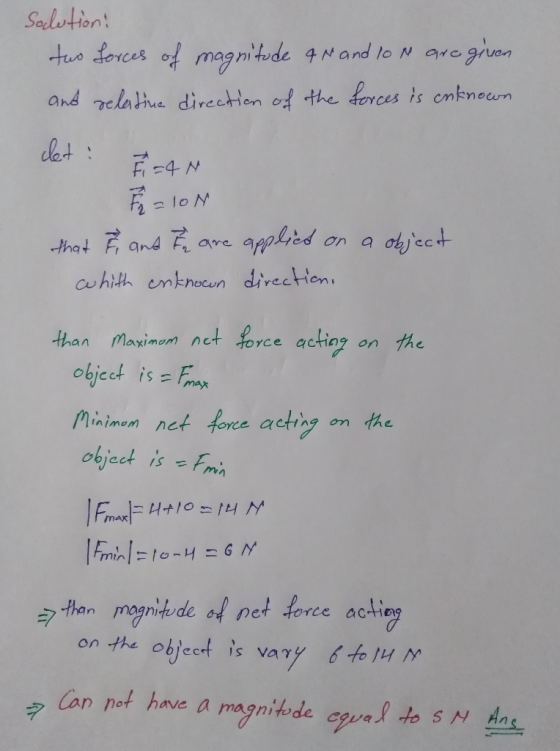
Two forces of magide 4 Nad 10 N are applied to an object. The relative direction...
Two forces are acting on an object F1: 13 N 57.5o F2: 23.5 N 12.3o Which...
Two forces are acting on an object F1: 13 N 57.5o F2: 23.5 N 12.3o Which of the following statements are true? Why? (select all that apply) A. The object could remain stationary B. The object could move with constant velocity C.The object would experience a net force D.The object would accelerate Suppose F1 in the problem above was rotated so that it pointed in exactly the opposite direction as F2. Assume F2 is unchanged in direction, and assume both...
Only two forces act on an object (mass = 4.30 kg), as in the drawing. (F...
 Only two forces act on an object (mass = 4.30 kg), as in the
drawing. (F = 74.0 N.) Find the magnitude and direction
(relative to the x axis) of the acceleration of the
object.
Only two forces act on an object (mass = 4.30 kg), as in the drawing. (F = 74.0 N.) Find the magnitude and direction (relative to the x axis) of the acceleration of the object. magnitude 17.36 1x m/s2 direction o counterclockwise from the +x...
Only two forces act on an object (mass = 4.30 kg), as in the
drawing. (F = 74.0 N.) Find the magnitude and direction
(relative to the x axis) of the acceleration of the
object.
Only two forces act on an object (mass = 4.30 kg), as in the drawing. (F = 74.0 N.) Find the magnitude and direction (relative to the x axis) of the acceleration of the object. magnitude 17.36 1x m/s2 direction o counterclockwise from the +x...
Only two forces act on an object (mass = 6.93 kg), as in the drawing. Find...
 Only two forces act on an object (mass = 6.93 kg), as in the
drawing. Find the (a) magnitude and (b) direction (relative to the
x axis) of the acceleration of the object.
Only two forces act on an object (mass = 6.93 kg), as in the drawing. Find the (a) magnitude and (b) direction (relative to the x axis) of the acceleration of the object. 60.0N - Ex 40.0 N (a) Number Units Units (b) Number
Only two forces act on an object (mass = 6.93 kg), as in the
drawing. Find the (a) magnitude and (b) direction (relative to the
x axis) of the acceleration of the object.
Only two forces act on an object (mass = 6.93 kg), as in the drawing. Find the (a) magnitude and (b) direction (relative to the x axis) of the acceleration of the object. 60.0N - Ex 40.0 N (a) Number Units Units (b) Number
Only two forces act on an object (mass=5.75 kg). As seen in the picture. Find the...
 Only two forces act on an object (mass=5.75 kg). As seen in the
picture. Find the a. magnitude and b. direction relative to the x
acis of the acceleration of the object.
magnit and (b) direction 60.0 N + 40.0 N
Only two forces act on an object (mass=5.75 kg). As seen in the
picture. Find the a. magnitude and b. direction relative to the x
acis of the acceleration of the object.
magnit and (b) direction 60.0 N + 40.0 N
Two forces of 200 N each are applied to an object, such that they are at...
 Two forces of 200 N each are applied to an object, such that they are at 140 degree from each other. what is the magnitude of the third force necessary to keep the object stationary? A satellite in a stable circular orbit around the Earth, travelling at 2.3 Times 10^2 km above the ocean has a period of The planet Venus has a period of 225 days in its orbit around the sun. The mean radius of its orbit is:...
Two forces of magnitude 10 newtons (N) and 40 N act on an object at angles...
 Two forces of magnitude 10 newtons (N) and 40 N act on an object at angles of 30° and -45° with the positive x-axis as shown in the figure. Find the direction and magnitude of the resultant force; that is, find F, +F2. F|-10N 30 45 0 1F21-40N FyF2-DI (Simplify your answer, including any radicals. Use integers or fractions for any numbers in the expression.) Enter your answer in each of the answer boxes.
The magnitude and direction of two forces acting on an object are 80 pounds. S50 degrees...
 The magnitude and direction of two forces acting on an object
are 80 pounds. S50 degrees E, and 110 pounds, N76 degrees
E,respectively. Find the magnitude, to the nearest hundredth of a
pound
The magnitude and direction of two forces acting on an object are 80 pounds, 550°E, and 110 pounds, N76°E, respectively the nearest tenth of a degree of the resultant force. The magnitude is approximately 169.83 pounds (Do not round until the final answer. Then found to the...
The magnitude and direction of two forces acting on an object
are 80 pounds. S50 degrees E, and 110 pounds, N76 degrees
E,respectively. Find the magnitude, to the nearest hundredth of a
pound
The magnitude and direction of two forces acting on an object are 80 pounds, 550°E, and 110 pounds, N76°E, respectively the nearest tenth of a degree of the resultant force. The magnitude is approximately 169.83 pounds (Do not round until the final answer. Then found to the...
Two forces act on an object. The first force has a magnitude of 10.0 N and...
Two forces act on an object. The first force has a magnitude of 10.0 N and is directed in the positive x-direction. The second force has a magnitude of 15.0 N and is directed in the positive y-direction. What is the magnitude and direction of the resultant force?
Only two forces act on an object (mass=4.92 kg), as in the drawing. Find (a) the...
 Only two forces act on an object (mass=4.92 kg), as in the drawing. Find (a) the magnitude and (b) the direction (relative to the x axis) of the acceleration of the object. +V 145.0 60.0 N - - +X 40.0 N (a) Number Units (b) Number Units
Two forces equal in magnitude and opposite in direction, acting on an object at two different...
 Two forces equal in magnitude and opposite in direction, acting on an object at two different points, form what is called a couple. Two antiparallel forces with equal magnitudes_1 = F_2 =7.90 N are applied to a rod as shown in the figure (Figure1). What should the distance l between the forces be if they are to provide a net torque of 5.20 N m about the left end of the rod? Is the sense of this torque clockwise or...
 Only two forces act on an object (mass = 4.30 kg), as in the
drawing. (F = 74.0 N.) Find the magnitude and direction
(relative to the x axis) of the acceleration of the
object.
Only two forces act on an object (mass = 4.30 kg), as in the drawing. (F = 74.0 N.) Find the magnitude and direction (relative to the x axis) of the acceleration of the object. magnitude 17.36 1x m/s2 direction o counterclockwise from the +x...
Only two forces act on an object (mass = 4.30 kg), as in the
drawing. (F = 74.0 N.) Find the magnitude and direction
(relative to the x axis) of the acceleration of the
object.
Only two forces act on an object (mass = 4.30 kg), as in the drawing. (F = 74.0 N.) Find the magnitude and direction (relative to the x axis) of the acceleration of the object. magnitude 17.36 1x m/s2 direction o counterclockwise from the +x...
 Only two forces act on an object (mass = 6.93 kg), as in the
drawing. Find the (a) magnitude and (b) direction (relative to the
x axis) of the acceleration of the object.
Only two forces act on an object (mass = 6.93 kg), as in the drawing. Find the (a) magnitude and (b) direction (relative to the x axis) of the acceleration of the object. 60.0N - Ex 40.0 N (a) Number Units Units (b) Number
Only two forces act on an object (mass = 6.93 kg), as in the
drawing. Find the (a) magnitude and (b) direction (relative to the
x axis) of the acceleration of the object.
Only two forces act on an object (mass = 6.93 kg), as in the drawing. Find the (a) magnitude and (b) direction (relative to the x axis) of the acceleration of the object. 60.0N - Ex 40.0 N (a) Number Units Units (b) Number
 Only two forces act on an object (mass=5.75 kg). As seen in the
picture. Find the a. magnitude and b. direction relative to the x
acis of the acceleration of the object.
magnit and (b) direction 60.0 N + 40.0 N
Only two forces act on an object (mass=5.75 kg). As seen in the
picture. Find the a. magnitude and b. direction relative to the x
acis of the acceleration of the object.
magnit and (b) direction 60.0 N + 40.0 N
 Two forces of 200 N each are applied to an object, such that they are at 140 degree from each other. what is the magnitude of the third force necessary to keep the object stationary? A satellite in a stable circular orbit around the Earth, travelling at 2.3 Times 10^2 km above the ocean has a period of The planet Venus has a period of 225 days in its orbit around the sun. The mean radius of its orbit is:...
 Two forces of magnitude 10 newtons (N) and 40 N act on an object at angles of 30° and -45° with the positive x-axis as shown in the figure. Find the direction and magnitude of the resultant force; that is, find F, +F2. F|-10N 30 45 0 1F21-40N FyF2-DI (Simplify your answer, including any radicals. Use integers or fractions for any numbers in the expression.) Enter your answer in each of the answer boxes.
 The magnitude and direction of two forces acting on an object
are 80 pounds. S50 degrees E, and 110 pounds, N76 degrees
E,respectively. Find the magnitude, to the nearest hundredth of a
pound
The magnitude and direction of two forces acting on an object are 80 pounds, 550°E, and 110 pounds, N76°E, respectively the nearest tenth of a degree of the resultant force. The magnitude is approximately 169.83 pounds (Do not round until the final answer. Then found to the...
The magnitude and direction of two forces acting on an object
are 80 pounds. S50 degrees E, and 110 pounds, N76 degrees
E,respectively. Find the magnitude, to the nearest hundredth of a
pound
The magnitude and direction of two forces acting on an object are 80 pounds, 550°E, and 110 pounds, N76°E, respectively the nearest tenth of a degree of the resultant force. The magnitude is approximately 169.83 pounds (Do not round until the final answer. Then found to the...
 Only two forces act on an object (mass=4.92 kg), as in the drawing. Find (a) the magnitude and (b) the direction (relative to the x axis) of the acceleration of the object. +V 145.0 60.0 N - - +X 40.0 N (a) Number Units (b) Number Units
 Two forces equal in magnitude and opposite in direction, acting on an object at two different points, form what is called a couple. Two antiparallel forces with equal magnitudes_1 = F_2 =7.90 N are applied to a rod as shown in the figure (Figure1). What should the distance l between the forces be if they are to provide a net torque of 5.20 N m about the left end of the rod? Is the sense of this torque clockwise or...
Most questions answered within 3 hours.
-
Where is the error in this code sequence?
String s1 = "Hello";
String s2 = "ello";...
asked 11 months ago -
Financial data for Joel de Paris, Inc., for last year
follow:
Joel de Paris, Inc.
Balance...
asked 11 months ago -
Consider this reaction:
Al2(SO4)3 (aq)+ BaCl3
(aq) Al2Cl6 (aq)- +
3BaSO4(s) . What is the...
asked 11 months ago -
Suppose that Savneet is considering increasing her
recent random sample from 20 car rentals to 40...
asked 11 months ago -
Trucks arrive at an unloading terminal at an average rate of 120
per hour.
Trucks arrive...
asked 11 months ago -
Why are methanol and ethanol completely soluble in water while
octanol is not very little soluble....
asked 11 months ago -
A facilities manager at a university reads in a research report
that the mean amount of...
asked 11 months ago -
When the CuSO4 is rehydrated by adding water to the anhydrous
compound, is this an endothermic...
asked 11 months ago -
A ray of sunlight is passing from diamond into crown glass; the
angle of incidence is...
asked 11 months ago -
A block of mass 0.249 kg is placed on top of a light, vertical
spring of...
asked 11 months ago -
how do the kidneys compensate in the presences of acidosis
a) trigger hyperventilate
b) reserve acid...
asked 11 months ago -
Question 501 pts
The rental rate of capital to the firm increases. Which of the
following...
asked 11 months ago