


Homework Answers
Protonated and deprotonated form of amino acid depend on the pH and pKa value. If pH value is greater than the pKa the ionizable group loses its proton and remains in deprotonated form. In this peptide there are four ionizable groups two of the peptide chain, amino and carboxy terminal which are not involved in peptide bond formation and other two are side chain of the amino acid, aspartic acid and lysine.
Ans d- at pH 7.4 the charge can be calculated as
the COO- group of the C terminal (pKa= 2.34) and aspartic acid (pKa= 3.86)present in deprotonated form and contains -2 charge
the NH3+ group of N terminal and side chain of lysine is present in protonated form and contain charge +2 (+1 of amino terminal and +1 for side chain)
Total charge on peptide =-1-1+1+1 = 0
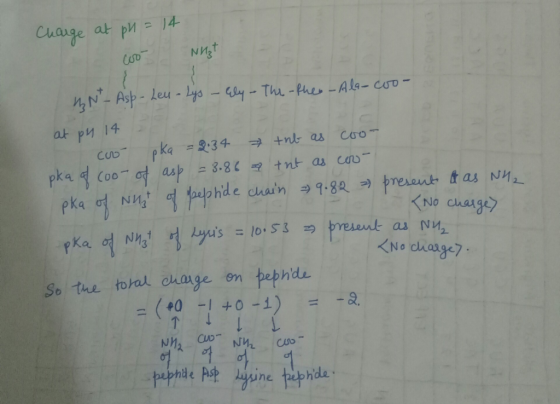
Ans e- Charge on peptide at pH =14
COO- is present in its deprotonated form as explain previously pH is greater than the pKa. Charge due to both COO- group = -1-1 =-2
NH3 group of N terminal of peptide chain also present in ionized form as pKa for NH3+ is 9.83 which is lower than the pH
Side chain of lysine is also loose its proton as pH>pKa (10.53)
So charge due to amino group is zero, total charge on protein =
-2 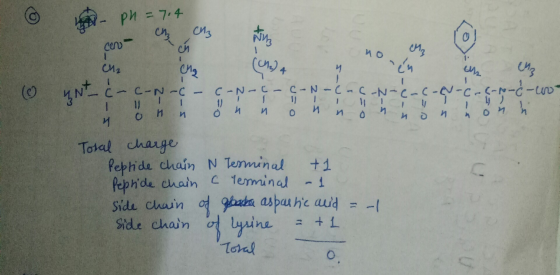
Add Answer to:
C,D, and E i need help with.
17. The following peptide forms part of Human Hemoglobin...
PLEASE HELP OCHEM QUESTION 1. In the following protein, identify the type of bonding or interaction...
 PLEASE HELP OCHEM QUESTION
1. In the following protein, identify the type of bonding or interaction that is responsible for holding the two peptide chains together at each amino acid pair, above (A) and below (B). Gly - Ala - Ser - Cys - Val - Asp - Leu - Thr - His - Ile-Tyr-Glu - Phe - Lys - Cys - Met - Asn Val - Leu -Gin-Cys - Pro-Lys - Met - Tyr - Asp -Phe-Asn-Lys - Ile...
PLEASE HELP OCHEM QUESTION
1. In the following protein, identify the type of bonding or interaction that is responsible for holding the two peptide chains together at each amino acid pair, above (A) and below (B). Gly - Ala - Ser - Cys - Val - Asp - Leu - Thr - His - Ile-Tyr-Glu - Phe - Lys - Cys - Met - Asn Val - Leu -Gin-Cys - Pro-Lys - Met - Tyr - Asp -Phe-Asn-Lys - Ile...
On your internship, you visit the Mass Spectrometry Lab. Mass spectrometry can identify short peptide fragments...
On your internship, you visit the Mass Spectrometry Lab. Mass spectrometry can identify short peptide fragments based on their molecular weights. Your fellow intern Jerry has neglected to label his tubes of amyloid beta peptide 42 after digesting them with some proteases that we learned about in Module 6: pepsin, trypsin, and chymotrypsin. Help him figure out what protease is in each tube. Jerry’s supervisor has the fragments listed in the same order as the original peptide primary sequence, which...
How many amino acids are there in the disease causing variant of the Amyloid-beta (Ab) peptide?...
 How many amino acids are there in the disease causing variant of
the Amyloid-beta (Ab) peptide?
Determine which of these four peptides is most likely to become a beta sheet. Lys-Thr-Val-Ile-Trp-Pro-Phe-Tyr-Ile-Gln-Ile-Gly Arg-Ser-Tyr-Glu-Gly-Leu-Lys-Arg-Ile-Ala-Glu-Ser Ala-Glu-Met-Leu-Gln-Lys-Arg-Gly-Cys-Gly-Asp-Glu Met-Leu-Lys-Ala-Ser-Ala-Leu-Glu-Lys-Leu-Ser-Glu
How many amino acids are there in the disease causing variant of
the Amyloid-beta (Ab) peptide?
Determine which of these four peptides is most likely to become a beta sheet. Lys-Thr-Val-Ile-Trp-Pro-Phe-Tyr-Ile-Gln-Ile-Gly Arg-Ser-Tyr-Glu-Gly-Leu-Lys-Arg-Ile-Ala-Glu-Ser Ala-Glu-Met-Leu-Gln-Lys-Arg-Gly-Cys-Gly-Asp-Glu Met-Leu-Lys-Ala-Ser-Ala-Leu-Glu-Lys-Leu-Ser-Glu
What amino acid would the Manticodon code for RNA codon table 2nd position Tot position СТА...
 What amino acid would the Manticodon code for RNA codon table 2nd position Tot position СТА Tyr Phe Phe > eu eu Oulaa Jooo 9999 stop stop eu eu eu Let 0 - puchbucobucusura BER < Val Val Asp Ala Asp Ala Glu Ala Glu Amino Acids Keu Pro Pro His Weu Leu Gin lle Pro Thr Thr Thr Thr Asn Asn lle Ser Ser Arg lle Met Lys Lys bucoucouco Arg > Asp Asp Val Val Val Val Ala...
5. Consider the following peptide: His-Ser-Gln-Gly-Thr-Phe-Thr-Ser-Asp-Tyr-Ser-Lys-Tyr-Leu-Asp-Ser-Arg-Arg-Ala-Gin- Asp-Phe-Val-Gln-Trp-Leu-Met-Asn-Thr a. What are the fragments, if it is cleaved...
 5. Consider the following peptide: His-Ser-Gln-Gly-Thr-Phe-Thr-Ser-Asp-Tyr-Ser-Lys-Tyr-Leu-Asp-Ser-Arg-Arg-Ala-Gin- Asp-Phe-Val-Gln-Trp-Leu-Met-Asn-Thr a. What are the fragments, if it is cleaved by trypsin? b. What are the fragments, if it is cleaved by chymotrypsin? c. What are the fragments, if it is cleaved by pepsin?
On your internship, you visit the Mass Spectrometry Lab. Mass spectrometry can identify short peptide fragments...
On your internship, you visit the Mass Spectrometry Lab. Mass spectrometry can identify short peptide fragments based on their molecular weights. Your fellow intern Jerry has neglected to label his tubes of amyloid beta peptide 42 after digesting them with some proteases that we learned about in Module 6: pepsin, trypsin, and chymotrypsin. Help him figure out what protease is in each tube. Jerry’s supervisor has the fragments listed in the same order as the original peptide primary sequence, which...
10. The peptide shown has the amino acid sequence: A. Val-Ser-Ile-Glu-Lys B. Lys-Glu-Ile-Ser-Val C. Thr-Asp-Leu-Gln-Arg D....
 10. The peptide shown has the amino acid sequence: A. Val-Ser-Ile-Glu-Lys B. Lys-Glu-Ile-Ser-Val C. Thr-Asp-Leu-Gln-Arg D. Val-Asp-Ile-Glu-Arg 11. Which of the following describes the entire three- dimensional structure of a single polypeptide? A. Secondary structure B. Quaternary structure C. Tertiary structure D. Primary structure 12. What is the primary driving force in the formation of protein tertiary structure? A. Energy released when additional ion pairs are formed. B. The exclusion of non-polar substances from aqueous solution. C. The formation of...
Based on where CNBR and trypsin cut, evaluate the following experimental data and predict the N-...
Based on where CNBR and trypsin cut, evaluate the following experimental data and predict the N- and C-terminal amino acids of the parent peptide (peptide before cutting). Enter your answer using the three letter amino acid abbreviations, with a comma in between. For example, if the N-terminal residue is alanine and C-terminal residue is glycine you would write: Ala, Gly. Cleavage with CNBR produced the following peptides: Gly-Ala-Lys-Leu-Pro-Met Phe-Trp-Met Asp-Gly-Arg-Cys-Ala-Gln Cleavage with trypsin: Cys-Ala-Gln Phe-Trp-Met-Gly-Ala-Lys Leu-Pro-Met-Asp-Gly-Arg
What fragments will be obtained by a trypsin hydrolysis of the following octapeptide? Ala-Val-Trp-Lys-Phe-Gly-Arg-Met A) Ala-Val-Trp-Lys-Phe...
 What fragments will be obtained by a trypsin hydrolysis of the following octapeptide? Ala-Val-Trp-Lys-Phe-Gly-Arg-Met A) Ala-Val-Trp-Lys-Phe and Gly-Arg-Met 3) Ala-Val-Trp-Lys-Phe-Gly and Arg-Met - Ala-Val-Trp-Lys and Phe-Gly-Arg and Met ) Ala-Val-Trp-Lys and Phe and Gly-Arg and Met ) Ala-Val-Trp and Lys-Phe-Gly and Arg-Met Bradykinin is a nonapeptide, Arg-Pro-Pro-Gly-Phe-Ser-Pro-Phe-Arg. In addition to one mole of Arg, what peptides are present after hydrolysis of bradykinin with chymotrypsin? A) Arg-Pro-Pro and Gly-Phe and Ser-Pro-Phe B) Pro-Pro-Gly and Phe-Ser-Pro-Phe-Arg C) Arg-Pro-Pro-Gly-Phe and Ser-Pro-Phe ?) Arg-Pro-Pro-Gly-Phe-Ser...
Need help with #2 Clearly provide the 3-letter symbol for the correct sequence of cach amino...
 Need help with #2
Clearly provide the 3-letter symbol for the correct sequence of cach amino acid in each of listings of the amino acids in the peptide or in any fragments are simply listed in alphabetical order. A subscriptive the number of that amino acid. Use parentheses to incorporate the unknown amino acids after each treatment 1. A five amino acid peptide contains: Arg. Glu, His, Phe, and Ser This peptide yields the following results when broken down into...
Need help with #2
Clearly provide the 3-letter symbol for the correct sequence of cach amino acid in each of listings of the amino acids in the peptide or in any fragments are simply listed in alphabetical order. A subscriptive the number of that amino acid. Use parentheses to incorporate the unknown amino acids after each treatment 1. A five amino acid peptide contains: Arg. Glu, His, Phe, and Ser This peptide yields the following results when broken down into...
 PLEASE HELP OCHEM QUESTION
1. In the following protein, identify the type of bonding or interaction that is responsible for holding the two peptide chains together at each amino acid pair, above (A) and below (B). Gly - Ala - Ser - Cys - Val - Asp - Leu - Thr - His - Ile-Tyr-Glu - Phe - Lys - Cys - Met - Asn Val - Leu -Gin-Cys - Pro-Lys - Met - Tyr - Asp -Phe-Asn-Lys - Ile...
PLEASE HELP OCHEM QUESTION
1. In the following protein, identify the type of bonding or interaction that is responsible for holding the two peptide chains together at each amino acid pair, above (A) and below (B). Gly - Ala - Ser - Cys - Val - Asp - Leu - Thr - His - Ile-Tyr-Glu - Phe - Lys - Cys - Met - Asn Val - Leu -Gin-Cys - Pro-Lys - Met - Tyr - Asp -Phe-Asn-Lys - Ile...
 How many amino acids are there in the disease causing variant of
the Amyloid-beta (Ab) peptide?
Determine which of these four peptides is most likely to become a beta sheet. Lys-Thr-Val-Ile-Trp-Pro-Phe-Tyr-Ile-Gln-Ile-Gly Arg-Ser-Tyr-Glu-Gly-Leu-Lys-Arg-Ile-Ala-Glu-Ser Ala-Glu-Met-Leu-Gln-Lys-Arg-Gly-Cys-Gly-Asp-Glu Met-Leu-Lys-Ala-Ser-Ala-Leu-Glu-Lys-Leu-Ser-Glu
How many amino acids are there in the disease causing variant of
the Amyloid-beta (Ab) peptide?
Determine which of these four peptides is most likely to become a beta sheet. Lys-Thr-Val-Ile-Trp-Pro-Phe-Tyr-Ile-Gln-Ile-Gly Arg-Ser-Tyr-Glu-Gly-Leu-Lys-Arg-Ile-Ala-Glu-Ser Ala-Glu-Met-Leu-Gln-Lys-Arg-Gly-Cys-Gly-Asp-Glu Met-Leu-Lys-Ala-Ser-Ala-Leu-Glu-Lys-Leu-Ser-Glu
 What amino acid would the Manticodon code for RNA codon table 2nd position Tot position СТА Tyr Phe Phe > eu eu Oulaa Jooo 9999 stop stop eu eu eu Let 0 - puchbucobucusura BER < Val Val Asp Ala Asp Ala Glu Ala Glu Amino Acids Keu Pro Pro His Weu Leu Gin lle Pro Thr Thr Thr Thr Asn Asn lle Ser Ser Arg lle Met Lys Lys bucoucouco Arg > Asp Asp Val Val Val Val Ala...
 5. Consider the following peptide: His-Ser-Gln-Gly-Thr-Phe-Thr-Ser-Asp-Tyr-Ser-Lys-Tyr-Leu-Asp-Ser-Arg-Arg-Ala-Gin- Asp-Phe-Val-Gln-Trp-Leu-Met-Asn-Thr a. What are the fragments, if it is cleaved by trypsin? b. What are the fragments, if it is cleaved by chymotrypsin? c. What are the fragments, if it is cleaved by pepsin?
 10. The peptide shown has the amino acid sequence: A. Val-Ser-Ile-Glu-Lys B. Lys-Glu-Ile-Ser-Val C. Thr-Asp-Leu-Gln-Arg D. Val-Asp-Ile-Glu-Arg 11. Which of the following describes the entire three- dimensional structure of a single polypeptide? A. Secondary structure B. Quaternary structure C. Tertiary structure D. Primary structure 12. What is the primary driving force in the formation of protein tertiary structure? A. Energy released when additional ion pairs are formed. B. The exclusion of non-polar substances from aqueous solution. C. The formation of...
 What fragments will be obtained by a trypsin hydrolysis of the following octapeptide? Ala-Val-Trp-Lys-Phe-Gly-Arg-Met A) Ala-Val-Trp-Lys-Phe and Gly-Arg-Met 3) Ala-Val-Trp-Lys-Phe-Gly and Arg-Met - Ala-Val-Trp-Lys and Phe-Gly-Arg and Met ) Ala-Val-Trp-Lys and Phe and Gly-Arg and Met ) Ala-Val-Trp and Lys-Phe-Gly and Arg-Met Bradykinin is a nonapeptide, Arg-Pro-Pro-Gly-Phe-Ser-Pro-Phe-Arg. In addition to one mole of Arg, what peptides are present after hydrolysis of bradykinin with chymotrypsin? A) Arg-Pro-Pro and Gly-Phe and Ser-Pro-Phe B) Pro-Pro-Gly and Phe-Ser-Pro-Phe-Arg C) Arg-Pro-Pro-Gly-Phe and Ser-Pro-Phe ?) Arg-Pro-Pro-Gly-Phe-Ser...
 Need help with #2
Clearly provide the 3-letter symbol for the correct sequence of cach amino acid in each of listings of the amino acids in the peptide or in any fragments are simply listed in alphabetical order. A subscriptive the number of that amino acid. Use parentheses to incorporate the unknown amino acids after each treatment 1. A five amino acid peptide contains: Arg. Glu, His, Phe, and Ser This peptide yields the following results when broken down into...
Need help with #2
Clearly provide the 3-letter symbol for the correct sequence of cach amino acid in each of listings of the amino acids in the peptide or in any fragments are simply listed in alphabetical order. A subscriptive the number of that amino acid. Use parentheses to incorporate the unknown amino acids after each treatment 1. A five amino acid peptide contains: Arg. Glu, His, Phe, and Ser This peptide yields the following results when broken down into...
Most questions answered within 3 hours.
-
Where is the error in this code sequence?
String s1 = "Hello";
String s2 = "ello";...
asked 10 months ago -
Financial data for Joel de Paris, Inc., for last year
follow:
Joel de Paris, Inc.
Balance...
asked 10 months ago -
Consider this reaction:
Al2(SO4)3 (aq)+ BaCl3
(aq) Al2Cl6 (aq)- +
3BaSO4(s) . What is the...
asked 10 months ago -
Suppose that Savneet is considering increasing her
recent random sample from 20 car rentals to 40...
asked 10 months ago -
Trucks arrive at an unloading terminal at an average rate of 120
per hour.
Trucks arrive...
asked 10 months ago -
Why are methanol and ethanol completely soluble in water while
octanol is not very little soluble....
asked 10 months ago -
A facilities manager at a university reads in a research report
that the mean amount of...
asked 10 months ago -
When the CuSO4 is rehydrated by adding water to the anhydrous
compound, is this an endothermic...
asked 10 months ago -
A ray of sunlight is passing from diamond into crown glass; the
angle of incidence is...
asked 10 months ago -
A block of mass 0.249 kg is placed on top of a light, vertical
spring of...
asked 10 months ago -
how do the kidneys compensate in the presences of acidosis
a) trigger hyperventilate
b) reserve acid...
asked 10 months ago -
Question 501 pts
The rental rate of capital to the firm increases. Which of the
following...
asked 10 months ago