
Homework Answers
1) F = P A =
= (1.013-0.960)x(1.2x1.3) = 0.11448 kN
2) bouyant force > WM + WL
=> water x(n x pi R2L)g > 320
xg +
log x(n x pi R2L)g
=> 16.579 n > 320
=> nmin = 19.3 = 20 logs
3) Q = Q(-12 to 0) + Q(s to L) +Q(0 to 5) = (3.2 x 2.108 x 12) kJ + (3.2 x 334) kJ + (3.2 x 4.186 x 5) kJ = 1216.7 kJ
4) When heat is transferred from one material to another it is called conduction. Metal is a good conductor of heat, while nonmetals like wood and plastic are poor conductors. The temperature of any metal object in any environment is about the same as the air that surrounds it. But in case of non metals there is a temperature difference.
When you touch a metal object that's surrounded by air cooler than your body, the object quickly conducts heat away from your fingertips, which makes them feel cold. The sensation travels to your brain, which perceives that the metal object is cold. But in case of plastic they don't adapt to the surroundings because of poor conductivity.
5) E= W = q x V = 5e x 20 V = 100 eV or 100x 1.6x10-19 J = 1.6x 10⁻¹⁷ J
6) F = (Kq1q3/r12 )
i +
(Kq2q3/r22
)i where
i is a unit vector in positive X direction that is
toeard -4 C
= (9x109 x 6 x10-6 x 3x10-6/0.052 ) -i + (9x109 x 4 x10-6 x 3x10-6/0.062 ) -i
= 94.8 N (-i) or
94.8 N towards 6C
7) a)
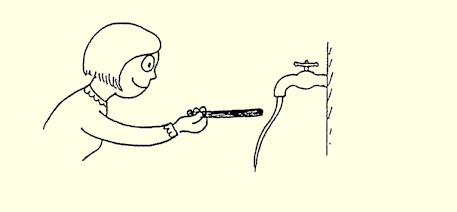
The stream of water deviates a little towards the comb.
b) Water has no net electrical charge, but the negatively charged comb induces a complementary charge in the water. The electrons in the water can move somewhat. When the negatively charged comb comes near the water, it repels the electrons, so that the side of the water nearest the comb then has a positive charge. The attraction between this positive charge and the negatively charged comb results in a net force on the water, bending the stream.
8) v2 - u2 = 2aS => 0 - u2 = 2x-9.8 x 15
=> u = 17.146 m/s
therefore time to reach maximum height = (v-u) / a = (0-17.146)/-9.8 = 1.7496 s
a) so total time taken by ball to return = 2 x 1.7496 = 3.499 s
b) V before landing = velocity with which it was thrown = u = 17.146m/s
Add Answer to:
Show all working clearly and include diagrams where appropriate. Express all answers to the correct number...
A U-tube contains liquid of unknown density. An oil of density 770 kg/m³ is poured into...
 A U-tube contains liquid of unknown density. An oil of density
770 kg/m³ is poured into one arm of the tube until the oil column
is 13.5 cm high. The oil-air interface is then 4.5 cm above the
liquid level in the other arm of the U-tube. Find the density of
the liquid.
A raft is made of 11 logs lashed together. Each is 38.0 cm in
diameter and has a length of 7.00 m. How many people (whole number)...
A U-tube contains liquid of unknown density. An oil of density
770 kg/m³ is poured into one arm of the tube until the oil column
is 13.5 cm high. The oil-air interface is then 4.5 cm above the
liquid level in the other arm of the U-tube. Find the density of
the liquid.
A raft is made of 11 logs lashed together. Each is 38.0 cm in
diameter and has a length of 7.00 m. How many people (whole number)...
Lol 0-15 Show complete solutions including formulas and express all answers to three sig figures. Don't...
 Lol 0-15 Show complete solutions including formulas and express all answers to three sig figures. Don't forget units. 1. A tank with a volume of o.250 m3 is filled with an ideal gas at an abrsolute pressure of 1.01x10⁵ Pa when the temperature is 20.0 C. a) Use the ideal gas law to calculate the number of moles of gas in the tank. b) The temperature of the gas is then raised to 6 C 2. The mass of one...
To receive full credit you must clearly show all DT YOU" of the proper use of...
 To receive full credit you must clearly show all DT YOU" of the proper use of units): I need enough information to be able to follow your understuu physics principles involved in each question or problem. Write your work on other sheets of paper and attach them to this page. 2 Had tam or w world Home Exercise #7 o 220m to na nga T (5) 1. Problem #30 from Chapter 9 2. Problem #44 from Chapter 9 totoolsvart notarib...
1) A 3.00 g bullet traveling horizontally at 400 m/s hits a 3.00 kg wooden block...
1) A 3.00 g bullet traveling horizontally at 400 m/s hits a 3.00 kg wooden block which is initially at rest on a smooth horizontal table. The bullet buries itself in the block without passing through. The speed of the block after the collision is a) 0.4 m/s. b) 1.2 m/s. c) 2.0 m/s. d) 2.8 m/s. e) 3.6 m/s. 2) What type of collision was seen in the previous problem? a) elastic collision b) inelastic collision c) perfectly elastic...
All of the following questions are in relation to the following journal article which is available...
 All of the following questions are in relation to the following journal article which is available on Moodle: Parr CL, Magnus MC, Karlstad O, Holvik K, Lund-Blix NA, Jaugen M, et al. Vitamin A and D intake in pregnancy, infant supplementation and asthma development: the Norwegian Mother and Child Cohort. Am J Clin Nutr 2018:107:789-798 QUESTIONS: 1. State one hypothesis the author's proposed in the manuscript. 2. There is previous research that shows that adequate Vitamin A intake is required...
 A U-tube contains liquid of unknown density. An oil of density
770 kg/m³ is poured into one arm of the tube until the oil column
is 13.5 cm high. The oil-air interface is then 4.5 cm above the
liquid level in the other arm of the U-tube. Find the density of
the liquid.
A raft is made of 11 logs lashed together. Each is 38.0 cm in
diameter and has a length of 7.00 m. How many people (whole number)...
A U-tube contains liquid of unknown density. An oil of density
770 kg/m³ is poured into one arm of the tube until the oil column
is 13.5 cm high. The oil-air interface is then 4.5 cm above the
liquid level in the other arm of the U-tube. Find the density of
the liquid.
A raft is made of 11 logs lashed together. Each is 38.0 cm in
diameter and has a length of 7.00 m. How many people (whole number)...
 Lol 0-15 Show complete solutions including formulas and express all answers to three sig figures. Don't forget units. 1. A tank with a volume of o.250 m3 is filled with an ideal gas at an abrsolute pressure of 1.01x10⁵ Pa when the temperature is 20.0 C. a) Use the ideal gas law to calculate the number of moles of gas in the tank. b) The temperature of the gas is then raised to 6 C 2. The mass of one...
 To receive full credit you must clearly show all DT YOU" of the proper use of units): I need enough information to be able to follow your understuu physics principles involved in each question or problem. Write your work on other sheets of paper and attach them to this page. 2 Had tam or w world Home Exercise #7 o 220m to na nga T (5) 1. Problem #30 from Chapter 9 2. Problem #44 from Chapter 9 totoolsvart notarib...
 All of the following questions are in relation to the following journal article which is available on Moodle: Parr CL, Magnus MC, Karlstad O, Holvik K, Lund-Blix NA, Jaugen M, et al. Vitamin A and D intake in pregnancy, infant supplementation and asthma development: the Norwegian Mother and Child Cohort. Am J Clin Nutr 2018:107:789-798 QUESTIONS: 1. State one hypothesis the author's proposed in the manuscript. 2. There is previous research that shows that adequate Vitamin A intake is required...
Most questions answered within 3 hours.
-
Where is the error in this code sequence?
String s1 = "Hello";
String s2 = "ello";...
asked 10 months ago -
Financial data for Joel de Paris, Inc., for last year
follow:
Joel de Paris, Inc.
Balance...
asked 10 months ago -
Consider this reaction:
Al2(SO4)3 (aq)+ BaCl3
(aq) Al2Cl6 (aq)- +
3BaSO4(s) . What is the...
asked 10 months ago -
Suppose that Savneet is considering increasing her
recent random sample from 20 car rentals to 40...
asked 10 months ago -
Trucks arrive at an unloading terminal at an average rate of 120
per hour.
Trucks arrive...
asked 10 months ago -
Why are methanol and ethanol completely soluble in water while
octanol is not very little soluble....
asked 10 months ago -
A facilities manager at a university reads in a research report
that the mean amount of...
asked 10 months ago -
When the CuSO4 is rehydrated by adding water to the anhydrous
compound, is this an endothermic...
asked 10 months ago -
A ray of sunlight is passing from diamond into crown glass; the
angle of incidence is...
asked 10 months ago -
A block of mass 0.249 kg is placed on top of a light, vertical
spring of...
asked 10 months ago -
how do the kidneys compensate in the presences of acidosis
a) trigger hyperventilate
b) reserve acid...
asked 10 months ago -
Question 501 pts
The rental rate of capital to the firm increases. Which of the
following...
asked 10 months ago