
Homework Answers
Add Answer to:
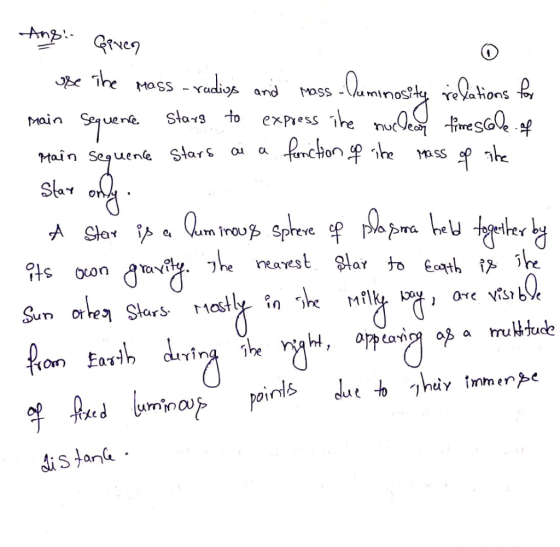
(b) Use the mass-radius and mass-luminosity relations for main-sequence stars to express the dynamical timescale of...
Ty Lifetimes. Zero-age main sequence stars much less than 0.5Mo are the alternate form of "dark m...
 ty Lifetimes. Zero-age main sequence stars much less than 0.5Mo are the alternate form of "dark matter". Assume a brown dwarf's luminosity derives from gravitational contraction alone. Its mass is 0.05 Mo, and its luminosity is 3 x 10⁻³Lo. Such stars maintain a tight correlation between radus and mass given by R 9 x 10 (M/Mo)-1em. If we assume that its luminosity has been constart a) calculate a radiation temperature and wavelength to demonstrate these stellar objects as "dark". (b)...
The mass of a main-sequence star is 10 times the mass of the Sun. Its luminosity...
The mass of a main-sequence star is 10 times the mass of the Sun. Its luminosity is 3,000 times the luminosity of the Sun. Find its lifetime in years, giving the answer to two significant figures.
• The background pages of this module talked about the mass-luminosity relationship for stars on the...
• The background pages of this module talked about the mass-luminosity relationship for stars on the main sequence: L M 3.5 Question 8: What can you conclude about the masses of stars along the main sequence? Luminosity increases as mass increases as we move from the lower right to the upper left.
Last time we found that the time a star stays on the main sequence depends critically...
Last time we found that the time a star stays on the main sequence depends critically on its mass. We found this result by using the empirical relation that the luminosity L depends strongly on its mass, L∝M^3.5. Now let us assume that instead for all stars the luminosity L is directlyproportional to M, L∝M. If the sun stays on the main sequence for 10Gyr, how long would a60M star stay on the main sequence, and a 0.5 M star, given...
All of this is nice, but stars don't do much as they exist on the Main...
 All of this is nice, but stars don't do much as they exist on the Main Sequence except stay extremely stable and fuse hydrogen into helium in the core. But for a high-mass star like Betelgeuse what will we expect to happen when hydrogen runs out in the core? Helium will start fusing in the core, a shell of hydrogen will start fusing around the core, and the rest of the star will expand causing the radius to increase, the...
Using the Mass-Luminosity relationship, estimate the luminosities for each of the following stars: 25 MSun star...
Using the Mass-Luminosity relationship, estimate the luminosities for each of the following stars: 25 MSun star 2.5 MSun star 0.25 MSun star
It is thought that stars form with an initial mass function dN dM x M235AM235 where A is a constant of proportionality to be determined. Stars are born in the range from 0.08 to 120 Mo (a) Above/belo...
 It is thought that stars form with an initial mass function dN dM x M235AM235 where A is a constant of proportionality to be determined. Stars are born in the range from 0.08 to 120 Mo (a) Above/below what stellar mass do 50% of the total number of stars form? (b) Stars above what mass are responsible for producing 10% of the total stellar mass? (c) Main sequence stars have a power law relation between mass and luminosity, L x...
30. Why are the Balmer lines in the spectra of giant stars narrower than those for...
30. Why are the Balmer lines in the spectra of giant stars narrower than those for main-sequence stars? 31. Binary stars are [common, very rare]. 32. Binary stars allow us to determine what very important property of stars? 33. In a binary system the center of mass lies closer to the [more massive, less massive] star. 34. What type of star is Sirius B? [main sequence, white dwarf, giant] 35. Why does a spectroscopic binary system only allow us to...
It is thought that stars form with an initial mass function dN/dM ox M2.5 AM-2.35 where A is a constant of proportionality to be determined. Stars are born in the range from 0.08 to 120 Mo (a) Above/...
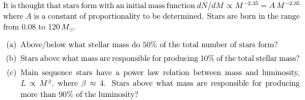 It is thought that stars form with an initial mass function dN/dM ox M2.5 AM-2.35 where A is a constant of proportionality to be determined. Stars are born in the range from 0.08 to 120 Mo (a) Above/below what stellar mass do 50% of the total number of stars form? (b) Stars above what mass are responsible for producing 10% of the total stellar mass? (c) Main sequence stars have a power law relation between mass and luminosity, L x...
It is thought that stars form with an initial mass function dN dM x M235AM235 where...
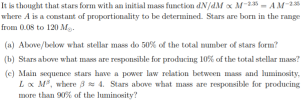 It is thought that stars form with an initial mass function dN dM x M235AM235 where A is a constant of proportionality to be determined. Stars are born in the range from 0.08 to 120 Mo (a) Above/below what stellar mass do 50% of the total number of stars form? (b) Stars above what mass are responsible for producing 10% of the total stellar mass? (c) Main sequence stars have a power law relation between mass and luminosity, L x...
 ty Lifetimes. Zero-age main sequence stars much less than 0.5Mo are the alternate form of "dark matter". Assume a brown dwarf's luminosity derives from gravitational contraction alone. Its mass is 0.05 Mo, and its luminosity is 3 x 10⁻³Lo. Such stars maintain a tight correlation between radus and mass given by R 9 x 10 (M/Mo)-1em. If we assume that its luminosity has been constart a) calculate a radiation temperature and wavelength to demonstrate these stellar objects as "dark". (b)...
 All of this is nice, but stars don't do much as they exist on the Main Sequence except stay extremely stable and fuse hydrogen into helium in the core. But for a high-mass star like Betelgeuse what will we expect to happen when hydrogen runs out in the core? Helium will start fusing in the core, a shell of hydrogen will start fusing around the core, and the rest of the star will expand causing the radius to increase, the...
 It is thought that stars form with an initial mass function dN dM x M235AM235 where A is a constant of proportionality to be determined. Stars are born in the range from 0.08 to 120 Mo (a) Above/below what stellar mass do 50% of the total number of stars form? (b) Stars above what mass are responsible for producing 10% of the total stellar mass? (c) Main sequence stars have a power law relation between mass and luminosity, L x...
 It is thought that stars form with an initial mass function dN/dM ox M2.5 AM-2.35 where A is a constant of proportionality to be determined. Stars are born in the range from 0.08 to 120 Mo (a) Above/below what stellar mass do 50% of the total number of stars form? (b) Stars above what mass are responsible for producing 10% of the total stellar mass? (c) Main sequence stars have a power law relation between mass and luminosity, L x...
 It is thought that stars form with an initial mass function dN dM x M235AM235 where A is a constant of proportionality to be determined. Stars are born in the range from 0.08 to 120 Mo (a) Above/below what stellar mass do 50% of the total number of stars form? (b) Stars above what mass are responsible for producing 10% of the total stellar mass? (c) Main sequence stars have a power law relation between mass and luminosity, L x...
Most questions answered within 3 hours.
-
Where is the error in this code sequence?
String s1 = "Hello";
String s2 = "ello";...
asked 10 months ago -
Financial data for Joel de Paris, Inc., for last year
follow:
Joel de Paris, Inc.
Balance...
asked 10 months ago -
Consider this reaction:
Al2(SO4)3 (aq)+ BaCl3
(aq) Al2Cl6 (aq)- +
3BaSO4(s) . What is the...
asked 10 months ago -
Suppose that Savneet is considering increasing her
recent random sample from 20 car rentals to 40...
asked 10 months ago -
Trucks arrive at an unloading terminal at an average rate of 120
per hour.
Trucks arrive...
asked 10 months ago -
Why are methanol and ethanol completely soluble in water while
octanol is not very little soluble....
asked 10 months ago -
A facilities manager at a university reads in a research report
that the mean amount of...
asked 10 months ago -
When the CuSO4 is rehydrated by adding water to the anhydrous
compound, is this an endothermic...
asked 10 months ago -
A ray of sunlight is passing from diamond into crown glass; the
angle of incidence is...
asked 10 months ago -
A block of mass 0.249 kg is placed on top of a light, vertical
spring of...
asked 10 months ago -
how do the kidneys compensate in the presences of acidosis
a) trigger hyperventilate
b) reserve acid...
asked 10 months ago -
Question 501 pts
The rental rate of capital to the firm increases. Which of the
following...
asked 10 months ago