The mass of a main-sequence star is 10 times the mass of the Sun. Its luminosity...
The mass of a main-sequence star is 10 times the mass of the Sun. Its luminosity is 3,000 times the luminosity of the Sun.
Find its lifetime in years, giving the answer to two significant figures.
Homework Answers

Add Answer to:
The mass of a main-sequence star is 10 times the mass of the
Sun. Its luminosity...
Sirius, the brightest star in the sky, is a main-sequence star, as is the Sun, but...
Sirius, the brightest star in the sky, is a main-sequence star, as is the Sun, but Sirius has a luminosity about 27 times that of the Sun and a mass about 3 times that of the Sun. Use this information to determine which star will live longer, and by what factor, approximately.
A 100 MꙨ (i.e 100 times the mass of the Sun) main-sequence star is close to...
A 100 MꙨ (i.e 100 times the mass of the Sun) main-sequence star is close to its Eddington limit, is powered by the CNO cycle, and has a central temperature of 3x10^7 K. How massive must a star be before it can begin burning He while still on the main sequence? From this, estimate how many such stars (if any) you might expect to find in the Milky Way.
What is the hydrogen-fusing lifetime of a star with a mass 1.3 times that of the...
What is the hydrogen-fusing lifetime of a star with a mass 1.3 times that of the Sun, which shines with a luminosity that is 3.2 times that of the Sun? Report your answer in millions of years (Myr).
5. The HR Diagram. Suppose we consider a main sequence “O star” much more massive than...
5. The HR Diagram. Suppose we consider a main sequence “O star” much more massive than the sun. According to the formulae shown in lecture: a. What is the luminosity of a main-sequence O star (in solar units, Lsun) of mass 100 solar masses? b. If the sun were a 100 solar mass main-sequence O star, how much brighter would it appear from the earth? c. What is the hydrogen fusing lifetime of this star in years? d. If the...
Imagine the Sun was replaced by a star whose luminosity was 9 times the luminosity of...
Imagine the Sun was replaced by a star whose luminosity was 9 times the luminosity of the Sun. By what factor would the brightness of sunlight here on Earth change?
Question 61 2.5 pts Star B's luminosity is 26.8 times that of star A's luminosity. Star...
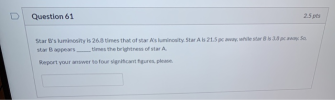 Question 61 2.5 pts Star B's luminosity is 26.8 times that of star A's luminosity. Star Ais 21.5 pc away, while star Bis 3.8 pc away. So, star B appears __times the brightness of star A. Report your answer to four significant figures, please.
Last time we found that the time a star stays on the main sequence depends critically...
Last time we found that the time a star stays on the main sequence depends critically on its mass. We found this result by using the empirical relation that the luminosity L depends strongly on its mass, L∝M^3.5. Now let us assume that instead for all stars the luminosity L is directlyproportional to M, L∝M. If the sun stays on the main sequence for 10Gyr, how long would a60M star stay on the main sequence, and a 0.5 M star, given...
m. solar nebula к. asteroid I. comet Jovlll plalie n. planetesimal 2. A star had 10 times the mass of the Sun when it was on the Main Sequence. At the end of its life it has a core with a mass t...
 m. solar nebula к. asteroid I. comet Jovlll plalie n. planetesimal 2. A star had 10 times the mass of the Sun when it was on the Main Sequence. At the end of its life it has a core with a mass two times the mass of theSn. Explin what hppdto the rest of the mas and wiy, o. lunar eclipse p. solar eclipse 9. Where did the heavy elements that most of the Earth is composed of originate? a)...
PartA Constants Suppose a star the size of our Sun, but with mass 9.0 times as...
 PartA Constants Suppose a star the size of our Sun, but with mass 9.0 times as great, were rotating at a speed of 1.0 revolution every 10 days. If it were to undergo gravitational collapse to a neutron star of radius 12 km, losing three-quarters of its mass in the process, what would its rotation speed be? Assume also that the thrown-off mass carries off either no angular momentum Express your answer using two significant figures. A2c rev/s Part B...
(b) Use the mass-radius and mass-luminosity relations for main-sequence stars to express the dynamical timescale of...
 (b) Use the mass-radius and mass-luminosity relations for main-sequence stars to express the dynamical timescale of main-sequence stars as a function of the mass of the star only.
 Question 61 2.5 pts Star B's luminosity is 26.8 times that of star A's luminosity. Star Ais 21.5 pc away, while star Bis 3.8 pc away. So, star B appears __times the brightness of star A. Report your answer to four significant figures, please.
 m. solar nebula к. asteroid I. comet Jovlll plalie n. planetesimal 2. A star had 10 times the mass of the Sun when it was on the Main Sequence. At the end of its life it has a core with a mass two times the mass of theSn. Explin what hppdto the rest of the mas and wiy, o. lunar eclipse p. solar eclipse 9. Where did the heavy elements that most of the Earth is composed of originate? a)...
 PartA Constants Suppose a star the size of our Sun, but with mass 9.0 times as great, were rotating at a speed of 1.0 revolution every 10 days. If it were to undergo gravitational collapse to a neutron star of radius 12 km, losing three-quarters of its mass in the process, what would its rotation speed be? Assume also that the thrown-off mass carries off either no angular momentum Express your answer using two significant figures. A2c rev/s Part B...
 (b) Use the mass-radius and mass-luminosity relations for main-sequence stars to express the dynamical timescale of main-sequence stars as a function of the mass of the star only.
Most questions answered within 3 hours.
-
Where is the error in this code sequence?
String s1 = "Hello";
String s2 = "ello";...
asked 11 months ago -
Financial data for Joel de Paris, Inc., for last year
follow:
Joel de Paris, Inc.
Balance...
asked 11 months ago -
Consider this reaction:
Al2(SO4)3 (aq)+ BaCl3
(aq) Al2Cl6 (aq)- +
3BaSO4(s) . What is the...
asked 11 months ago -
Suppose that Savneet is considering increasing her
recent random sample from 20 car rentals to 40...
asked 11 months ago -
Trucks arrive at an unloading terminal at an average rate of 120
per hour.
Trucks arrive...
asked 11 months ago -
Why are methanol and ethanol completely soluble in water while
octanol is not very little soluble....
asked 11 months ago -
A facilities manager at a university reads in a research report
that the mean amount of...
asked 11 months ago -
When the CuSO4 is rehydrated by adding water to the anhydrous
compound, is this an endothermic...
asked 11 months ago -
A ray of sunlight is passing from diamond into crown glass; the
angle of incidence is...
asked 11 months ago -
A block of mass 0.249 kg is placed on top of a light, vertical
spring of...
asked 11 months ago -
how do the kidneys compensate in the presences of acidosis
a) trigger hyperventilate
b) reserve acid...
asked 11 months ago -
Question 501 pts
The rental rate of capital to the firm increases. Which of the
following...
asked 11 months ago