Imagine the Sun was replaced by a star whose luminosity was 9 times the luminosity of...
Imagine the Sun was replaced by a star whose luminosity was 9 times the luminosity of the Sun. By what factor would the brightness of sunlight here on Earth change?
Homework Answers

Add Answer to:
Imagine the Sun was replaced by a star whose luminosity was 9
times the luminosity of...
The mass of a main-sequence star is 10 times the mass of the Sun. Its luminosity...
The mass of a main-sequence star is 10 times the mass of the Sun. Its luminosity is 3,000 times the luminosity of the Sun. Find its lifetime in years, giving the answer to two significant figures.
Question 61 2.5 pts Star B's luminosity is 26.8 times that of star A's luminosity. Star...
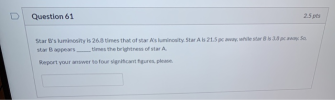 Question 61 2.5 pts Star B's luminosity is 26.8 times that of star A's luminosity. Star Ais 21.5 pc away, while star Bis 3.8 pc away. So, star B appears __times the brightness of star A. Report your answer to four significant figures, please.
What star is 20 pc from Earth, has a luminosity of 160 times that of the...
What star is 20 pc from Earth, has a luminosity of 160 times that of the Sun, a surface temperature of 4000 K, and has an absolute magnitude of -0.066? How would I figure this out?
Sirius, the brightest star in the sky, is a main-sequence star, as is the Sun, but...
Sirius, the brightest star in the sky, is a main-sequence star, as is the Sun, but Sirius has a luminosity about 27 times that of the Sun and a mass about 3 times that of the Sun. Use this information to determine which star will live longer, and by what factor, approximately.
Star A is 19 times as far away as star B. Both appear to have the...
Star A is 19 times as far away as star B. Both appear to have the same brightness. What is the ratio of the luminosity of star A to that of star B?
Star A is 5 times as far away as star B. Both appear to have the...
Star A is 5 times as far away as star B. Both appear to have the same brightness. What is the ratio of the luminosity of star A to that of star B?
Betelgeuse, a bright red star in the constellation Orion, has a luminosity that is 100,000 times...
 Betelgeuse, a bright red star in the constellation Orion, has a luminosity that is 100,000 times that of the Sun However, the surface temperature of Betelgeuse is only 3000 K. Assuming that the emissivity of stars is 1, find the radius of Betelgeuse.
The star Betelgeuse has a temperature only half that of the Sun but has 100,000 times...
The star Betelgeuse has a temperature only half that of the Sun but has 100,000 times the luminosity of the Sun. Using only this information, calculate the radius of the Betelgeuse in terms of the Sun's.
4) Suppose you observe a star that is three times as hot as the sun, but...
4) Suppose you observe a star that is three times as hot as the sun, but also three smaller in radius than the sun. a) What is the wavelength at which its spectrum peaks? Is that wavelength shorter or longer than that of the sun? b) How much more (or less) power (ie., luminosity or energy per time) is it emitting in total, compared to the sun?
Imagine we find a star that has the same radius as the Sun, but its temperature...
Imagine we find a star that has the same radius as the Sun, but its temperature is 9.6 times greater. That star should be _____ times as luminous as the Sun. Suppose we find a planet with an orbital period of 200 days around a star with the same mass as the Sun, but only 75 percent as luminous. What is the planet’s semi-major axis, in AU?
 Question 61 2.5 pts Star B's luminosity is 26.8 times that of star A's luminosity. Star Ais 21.5 pc away, while star Bis 3.8 pc away. So, star B appears __times the brightness of star A. Report your answer to four significant figures, please.
 Betelgeuse, a bright red star in the constellation Orion, has a luminosity that is 100,000 times that of the Sun However, the surface temperature of Betelgeuse is only 3000 K. Assuming that the emissivity of stars is 1, find the radius of Betelgeuse.
Most questions answered within 3 hours.
-
Where is the error in this code sequence?
String s1 = "Hello";
String s2 = "ello";...
asked 10 months ago -
Financial data for Joel de Paris, Inc., for last year
follow:
Joel de Paris, Inc.
Balance...
asked 10 months ago -
Consider this reaction:
Al2(SO4)3 (aq)+ BaCl3
(aq) Al2Cl6 (aq)- +
3BaSO4(s) . What is the...
asked 10 months ago -
Suppose that Savneet is considering increasing her
recent random sample from 20 car rentals to 40...
asked 10 months ago -
Trucks arrive at an unloading terminal at an average rate of 120
per hour.
Trucks arrive...
asked 10 months ago -
Why are methanol and ethanol completely soluble in water while
octanol is not very little soluble....
asked 10 months ago -
A facilities manager at a university reads in a research report
that the mean amount of...
asked 10 months ago -
When the CuSO4 is rehydrated by adding water to the anhydrous
compound, is this an endothermic...
asked 10 months ago -
A ray of sunlight is passing from diamond into crown glass; the
angle of incidence is...
asked 10 months ago -
A block of mass 0.249 kg is placed on top of a light, vertical
spring of...
asked 10 months ago -
how do the kidneys compensate in the presences of acidosis
a) trigger hyperventilate
b) reserve acid...
asked 10 months ago -
Question 501 pts
The rental rate of capital to the firm increases. Which of the
following...
asked 10 months ago