What is the hydrogen-fusing lifetime of a star with a mass 1.3 times that of the...
What is the hydrogen-fusing lifetime of a star with a mass 1.3 times that of the Sun, which shines with a luminosity that is 3.2 times that of the Sun? Report your answer in millions of years (Myr).
Homework Answers
The approximate stellar lifetime of star is given through the equation:

Hence

I hope this helps. Have a nice day.
Add Answer to:
What is the hydrogen-fusing lifetime of a star with a mass 1.3
times that of the...
The mass of a main-sequence star is 10 times the mass of the Sun. Its luminosity...
The mass of a main-sequence star is 10 times the mass of the Sun. Its luminosity is 3,000 times the luminosity of the Sun. Find its lifetime in years, giving the answer to two significant figures.
5. The HR Diagram. Suppose we consider a main sequence “O star” much more massive than...
5. The HR Diagram. Suppose we consider a main sequence “O star” much more massive than the sun. According to the formulae shown in lecture: a. What is the luminosity of a main-sequence O star (in solar units, Lsun) of mass 100 solar masses? b. If the sun were a 100 solar mass main-sequence O star, how much brighter would it appear from the earth? c. What is the hydrogen fusing lifetime of this star in years? d. If the...
According to Einstein’s formula, E=mc^2, the energy radiated away from the Sun (or any star for...
According to Einstein’s formula, E=mc^2, the energy radiated away from the Sun (or any star for that matter) represents a loss in mass. That is, every Joule of energy radiated away from the Sun diminishes its mass by m=E/c^2. Assume that the Sun’s luminosity is 3.8X10^26 J/s. a) Determine the amount of mass (in kg) that the Sun would lose by shining at that same luminosity for 10 billion years. b) Sirius A will last about 90 million years as a...
Sirius, the brightest star in the sky, is a main-sequence star, as is the Sun, but...
Sirius, the brightest star in the sky, is a main-sequence star, as is the Sun, but Sirius has a luminosity about 27 times that of the Sun and a mass about 3 times that of the Sun. Use this information to determine which star will live longer, and by what factor, approximately.
In a certain binary-star system, each star has the same mass which is 4.4 times of...
In a certain binary-star system, each star has the same mass which is 4.4 times of that of the Sun, and they revolve about their center of mass. The distance between them is 5.7 times the distance between Earth and the Sun. What is their period of revolution in years?
In a certain binary-star system, each star has the same mass which is 3.7 times of...
In a certain binary-star system, each star has the same mass which is 3.7 times of that of the Sun, and they revolve about their center of mass. The distance between them is 6.9 times the distance between Earth and the Sun. What is their period of revolution in years?
In a certain binary-star system, each star has the same mass which is 9.6 times of...
In a certain binary-star system, each star has the same mass which is 9.6 times of that of the Sun, and they revolve about their center of mass. The distance between them is 8.0 times the distance between Earth and the Sun. What is their period of revolution in years?
Question 61 2.5 pts Star B's luminosity is 26.8 times that of star A's luminosity. Star...
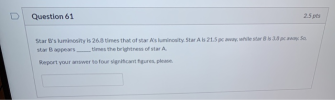 Question 61 2.5 pts Star B's luminosity is 26.8 times that of star A's luminosity. Star Ais 21.5 pc away, while star Bis 3.8 pc away. So, star B appears __times the brightness of star A. Report your answer to four significant figures, please.
6. The bright star Arcturus in the constellation Boötes has a surface temperature about 0.74 times...
6. The bright star Arcturus in the constellation Boötes has a surface temperature about 0.74 times that of the Sun. Its luminosity is about 170 times that of the Sun. (a) What is Arcturus’ radius compared to the radius of the Sun (in units of solar radii, ?⊙)? (b) What type of star is Arcturus (a dwarf, a giant, or a supergiant)? Explain your reasoning.
C. i. As a star runs out of hydrogen to fuel nuclear fusion in its core,...
 C. i. As a star runs out of hydrogen to fuel nuclear fusion in its core, changes within the star usually cause it to leave the main sequence, expanding and cooling as it does so. Would a star with a radius 100 times that of the Sun, but a surface temperature 0.4 times that of the Sun, be more, or less luminous than the Sun? Show and explain your reasoning. You may assume the surface area of a sphere is...
 Question 61 2.5 pts Star B's luminosity is 26.8 times that of star A's luminosity. Star Ais 21.5 pc away, while star Bis 3.8 pc away. So, star B appears __times the brightness of star A. Report your answer to four significant figures, please.
 C. i. As a star runs out of hydrogen to fuel nuclear fusion in its core, changes within the star usually cause it to leave the main sequence, expanding and cooling as it does so. Would a star with a radius 100 times that of the Sun, but a surface temperature 0.4 times that of the Sun, be more, or less luminous than the Sun? Show and explain your reasoning. You may assume the surface area of a sphere is...
Most questions answered within 3 hours.
-
Where is the error in this code sequence?
String s1 = "Hello";
String s2 = "ello";...
asked 11 months ago -
Financial data for Joel de Paris, Inc., for last year
follow:
Joel de Paris, Inc.
Balance...
asked 11 months ago -
Consider this reaction:
Al2(SO4)3 (aq)+ BaCl3
(aq) Al2Cl6 (aq)- +
3BaSO4(s) . What is the...
asked 11 months ago -
Suppose that Savneet is considering increasing her
recent random sample from 20 car rentals to 40...
asked 11 months ago -
Trucks arrive at an unloading terminal at an average rate of 120
per hour.
Trucks arrive...
asked 11 months ago -
Why are methanol and ethanol completely soluble in water while
octanol is not very little soluble....
asked 11 months ago -
A facilities manager at a university reads in a research report
that the mean amount of...
asked 11 months ago -
When the CuSO4 is rehydrated by adding water to the anhydrous
compound, is this an endothermic...
asked 11 months ago -
A ray of sunlight is passing from diamond into crown glass; the
angle of incidence is...
asked 11 months ago -
A block of mass 0.249 kg is placed on top of a light, vertical
spring of...
asked 11 months ago -
how do the kidneys compensate in the presences of acidosis
a) trigger hyperventilate
b) reserve acid...
asked 11 months ago -
Question 501 pts
The rental rate of capital to the firm increases. Which of the
following...
asked 11 months ago