A heat engine takes in 125 kJ of heat from a reservoir at 815 K and...
A heat engine takes in 125 kJ of heat from a reservoir at 815 K and exhausts 85.0 kJ to a reservoir at 292 K. What is the efficiency of the engine?
Homework Answers
We are given the following data :




Now, the efficiency of any heat engine is given by the work done by the heat engine per unit heat taken from the hot reservoir.
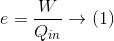
To get the efficiency we need to find the work done by the heat engine.
Assuming that the heat is not lost by any other means other than work, the work done will be equal to

So, using in (1)

So, using the values of  and
and  , we get the efficiency

Which is the required efficiency.
BONUS
By looking at the question I see that the reservoir temperatures are also provided. So, I am guessing that the efficiency of an ideal engine operating between the same two reservoirs was also asked / will be asked. So, I am solving that too below.
The efficiency of an ideal engine operating between two
reservoirs with temperatures  and
and  is given by
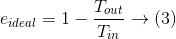
Using the values provided, we get
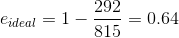
Notice that the efficiency of an ideal heat engine is much more
than the efficiency calculated before although the two heat engines
work between the same two temperatures. By definition, an ideal
engine always has the maximum efficiency for any value of
and
.
Thank you for posting your problem to Chegg.
If you liked my solution to your problem, a thumbs up will be
highly appreciated. It really motivates me to do more!
Add Answer to:
A heat engine takes in 125 kJ of heat from a reservoir at 815 K
and...
A heat engine extracts 51 kJ from the hot reservoir and exhausts 30 kJ into the cold reservoir. Part A What is the wo...
A heat engine extracts 51 kJ from the hot reservoir and exhausts 30 kJ into the cold reservoir. Part A What is the work done? ANSWER: Part B What is the efficiency?
In one cycle, a certain heat engine takes in 1000 J1000 J of heat from its...
 In one cycle, a certain heat engine takes in 1000 J1000 J of
heat from its high‑temperature reservoir and exhausts 700 J700 J of
heat to its low‑temperature reservoir.
What is the efficiency of the heat engine under these
conditions? 70%,30%,43%,143%,300%.
In one cycle, a certain heat engine takes in 1000 J of heat from its high-temperature reservoir and exhausts 700 J of heat to its low-temperature reservoir. Hot reservoir What is the efficiency of the heat engine under these...
In one cycle, a certain heat engine takes in 1000 J1000 J of
heat from its high‑temperature reservoir and exhausts 700 J700 J of
heat to its low‑temperature reservoir.
What is the efficiency of the heat engine under these
conditions? 70%,30%,43%,143%,300%.
In one cycle, a certain heat engine takes in 1000 J of heat from its high-temperature reservoir and exhausts 700 J of heat to its low-temperature reservoir. Hot reservoir What is the efficiency of the heat engine under these...
A Carnot engine takes 2000 J of heat from a reservoir at 500 K, does some...
 A Carnot engine takes 2000 J of heat from a reservoir at 500 K, does some work, and discards some heat to a reservoir at 350 K. How much work does it do, how much heat is discarded, and what is its efficiency?
Question 2 (20%) A heat engine takes 425 kJ of heat from a reservoir at 1000...
 Question 2 (20%) A heat engine takes 425 kJ of heat from a reservoir at 1000 °C and discharges its excess heat to a reservoir at 400 °C. This heat engine produces 200 kJ net work. Explain mathematically if this engine is reversible or irreversible and if it is possible to have such a heat engine. Describe the physical reasoning behind your answer.
Problem 14-Carnot engine (14 points) The Carnot engine takes 1800 J of heat from a reservoir...
 Problem 14-Carnot engine (14 points) The Carnot engine takes 1800 J of heat from a reservoir at 600 K, does some work, and discards some heat to a reservoir at 300 K. How much work does it do, how much heat is discarded, and what is its efficiency?
An ideal heat engine takes in heat from a reservoir at 380 °C and has an...
An ideal heat engine takes in heat from a reservoir at 380 °C and has an efficiency of 34%. If the exhaust temperature does not vary and the efficiency is increased to 44%, what would be the increase in the temperature of the hot reservoir?
6) A Carnot engine takes heat in from a reservoir at 400 K and discards heat...
 6) A Carnot engine takes heat in from a reservoir at 400 K and discards heat to a reservoir at 300 K. If the engine does 12,000 J of work per cycle, how much heat does it take in per cycle? a) 9000 b) 16,000 c)24,000 d) 48,000 e) none of the above
What is the total entropy change if a 0.410 efficiency engine takes 3.91E3 J of heat...
What is the total entropy change if a 0.410 efficiency engine takes 3.91E3 J of heat from a 332 degC reservoir and exhausts it to a 36.0 degC reservoir?
2. An ideal heat engine takes in heat from a reservoir at 380 °C and has...
 2. An ideal heat engine takes in heat from a reservoir at 380 °C and has an efficiency of 28%. If the exhaust temperature does not vary and the efficiency is increased to 42%, what would be the increase in the temperature of the hot reservoir 251.2115 oc
 In one cycle, a certain heat engine takes in 1000 J1000 J of
heat from its high‑temperature reservoir and exhausts 700 J700 J of
heat to its low‑temperature reservoir.
What is the efficiency of the heat engine under these
conditions? 70%,30%,43%,143%,300%.
In one cycle, a certain heat engine takes in 1000 J of heat from its high-temperature reservoir and exhausts 700 J of heat to its low-temperature reservoir. Hot reservoir What is the efficiency of the heat engine under these...
In one cycle, a certain heat engine takes in 1000 J1000 J of
heat from its high‑temperature reservoir and exhausts 700 J700 J of
heat to its low‑temperature reservoir.
What is the efficiency of the heat engine under these
conditions? 70%,30%,43%,143%,300%.
In one cycle, a certain heat engine takes in 1000 J of heat from its high-temperature reservoir and exhausts 700 J of heat to its low-temperature reservoir. Hot reservoir What is the efficiency of the heat engine under these...
 A Carnot engine takes 2000 J of heat from a reservoir at 500 K, does some work, and discards some heat to a reservoir at 350 K. How much work does it do, how much heat is discarded, and what is its efficiency?
 Question 2 (20%) A heat engine takes 425 kJ of heat from a reservoir at 1000 °C and discharges its excess heat to a reservoir at 400 °C. This heat engine produces 200 kJ net work. Explain mathematically if this engine is reversible or irreversible and if it is possible to have such a heat engine. Describe the physical reasoning behind your answer.
 Problem 14-Carnot engine (14 points) The Carnot engine takes 1800 J of heat from a reservoir at 600 K, does some work, and discards some heat to a reservoir at 300 K. How much work does it do, how much heat is discarded, and what is its efficiency?
 6) A Carnot engine takes heat in from a reservoir at 400 K and discards heat to a reservoir at 300 K. If the engine does 12,000 J of work per cycle, how much heat does it take in per cycle? a) 9000 b) 16,000 c)24,000 d) 48,000 e) none of the above
 2. An ideal heat engine takes in heat from a reservoir at 380 °C and has an efficiency of 28%. If the exhaust temperature does not vary and the efficiency is increased to 42%, what would be the increase in the temperature of the hot reservoir 251.2115 oc
Most questions answered within 3 hours.
-
Where is the error in this code sequence?
String s1 = "Hello";
String s2 = "ello";...
asked 11 months ago -
Financial data for Joel de Paris, Inc., for last year
follow:
Joel de Paris, Inc.
Balance...
asked 11 months ago -
Consider this reaction:
Al2(SO4)3 (aq)+ BaCl3
(aq) Al2Cl6 (aq)- +
3BaSO4(s) . What is the...
asked 11 months ago -
Suppose that Savneet is considering increasing her
recent random sample from 20 car rentals to 40...
asked 11 months ago -
Trucks arrive at an unloading terminal at an average rate of 120
per hour.
Trucks arrive...
asked 11 months ago -
Why are methanol and ethanol completely soluble in water while
octanol is not very little soluble....
asked 11 months ago -
A facilities manager at a university reads in a research report
that the mean amount of...
asked 11 months ago -
When the CuSO4 is rehydrated by adding water to the anhydrous
compound, is this an endothermic...
asked 11 months ago -
A ray of sunlight is passing from diamond into crown glass; the
angle of incidence is...
asked 11 months ago -
A block of mass 0.249 kg is placed on top of a light, vertical
spring of...
asked 11 months ago -
how do the kidneys compensate in the presences of acidosis
a) trigger hyperventilate
b) reserve acid...
asked 11 months ago -
Question 501 pts
The rental rate of capital to the firm increases. Which of the
following...
asked 11 months ago