
Homework Answers
If and only if A language is computably enumerable in increasing order then this language will be decidable. That is, a language A is decidable if and only if it is finite or there is a total computable function f: N → {0,1}* for all numbers n,
Such that range f=(A) and each f(n) comes strictly before f(n+1) in the standard enumeration of {0,1}* i.e.
f(n) < f(n + 1)
If A is finite, then it will be decidable.
Let A is not finite, and a function f: N → {0,1}* and
for all n, f(n) < f(n + 1).
So, we can present formulation of a Turing Machine that decides A, given below:-
STEP-1: TAKE input X
STEP-2: Initialize I to 0.
STEP-3: while f(I) < X do
STEP-4: Increment the value of I by 1
STEP-5: END while
STEP-6: if f(I) == X then
STEP-7: Take the value of X and HALT
STEP-8: else refuse the value of X and HALT
Vice-Versa, Let A is decidable. If A is finite, then it is computably enumerable by definition mentioned above. If A is infinite, then there is a computable function f: N → {0,1}* that forms enumeration of A in the increasing order.
So there is a computable function f that enumerates A ,
it means A is computably enumerable and by all observation given above we can say that range f=(A) and each f(n) comes strictly before f(n+1) in the standard enumeration of {0,1}* i.e.
f(n) < f(n + 1)
Add Answer to:
Prove that a language A is decidable if and only if it is finite or there...
Let F IN = {M | L(M) is finite}, and recall HP = {M#w | M...
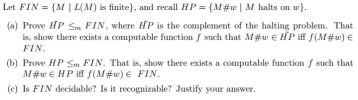 Let F IN = {M | L(M) is finite}, and recall HP = {M#w | M halts
on w}.
(a) Prove HP¯ ≤m F IN, where HP¯ is the complement of the
halting problem. That is, show there exists a computable function f
such that M#w ∈ HP¯ iff f(M#w) ∈ F IN.
(b) Prove HP ≤m F IN. That is, show there exists a computable
function f such that M#w ∈ HP iff f(M#w) ∈ F IN.
(c) Is...
Let F IN = {M | L(M) is finite}, and recall HP = {M#w | M halts
on w}.
(a) Prove HP¯ ≤m F IN, where HP¯ is the complement of the
halting problem. That is, show there exists a computable function f
such that M#w ∈ HP¯ iff f(M#w) ∈ F IN.
(b) Prove HP ≤m F IN. That is, show there exists a computable
function f such that M#w ∈ HP iff f(M#w) ∈ F IN.
(c) Is...
1. If L is the complement of a language recognized by a non-deterministic finite automaton, then...
1. If L is the complement of a language recognized by a non-deterministic finite automaton, then L is _______ a) finite b) regular but not necessarily finite c) deterministic context-free but not necessarily regular d) context-free but not necessarily deterministic context-free e) recursive (that is, decidable) but not necessarily context-free f) recursively enumerable (that is, partially decidable) but not necessarily recursive g) not recursively enumerable
9. (1 point) Alice claims that a language is decidable if there exists some non-deterministic TM...
 9. (1 point) Alice claims that a language is decidable if there exists some non-deterministic TM that decides it. Bob claims that a language is decidable if there exists some deterministic TM that decides it. Whose claim is correct? A. Both Alice's and Bob's. B. Only Alice's. C. Only Bob's. D. Neither Alice's nor Bob's. 10. (1 point) Which of the following is true? A. If an enumerator enumerates a language L, then L is decidable. B. If a language...
Prove that a language A is regular if and only if there exists an NFA (nondeterministic...
Prove that a language A is regular if and only if there exists an NFA (nondeterministic finite automaton) which recognizes A.
Only 5-9 please 1. (10 points) True/False. Briefly justify your answer for each statement. 1) Any subset of a decidable...
 Only 5-9 please
1. (10 points) True/False. Briefly justify your answer for each statement. 1) Any subset of a decidable set is decidable 2) Any subset of a regular language is decidable 3) Any regular language is decidable 4) Any decidable set is context-free 5) There is a recognizable but not decidable language 6) Recognizable sets are closed under complement. 7) Decidable sets are closed under complement. 8) Recognizable sets are closed under union 9) Decidable sets are closed under...
Only 5-9 please
1. (10 points) True/False. Briefly justify your answer for each statement. 1) Any subset of a decidable set is decidable 2) Any subset of a regular language is decidable 3) Any regular language is decidable 4) Any decidable set is context-free 5) There is a recognizable but not decidable language 6) Recognizable sets are closed under complement. 7) Decidable sets are closed under complement. 8) Recognizable sets are closed under union 9) Decidable sets are closed under...
Determining whether languages are finite, regular, context free, or recursive 1. (Each part is worth 2 points) Fill in the blanks with one of the following (some choices might not be used): a) finit...
 Determining whether languages are finite, regular, context free,
or recursive
1. (Each part is worth 2 points) Fill in the blanks with one of the following (some choices might not be used): a) finite b) regular but not finite d) context-free but not deterministic context-free e) recursive (that is, decidable) but not context-free f) recursively enumerable (that is, partially decidable) but not recursive g) not recursively enumerable Recall that if M is a Turing machine then "M" (also written as...
Determining whether languages are finite, regular, context free,
or recursive
1. (Each part is worth 2 points) Fill in the blanks with one of the following (some choices might not be used): a) finite b) regular but not finite d) context-free but not deterministic context-free e) recursive (that is, decidable) but not context-free f) recursively enumerable (that is, partially decidable) but not recursive g) not recursively enumerable Recall that if M is a Turing machine then "M" (also written as...
solve #5 only please 5 Prove that the function f in problem 4 is integrable and...
 solve #5 only please
5 Prove that the function f in problem 4 is integrable and sf = 0. Suggestion: Use the suggestion for problem 4(a) to show that given €>0, there is a partition Pof [0, 1] with Uff, P) < 2€ , while Laf, P) =0. Do this by enclosing the points of the finite set where f(x) 2e in a finite set of disjoint closed intervals, each contained in (0,1), with the sum of the lengths <€....
solve #5 only please
5 Prove that the function f in problem 4 is integrable and sf = 0. Suggestion: Use the suggestion for problem 4(a) to show that given €>0, there is a partition Pof [0, 1] with Uff, P) < 2€ , while Laf, P) =0. Do this by enclosing the points of the finite set where f(x) 2e in a finite set of disjoint closed intervals, each contained in (0,1), with the sum of the lengths <€....
true or False with prove? (f) ___ NP =co-NP (g) The complement of any recursive language...
 true or False with prove?
(f) ___ NP =co-NP (g) The complement of any recursive language is recursive. h) The grader's problem is decidable. We say programs Pi and P are equivalent if they give the same output if given the same input. The problem is to decide whether two programs (in C++, Pascal, Java, or some other modern programming language) are equivalent. )Given any CF language L, there is always an unambiguous CF grammar which generates L 6)Given any...
true or False with prove?
(f) ___ NP =co-NP (g) The complement of any recursive language is recursive. h) The grader's problem is decidable. We say programs Pi and P are equivalent if they give the same output if given the same input. The problem is to decide whether two programs (in C++, Pascal, Java, or some other modern programming language) are equivalent. )Given any CF language L, there is always an unambiguous CF grammar which generates L 6)Given any...
PLEASE ANSWER ALL! SHOWS STEPS 2. (a) Prove by using the definition of convergence only, without using limit theo- (b) Prove by using the definition of continuity, or by using the є_ó property, that 3...
 PLEASE ANSWER ALL! SHOWS STEPS
2. (a) Prove by using the definition of convergence only, without using limit theo- (b) Prove by using the definition of continuity, or by using the є_ó property, that 3. Let f be a twice differentiable function defined on the closed interval [0, 1]. Suppose rems, that if (S) is a sequence converging to s, then lim, 10 2 f (x) is a continuous function on R r,s,t e [0,1] are defined so that r...
PLEASE ANSWER ALL! SHOWS STEPS
2. (a) Prove by using the definition of convergence only, without using limit theo- (b) Prove by using the definition of continuity, or by using the є_ó property, that 3. Let f be a twice differentiable function defined on the closed interval [0, 1]. Suppose rems, that if (S) is a sequence converging to s, then lim, 10 2 f (x) is a continuous function on R r,s,t e [0,1] are defined so that r...
Let and be two finite measures on . Prove that if and only if the condition...
 Let
and
be two finite measures on
.
Prove that
if and only if the condition
implies
, for each
.
Thank you for your explanations.
We were unable to transcribe this imageWe were unable to transcribe this image(N, P (N)) μ<<φ 6({n})=0 ({n}) = 0 neN
Let
and
be two finite measures on
.
Prove that
if and only if the condition
implies
, for each
.
Thank you for your explanations.
We were unable to transcribe this imageWe were unable to transcribe this image(N, P (N)) μ<<φ 6({n})=0 ({n}) = 0 neN
 Let F IN = {M | L(M) is finite}, and recall HP = {M#w | M halts
on w}.
(a) Prove HP¯ ≤m F IN, where HP¯ is the complement of the
halting problem. That is, show there exists a computable function f
such that M#w ∈ HP¯ iff f(M#w) ∈ F IN.
(b) Prove HP ≤m F IN. That is, show there exists a computable
function f such that M#w ∈ HP iff f(M#w) ∈ F IN.
(c) Is...
Let F IN = {M | L(M) is finite}, and recall HP = {M#w | M halts
on w}.
(a) Prove HP¯ ≤m F IN, where HP¯ is the complement of the
halting problem. That is, show there exists a computable function f
such that M#w ∈ HP¯ iff f(M#w) ∈ F IN.
(b) Prove HP ≤m F IN. That is, show there exists a computable
function f such that M#w ∈ HP iff f(M#w) ∈ F IN.
(c) Is...
 9. (1 point) Alice claims that a language is decidable if there exists some non-deterministic TM that decides it. Bob claims that a language is decidable if there exists some deterministic TM that decides it. Whose claim is correct? A. Both Alice's and Bob's. B. Only Alice's. C. Only Bob's. D. Neither Alice's nor Bob's. 10. (1 point) Which of the following is true? A. If an enumerator enumerates a language L, then L is decidable. B. If a language...
 Only 5-9 please
1. (10 points) True/False. Briefly justify your answer for each statement. 1) Any subset of a decidable set is decidable 2) Any subset of a regular language is decidable 3) Any regular language is decidable 4) Any decidable set is context-free 5) There is a recognizable but not decidable language 6) Recognizable sets are closed under complement. 7) Decidable sets are closed under complement. 8) Recognizable sets are closed under union 9) Decidable sets are closed under...
Only 5-9 please
1. (10 points) True/False. Briefly justify your answer for each statement. 1) Any subset of a decidable set is decidable 2) Any subset of a regular language is decidable 3) Any regular language is decidable 4) Any decidable set is context-free 5) There is a recognizable but not decidable language 6) Recognizable sets are closed under complement. 7) Decidable sets are closed under complement. 8) Recognizable sets are closed under union 9) Decidable sets are closed under...
 Determining whether languages are finite, regular, context free,
or recursive
1. (Each part is worth 2 points) Fill in the blanks with one of the following (some choices might not be used): a) finite b) regular but not finite d) context-free but not deterministic context-free e) recursive (that is, decidable) but not context-free f) recursively enumerable (that is, partially decidable) but not recursive g) not recursively enumerable Recall that if M is a Turing machine then "M" (also written as...
Determining whether languages are finite, regular, context free,
or recursive
1. (Each part is worth 2 points) Fill in the blanks with one of the following (some choices might not be used): a) finite b) regular but not finite d) context-free but not deterministic context-free e) recursive (that is, decidable) but not context-free f) recursively enumerable (that is, partially decidable) but not recursive g) not recursively enumerable Recall that if M is a Turing machine then "M" (also written as...
 solve #5 only please
5 Prove that the function f in problem 4 is integrable and sf = 0. Suggestion: Use the suggestion for problem 4(a) to show that given €>0, there is a partition Pof [0, 1] with Uff, P) < 2€ , while Laf, P) =0. Do this by enclosing the points of the finite set where f(x) 2e in a finite set of disjoint closed intervals, each contained in (0,1), with the sum of the lengths <€....
solve #5 only please
5 Prove that the function f in problem 4 is integrable and sf = 0. Suggestion: Use the suggestion for problem 4(a) to show that given €>0, there is a partition Pof [0, 1] with Uff, P) < 2€ , while Laf, P) =0. Do this by enclosing the points of the finite set where f(x) 2e in a finite set of disjoint closed intervals, each contained in (0,1), with the sum of the lengths <€....
 true or False with prove?
(f) ___ NP =co-NP (g) The complement of any recursive language is recursive. h) The grader's problem is decidable. We say programs Pi and P are equivalent if they give the same output if given the same input. The problem is to decide whether two programs (in C++, Pascal, Java, or some other modern programming language) are equivalent. )Given any CF language L, there is always an unambiguous CF grammar which generates L 6)Given any...
true or False with prove?
(f) ___ NP =co-NP (g) The complement of any recursive language is recursive. h) The grader's problem is decidable. We say programs Pi and P are equivalent if they give the same output if given the same input. The problem is to decide whether two programs (in C++, Pascal, Java, or some other modern programming language) are equivalent. )Given any CF language L, there is always an unambiguous CF grammar which generates L 6)Given any...
 PLEASE ANSWER ALL! SHOWS STEPS
2. (a) Prove by using the definition of convergence only, without using limit theo- (b) Prove by using the definition of continuity, or by using the є_ó property, that 3. Let f be a twice differentiable function defined on the closed interval [0, 1]. Suppose rems, that if (S) is a sequence converging to s, then lim, 10 2 f (x) is a continuous function on R r,s,t e [0,1] are defined so that r...
PLEASE ANSWER ALL! SHOWS STEPS
2. (a) Prove by using the definition of convergence only, without using limit theo- (b) Prove by using the definition of continuity, or by using the є_ó property, that 3. Let f be a twice differentiable function defined on the closed interval [0, 1]. Suppose rems, that if (S) is a sequence converging to s, then lim, 10 2 f (x) is a continuous function on R r,s,t e [0,1] are defined so that r...
 Let
and
be two finite measures on
.
Prove that
if and only if the condition
implies
, for each
.
Thank you for your explanations.
We were unable to transcribe this imageWe were unable to transcribe this image(N, P (N)) μ<<φ 6({n})=0 ({n}) = 0 neN
Let
and
be two finite measures on
.
Prove that
if and only if the condition
implies
, for each
.
Thank you for your explanations.
We were unable to transcribe this imageWe were unable to transcribe this image(N, P (N)) μ<<φ 6({n})=0 ({n}) = 0 neN
Most questions answered within 3 hours.
-
Where is the error in this code sequence?
String s1 = "Hello";
String s2 = "ello";...
asked 10 months ago -
Financial data for Joel de Paris, Inc., for last year
follow:
Joel de Paris, Inc.
Balance...
asked 10 months ago -
Consider this reaction:
Al2(SO4)3 (aq)+ BaCl3
(aq) Al2Cl6 (aq)- +
3BaSO4(s) . What is the...
asked 10 months ago -
Suppose that Savneet is considering increasing her
recent random sample from 20 car rentals to 40...
asked 10 months ago -
Trucks arrive at an unloading terminal at an average rate of 120
per hour.
Trucks arrive...
asked 10 months ago -
Why are methanol and ethanol completely soluble in water while
octanol is not very little soluble....
asked 10 months ago -
A facilities manager at a university reads in a research report
that the mean amount of...
asked 10 months ago -
When the CuSO4 is rehydrated by adding water to the anhydrous
compound, is this an endothermic...
asked 10 months ago -
A ray of sunlight is passing from diamond into crown glass; the
angle of incidence is...
asked 10 months ago -
A block of mass 0.249 kg is placed on top of a light, vertical
spring of...
asked 10 months ago -
how do the kidneys compensate in the presences of acidosis
a) trigger hyperventilate
b) reserve acid...
asked 10 months ago -
Question 501 pts
The rental rate of capital to the firm increases. Which of the
following...
asked 10 months ago