Prove that a language A is regular if and only if there exists an NFA (nondeterministic...
Prove that a language A is regular if and only if there exists an NFA (nondeterministic finite automaton) which recognizes A.
Homework Answers
The forward bearing is unimportant, since A normal methods there is a DFA
that remembers it, and a DFA can be viewed as a NFA rather quickly.
So we center around the regressive bearing. Expect that A will be a dialect that
is perceived by a NFA M = (Q, Σ, ∆, q0, F). Without loss of simplification,
we realize we can take the NFA to have no advances. To demonstrate An is standard,
we have to develop a DFA M0 = (R, Σ, δ, r0, G) that perceives A. (To
recognize conditions of M from conditions of M0
, we use r to extend over conditions of
M0
, and R to speak to the arrangement all things considered.)
The DFA M0 will mimic the NFA M, as in when following
images of a string in M0
, the way taken will some way or another catch all the
conceivable ways that can be taken in M.
Characterize M0 = (R, Σ, δ, r0, G) by taking:
R = {r | r ⊆ Q}
δ(r, a) = {q
0
| q
0 ∈ ∆(q, a) for some q ∈ r}
= ∪q∈r∆(q, a)
r0 = {q0}
G = {r | r ∩ F 6= ∅}
We currently need to confirm that L(M0
) = L(M), that will be, that M0 and M
perceive a similar dialect. At the end of the day, we have to demonstrate that for
each string w, M acknowledges w if and just if M0 acknowledges w.
We do this by acceptance on the length of w (since we have to appear
something valid for a vast number of things). In the first place, characterize some valuable
documentation. On the off chance that δ is the change connection of a DFA, δ
∗
(q, w) lets you know
which state you end up in on the off chance that you pursue every one of the images in w from state q,
in view of the change δ. Formally, δ
∗
is characterized inductively on the structure
of a string:
δ
∗
(q, ) = q
δ
∗
(q, w · a) = δ(δ
∗
(q, w), a),
where w · an is the link of string w and image a. It isn't difficult to
demonstrate that a DFA M = (Q, Σ, δ, q0, F) acknowledges w if and just if δ
∗
(q0, w) is in
F.
Correspondingly, if ∆ is the progress connection of a NFA without advances,
we can characterize ∆∗
that reveal to you which states you can finish up in the event that you pursue
1
every one of the images in w from state q of the NFA, in view of the change ∆. As
above:
∆∗
(q, ) = {q}
∆∗
(q, w · a) = ∪q
0∈∆∗(q,w)∆(q
0
, a)
Once more, it isn't difficult to demonstrate that a NFA M = (Q, Σ, ∆, q0, F) acknowledges w
on the off chance that and just ∆∗
(q0, w) has an express that shows up in F.
Presently, given our automata M and M0 as characterized above, we demonstrate that
for all strings w, δ
∗
(r0, w) = ∆∗
(q0, w). For the base case w = , since
r0 = {q0}, we have δ
∗
(r0, ) = δ
∗
({q0}, ) = {q0} = ∆∗
(q0, ), as required.
For the inductive case, accept the outcome is valid for a string w, we have to
show it is valid for a string w · a: By definition, δ
∗
(r0, w · a) = δ(δ
∗
(r0, w), a).
By the enlistment speculation, δ
∗
(r0, w) = ∆∗
(q0, w), and consequently δ
∗
(r0, w · a) =
δ(∆∗
(q0, w), a). By the meaning of δ, δ(∆∗
(q0, w), a) = ∪q∈∆∗(q0,w)∆(q, a),
which is simply ∆∗
(q0, w · an), as required. This demonstrates the announcement.
Presently, assume that M acknowledges w, that is, ∆∗
(q0, w) ∩ F 6= ∅. By the
above outcome, this is identical to δ
∗
(r0, w) ∩ F 6= ∅, that is, δ
∗
(r0, w) ∈ G,
what's more, this is equal to M0 tolerating w. This sets up that M and M0
acknowledge similar strings, that is, perceive a similar dialect.
Add Answer to:
Prove that a language A is regular if and only
if there exists an NFA (nondeterministic...
Given an NFA N, prove that there exists an NFA N' with one accept state that...
Given an NFA N, prove that there exists an NFA N' with one accept state that recognizes the same language as N.
2. If L is a regular language, prove that the language 11 = { uv/ u...
 2. If L is a regular language, prove that the language 11 = { uv/ u E 1 , |v|-2) is also regular. (Hint: Can you build an NFA of L1 using an NFA of a language L? Use N, the NFA of the language L)
Question 1: Every language is regular T/F Question 2: There exists a DFA that has only...
Question 1: Every language is regular T/F Question 2: There exists a DFA that has only one final state T/F Question 3: Let M be a DFA, and define flip(M) as the DFA which is identical to M except you flip that final state. Then for every M, the language L(M)^c (complement) = L( flip (M)). T/F Question 4: Let G be a right linear grammar, and reverse(G)=reverse of G, i.e. if G has a rule A -> w B...
Here is a nondeterministic finite automaton: 0 0 0,1 A B cal 1 0 Convert this...
 Here is a nondeterministic finite automaton: 0 0 0,1 A B cal 1 0 Convert this NFA to a DFA, using the "lazy' version of the subset construction Which of the following sets of NFA states becomes a state of the DFA constructed in this manner? (B.CD) (A,B,D) (B) (AD)
(20 pt.) Prove that the class of regular languages is closed under reverse. That is, show...
(20 pt.) Prove that the class of regular languages is closed under reverse. That is, show that if ? is a regular language, then ?? = {?? | ? ∈ ?} is also regular. Hint: given a DFA ? = (?, Σ, ?, ?0, ?) that recognizes ?, construct a new NFA ? = (?′, Σ, ?′, ?0′, ?′)that recognizes ?? and justify why your construction is correct.
5. Show the negation of the following nondeterministic finite automata (NFA): 0,1 0,1 0 do 91...
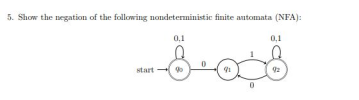 5. Show the negation of the following nondeterministic finite automata (NFA): 0,1 0,1 0 do 91 42
(20 pt.) Prove that the class of regular languages is closed under reverse. That is, show...
 (20 pt.) Prove that the class of regular languages is closed under reverse. That is, show that if A is a regular language, then AR = {wR WE A} is also regular. Hint: given a DFA M = (Q,2,8,90, F) that recognizes A, construct a new NFA N = (Q', 2,8', qo',F') that recognizes AR and justify why your construction is correct.
Solve Regular expression to epsilon-NFA problem For the following regular expression: (((00)*(11))|01)* Over the alphabet {0,1}...
 Solve Regular expression to epsilon-NFA problem For the following regular expression: (((00)*(11))|01)* Over the alphabet {0,1} Give an epsilon-NFA that recognizes the same language. HELP: Block Canvas Tutorial
Problem 3 [20 points Prove that the class of regular languages is closed under reverse. That...
 Problem 3 [20 points Prove that the class of regular languages is closed under reverse. That is, show that if A is a regular language, then AR -[wR | w e A is also regular. [Hint: given a DFA M = (Q,Σ, δ, q0,F) that recognizes A, construct a new NFA (Q', Σ,8,6, F') that recognizes AR.]
5. (20 pt.) Prove that the class of regular languages is closed under reverse. That is,...
 5. (20 pt.) Prove that the class of regular languages is closed under reverse. That is, show that if A is a regular language, then AR = {wR W E A} is also regular. Hint: given a DFA M = (Q,2,8,90, F) that recognizes A, construct a new NFA N = (Q', 2,8', qo',F') that recognizes AR and justify why your construction is correct.
 2. If L is a regular language, prove that the language 11 = { uv/ u E 1 , |v|-2) is also regular. (Hint: Can you build an NFA of L1 using an NFA of a language L? Use N, the NFA of the language L)
 Here is a nondeterministic finite automaton: 0 0 0,1 A B cal 1 0 Convert this NFA to a DFA, using the "lazy' version of the subset construction Which of the following sets of NFA states becomes a state of the DFA constructed in this manner? (B.CD) (A,B,D) (B) (AD)
 5. Show the negation of the following nondeterministic finite automata (NFA): 0,1 0,1 0 do 91 42
 (20 pt.) Prove that the class of regular languages is closed under reverse. That is, show that if A is a regular language, then AR = {wR WE A} is also regular. Hint: given a DFA M = (Q,2,8,90, F) that recognizes A, construct a new NFA N = (Q', 2,8', qo',F') that recognizes AR and justify why your construction is correct.
 Solve Regular expression to epsilon-NFA problem For the following regular expression: (((00)*(11))|01)* Over the alphabet {0,1} Give an epsilon-NFA that recognizes the same language. HELP: Block Canvas Tutorial
 Problem 3 [20 points Prove that the class of regular languages is closed under reverse. That is, show that if A is a regular language, then AR -[wR | w e A is also regular. [Hint: given a DFA M = (Q,Σ, δ, q0,F) that recognizes A, construct a new NFA (Q', Σ,8,6, F') that recognizes AR.]
 5. (20 pt.) Prove that the class of regular languages is closed under reverse. That is, show that if A is a regular language, then AR = {wR W E A} is also regular. Hint: given a DFA M = (Q,2,8,90, F) that recognizes A, construct a new NFA N = (Q', 2,8', qo',F') that recognizes AR and justify why your construction is correct.
Most questions answered within 3 hours.
-
Where is the error in this code sequence?
String s1 = "Hello";
String s2 = "ello";...
asked 10 months ago -
Financial data for Joel de Paris, Inc., for last year
follow:
Joel de Paris, Inc.
Balance...
asked 10 months ago -
Consider this reaction:
Al2(SO4)3 (aq)+ BaCl3
(aq) Al2Cl6 (aq)- +
3BaSO4(s) . What is the...
asked 10 months ago -
Suppose that Savneet is considering increasing her
recent random sample from 20 car rentals to 40...
asked 10 months ago -
Trucks arrive at an unloading terminal at an average rate of 120
per hour.
Trucks arrive...
asked 10 months ago -
Why are methanol and ethanol completely soluble in water while
octanol is not very little soluble....
asked 10 months ago -
A facilities manager at a university reads in a research report
that the mean amount of...
asked 10 months ago -
When the CuSO4 is rehydrated by adding water to the anhydrous
compound, is this an endothermic...
asked 10 months ago -
A ray of sunlight is passing from diamond into crown glass; the
angle of incidence is...
asked 10 months ago -
A block of mass 0.249 kg is placed on top of a light, vertical
spring of...
asked 10 months ago -
how do the kidneys compensate in the presences of acidosis
a) trigger hyperventilate
b) reserve acid...
asked 10 months ago -
Question 501 pts
The rental rate of capital to the firm increases. Which of the
following...
asked 10 months ago