Given an NFA N, prove that there exists an NFA N' with one accept state that...
Given an NFA N, prove that there exists an NFA N' with one accept state that recognizes the same language as N.
Homework Answers
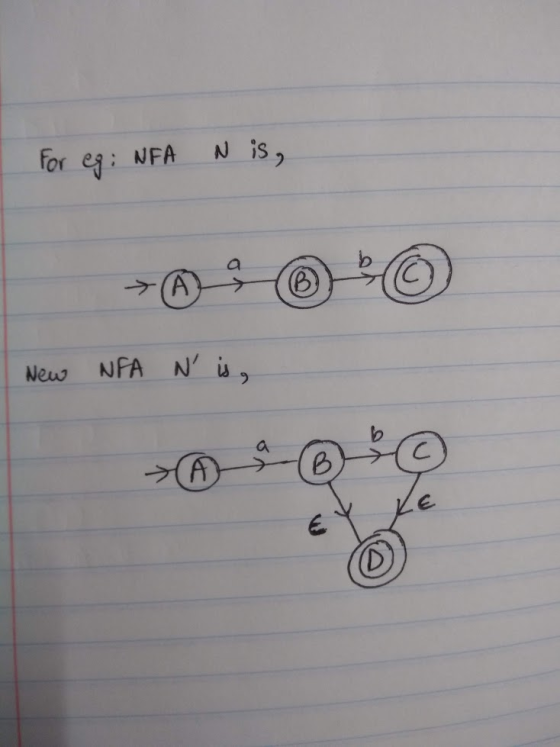
Any NFA can be converted into a new NFA with only one final state that accepts the same language.
This can be done with the help of epsilon transitions.
Simply create a new final state and connect all the previous final states to it with epsilon transitions.
All the older final states would be regular states now. An example of this is shown in the image.
Upvote if this helped!
Add Answer to:
Given an NFA N, prove that there exists an NFA N' with one
accept state that...
Prove that a language A is regular if and only if there exists an NFA (nondeterministic...
Prove that a language A is regular if and only if there exists an NFA (nondeterministic finite automaton) which recognizes A.
Consider the NFA N with states labeled q1, q2 and q3, where q1 is the start...
Consider the NFA N with states labeled q1, q2 and q3, where q1 is the start state and q2 and q3 are the final (accepting) states. The transition function for N is δ(q1,a) = {q1}, δ(q1,b) = {q1,q2}, δ(q2,a) = {q3}, δ(q2,b)= ∅, δ(q3,a)= ∅, and δ(q3,b)= ∅. Let L be the language recognized by N i.e. L(N). a) Draw the state diagram for N. b) Describe in plain English what's in the language L. c) Via the construction NFA to...
Submit a JFLAP file containing a two-state NFA that recognizes the language described by (ab ∪...
Submit a JFLAP file containing a two-state NFA that recognizes the language described by (ab ∪ a) ∗
(20 pt.) Prove that the class of regular languages is closed under reverse. That is, show...
 (20 pt.) Prove that the class of regular languages is closed under reverse. That is, show that if A is a regular language, then AR = {wR WE A} is also regular. Hint: given a DFA M = (Q,2,8,90, F) that recognizes A, construct a new NFA N = (Q', 2,8', qo',F') that recognizes AR and justify why your construction is correct.
5. (20 pt.) Prove that the class of regular languages is closed under reverse. That is,...
 5. (20 pt.) Prove that the class of regular languages is closed under reverse. That is, show that if A is a regular language, then AR = {wR W E A} is also regular. Hint: given a DFA M = (Q,2,8,90, F) that recognizes A, construct a new NFA N = (Q', 2,8', qo',F') that recognizes AR and justify why your construction is correct.
(20 pt.) Prove that the class of regular languages is closed under reverse. That is, show...
(20 pt.) Prove that the class of regular languages is closed under reverse. That is, show that if ? is a regular language, then ?? = {?? | ? ∈ ?} is also regular. Hint: given a DFA ? = (?, Σ, ?, ?0, ?) that recognizes ?, construct a new NFA ? = (?′, Σ, ?′, ?0′, ?′)that recognizes ?? and justify why your construction is correct.
Design an NFA N that recognizes all strings having the second and fourth symbols the same...
 Design an NFA N that recognizes all strings having the second and fourth symbols the same as the last symbol. (a) Give the formal definition of N. (b) Draw the state transition diagram of N. Upload the photo of your answer on paper; make sure that it is read- able, it is not rotated and it is well cropped (i.e. does not contain unnecessary white space, margins, or other objects on the picture).
2. (a) Using Thompson's construction, construct an NFA that recognizes the same language as defined by...
 2. (a) Using Thompson's construction, construct an NFA that recognizes the same language as defined by the following regular expression (1 010) *1 (b) Using the subset construction, convert the NFA into a DFA. Optimize the resulting DFA by merging any equivalent states
Problem 3 [20 points Prove that the class of regular languages is closed under reverse. That...
 Problem 3 [20 points Prove that the class of regular languages is closed under reverse. That is, show that if A is a regular language, then AR -[wR | w e A is also regular. [Hint: given a DFA M = (Q,Σ, δ, q0,F) that recognizes A, construct a new NFA (Q', Σ,8,6, F') that recognizes AR.]
Question 1: Every language is regular T/F Question 2: There exists a DFA that has only...
Question 1: Every language is regular T/F Question 2: There exists a DFA that has only one final state T/F Question 3: Let M be a DFA, and define flip(M) as the DFA which is identical to M except you flip that final state. Then for every M, the language L(M)^c (complement) = L( flip (M)). T/F Question 4: Let G be a right linear grammar, and reverse(G)=reverse of G, i.e. if G has a rule A -> w B...
 (20 pt.) Prove that the class of regular languages is closed under reverse. That is, show that if A is a regular language, then AR = {wR WE A} is also regular. Hint: given a DFA M = (Q,2,8,90, F) that recognizes A, construct a new NFA N = (Q', 2,8', qo',F') that recognizes AR and justify why your construction is correct.
 5. (20 pt.) Prove that the class of regular languages is closed under reverse. That is, show that if A is a regular language, then AR = {wR W E A} is also regular. Hint: given a DFA M = (Q,2,8,90, F) that recognizes A, construct a new NFA N = (Q', 2,8', qo',F') that recognizes AR and justify why your construction is correct.
 Design an NFA N that recognizes all strings having the second and fourth symbols the same as the last symbol. (a) Give the formal definition of N. (b) Draw the state transition diagram of N. Upload the photo of your answer on paper; make sure that it is read- able, it is not rotated and it is well cropped (i.e. does not contain unnecessary white space, margins, or other objects on the picture).
 2. (a) Using Thompson's construction, construct an NFA that recognizes the same language as defined by the following regular expression (1 010) *1 (b) Using the subset construction, convert the NFA into a DFA. Optimize the resulting DFA by merging any equivalent states
 Problem 3 [20 points Prove that the class of regular languages is closed under reverse. That is, show that if A is a regular language, then AR -[wR | w e A is also regular. [Hint: given a DFA M = (Q,Σ, δ, q0,F) that recognizes A, construct a new NFA (Q', Σ,8,6, F') that recognizes AR.]
Most questions answered within 3 hours.
-
Where is the error in this code sequence?
String s1 = "Hello";
String s2 = "ello";...
asked 10 months ago -
Financial data for Joel de Paris, Inc., for last year
follow:
Joel de Paris, Inc.
Balance...
asked 10 months ago -
Consider this reaction:
Al2(SO4)3 (aq)+ BaCl3
(aq) Al2Cl6 (aq)- +
3BaSO4(s) . What is the...
asked 10 months ago -
Suppose that Savneet is considering increasing her
recent random sample from 20 car rentals to 40...
asked 10 months ago -
Trucks arrive at an unloading terminal at an average rate of 120
per hour.
Trucks arrive...
asked 10 months ago -
Why are methanol and ethanol completely soluble in water while
octanol is not very little soluble....
asked 10 months ago -
A facilities manager at a university reads in a research report
that the mean amount of...
asked 10 months ago -
When the CuSO4 is rehydrated by adding water to the anhydrous
compound, is this an endothermic...
asked 10 months ago -
A ray of sunlight is passing from diamond into crown glass; the
angle of incidence is...
asked 10 months ago -
A block of mass 0.249 kg is placed on top of a light, vertical
spring of...
asked 10 months ago -
how do the kidneys compensate in the presences of acidosis
a) trigger hyperventilate
b) reserve acid...
asked 10 months ago -
Question 501 pts
The rental rate of capital to the firm increases. Which of the
following...
asked 10 months ago