
Homework Answers


Add Answer to:
Problem # 2: For the each circuit show n below find : a) and b) ω1...
Derive the transfer function of the circuit in Fig.P2.93(foranidealopamp)andshowthatitcanbewritten in the form Vo Vi = −R2/R1...
 Derive the transfer function of the circuit in
Fig.P2.93(foranidealopamp)andshowthatitcanbewritten in the
form
Vo Vi = −R2/R1 [1+(ω1/jω)][1+j(ω/ω2)] whereω1=1/C1R1
andω2=1/C2R2.Assumingthatthecircuit is designed such that ω2 ω1,
find approximate expressions
for the transfer function in the following frequency regions: (a)
ωω1 (b) ω1 ωω2 (c) ωω2
Vo
FigureP2.93
Use these approximations to sketch a Bode plot for the magnitude
response. Observe that the circuit performs as an amplifier whose
gain rolls off at the low-frequency end in the manner of a
high-pass...
Derive the transfer function of the circuit in
Fig.P2.93(foranidealopamp)andshowthatitcanbewritten in the
form
Vo Vi = −R2/R1 [1+(ω1/jω)][1+j(ω/ω2)] whereω1=1/C1R1
andω2=1/C2R2.Assumingthatthecircuit is designed such that ω2 ω1,
find approximate expressions
for the transfer function in the following frequency regions: (a)
ωω1 (b) ω1 ωω2 (c) ωω2
Vo
FigureP2.93
Use these approximations to sketch a Bode plot for the magnitude
response. Observe that the circuit performs as an amplifier whose
gain rolls off at the low-frequency end in the manner of a
high-pass...
Problem 3 The periodic voltage source in the circuit shown in Figure P3 (a) has the waveform shown in Figure P3 (b). a) Derive the expression for Cn b) Find the values of the complex coefficients Co,...
 Problem 3 The periodic voltage source in the circuit shown in Figure P3 (a) has the waveform shown in Figure P3 (b). a) Derive the expression for Cn b) Find the values of the complex coefficients Co, C1, C1, C 2, C2, C3, C3, C4, and C4 for the input voltage vg, if V,-54 V and T-10π us c) Repeat b) for Vo. d) Use the complex coefficients found in c) to estimate the average power delivered to the 250...
Problem 1 (10 points): The switch in the circuit of Fig. 1 has been in position...
 Problem 1 (10 points): The switch in the circuit of Fig. 1 has been in position a for a long time. Att 0, the switch moves to position b 1. (4 points) Construct an s-domain circuit for t> 0 2. (4 points) Find Vo(s) and vo(t) for t> 0 3. (2 points) Find IL(s) and iL () fort > 0. t-0 Ri R2 R1 = 400 ohms, R2 = 1000 ohms, C = 6.25 nF L 16 mH, and vg-360...
1. A paralll RLC circuit consists of a A series RLC circuit consists of the same...
 1. A paralll RLC circuit consists of a A series RLC circuit consists of the same 5000 Ω resistor, 1.25 H inductor, and 8 nF capacitor. a) Find the roots of the characteristic 2. 5000 Ω resistor, a 1.25 H inductor, and an 8 nF capacitor. a) Find the roots of the characteristic equation equation b) Is the response over-damped or b) Is the response over-damped or under-damped? under-damped? c) How would you need to change the resistance to get...
Problem 3: The switch in the following circuit has been in position a for a long...
 Problem 3: The switch in the following circuit has been in position a for a long time. At t = 0 the switch moves instantaneously to position b. Find the voltage vo(t) for t 2 0. t =0 10ih 6 ΚΩ а 50 V4 k vo3 51.2 mH 8 μF 150 Q 60 0
just do question 26 and 30 and show all your work (a) Select R so that 26. For the cincuit of Fig. 943,.40 30u-) m v...
 just do question 26 and 30 and show all your work
(a) Select R so that 26. For the cincuit of Fig. 943,.40 30u-) m v(0+) 6 V. (b) Compute (2 ms). (c) Determine the settling time of the capacitor voltage. (d) Is the inductor current settling time the same as your answer to part (c)? 27. The current source in Fig. 9.43 is id) = 101(1-1) μ A. (a) Select Ri such that iLO")-2 μΑ. Compute L at t-500...
just do question 26 and 30 and show all your work
(a) Select R so that 26. For the cincuit of Fig. 943,.40 30u-) m v(0+) 6 V. (b) Compute (2 ms). (c) Determine the settling time of the capacitor voltage. (d) Is the inductor current settling time the same as your answer to part (c)? 27. The current source in Fig. 9.43 is id) = 101(1-1) μ A. (a) Select Ri such that iLO")-2 μΑ. Compute L at t-500...
Resistive circuit problem, please show clear step. Thank you. 3.Find the equivalent resistance Rab for each...
 Resistive circuit problem, please show clear step. Thank you.
3.Find the equivalent resistance Rab for each of the circuits in Fig. P3.8. Figuro P3. Figure P3.8 6Ω 3Ω 18Ω 3Ω 5Ω 9Ω 2.5Ω 6Ω 5Ω 40Ω 12Ω 45 Ω 5Ω 20 Ω 60Ω 30Ω 2611 75Ω 15 Ω 1Ω 3Ω 10 Ω 3.4 Ω 1.25 Ω 10Ω 15Ω 5.2 Ω
Resistive circuit problem, please show clear step. Thank you.
3.Find the equivalent resistance Rab for each of the circuits in Fig. P3.8. Figuro P3. Figure P3.8 6Ω 3Ω 18Ω 3Ω 5Ω 9Ω 2.5Ω 6Ω 5Ω 40Ω 12Ω 45 Ω 5Ω 20 Ω 60Ω 30Ω 2611 75Ω 15 Ω 1Ω 3Ω 10 Ω 3.4 Ω 1.25 Ω 10Ω 15Ω 5.2 Ω
This multi-part problem also contains (not shown above) the following sub-parts g.) Find v(t) for t >= 0 if the 12.5...
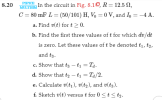 This multi-part problem also contains (not shown above) the
following sub-parts
g.) Find v(t) for t >= 0 if the 12.5 Ohm
resistor is removed from the circuit
h.) Calculate the frequency of v(t) in
hertz
i.) Calculate the maximum amplitude of v(t) in
volts.
Attached is Figure 8.1
MISPICEM In the circuit in Fig. 8.19, R 12.5 Ω, 820 MULTISIM a. Find v(t) for t20 b. Find the first three values of t for which dv/dt is zero. Let...
This multi-part problem also contains (not shown above) the
following sub-parts
g.) Find v(t) for t >= 0 if the 12.5 Ohm
resistor is removed from the circuit
h.) Calculate the frequency of v(t) in
hertz
i.) Calculate the maximum amplitude of v(t) in
volts.
Attached is Figure 8.1
MISPICEM In the circuit in Fig. 8.19, R 12.5 Ω, 820 MULTISIM a. Find v(t) for t20 b. Find the first three values of t for which dv/dt is zero. Let...
this is all thats given Problem IV-B In the circuit of Fig. IV-B(a), determine: K, I,...
 this is all thats given
Problem IV-B In the circuit of Fig. IV-B(a), determine: K, I, I, I in terms of V, and resistive elements and show that: V B I3 px{I,x(R, +2R2)-V,)/ (R, + 2R 2 ) ] (i) FIG. IV-B(a): Id-"A RI R3 I1 I+ R2 KI3 I3 Vo In the circuit of Fig. IV-B(b) shown below 11 Determine: K, 1, 1, Is and V = B I3 elements in terms of Vo and resistive (a) Show that...
this is all thats given
Problem IV-B In the circuit of Fig. IV-B(a), determine: K, I, I, I in terms of V, and resistive elements and show that: V B I3 px{I,x(R, +2R2)-V,)/ (R, + 2R 2 ) ] (i) FIG. IV-B(a): Id-"A RI R3 I1 I+ R2 KI3 I3 Vo In the circuit of Fig. IV-B(b) shown below 11 Determine: K, 1, 1, Is and V = B I3 elements in terms of Vo and resistive (a) Show that...
Problem 4 a) Find the Norton equivalent circuit external to points “a” and “b” in figure...
 Problem 4 a) Find the Norton equivalent circuit external to points “a” and “b” in figure below. b) Find the magnitude and polarity of the voltage across the 100 N2 resistor. 602 16 VO 100 22 80 Ω 8 A 40 Ω 8 V + b Problem 5 Find the Norton equivalent circuit for the network external to the 4.7 k2 resistor in figure below. 3.3 k92 1 k92 1.2 k92 ş 5 mA î 2.2 k92 ww 3.3 k92...
 Derive the transfer function of the circuit in
Fig.P2.93(foranidealopamp)andshowthatitcanbewritten in the
form
Vo Vi = −R2/R1 [1+(ω1/jω)][1+j(ω/ω2)] whereω1=1/C1R1
andω2=1/C2R2.Assumingthatthecircuit is designed such that ω2 ω1,
find approximate expressions
for the transfer function in the following frequency regions: (a)
ωω1 (b) ω1 ωω2 (c) ωω2
Vo
FigureP2.93
Use these approximations to sketch a Bode plot for the magnitude
response. Observe that the circuit performs as an amplifier whose
gain rolls off at the low-frequency end in the manner of a
high-pass...
Derive the transfer function of the circuit in
Fig.P2.93(foranidealopamp)andshowthatitcanbewritten in the
form
Vo Vi = −R2/R1 [1+(ω1/jω)][1+j(ω/ω2)] whereω1=1/C1R1
andω2=1/C2R2.Assumingthatthecircuit is designed such that ω2 ω1,
find approximate expressions
for the transfer function in the following frequency regions: (a)
ωω1 (b) ω1 ωω2 (c) ωω2
Vo
FigureP2.93
Use these approximations to sketch a Bode plot for the magnitude
response. Observe that the circuit performs as an amplifier whose
gain rolls off at the low-frequency end in the manner of a
high-pass...
 Problem 3 The periodic voltage source in the circuit shown in Figure P3 (a) has the waveform shown in Figure P3 (b). a) Derive the expression for Cn b) Find the values of the complex coefficients Co, C1, C1, C 2, C2, C3, C3, C4, and C4 for the input voltage vg, if V,-54 V and T-10π us c) Repeat b) for Vo. d) Use the complex coefficients found in c) to estimate the average power delivered to the 250...
 Problem 1 (10 points): The switch in the circuit of Fig. 1 has been in position a for a long time. Att 0, the switch moves to position b 1. (4 points) Construct an s-domain circuit for t> 0 2. (4 points) Find Vo(s) and vo(t) for t> 0 3. (2 points) Find IL(s) and iL () fort > 0. t-0 Ri R2 R1 = 400 ohms, R2 = 1000 ohms, C = 6.25 nF L 16 mH, and vg-360...
 1. A paralll RLC circuit consists of a A series RLC circuit consists of the same 5000 Ω resistor, 1.25 H inductor, and 8 nF capacitor. a) Find the roots of the characteristic 2. 5000 Ω resistor, a 1.25 H inductor, and an 8 nF capacitor. a) Find the roots of the characteristic equation equation b) Is the response over-damped or b) Is the response over-damped or under-damped? under-damped? c) How would you need to change the resistance to get...
 Problem 3: The switch in the following circuit has been in position a for a long time. At t = 0 the switch moves instantaneously to position b. Find the voltage vo(t) for t 2 0. t =0 10ih 6 ΚΩ а 50 V4 k vo3 51.2 mH 8 μF 150 Q 60 0
 just do question 26 and 30 and show all your work
(a) Select R so that 26. For the cincuit of Fig. 943,.40 30u-) m v(0+) 6 V. (b) Compute (2 ms). (c) Determine the settling time of the capacitor voltage. (d) Is the inductor current settling time the same as your answer to part (c)? 27. The current source in Fig. 9.43 is id) = 101(1-1) μ A. (a) Select Ri such that iLO")-2 μΑ. Compute L at t-500...
just do question 26 and 30 and show all your work
(a) Select R so that 26. For the cincuit of Fig. 943,.40 30u-) m v(0+) 6 V. (b) Compute (2 ms). (c) Determine the settling time of the capacitor voltage. (d) Is the inductor current settling time the same as your answer to part (c)? 27. The current source in Fig. 9.43 is id) = 101(1-1) μ A. (a) Select Ri such that iLO")-2 μΑ. Compute L at t-500...
 Resistive circuit problem, please show clear step. Thank you.
3.Find the equivalent resistance Rab for each of the circuits in Fig. P3.8. Figuro P3. Figure P3.8 6Ω 3Ω 18Ω 3Ω 5Ω 9Ω 2.5Ω 6Ω 5Ω 40Ω 12Ω 45 Ω 5Ω 20 Ω 60Ω 30Ω 2611 75Ω 15 Ω 1Ω 3Ω 10 Ω 3.4 Ω 1.25 Ω 10Ω 15Ω 5.2 Ω
Resistive circuit problem, please show clear step. Thank you.
3.Find the equivalent resistance Rab for each of the circuits in Fig. P3.8. Figuro P3. Figure P3.8 6Ω 3Ω 18Ω 3Ω 5Ω 9Ω 2.5Ω 6Ω 5Ω 40Ω 12Ω 45 Ω 5Ω 20 Ω 60Ω 30Ω 2611 75Ω 15 Ω 1Ω 3Ω 10 Ω 3.4 Ω 1.25 Ω 10Ω 15Ω 5.2 Ω
 This multi-part problem also contains (not shown above) the
following sub-parts
g.) Find v(t) for t >= 0 if the 12.5 Ohm
resistor is removed from the circuit
h.) Calculate the frequency of v(t) in
hertz
i.) Calculate the maximum amplitude of v(t) in
volts.
Attached is Figure 8.1
MISPICEM In the circuit in Fig. 8.19, R 12.5 Ω, 820 MULTISIM a. Find v(t) for t20 b. Find the first three values of t for which dv/dt is zero. Let...
This multi-part problem also contains (not shown above) the
following sub-parts
g.) Find v(t) for t >= 0 if the 12.5 Ohm
resistor is removed from the circuit
h.) Calculate the frequency of v(t) in
hertz
i.) Calculate the maximum amplitude of v(t) in
volts.
Attached is Figure 8.1
MISPICEM In the circuit in Fig. 8.19, R 12.5 Ω, 820 MULTISIM a. Find v(t) for t20 b. Find the first three values of t for which dv/dt is zero. Let...
 this is all thats given
Problem IV-B In the circuit of Fig. IV-B(a), determine: K, I, I, I in terms of V, and resistive elements and show that: V B I3 px{I,x(R, +2R2)-V,)/ (R, + 2R 2 ) ] (i) FIG. IV-B(a): Id-"A RI R3 I1 I+ R2 KI3 I3 Vo In the circuit of Fig. IV-B(b) shown below 11 Determine: K, 1, 1, Is and V = B I3 elements in terms of Vo and resistive (a) Show that...
this is all thats given
Problem IV-B In the circuit of Fig. IV-B(a), determine: K, I, I, I in terms of V, and resistive elements and show that: V B I3 px{I,x(R, +2R2)-V,)/ (R, + 2R 2 ) ] (i) FIG. IV-B(a): Id-"A RI R3 I1 I+ R2 KI3 I3 Vo In the circuit of Fig. IV-B(b) shown below 11 Determine: K, 1, 1, Is and V = B I3 elements in terms of Vo and resistive (a) Show that...
 Problem 4 a) Find the Norton equivalent circuit external to points “a” and “b” in figure below. b) Find the magnitude and polarity of the voltage across the 100 N2 resistor. 602 16 VO 100 22 80 Ω 8 A 40 Ω 8 V + b Problem 5 Find the Norton equivalent circuit for the network external to the 4.7 k2 resistor in figure below. 3.3 k92 1 k92 1.2 k92 ş 5 mA î 2.2 k92 ww 3.3 k92...
Most questions answered within 3 hours.
-
Where is the error in this code sequence?
String s1 = "Hello";
String s2 = "ello";...
asked 10 months ago -
Financial data for Joel de Paris, Inc., for last year
follow:
Joel de Paris, Inc.
Balance...
asked 10 months ago -
Consider this reaction:
Al2(SO4)3 (aq)+ BaCl3
(aq) Al2Cl6 (aq)- +
3BaSO4(s) . What is the...
asked 10 months ago -
Suppose that Savneet is considering increasing her
recent random sample from 20 car rentals to 40...
asked 10 months ago -
Trucks arrive at an unloading terminal at an average rate of 120
per hour.
Trucks arrive...
asked 10 months ago -
Why are methanol and ethanol completely soluble in water while
octanol is not very little soluble....
asked 10 months ago -
A facilities manager at a university reads in a research report
that the mean amount of...
asked 10 months ago -
When the CuSO4 is rehydrated by adding water to the anhydrous
compound, is this an endothermic...
asked 10 months ago -
A ray of sunlight is passing from diamond into crown glass; the
angle of incidence is...
asked 10 months ago -
A block of mass 0.249 kg is placed on top of a light, vertical
spring of...
asked 10 months ago -
how do the kidneys compensate in the presences of acidosis
a) trigger hyperventilate
b) reserve acid...
asked 10 months ago -
Question 501 pts
The rental rate of capital to the firm increases. Which of the
following...
asked 10 months ago