equilibrium
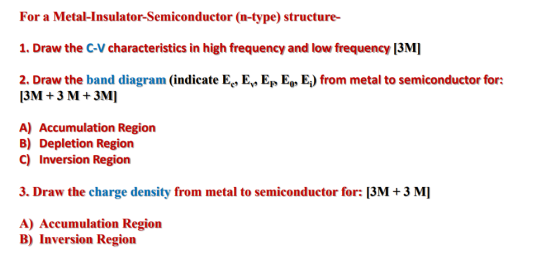
For a Metal-Insulator-Semiconductor (n-type) structure-
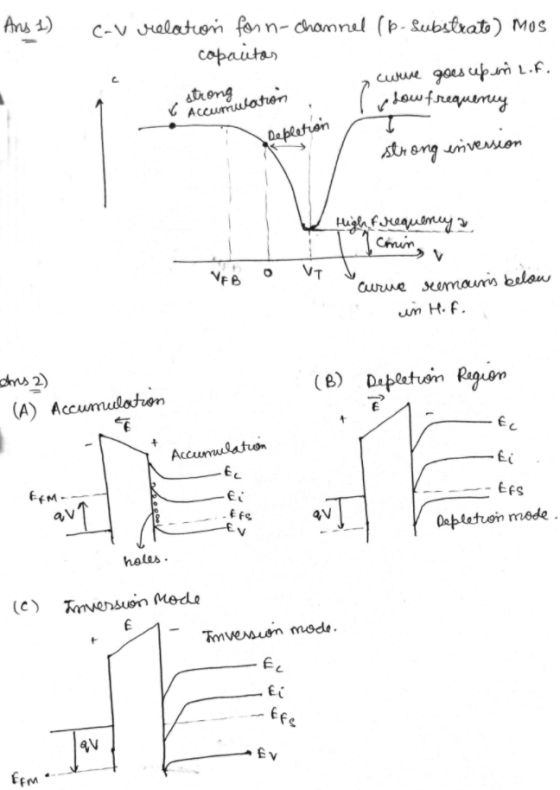
1. Draw the C-V characteristics in high frequency and low frequency
2. Draw the band diagram (indicate Ec, Ev, EF, E0, Ei) from metal to semiconductor for:
A) Accumulation Region
B) Depletion Region
C) Inversion Region
3. Draw the charge density from metal to semiconductor for:
A) Accumulation Region
B) Inversion Region
Homework Answers
equilibrium
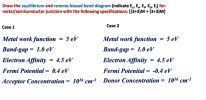 Draw the equilibrium and reverse-biased band diagram (indicate Ec, Ev, EF, E0, Ei) for- metal/semiconductor junction with the following specifications: [(3+3)M +(3+3)M]Metal work function = 5 eVBand-gap = 1.0 eVElectron Affinity = 4.5 eVFermi Potential = 0.4 eVCase 2Metal work function = 5 eVBand-gap = 1.0 eVElectron Affinity = 4.5 eVFermi Potential = -0.4 eVAcceptor Concentration = 1016 cm-3
Draw the energy band diagram at equilibrium for the p+ /n/p semiconductor heterostructure (p+ indicates a...
Draw the energy band diagram at equilibrium for the p+ /n/p semiconductor heterostructure (p+ indicates a p-type semiconductor which is heavily doped, i.e., more heavily doped than p). You should indicate Ec (conduction band), Ev (valence band), Ei (intrinsic Fermi level), and Ef (Fermi level) throughout the device structure. show your work (i.e., you should start from the diagram of individual material pieces). State any reason for your drawing.
Subject : Semiconductor topic MOS + 1. Figure 1 illustrates the energy band diagram of a...
 Subject :
Semiconductor
topic MOS
+ 1. Figure 1 illustrates the energy band diagram of a Metal-Oxide-Semiconductor (MOS). Based on the Figure 1 and the given parameters, Semicon surface Ec Figure 1 a) write the posson's equation that relates the potential and distance from the oxide-semiconductor interface b) write the mathematical relationship of the surface potential as a function of substrate doping concentration when the surface is under strong inversion condition c) write the equation for the maximum width of...
Subject :
Semiconductor
topic MOS
+ 1. Figure 1 illustrates the energy band diagram of a Metal-Oxide-Semiconductor (MOS). Based on the Figure 1 and the given parameters, Semicon surface Ec Figure 1 a) write the posson's equation that relates the potential and distance from the oxide-semiconductor interface b) write the mathematical relationship of the surface potential as a function of substrate doping concentration when the surface is under strong inversion condition c) write the equation for the maximum width of...
For a MOS-structure with an n-type Si, (a) estimate the inversion voltage onset assuming that the flat band condition is Vo 0.5V and draw the corresponding energy band diagram. (b) Using ND 5*101...
 For a MOS-structure with an n-type Si, (a) estimate the inversion voltage onset assuming that the flat band condition is Vo 0.5V and draw the corresponding energy band diagram. (b) Using ND 5*1017 cm3, calculate thickness of the depletion region under applied 1V bias (assume depletion mode) (c) For the same MOS structure, sketch a C-V curve and (d) calculate high-frequency maximum and minimum capacitances assuming metal contact area of 10 um2 and Si thickness of 500A (SiO2 dielectric constant...
Problem 1 (25 points) Si at T = 300K contains donor impurity atoms at a density of 5x 10'6cm and ...
 Problem 1 (25 points) Si at T = 300K contains donor impurity atoms at a density of 5x 10'6cm and acceptor impurity atoms at a density of 2x106 cm-3 . Assume ni 1.5x10'0cm-3, kT-0.026eV a) (5 points) Is the semiconductor n type or p type? b) (10 points) Determine n, and Po c) (10 points) Draw the energy band diagram (Ec, Ev, EFi, Ef) and indicate the position of Ef with respect to Epi
Problem 1 (25 points) Si at...
Problem 1 (25 points) Si at T = 300K contains donor impurity atoms at a density of 5x 10'6cm and acceptor impurity atoms at a density of 2x106 cm-3 . Assume ni 1.5x10'0cm-3, kT-0.026eV a) (5 points) Is the semiconductor n type or p type? b) (10 points) Determine n, and Po c) (10 points) Draw the energy band diagram (Ec, Ev, EFi, Ef) and indicate the position of Ef with respect to Epi
Problem 1 (25 points) Si at...
Problem3: Consider a MOS capacitor maintained at T 300K with the following characteristics: Assume Esi 1.9,x 3.9,8.85 x 10-14 F/cm, and n 1.5 x 1010cm3 . Gate material is n+ poly-silicon . Total n...
 Problem3: Consider a MOS capacitor maintained at T 300K with the following characteristics: Assume Esi 1.9,x 3.9,8.85 x 10-14 F/cm, and n 1.5 x 1010cm3 . Gate material is n+ poly-silicon . Total negative oxide charge of 5x 10¹¹q C/cnm2 . Substrate is n-type Si, with doping concentration 1x1016 cm3 Oxide thickness 5 nm . The electron affinity for Si is 4.03eV? a) Draw the band diagram at equilibrium. b) From part (a). What is the substrate (bulk) condition at...
Draw the band diagram (the relative positions of conduction band edge EC, valence band edge Ev,...
 Draw the band diagram (the relative positions of conduction band
edge EC, valence band edge Ev, Fermi level EF) for the four
following cases. Clearly note EC −EF, EF −EV, Ei −EF, EG = EC −EV.
Ei is the intrinsic Fermi level. Take NC=NV =1025 m−3, EG=1.1 eV,
ni=1.5×10¹⁶ m−3, kT=0.026 eV.
(Q1.1) p-type, NA=5×10²³ m−3.
(Q1.2) p-type, NA=5×10²¹ m−3.
(Q1.3) n-type, ND=5×10²³ m−3.
(Q1.4) n-type, ND=5×10²¹ m−3.
Q2 Draw the band diagram (the relative positions of conduction band edge...
Draw the band diagram (the relative positions of conduction band
edge EC, valence band edge Ev, Fermi level EF) for the four
following cases. Clearly note EC −EF, EF −EV, Ei −EF, EG = EC −EV.
Ei is the intrinsic Fermi level. Take NC=NV =1025 m−3, EG=1.1 eV,
ni=1.5×10¹⁶ m−3, kT=0.026 eV.
(Q1.1) p-type, NA=5×10²³ m−3.
(Q1.2) p-type, NA=5×10²¹ m−3.
(Q1.3) n-type, ND=5×10²³ m−3.
(Q1.4) n-type, ND=5×10²¹ m−3.
Q2 Draw the band diagram (the relative positions of conduction band edge...
2. The equilibrium and steady state conditions before and after illumination of a silicon semicon...
 2. The equilibrium and steady state conditions before and after illumination of a silicon semiconductor are characterized by the energy band shown in figure below. Determine for before and after illumination: (Assume room temperature, and use the semiconductor parameters given in the textbook) a) no and po the equilibrium carrier concentrations b) n and p under steady state conditions. c) No? d) e) Do we have low injection condition when the semiconductor is illuminated? What is the resistivity of the...
Derive C-V characteristics for n-type MOS at high frequency and low frequency (10points). Hints: Strong inversion...
 Derive C-V characteristics for n-type MOS at high frequency and
low frequency (10points).
Hints:
Strong inversion Accumulation Depletion Moderate inversion Figure 10.271 Ideal low-frequency capacitance versus gate voltage of a MOS capacitor with an n-type substrate.
Derive C-V characteristics for n-type MOS at high frequency and
low frequency (10points).
Hints:
Strong inversion Accumulation Depletion Moderate inversion Figure 10.271 Ideal low-frequency capacitance versus gate voltage of a MOS capacitor with an n-type substrate.
Problem 3 (25 points) Consider a MOS capacitor with p polysilicon gate and p-type silicon substrate with NA 1016 cm3. Ef- Ev in the polysilicon gate. Assume the following parameters: I200A, , 1.5x10°...
 Problem 3 (25 points) Consider a MOS capacitor with p polysilicon gate and p-type silicon substrate with NA 1016 cm3. Ef- Ev in the polysilicon gate. Assume the following parameters: I200A, , 1.5x10° cm*,E, -3.9x8.854x104FIcm ox a) (5 points) Calculate the metal-semiconductor work function difference. b) (5 points) Calculate the surface potential at the threshold inversion. c) (5 points) Calculate the depletion width (in μm) at the threshold inversion. d) (5 points) Calculate the flat band voltage. e) (5 points)...
 Subject :
Semiconductor
topic MOS
+ 1. Figure 1 illustrates the energy band diagram of a Metal-Oxide-Semiconductor (MOS). Based on the Figure 1 and the given parameters, Semicon surface Ec Figure 1 a) write the posson's equation that relates the potential and distance from the oxide-semiconductor interface b) write the mathematical relationship of the surface potential as a function of substrate doping concentration when the surface is under strong inversion condition c) write the equation for the maximum width of...
Subject :
Semiconductor
topic MOS
+ 1. Figure 1 illustrates the energy band diagram of a Metal-Oxide-Semiconductor (MOS). Based on the Figure 1 and the given parameters, Semicon surface Ec Figure 1 a) write the posson's equation that relates the potential and distance from the oxide-semiconductor interface b) write the mathematical relationship of the surface potential as a function of substrate doping concentration when the surface is under strong inversion condition c) write the equation for the maximum width of...
 For a MOS-structure with an n-type Si, (a) estimate the inversion voltage onset assuming that the flat band condition is Vo 0.5V and draw the corresponding energy band diagram. (b) Using ND 5*1017 cm3, calculate thickness of the depletion region under applied 1V bias (assume depletion mode) (c) For the same MOS structure, sketch a C-V curve and (d) calculate high-frequency maximum and minimum capacitances assuming metal contact area of 10 um2 and Si thickness of 500A (SiO2 dielectric constant...
 Problem 1 (25 points) Si at T = 300K contains donor impurity atoms at a density of 5x 10'6cm and acceptor impurity atoms at a density of 2x106 cm-3 . Assume ni 1.5x10'0cm-3, kT-0.026eV a) (5 points) Is the semiconductor n type or p type? b) (10 points) Determine n, and Po c) (10 points) Draw the energy band diagram (Ec, Ev, EFi, Ef) and indicate the position of Ef with respect to Epi
Problem 1 (25 points) Si at...
Problem 1 (25 points) Si at T = 300K contains donor impurity atoms at a density of 5x 10'6cm and acceptor impurity atoms at a density of 2x106 cm-3 . Assume ni 1.5x10'0cm-3, kT-0.026eV a) (5 points) Is the semiconductor n type or p type? b) (10 points) Determine n, and Po c) (10 points) Draw the energy band diagram (Ec, Ev, EFi, Ef) and indicate the position of Ef with respect to Epi
Problem 1 (25 points) Si at...
 Problem3: Consider a MOS capacitor maintained at T 300K with the following characteristics: Assume Esi 1.9,x 3.9,8.85 x 10-14 F/cm, and n 1.5 x 1010cm3 . Gate material is n+ poly-silicon . Total negative oxide charge of 5x 10¹¹q C/cnm2 . Substrate is n-type Si, with doping concentration 1x1016 cm3 Oxide thickness 5 nm . The electron affinity for Si is 4.03eV? a) Draw the band diagram at equilibrium. b) From part (a). What is the substrate (bulk) condition at...
 Draw the band diagram (the relative positions of conduction band
edge EC, valence band edge Ev, Fermi level EF) for the four
following cases. Clearly note EC −EF, EF −EV, Ei −EF, EG = EC −EV.
Ei is the intrinsic Fermi level. Take NC=NV =1025 m−3, EG=1.1 eV,
ni=1.5×10¹⁶ m−3, kT=0.026 eV.
(Q1.1) p-type, NA=5×10²³ m−3.
(Q1.2) p-type, NA=5×10²¹ m−3.
(Q1.3) n-type, ND=5×10²³ m−3.
(Q1.4) n-type, ND=5×10²¹ m−3.
Q2 Draw the band diagram (the relative positions of conduction band edge...
Draw the band diagram (the relative positions of conduction band
edge EC, valence band edge Ev, Fermi level EF) for the four
following cases. Clearly note EC −EF, EF −EV, Ei −EF, EG = EC −EV.
Ei is the intrinsic Fermi level. Take NC=NV =1025 m−3, EG=1.1 eV,
ni=1.5×10¹⁶ m−3, kT=0.026 eV.
(Q1.1) p-type, NA=5×10²³ m−3.
(Q1.2) p-type, NA=5×10²¹ m−3.
(Q1.3) n-type, ND=5×10²³ m−3.
(Q1.4) n-type, ND=5×10²¹ m−3.
Q2 Draw the band diagram (the relative positions of conduction band edge...
 2. The equilibrium and steady state conditions before and after illumination of a silicon semiconductor are characterized by the energy band shown in figure below. Determine for before and after illumination: (Assume room temperature, and use the semiconductor parameters given in the textbook) a) no and po the equilibrium carrier concentrations b) n and p under steady state conditions. c) No? d) e) Do we have low injection condition when the semiconductor is illuminated? What is the resistivity of the...
 Derive C-V characteristics for n-type MOS at high frequency and
low frequency (10points).
Hints:
Strong inversion Accumulation Depletion Moderate inversion Figure 10.271 Ideal low-frequency capacitance versus gate voltage of a MOS capacitor with an n-type substrate.
Derive C-V characteristics for n-type MOS at high frequency and
low frequency (10points).
Hints:
Strong inversion Accumulation Depletion Moderate inversion Figure 10.271 Ideal low-frequency capacitance versus gate voltage of a MOS capacitor with an n-type substrate.
 Problem 3 (25 points) Consider a MOS capacitor with p polysilicon gate and p-type silicon substrate with NA 1016 cm3. Ef- Ev in the polysilicon gate. Assume the following parameters: I200A, , 1.5x10° cm*,E, -3.9x8.854x104FIcm ox a) (5 points) Calculate the metal-semiconductor work function difference. b) (5 points) Calculate the surface potential at the threshold inversion. c) (5 points) Calculate the depletion width (in μm) at the threshold inversion. d) (5 points) Calculate the flat band voltage. e) (5 points)...
Most questions answered within 3 hours.
-
Where is the error in this code sequence?
String s1 = "Hello";
String s2 = "ello";...
asked 10 months ago -
Financial data for Joel de Paris, Inc., for last year
follow:
Joel de Paris, Inc.
Balance...
asked 10 months ago -
Consider this reaction:
Al2(SO4)3 (aq)+ BaCl3
(aq) Al2Cl6 (aq)- +
3BaSO4(s) . What is the...
asked 10 months ago -
Suppose that Savneet is considering increasing her
recent random sample from 20 car rentals to 40...
asked 10 months ago -
Trucks arrive at an unloading terminal at an average rate of 120
per hour.
Trucks arrive...
asked 10 months ago -
Why are methanol and ethanol completely soluble in water while
octanol is not very little soluble....
asked 10 months ago -
A facilities manager at a university reads in a research report
that the mean amount of...
asked 10 months ago -
When the CuSO4 is rehydrated by adding water to the anhydrous
compound, is this an endothermic...
asked 10 months ago -
A ray of sunlight is passing from diamond into crown glass; the
angle of incidence is...
asked 10 months ago -
A block of mass 0.249 kg is placed on top of a light, vertical
spring of...
asked 10 months ago -
how do the kidneys compensate in the presences of acidosis
a) trigger hyperventilate
b) reserve acid...
asked 10 months ago -
Question 501 pts
The rental rate of capital to the firm increases. Which of the
following...
asked 10 months ago