
Homework Answers
We use the formula:
A=P(1+r/100)^n
where
A=future value
P=present value
r=rate of interest
n=time period.
A=45*(1-0.12)^3
=45*(0.88)^3
=45*0.681472
=$30.67(Approx).
Add Answer to:
Dylan purchased 1,000 shares in a start-up company for $45 per share after the stocks Initial...
4 Stock Investment. Aspen purchased a dot-com stock, which was heavily advertised on the Internet for...
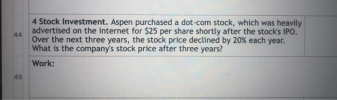 4 Stock Investment. Aspen purchased a dot-com stock, which was heavily advertised on the Internet for $25 per share shortly after the stock's IPO. 44 Over the next three years, the stock price declined by 20% each year. What is the company's stock price after three years? Work: 45
Facebook's initial IPO found stock shares trading at 50% below their initial per share price. Management accountants ana...
Facebook's initial IPO found stock shares trading at 50% below their initial per share price. Management accountants analyzed costs and benefits of different courses of action to help improve the company's monetization. A few years later, Facebook was trading at three times its IPO price. Why did Facebook IPO not do well and price high in the beginning?
Assume that Janet Leigh purchased stock that costs $12.25 per share and purchased 1,000 shares; If...
Assume that Janet Leigh purchased stock that costs $12.25 per share and purchased 1,000 shares; If Janet sold all shares for $21.75 after holding the stock for 15 months, and the single taxpayer was in the 39.6% bracket what are the taxes on this gain? If Janet sold all shares for $19.50 after holding the stock for 8 months, and the single taxpayer was in the 39.6% bracket, what are the taxes on this gain?
You purchased 100 shares of stock for $10 dollars per share. After holding the stock for...
You purchased 100 shares of stock for $10 dollars per share. After holding the stock for 10 years and not receiving any dividends you sell the stock for $42 per share. what is the effective annual rate of return on this investment?
1. Company A sold 100,000 shares in an initial public offering. The underwriter's explicit fees were...
1. Company A sold 100,000 shares in an initial public offering. The underwriter's explicit fees were $90,000. The offering price for the shares was $30, but immediately upon issue, the share price jumped to $43. What is the net proceeds this company receives from this offering? 2. If you are pessimistic about stock A and its market price is $100/share. You short sell 1,000 shares. Suppose the stock A price falls to $70/share. You close your position and what is...
QUESTION 16 6.25 points Save Answer Suppose that you purchased 1,000 shares of stock for $45/share...
 QUESTION 16 6.25 points Save Answer Suppose that you purchased 1,000 shares of stock for $45/share three months ago. Find your geometric mean return if you sell all your shares today for $38/share. .0548 .4915 O- 1556 O-3978
1. Company A sold 100,000 shares in an initial public offering. The underwriter's explicit fees were $90,000. The offeri...
1. Company A sold 100,000 shares in an initial public offering. The underwriter's explicit fees were $90,000. The offering price for the shares was $30, but immediately upon issue, the share price jumped to $43. What is the net proceeds this company receives from this offering? 2. If you are pessimistic about stock A and its market price is $100/share. You short sell 1,000 shares. Suppose the stock A price falls to $70/share. You close your position and what is...
5-5. Yesterday Sandi sold 1,000 shares of stock that she owned for $45 per share. When...
 5-5. Yesterday Sandi sold 1,000 shares of stock that she owned for $45 per share. When she purchased the stock two years ago, Sandi paid $50 per share. Every three months during the time that she held the stock, Sandi received a quarterly dividend equal to $0.50 per share. A total of eight dividends were received. (a) What return (yield) did Sandi earn during the two years she held the stock? (b) If the price of the stock was $45...
Question 9 (1 point) You purchased 100 shares of stock for $5 per share. After holding...
 Question 9 (1 point) You purchased 100 shares of stock for $5 per share. After holding the stock for 8 years and not receiving any dividends, you sell the stock for $42 per share. What are the holding period and annual return on this investment? 185%, 14.42% 920%, 41.63% 740%, 30.48% 625%, 27.66%
You purchased shares of a mutual fund at an offering price of $95 per share at...
You purchased shares of a mutual fund at an offering price of $95 per share at the beginning of the year and paid a front–end load of 4.00%. If the securities in which the fund invested increased in value by 13.25% during the year, and the fund’s expense ratio was 1.50%, what is your rate of return if you sold the fund at the end of the year? Enter your answer rounded to two decimal places. The price of a...
 4 Stock Investment. Aspen purchased a dot-com stock, which was heavily advertised on the Internet for $25 per share shortly after the stock's IPO. 44 Over the next three years, the stock price declined by 20% each year. What is the company's stock price after three years? Work: 45
 QUESTION 16 6.25 points Save Answer Suppose that you purchased 1,000 shares of stock for $45/share three months ago. Find your geometric mean return if you sell all your shares today for $38/share. .0548 .4915 O- 1556 O-3978
 5-5. Yesterday Sandi sold 1,000 shares of stock that she owned for $45 per share. When she purchased the stock two years ago, Sandi paid $50 per share. Every three months during the time that she held the stock, Sandi received a quarterly dividend equal to $0.50 per share. A total of eight dividends were received. (a) What return (yield) did Sandi earn during the two years she held the stock? (b) If the price of the stock was $45...
 Question 9 (1 point) You purchased 100 shares of stock for $5 per share. After holding the stock for 8 years and not receiving any dividends, you sell the stock for $42 per share. What are the holding period and annual return on this investment? 185%, 14.42% 920%, 41.63% 740%, 30.48% 625%, 27.66%
Most questions answered within 3 hours.
-
Where is the error in this code sequence?
String s1 = "Hello";
String s2 = "ello";...
asked 11 months ago -
Financial data for Joel de Paris, Inc., for last year
follow:
Joel de Paris, Inc.
Balance...
asked 11 months ago -
Consider this reaction:
Al2(SO4)3 (aq)+ BaCl3
(aq) Al2Cl6 (aq)- +
3BaSO4(s) . What is the...
asked 11 months ago -
Suppose that Savneet is considering increasing her
recent random sample from 20 car rentals to 40...
asked 11 months ago -
Trucks arrive at an unloading terminal at an average rate of 120
per hour.
Trucks arrive...
asked 11 months ago -
Why are methanol and ethanol completely soluble in water while
octanol is not very little soluble....
asked 11 months ago -
A facilities manager at a university reads in a research report
that the mean amount of...
asked 11 months ago -
When the CuSO4 is rehydrated by adding water to the anhydrous
compound, is this an endothermic...
asked 11 months ago -
A ray of sunlight is passing from diamond into crown glass; the
angle of incidence is...
asked 11 months ago -
A block of mass 0.249 kg is placed on top of a light, vertical
spring of...
asked 11 months ago -
how do the kidneys compensate in the presences of acidosis
a) trigger hyperventilate
b) reserve acid...
asked 11 months ago -
Question 501 pts
The rental rate of capital to the firm increases. Which of the
following...
asked 11 months ago