

Homework Answers

Add Answer to:
PSS 1.3 Vector Addition Constants Learning Goal: To practice Problem-Solving Strategy 1.3 Vector Addition. Three people...
Review I Constants Learning Goal: To practice Problem-Solving Strategy 8.1 Static equilibrium problems. Correct When you...
 Review I Constants Learning Goal: To practice Problem-Solving Strategy 8.1 Static equilibrium problems. Correct When you lift an object by moving only your forearm, the main lifting muscle in your arm is the biceps. Suppose the mass of a forearm is 1.20 kg. If the biceps is connected to the forearm a distance diceps = 2.50 cm from the elbow, how much force Fices must the biceps exert to hold a 500 g ball at the end af the forearm...
PSS 18.1: Calculation of Potential PartA Learning Goal: To apply Problem-Solving Strategy 18.1 Calculation of Which...
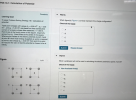 PSS 18.1: Calculation of Potential PartA Learning Goal: To apply Problem-Solving Strategy 18.1 Calculation of Which figuro(e) (Figure 1) correctly represent this charge configuration? Check all that apply Three point charges with values q- 6.00 nC, 3.00 nC, and qs-5.00 nC are placed on three consecutive corners of a square whose side measures s 4.00 m Point A lies at the fourth corner of the square, diagonally across from 92. Point B lies at the center of the square. What...
± PSS 34.1 Image Formation by Mirrors Learning Goal: To practice Problem-Solving Strategy 34.1 Image Formation by Mir...
 ± PSS 34.1 Image Formation by Mirrors
Learning Goal:
To practice Problem-Solving Strategy 34.1 Image Formation by
Mirrors.
(Figure 1) Consider an object located at position P in
front of a concave mirror whose center of curvature is at position
C, as shown in the diagram. Draw a principal-ray diagram
to determine the size and position of the reflected image.
This problem involves using graphical methods to find the image
produced by the mirror. Writing down equations will be of...
± PSS 34.1 Image Formation by Mirrors
Learning Goal:
To practice Problem-Solving Strategy 34.1 Image Formation by
Mirrors.
(Figure 1) Consider an object located at position P in
front of a concave mirror whose center of curvature is at position
C, as shown in the diagram. Draw a principal-ray diagram
to determine the size and position of the reflected image.
This problem involves using graphical methods to find the image
produced by the mirror. Writing down equations will be of...
PSS 26.1 Resistors in Series and Parallel Learning Goal: To practice Problem-Solving Strategy 26.1 Resistors in...
 PSS 26.1 Resistors in Series and Parallel Learning Goal: To practice Problem-Solving Strategy 26.1 Resistors in Series and Parallel. Part A Two bulbs are connected in parallel across a source of emf = 12.0 V with a negligible internal resistance. One bulb has a resistance of 3.0 2, and the other is 3.5 . A resistor R is connected in Which of the following circuit diagrams represents the circuit described in this problem? A the circuit in series with the...
Learning Goal: To practice Problem-Solving Strategy 21.1 Coulomb's Law EXECUTE the solution as follows Three charged...
 Learning Goal: To practice Problem-Solving Strategy 21.1 Coulomb's Law EXECUTE the solution as follows Three charged particles are placed at each of three corners of an equilateral triangle whose sides are of length 3.4 cm. Two of the particles have a negative charge: q-7.3 nC and g2 14.6 nC The remaining particle has a positive charge, g3 8.0 nC. What is the net electric force acting on particle 3 due to particle 1 and particle 2 Part B Find the...
Learning Goal: To practice Problem-Solving Strategy 21.1 Coulomb's Law EXECUTE the solution as follows Three charged...
 Learning Goal: To practice Problem-Solving Strategy 21.1 Coulomb's Law EXECUTE the solution as follows Three charged particles are placed at each of three corners of an equilateral triangle whose sides are of length 3.4 cm. Two of the particles have a negative charge: q-7.3 nC and g2 14.6 nC The remaining particle has a positive charge, g3 8.0 nC. What is the net electric force acting on particle 3 due to particle 1 and particle 2 Part B Find the...
Learning Goal: To practice Problem-Solving Strategy 7.1 Work and kinetic energy. (Figure 1)Marjan, a skier of...
Learning Goal: To practice Problem-Solving Strategy 7.1 Work and kinetic energy. (Figure 1)Marjan, a skier of mass m, coasts a distance son level snow to a stop from a speed of v, as depicted in the figure. Use the work-energy principle to find the coefficient of kinetic friction ?k between the skis and the snow. What is the net force on the skier in the x direction? Enter an expression for the net force in terms of some or all...
+ PSS: Simple Harmonic Motion II: Energy ① 2 0f7 Constants Learning Goal: Part B To...
 + PSS: Simple Harmonic Motion II: Energy ① 2 0f7 Constants Learning Goal: Part B To practice Problem Solving Strategy: Simple Harmonic Motion Il: Energy A child's toy consists of a spherical object of mass 50 g attached to a spring. One end of the spring is fixed to the side of the baby's crib so that when the baby pulls on the toy and lets go, the object oscillates horizontally with a simple harmonic motion. The amplitude of the...
KHwork 01 Electric Force and Field Problem 1 Constants Learning Goal: To practice Problem-Solving Strategy 21.1...
 KHwork 01 Electric Force and Field Problem 1 Constants Learning Goal: To practice Problem-Solving Strategy 21.1 Coulomb's Law Three charged particles are placed at each of three comers of an equilateral triangle whose sides are of length 2.6 cm. Two of the particles have a negative charge: q1 -6.7 nC and g2-13.4 nC The remaining particle has a positive charge, 93 8.0 nC. What is the net electric force acting on particle 3 due to particle 1 and particle 2?...
Learning Goal: To practice Problem-Solving Strategy 8.1 Static equilibrium problems. When you lift an object by...
Learning Goal: To practice Problem-Solving Strategy 8.1 Static equilibrium problems. When you lift an object by moving only your forearm, the main lifting muscle in your arm is the biceps. Suppose the mass of a forearm is 1.40 kg . If the biceps is connected to the forearm a distance dbiceps = 3.50 cm from the elbow, how much force Fbiceps must the biceps exert to hold a 950 g ball at the end of the forearm at distance dball...
 Review I Constants Learning Goal: To practice Problem-Solving Strategy 8.1 Static equilibrium problems. Correct When you lift an object by moving only your forearm, the main lifting muscle in your arm is the biceps. Suppose the mass of a forearm is 1.20 kg. If the biceps is connected to the forearm a distance diceps = 2.50 cm from the elbow, how much force Fices must the biceps exert to hold a 500 g ball at the end af the forearm...
 PSS 18.1: Calculation of Potential PartA Learning Goal: To apply Problem-Solving Strategy 18.1 Calculation of Which figuro(e) (Figure 1) correctly represent this charge configuration? Check all that apply Three point charges with values q- 6.00 nC, 3.00 nC, and qs-5.00 nC are placed on three consecutive corners of a square whose side measures s 4.00 m Point A lies at the fourth corner of the square, diagonally across from 92. Point B lies at the center of the square. What...
 ± PSS 34.1 Image Formation by Mirrors
Learning Goal:
To practice Problem-Solving Strategy 34.1 Image Formation by
Mirrors.
(Figure 1) Consider an object located at position P in
front of a concave mirror whose center of curvature is at position
C, as shown in the diagram. Draw a principal-ray diagram
to determine the size and position of the reflected image.
This problem involves using graphical methods to find the image
produced by the mirror. Writing down equations will be of...
± PSS 34.1 Image Formation by Mirrors
Learning Goal:
To practice Problem-Solving Strategy 34.1 Image Formation by
Mirrors.
(Figure 1) Consider an object located at position P in
front of a concave mirror whose center of curvature is at position
C, as shown in the diagram. Draw a principal-ray diagram
to determine the size and position of the reflected image.
This problem involves using graphical methods to find the image
produced by the mirror. Writing down equations will be of...
 PSS 26.1 Resistors in Series and Parallel Learning Goal: To practice Problem-Solving Strategy 26.1 Resistors in Series and Parallel. Part A Two bulbs are connected in parallel across a source of emf = 12.0 V with a negligible internal resistance. One bulb has a resistance of 3.0 2, and the other is 3.5 . A resistor R is connected in Which of the following circuit diagrams represents the circuit described in this problem? A the circuit in series with the...
 Learning Goal: To practice Problem-Solving Strategy 21.1 Coulomb's Law EXECUTE the solution as follows Three charged particles are placed at each of three corners of an equilateral triangle whose sides are of length 3.4 cm. Two of the particles have a negative charge: q-7.3 nC and g2 14.6 nC The remaining particle has a positive charge, g3 8.0 nC. What is the net electric force acting on particle 3 due to particle 1 and particle 2 Part B Find the...
 Learning Goal: To practice Problem-Solving Strategy 21.1 Coulomb's Law EXECUTE the solution as follows Three charged particles are placed at each of three corners of an equilateral triangle whose sides are of length 3.4 cm. Two of the particles have a negative charge: q-7.3 nC and g2 14.6 nC The remaining particle has a positive charge, g3 8.0 nC. What is the net electric force acting on particle 3 due to particle 1 and particle 2 Part B Find the...
 + PSS: Simple Harmonic Motion II: Energy ① 2 0f7 Constants Learning Goal: Part B To practice Problem Solving Strategy: Simple Harmonic Motion Il: Energy A child's toy consists of a spherical object of mass 50 g attached to a spring. One end of the spring is fixed to the side of the baby's crib so that when the baby pulls on the toy and lets go, the object oscillates horizontally with a simple harmonic motion. The amplitude of the...
 KHwork 01 Electric Force and Field Problem 1 Constants Learning Goal: To practice Problem-Solving Strategy 21.1 Coulomb's Law Three charged particles are placed at each of three comers of an equilateral triangle whose sides are of length 2.6 cm. Two of the particles have a negative charge: q1 -6.7 nC and g2-13.4 nC The remaining particle has a positive charge, 93 8.0 nC. What is the net electric force acting on particle 3 due to particle 1 and particle 2?...
Most questions answered within 3 hours.
-
Where is the error in this code sequence?
String s1 = "Hello";
String s2 = "ello";...
asked 10 months ago -
Financial data for Joel de Paris, Inc., for last year
follow:
Joel de Paris, Inc.
Balance...
asked 10 months ago -
Consider this reaction:
Al2(SO4)3 (aq)+ BaCl3
(aq) Al2Cl6 (aq)- +
3BaSO4(s) . What is the...
asked 10 months ago -
Suppose that Savneet is considering increasing her
recent random sample from 20 car rentals to 40...
asked 10 months ago -
Trucks arrive at an unloading terminal at an average rate of 120
per hour.
Trucks arrive...
asked 10 months ago -
Why are methanol and ethanol completely soluble in water while
octanol is not very little soluble....
asked 10 months ago -
A facilities manager at a university reads in a research report
that the mean amount of...
asked 10 months ago -
When the CuSO4 is rehydrated by adding water to the anhydrous
compound, is this an endothermic...
asked 10 months ago -
A ray of sunlight is passing from diamond into crown glass; the
angle of incidence is...
asked 10 months ago -
A block of mass 0.249 kg is placed on top of a light, vertical
spring of...
asked 10 months ago -
how do the kidneys compensate in the presences of acidosis
a) trigger hyperventilate
b) reserve acid...
asked 10 months ago -
Question 501 pts
The rental rate of capital to the firm increases. Which of the
following...
asked 10 months ago