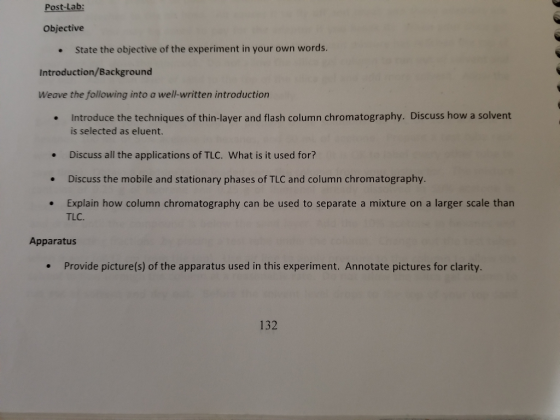
Can you help me answer the questions for the Introduction/Background?
1. Introduced the techniques of thin-layer and flask column chromatography. Discuss how a solvent is elected as eluent.
2. Discuss all the applications of TLC. What is it used for?
3. Discuss the mobile and stationary phases of TLC and column chromatography.
4. Explain how column chromatography can be used to separate a mixture on a larger scale than TLC.
Homework Answers


Add Answer to:
Can you help me answer the questions for the
Introduction/Background?
1. Introduced the techniques of thin-layer...
Hello all, we did a lab about column chromatography, objective was Separation of a Fluorene and...
 Hello all, we did a lab about column chromatography, objective
was Separation of a Fluorene and Fluorenol mixture.
Please answer the following (do not write in cursive):
Introduction and Background: Introduce technique of normal phase column chromatography and thin-layer chromatography. O Purpose o The principle of how they work – include the mobile and stationary phases o Rf value O Applications
Hello all, we did a lab about column chromatography, objective
was Separation of a Fluorene and Fluorenol mixture.
Please answer the following (do not write in cursive):
Introduction and Background: Introduce technique of normal phase column chromatography and thin-layer chromatography. O Purpose o The principle of how they work – include the mobile and stationary phases o Rf value O Applications
Problem 1 Thin layer Chromatography consist of three parts: The analyte, the stationary phase and mobile...
Problem 1 Thin layer Chromatography consist of three parts: The analyte, the stationary phase and mobile phase. Match each of these terms to what is was in out experiment. Stationary Phase ____ a) The solvent Mobile Phase ____ b) Silica Analyte ____ c) One of the analgesiscs Problem 2 Complete the sentences Analytes on a TLC should have a(n) _________ Rf in a less polar solvent. Analytes on a TLC should have a(n) _________ Rf in a more polar solvent....
2. An unknown compound was analyzed using thin layer chromatography, its constituted of two components (A...
 2. An unknown compound was analyzed using thin layer chromatography, its constituted of two components (A and B) as shown in the TLC (Silica coated stationary phase; Chloroform and Ethyl acetate as mobile phase). The mixture was then loaded onto column with silica as the stationary phase and the same solvent system was used. (2 points) Column Chromatography TLC time A В Predict the order of elution of the compounds (A and B). which one would be eluted first/last and...
Hi can someone help me with my pre lab theory questions (1,2,3) on rate of elution...
 Hi can someone help me with my pre lab theory questions (1,2,3)
on rate of elution or Rf? Here is some background below. Please
help explain as many as possible (1-3)! I dont really get the
relation ships in this lab, thank you!
1. What factors affect the rate of elution in organic compounds? 2. Explain what is the relationship between polarities of compounds (polar/non- polar compound) and rate of elution (Rf). 3. Explain what is the relationship between solvent...
Hi can someone help me with my pre lab theory questions (1,2,3)
on rate of elution or Rf? Here is some background below. Please
help explain as many as possible (1-3)! I dont really get the
relation ships in this lab, thank you!
1. What factors affect the rate of elution in organic compounds? 2. Explain what is the relationship between polarities of compounds (polar/non- polar compound) and rate of elution (Rf). 3. Explain what is the relationship between solvent...
These questions are from an experiment where we had a mixture of Ferrocene, acetylferrocene and diacetyl...
These questions are from an experiment where we had a mixture of Ferrocene, acetylferrocene and diacetyl ferrocene and we separated each by using column chromatography. Before doing the column chromatography we did TLC analysis to ensure that we did, in fact, have a mixture of these 3 compounds. During the column chromatography we first eluted the ferrocene using pure hexane. Then we eluted the acetylferrocene using a 1:1 mixture of hexane and methylene chloride. Then we eluted the diacetylferrocene using...
Background In this lab, we are going to learn how to use a powerful separation technique...
Background In this lab, we are going to learn how to use a powerful separation technique called chromatography which can separate compounds that are quite similar to one another. Chromatography is a general type of separation in which a mixture of compounds passes through a stationary phase. Different compounds have different relative affinities for the mixture traveling along the stationary phase, or the mobile phase, and the stationary phase, causing these compounds to separate from one another. More specifically, we’re...
Which of the following statements regarding thin layer chromatography are TRUE? Partition chromatography separates compounds based...
Which of the following statements regarding thin layer chromatography are TRUE? Partition chromatography separates compounds based on how they distribute themselves between the stationary and mobile phases. In thin layer chromatography, a polar organic compound will be attracted to the adsorbent and therefore travel further up the plate than a non-polar compound The Rf value is independent of the adsorbent material used. In thin layer chromatography, a polar organic compound will be repelled by the adsorbent and therefore travel not...
11. Why should you use pencil instead of pen when marking on a thin layer chromatography...
11. Why should you use pencil instead of pen when marking on a thin layer chromatography plate? a. Pencil lead isn't as dark. b. The components of pen ink will separate along with your sample, while pencil lead will not. c. Pen ink will not mark on a TLC plate. d. Pen ink will undergo a chemical reaction with the solvent. 12. Which of the following is not a reason to use thin-layer chromatography? a. To determine the number of...
Question 1 Which of the following is the advantage of straight packed column? Selected Answer: It...
 Question 1 Which of the following is the advantage of straight packed column? Selected Answer: It can be repacked easily Answers It can be packed uniformly It can be repacked easily It is compact It is easier to heat it evenly Question 2 Which of the following statements most accurately describes thin-layer chromatography? Selected Answer: technique used to separate non-volatile mixtures, the mobile phase has different properties from the stationary phase. Answers The mobile phase is the solvent also called...
Classify and breifky explain the different patterns of genetic inheritance in humans Questions for the Thin...
 Classify and breifky explain the different patterns of genetic
inheritance in humans
Questions for the Thin Layer Chromatography Laboratory 1. Why can't you use a pen to mark the origin of a TLC plate? Be explicit in your answer. 2. You were impatient to see how long it would take for your sample to resolve on the TLC plate, so you constantly removed the top from the chamber. Please explain why this is an incorrect practice. 3. What happens when...
Classify and breifky explain the different patterns of genetic
inheritance in humans
Questions for the Thin Layer Chromatography Laboratory 1. Why can't you use a pen to mark the origin of a TLC plate? Be explicit in your answer. 2. You were impatient to see how long it would take for your sample to resolve on the TLC plate, so you constantly removed the top from the chamber. Please explain why this is an incorrect practice. 3. What happens when...
 Hello all, we did a lab about column chromatography, objective
was Separation of a Fluorene and Fluorenol mixture.
Please answer the following (do not write in cursive):
Introduction and Background: Introduce technique of normal phase column chromatography and thin-layer chromatography. O Purpose o The principle of how they work – include the mobile and stationary phases o Rf value O Applications
Hello all, we did a lab about column chromatography, objective
was Separation of a Fluorene and Fluorenol mixture.
Please answer the following (do not write in cursive):
Introduction and Background: Introduce technique of normal phase column chromatography and thin-layer chromatography. O Purpose o The principle of how they work – include the mobile and stationary phases o Rf value O Applications
 2. An unknown compound was analyzed using thin layer chromatography, its constituted of two components (A and B) as shown in the TLC (Silica coated stationary phase; Chloroform and Ethyl acetate as mobile phase). The mixture was then loaded onto column with silica as the stationary phase and the same solvent system was used. (2 points) Column Chromatography TLC time A В Predict the order of elution of the compounds (A and B). which one would be eluted first/last and...
 Hi can someone help me with my pre lab theory questions (1,2,3)
on rate of elution or Rf? Here is some background below. Please
help explain as many as possible (1-3)! I dont really get the
relation ships in this lab, thank you!
1. What factors affect the rate of elution in organic compounds? 2. Explain what is the relationship between polarities of compounds (polar/non- polar compound) and rate of elution (Rf). 3. Explain what is the relationship between solvent...
Hi can someone help me with my pre lab theory questions (1,2,3)
on rate of elution or Rf? Here is some background below. Please
help explain as many as possible (1-3)! I dont really get the
relation ships in this lab, thank you!
1. What factors affect the rate of elution in organic compounds? 2. Explain what is the relationship between polarities of compounds (polar/non- polar compound) and rate of elution (Rf). 3. Explain what is the relationship between solvent...
 Question 1 Which of the following is the advantage of straight packed column? Selected Answer: It can be repacked easily Answers It can be packed uniformly It can be repacked easily It is compact It is easier to heat it evenly Question 2 Which of the following statements most accurately describes thin-layer chromatography? Selected Answer: technique used to separate non-volatile mixtures, the mobile phase has different properties from the stationary phase. Answers The mobile phase is the solvent also called...
 Classify and breifky explain the different patterns of genetic
inheritance in humans
Questions for the Thin Layer Chromatography Laboratory 1. Why can't you use a pen to mark the origin of a TLC plate? Be explicit in your answer. 2. You were impatient to see how long it would take for your sample to resolve on the TLC plate, so you constantly removed the top from the chamber. Please explain why this is an incorrect practice. 3. What happens when...
Classify and breifky explain the different patterns of genetic
inheritance in humans
Questions for the Thin Layer Chromatography Laboratory 1. Why can't you use a pen to mark the origin of a TLC plate? Be explicit in your answer. 2. You were impatient to see how long it would take for your sample to resolve on the TLC plate, so you constantly removed the top from the chamber. Please explain why this is an incorrect practice. 3. What happens when...
Most questions answered within 3 hours.
-
Where is the error in this code sequence?
String s1 = "Hello";
String s2 = "ello";...
asked 10 months ago -
Financial data for Joel de Paris, Inc., for last year
follow:
Joel de Paris, Inc.
Balance...
asked 10 months ago -
Consider this reaction:
Al2(SO4)3 (aq)+ BaCl3
(aq) Al2Cl6 (aq)- +
3BaSO4(s) . What is the...
asked 10 months ago -
Suppose that Savneet is considering increasing her
recent random sample from 20 car rentals to 40...
asked 10 months ago -
Trucks arrive at an unloading terminal at an average rate of 120
per hour.
Trucks arrive...
asked 10 months ago -
Why are methanol and ethanol completely soluble in water while
octanol is not very little soluble....
asked 10 months ago -
A facilities manager at a university reads in a research report
that the mean amount of...
asked 10 months ago -
When the CuSO4 is rehydrated by adding water to the anhydrous
compound, is this an endothermic...
asked 10 months ago -
A ray of sunlight is passing from diamond into crown glass; the
angle of incidence is...
asked 10 months ago -
A block of mass 0.249 kg is placed on top of a light, vertical
spring of...
asked 10 months ago -
how do the kidneys compensate in the presences of acidosis
a) trigger hyperventilate
b) reserve acid...
asked 10 months ago -
Question 501 pts
The rental rate of capital to the firm increases. Which of the
following...
asked 10 months ago