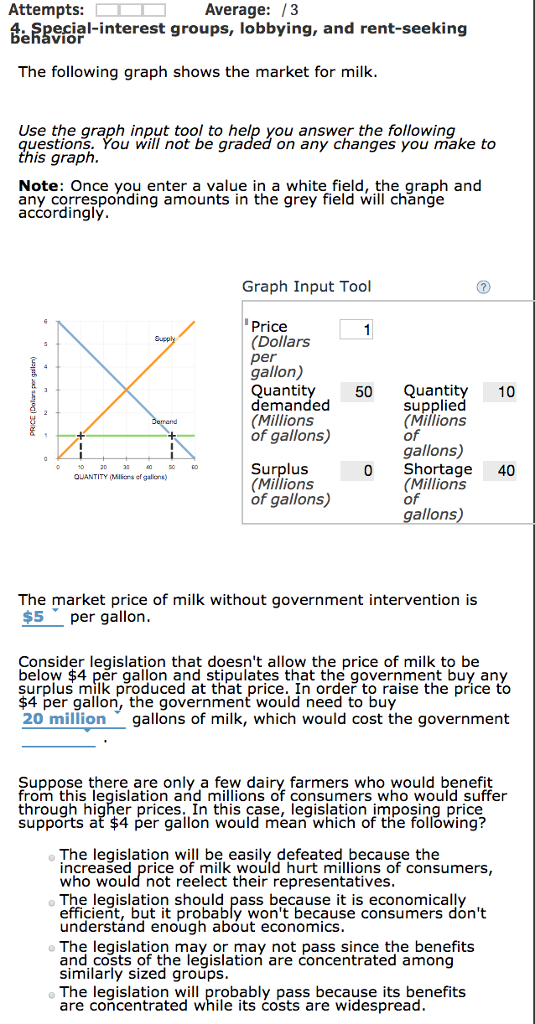
I'm not sure if the 2 questioned with the filled blanks are right or not either. So please answer all the questions
Homework Answers
$3
(It is determined at the intersection of demand and supply.)
20 million; $80 million
(At $4, supply = 40 and demand = 20. So, government needs to buy 40
- 20 = 20 million at a cost of 4*20 = $80 million.)
The legislation will probably pass because its benefits are
concentrated while its costs are widespread.
(As benefits are concentrated and costs are shared by a large
number of people so this legislation will probably pass.)
Add Answer to:
I'm not sure if the 2 questioned with the filled blanks are
right or not either....
First option: $4- $5- $6 Second option: 0 million- 67 million- 100 million- 95 million Third...
 First option: $4- $5- $6
Second option: 0 million- 67 million- 100 million- 95
million
Third option: $603 million- $909 million- $306 million- $54
million
4. Special-interest groups, lobbying, and rent-seeking behavior The following graph shows the market for milk. Use the graph input tool to help you answer the following questions. You will not be graded on any changes you make to this graph. Note: Once you enter a value in a white field, the graph and any corresponding...
First option: $4- $5- $6
Second option: 0 million- 67 million- 100 million- 95
million
Third option: $603 million- $909 million- $306 million- $54
million
4. Special-interest groups, lobbying, and rent-seeking behavior The following graph shows the market for milk. Use the graph input tool to help you answer the following questions. You will not be graded on any changes you make to this graph. Note: Once you enter a value in a white field, the graph and any corresponding...
3. Special-interest groups, lobbying, and rent-seeking behavior The following graph shows the market for orange juice....
 3. Special-interest groups, lobbying, and rent-seeking behavior The following graph shows the market for orange juice. Use the graph input tool to help you answer the following questions. You will not be graded on any changes you make to this graph. Note: Once you enter a value in a white field, the graph and any corresponding amounts in the grey field will change accordingly. Graph Input Tool Supply 88 Price (Dollars per gallon) Quantity demanded (Millions of gallons) Surplus (Millions...
3. Special-interest groups, lobbying, and rent-seeking behavior The following graph shows the market for paint. Use...
 3. Special-interest groups, lobbying, and rent-seeking behavior The following graph shows the market for paint. Use the graph input tool to help you answer the following questions. You will not be graded on any changes you make to this graph. Note: Once you enter a value in a white field, the graph and any corresponding amounts in the grey field will change accordingly. Graph Input Tool Price (Dollars per gallon) Quantity demanded (Milions of gallons) Surplus (Millions of gallons) Quantity...
Need help with this problem b-e, i did a already. Need help asap. Thanks Consider an agricultural subsidy provided by th...
 Need help with this problem
b-e, i did a already. Need help asap. Thanks
Consider an agricultural subsidy provided by the US government. Consider also that milk is one of the products subsidized. If there is NO trade with the rest of the world, the domestic price of milk in the US would be $2.25 per gallon and the equilibrium quantity would be 100 gallons at this price. After trade opens, at the world market price of $1.50 per gallon,...
Need help with this problem
b-e, i did a already. Need help asap. Thanks
Consider an agricultural subsidy provided by the US government. Consider also that milk is one of the products subsidized. If there is NO trade with the rest of the world, the domestic price of milk in the US would be $2.25 per gallon and the equilibrium quantity would be 100 gallons at this price. After trade opens, at the world market price of $1.50 per gallon,...
help pls 1 and 2 The table below contains data about the gasoline market If the...
 help pls 1 and 2
The table below contains data about the gasoline market If the price of a gallon of gasoline was Consumers would be willing to buy millions of gallons per day! Producers would be willing to sed millions of gallons per dayl: SO $2.75 $3.00 53.25 $3.50 SIIS Directions: Use the data above and the space below to graph the demand and succy curves for gasoline $3.50 $3.25 $3.00 $2.75 $2.50 $2.25 o 30 50 55 60...
help pls 1 and 2
The table below contains data about the gasoline market If the price of a gallon of gasoline was Consumers would be willing to buy millions of gallons per day! Producers would be willing to sed millions of gallons per dayl: SO $2.75 $3.00 53.25 $3.50 SIIS Directions: Use the data above and the space below to graph the demand and succy curves for gasoline $3.50 $3.25 $3.00 $2.75 $2.50 $2.25 o 30 50 55 60...
Assume that the market demand and supply curves for milk are as shown in the graph...
 Assume that the market demand and supply curves for milk are as
shown
in the graph below.
As shown in the graph, the market clearing price is $3 per
gallon and the quantity
exchanged is 100 gallons per hour. Now assume that the
government imposes a tax of
2$ per gallon of milk produced.
a.
What is the total tax revenue the government will collect? Also,
shade
the area on your graph where the total tax revenue is
represented.
b....
Assume that the market demand and supply curves for milk are as
shown
in the graph below.
As shown in the graph, the market clearing price is $3 per
gallon and the quantity
exchanged is 100 gallons per hour. Now assume that the
government imposes a tax of
2$ per gallon of milk produced.
a.
What is the total tax revenue the government will collect? Also,
shade
the area on your graph where the total tax revenue is
represented.
b....
2. Tax Incidence: (8 points) Oil Market with Tax Supply w Tax 5.50 Supply Price ($...
 2. Tax Incidence: (8 points) Oil Market with Tax Supply w Tax 5.50 Supply Price ($ per gallon) Demand 0.00 O 0.5 1 1.5 6.5 7 7.5 8 2 2.5 3 3.5 4 4.5 5 5.5 6 Quantity (Gallons of oil, millions) a. What is the competitive equilibrium price and quantity without government intervention? b. What is the consumer surplus (measured in dollars) in this market when there is no government intervention? c. What is the producer surplus (measured in...
Use the graph to the right for a monopoly to answer the questions 4.8 What quantity will the mono...
 Use the graph to the right for a monopoly to answer the questions 4.8 What quantity will the monopoly produce, and what price will the monopoly charge? MC 4.0 3.6 5 3.2 a 2.8 2.4 o 2.0 The monopoly will produce units and charge $L per unit. (Enter numeric responses using real numbers rounded to two decimal places.) ATC Suppose the government decides to regulate this monopoly and imposes a price ceiling of $2.40 (in other words, the monopoly can...
3. The (inverse) supply and demand curves for a cornpany are as follows: Supply: Ps-10+Qs Demand:...
 3. The (inverse) supply and demand curves for a cornpany are as follows: Supply: Ps-10+Qs Demand: Pd-70-2Qd where Q-millions of bushels and P-price per bushel in є. (a) Calculate the equilibrium price and quantity that would prevail in the free market and illustrate your (b) Calculate the consumer and producer surplus. (The area of a triangle is -base* perpendicular height) (c) Suppose the European parliament is considering introducing price support where they guarantee a price answer using a diagram Show...
Power stations emit sulfur dioxide as a waste product. This generates a cost to society that...
 Power stations emit sulfur dioxide as a waste product. This generates a cost to society that is not paid for by the firm; therefore, pollution is a negative externality of power production. Suppose the U.S. government wants to correct this market failure by getting firms to internalize the cost of pollution. To do this, the government can charge firms for pollution rights (the right to emit a given quantity of sulfur dioxide). The following graph shows the daily demand for...
 First option: $4- $5- $6
Second option: 0 million- 67 million- 100 million- 95
million
Third option: $603 million- $909 million- $306 million- $54
million
4. Special-interest groups, lobbying, and rent-seeking behavior The following graph shows the market for milk. Use the graph input tool to help you answer the following questions. You will not be graded on any changes you make to this graph. Note: Once you enter a value in a white field, the graph and any corresponding...
First option: $4- $5- $6
Second option: 0 million- 67 million- 100 million- 95
million
Third option: $603 million- $909 million- $306 million- $54
million
4. Special-interest groups, lobbying, and rent-seeking behavior The following graph shows the market for milk. Use the graph input tool to help you answer the following questions. You will not be graded on any changes you make to this graph. Note: Once you enter a value in a white field, the graph and any corresponding...
 3. Special-interest groups, lobbying, and rent-seeking behavior The following graph shows the market for orange juice. Use the graph input tool to help you answer the following questions. You will not be graded on any changes you make to this graph. Note: Once you enter a value in a white field, the graph and any corresponding amounts in the grey field will change accordingly. Graph Input Tool Supply 88 Price (Dollars per gallon) Quantity demanded (Millions of gallons) Surplus (Millions...
 3. Special-interest groups, lobbying, and rent-seeking behavior The following graph shows the market for paint. Use the graph input tool to help you answer the following questions. You will not be graded on any changes you make to this graph. Note: Once you enter a value in a white field, the graph and any corresponding amounts in the grey field will change accordingly. Graph Input Tool Price (Dollars per gallon) Quantity demanded (Milions of gallons) Surplus (Millions of gallons) Quantity...
 Need help with this problem
b-e, i did a already. Need help asap. Thanks
Consider an agricultural subsidy provided by the US government. Consider also that milk is one of the products subsidized. If there is NO trade with the rest of the world, the domestic price of milk in the US would be $2.25 per gallon and the equilibrium quantity would be 100 gallons at this price. After trade opens, at the world market price of $1.50 per gallon,...
Need help with this problem
b-e, i did a already. Need help asap. Thanks
Consider an agricultural subsidy provided by the US government. Consider also that milk is one of the products subsidized. If there is NO trade with the rest of the world, the domestic price of milk in the US would be $2.25 per gallon and the equilibrium quantity would be 100 gallons at this price. After trade opens, at the world market price of $1.50 per gallon,...
 help pls 1 and 2
The table below contains data about the gasoline market If the price of a gallon of gasoline was Consumers would be willing to buy millions of gallons per day! Producers would be willing to sed millions of gallons per dayl: SO $2.75 $3.00 53.25 $3.50 SIIS Directions: Use the data above and the space below to graph the demand and succy curves for gasoline $3.50 $3.25 $3.00 $2.75 $2.50 $2.25 o 30 50 55 60...
help pls 1 and 2
The table below contains data about the gasoline market If the price of a gallon of gasoline was Consumers would be willing to buy millions of gallons per day! Producers would be willing to sed millions of gallons per dayl: SO $2.75 $3.00 53.25 $3.50 SIIS Directions: Use the data above and the space below to graph the demand and succy curves for gasoline $3.50 $3.25 $3.00 $2.75 $2.50 $2.25 o 30 50 55 60...
 Assume that the market demand and supply curves for milk are as
shown
in the graph below.
As shown in the graph, the market clearing price is $3 per
gallon and the quantity
exchanged is 100 gallons per hour. Now assume that the
government imposes a tax of
2$ per gallon of milk produced.
a.
What is the total tax revenue the government will collect? Also,
shade
the area on your graph where the total tax revenue is
represented.
b....
Assume that the market demand and supply curves for milk are as
shown
in the graph below.
As shown in the graph, the market clearing price is $3 per
gallon and the quantity
exchanged is 100 gallons per hour. Now assume that the
government imposes a tax of
2$ per gallon of milk produced.
a.
What is the total tax revenue the government will collect? Also,
shade
the area on your graph where the total tax revenue is
represented.
b....
 2. Tax Incidence: (8 points) Oil Market with Tax Supply w Tax 5.50 Supply Price ($ per gallon) Demand 0.00 O 0.5 1 1.5 6.5 7 7.5 8 2 2.5 3 3.5 4 4.5 5 5.5 6 Quantity (Gallons of oil, millions) a. What is the competitive equilibrium price and quantity without government intervention? b. What is the consumer surplus (measured in dollars) in this market when there is no government intervention? c. What is the producer surplus (measured in...
 Use the graph to the right for a monopoly to answer the questions 4.8 What quantity will the monopoly produce, and what price will the monopoly charge? MC 4.0 3.6 5 3.2 a 2.8 2.4 o 2.0 The monopoly will produce units and charge $L per unit. (Enter numeric responses using real numbers rounded to two decimal places.) ATC Suppose the government decides to regulate this monopoly and imposes a price ceiling of $2.40 (in other words, the monopoly can...
 3. The (inverse) supply and demand curves for a cornpany are as follows: Supply: Ps-10+Qs Demand: Pd-70-2Qd where Q-millions of bushels and P-price per bushel in є. (a) Calculate the equilibrium price and quantity that would prevail in the free market and illustrate your (b) Calculate the consumer and producer surplus. (The area of a triangle is -base* perpendicular height) (c) Suppose the European parliament is considering introducing price support where they guarantee a price answer using a diagram Show...
 Power stations emit sulfur dioxide as a waste product. This generates a cost to society that is not paid for by the firm; therefore, pollution is a negative externality of power production. Suppose the U.S. government wants to correct this market failure by getting firms to internalize the cost of pollution. To do this, the government can charge firms for pollution rights (the right to emit a given quantity of sulfur dioxide). The following graph shows the daily demand for...
Most questions answered within 3 hours.
-
Where is the error in this code sequence?
String s1 = "Hello";
String s2 = "ello";...
asked 10 months ago -
Financial data for Joel de Paris, Inc., for last year
follow:
Joel de Paris, Inc.
Balance...
asked 10 months ago -
Consider this reaction:
Al2(SO4)3 (aq)+ BaCl3
(aq) Al2Cl6 (aq)- +
3BaSO4(s) . What is the...
asked 10 months ago -
Suppose that Savneet is considering increasing her
recent random sample from 20 car rentals to 40...
asked 10 months ago -
Trucks arrive at an unloading terminal at an average rate of 120
per hour.
Trucks arrive...
asked 10 months ago -
Why are methanol and ethanol completely soluble in water while
octanol is not very little soluble....
asked 10 months ago -
A facilities manager at a university reads in a research report
that the mean amount of...
asked 10 months ago -
When the CuSO4 is rehydrated by adding water to the anhydrous
compound, is this an endothermic...
asked 10 months ago -
A ray of sunlight is passing from diamond into crown glass; the
angle of incidence is...
asked 10 months ago -
A block of mass 0.249 kg is placed on top of a light, vertical
spring of...
asked 10 months ago -
how do the kidneys compensate in the presences of acidosis
a) trigger hyperventilate
b) reserve acid...
asked 10 months ago -
Question 501 pts
The rental rate of capital to the firm increases. Which of the
following...
asked 10 months ago