Write the mechanism of oxidation of an alcohol with sodium hypochlorite in the presence of glacial...
Write the mechanism of oxidation of an alcohol with sodium hypochlorite in the presence of glacial acetic acid. Indicate, which species is an electron acceptor.
Homework Answers

Add Answer to:
Write the mechanism of oxidation of an alcohol with sodium
hypochlorite in the presence of glacial...
[08 pts.] Briefly explain the roles of sodium hypochlorite and acetic acid in the oxidation of...
 [08 pts.] Briefly explain the roles of sodium hypochlorite and acetic acid in the oxidation of cyclohexanol. sodium hypochlorite and acetic aut are added together to create the hypochlurous act, which used to protorate the oth grap on cyclo hexarod. [12 pts.] Draw the major product for each of the following oxidation reactions. кон Na CrO; H2SO4, H,0 Na Cr2O7 H2SO4, H20 CHO PCC
Oxidation of alcohol Write an equation to represent the oxidation of an alcohol. Write a mechanism...
 Oxidation of alcohol Write an equation to represent the oxidation of an alcohol. Write a mechanism for the oxidation of an alcohol. Identify the reagents that may be used to oxidize a given alcohol. Identify the specific reagent that is used to oxidize primary alcohols to aldehydes rather than to carboxylic acids. Identify the product formed from the oxidation of a given alcohol with a specified oxidizing agent. Identify the alcohol needed to prepare a given aldehyde, ketone or carboxylic...
What is the role of the Acetic acid in the oxidation of Cyclohexanol to Cyclohexanone? Write...
What is the role of the Acetic acid in the oxidation of Cyclohexanol to Cyclohexanone? Write the balanced chemical reaction between acetic acid and sodium hypochlorite.
1. [09 pts.] Draw the chemical equations for formation of hypochlorous acid and oxidation of cyclohexanol....
 1. [09 pts.] Draw the chemical equations for formation of hypochlorous acid and oxidation of cyclohexanol. (No mechanism) 2. (11 pts.) Show the detailed mechanism for oxidation of cyclohexanol. Show all arrows to indicate movement of electrons. 3. [08 pts.] Briefly explain the roles of sodium hypochlorite and acetic acid in the oxidation of cyclohexanol.
a) Draw the mechanism (including electron-movement arrows) of the acid-catalyzed esterification + H2O Sulfuric Acetic acid...
 a) Draw the mechanism (including electron-movement arrows) of the acid-catalyzed esterification + H2O Sulfuric Acetic acid Isoamyl alcohol acid isoamyl acetatewater (concn.) (glacial)
Organic chemistry lab on Oxidation Puzzle Sample Questions 1. 2. 4. Write a mechanism for the...
 Organic chemistry lab on Oxidation Puzzle
Sample Questions 1. 2. 4. Write a mechanism for the reaction of 2-butanol with sodium hypochlorite in an acetic acid solution. Provide two disadvantages associated with using dichromate for the process of oxidation (i.e. justify why you will be using NaOCl instead of dichromate). What is the purpose of adding NaHSO, solution to the reaction? Draw all of the possible products which could form if two equivalents of NaOCI are used in the oxidation...
Organic chemistry lab on Oxidation Puzzle
Sample Questions 1. 2. 4. Write a mechanism for the reaction of 2-butanol with sodium hypochlorite in an acetic acid solution. Provide two disadvantages associated with using dichromate for the process of oxidation (i.e. justify why you will be using NaOCl instead of dichromate). What is the purpose of adding NaHSO, solution to the reaction? Draw all of the possible products which could form if two equivalents of NaOCI are used in the oxidation...
2) Draw the NFPA diamonds for glacial acetic acid, 3% (v/v) acetic acid, and sodium bicarbonate...
 2) Draw the NFPA diamonds for glacial acetic acid, 3% (v/v) acetic acid, and sodium bicarbonate (check MSDS sheets). 3.) Why is pure acetic acid known as glacial acetic acid? 4) Explain Boyle's Law, Charles' Law and Avogadro's Law.
What will the oxidation product of the following alcohol? Write a reasonable mechanism for the following...
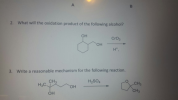 What will the oxidation product of the following alcohol? Write a reasonable mechanism for the following reaction.
Experiment for the oxidation of cyclododecanol to cyclododecanone A) In the experiment it states, in the...
Experiment for the oxidation of cyclododecanol to cyclododecanone A) In the experiment it states, in the 50ml round bottom flask add 1.00g of cyclododecanol, 4.0 ml of acetone and 1.5 ml of acetic acid. Warm the mixtures. slowly add 12.0 ml of sodium hypochlorite. 1) From that statement. "How do you caculate the number of moles of cyclododecanol, sodium hypochlorite, and acetic acid" ? 2) Show the formula and steps to calculate the number of moles from those compounds. B)...
There's been more spotlight on bleach recently. Bleach is sodium hypochlorite. a) is the hypochlorite ion...
 There's been more spotlight on bleach recently. Bleach is sodium hypochlorite. a) is the hypochlorite ion an acid or a base? b) Write the reaction of hypochlorite with water, showing reactants and products. c) What product in part b) corroborates your answer to part a)? Explain.
 [08 pts.] Briefly explain the roles of sodium hypochlorite and acetic acid in the oxidation of cyclohexanol. sodium hypochlorite and acetic aut are added together to create the hypochlurous act, which used to protorate the oth grap on cyclo hexarod. [12 pts.] Draw the major product for each of the following oxidation reactions. кон Na CrO; H2SO4, H,0 Na Cr2O7 H2SO4, H20 CHO PCC
 Oxidation of alcohol Write an equation to represent the oxidation of an alcohol. Write a mechanism for the oxidation of an alcohol. Identify the reagents that may be used to oxidize a given alcohol. Identify the specific reagent that is used to oxidize primary alcohols to aldehydes rather than to carboxylic acids. Identify the product formed from the oxidation of a given alcohol with a specified oxidizing agent. Identify the alcohol needed to prepare a given aldehyde, ketone or carboxylic...
 1. [09 pts.] Draw the chemical equations for formation of hypochlorous acid and oxidation of cyclohexanol. (No mechanism) 2. (11 pts.) Show the detailed mechanism for oxidation of cyclohexanol. Show all arrows to indicate movement of electrons. 3. [08 pts.] Briefly explain the roles of sodium hypochlorite and acetic acid in the oxidation of cyclohexanol.
 a) Draw the mechanism (including electron-movement arrows) of the acid-catalyzed esterification + H2O Sulfuric Acetic acid Isoamyl alcohol acid isoamyl acetatewater (concn.) (glacial)
 Organic chemistry lab on Oxidation Puzzle
Sample Questions 1. 2. 4. Write a mechanism for the reaction of 2-butanol with sodium hypochlorite in an acetic acid solution. Provide two disadvantages associated with using dichromate for the process of oxidation (i.e. justify why you will be using NaOCl instead of dichromate). What is the purpose of adding NaHSO, solution to the reaction? Draw all of the possible products which could form if two equivalents of NaOCI are used in the oxidation...
Organic chemistry lab on Oxidation Puzzle
Sample Questions 1. 2. 4. Write a mechanism for the reaction of 2-butanol with sodium hypochlorite in an acetic acid solution. Provide two disadvantages associated with using dichromate for the process of oxidation (i.e. justify why you will be using NaOCl instead of dichromate). What is the purpose of adding NaHSO, solution to the reaction? Draw all of the possible products which could form if two equivalents of NaOCI are used in the oxidation...
 2) Draw the NFPA diamonds for glacial acetic acid, 3% (v/v) acetic acid, and sodium bicarbonate (check MSDS sheets). 3.) Why is pure acetic acid known as glacial acetic acid? 4) Explain Boyle's Law, Charles' Law and Avogadro's Law.
 What will the oxidation product of the following alcohol? Write a reasonable mechanism for the following reaction.
 There's been more spotlight on bleach recently. Bleach is sodium hypochlorite. a) is the hypochlorite ion an acid or a base? b) Write the reaction of hypochlorite with water, showing reactants and products. c) What product in part b) corroborates your answer to part a)? Explain.
Most questions answered within 3 hours.
-
Where is the error in this code sequence?
String s1 = "Hello";
String s2 = "ello";...
asked 11 months ago -
Financial data for Joel de Paris, Inc., for last year
follow:
Joel de Paris, Inc.
Balance...
asked 11 months ago -
Consider this reaction:
Al2(SO4)3 (aq)+ BaCl3
(aq) Al2Cl6 (aq)- +
3BaSO4(s) . What is the...
asked 11 months ago -
Suppose that Savneet is considering increasing her
recent random sample from 20 car rentals to 40...
asked 11 months ago -
Trucks arrive at an unloading terminal at an average rate of 120
per hour.
Trucks arrive...
asked 11 months ago -
Why are methanol and ethanol completely soluble in water while
octanol is not very little soluble....
asked 11 months ago -
A facilities manager at a university reads in a research report
that the mean amount of...
asked 11 months ago -
When the CuSO4 is rehydrated by adding water to the anhydrous
compound, is this an endothermic...
asked 11 months ago -
A ray of sunlight is passing from diamond into crown glass; the
angle of incidence is...
asked 11 months ago -
A block of mass 0.249 kg is placed on top of a light, vertical
spring of...
asked 11 months ago -
how do the kidneys compensate in the presences of acidosis
a) trigger hyperventilate
b) reserve acid...
asked 11 months ago -
Question 501 pts
The rental rate of capital to the firm increases. Which of the
following...
asked 11 months ago