
Homework Answers
Add Answer to:
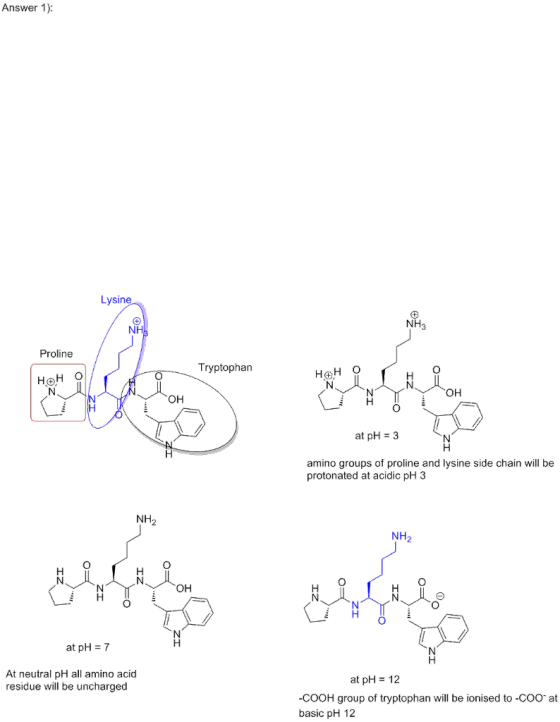
1. Identify the amino acids in the following tripeptide and provide the major structure of the...
The primary structure of a protein is formed by the condensation of amino acids in a...
 The primary structure of a protein is formed by the condensation of amino acids in a certain sequence. Consider the dipeptide formed by the condensation of glycine and tyrosine in Figure 8.31B. a. Draw the structure of the dipeptide that would be formed if the two amino acids condensed in the opposite sequence. b. How are the structures of the dipeptides in Figure 8.31B and your drawing related to each other? B 0 HN-C-0--OH HO H-N-C-C-OH H CHE H OH...
b) Write the structure of the following compounds (Fischer projection): (D)-serine, (S)-methionine c) Write the structure...
 b) Write the structure of the following compounds (Fischer projection): (D)-serine, (S)-methionine c) Write the structure of the following tripeptide: H-Ala-Pro-Phe-OH 2. Determine the N-terminal amino acid of the above tripeptide (H-Ala-Pro-Phe-OH) using the Sanger method (chemical equation). 3. Starting from alanine and glycine synthetize the glycyl-alanine (H-Ala-Gly-OH) dipeptide using mixed anhydride coupling method with Boc (amino) and Bn (carboxyl) protecting groups (reagents, reaction conditions, chemical equations). 4. Starting from the appropriate aldehyde synthetize alanine using the Strecker synthesis (reactions,...
Amino acids are useful building blocks for peptide synthesis. However, due to several reactive sites, protecting...
 Amino acids are useful building blocks for peptide synthesis. However, due to several reactive sites, protecting groups are used to direct regioselective synthesis. Below is the structure of an amino acid with a protecting group. H2N COOH Identify the protecting group. Which reagent was used to install this protecting group? Which reagent is used to remove this protecting group? Fmoc Benzyl chloroformate Boc 9-Fluorenylmethyl chloroformate amide 0 O O O TFA Piperidine DCC H2, Pd/C acetal Di-tert-butyl dicarbonate Acetic anhydride...
1. Partial hydrolysis of lysozyme yielded an octapeptide that was later identified as the N-terminal segment of...
1. Partial hydrolysis of lysozyme yielded an octapeptide that was later identified as the N-terminal segment of the protein. From the following information, determine the sequence of this octapeptide. a. The following amino acids were identified after complete hydrolysis of the octapeptide: Arginine (Arg) Glycine (Gly) Phenylalanine (Phe) Cysteine (Cys) Leucine (Leu) Valine (Val) Glutamic Acid (Glu) Lysine (Lys) b. Treatment of the octapeptide with dinitroflurobenzene (Sanger reagent) followed by complete hydrolysis gave lysine (Lys) labeled with two dinitrophenyl (DNP) groups. c. Treatment of the octapeptide with trypsin gave lysine...
1. Partial hydrolysis of lysozyme yielded an octapeptide that was later identified as the N-terminal segment of...
1. Partial hydrolysis of lysozyme yielded an octapeptide that was later identified as the N-terminal segment of the protein. From the following information, determine the sequence of this octapeptide. a. The following amino acids were identified after complete hydrolysis of the octapeptide: Arginine (Arg) Glycine (Gly) Phenylalanine (Phe) Cysteine (Cys) Leucine (Leu) Valine (Val) Glutamic Acid (Glu) Lysine (Lys) b. Treatment of the octapeptide with dinitroflurobenzene (Sanger reagent) followed by complete hydrolysis gave lysine (Lys) labeled with two dinitrophenyl (DNP) groups. c. Treatment of the octapeptide with trypsin gave lysine...
1.) Draw the structure of the amino acid Serine(ser), which has R=-CH2-OH. Label the alpha carbon. 2.) Draw the dipeptid...
1.) Draw the structure of the amino acid Serine(ser), which has R=-CH2-OH. Label the alpha carbon. 2.) Draw the dipeptide that forms between serine and alanine. The dipeptide sequence is Ser-Ala. Label the peptide bond. 3.) How many amino acids residues are in a polypeptide containing 6 peptide bonds? How many peptide bonds are in a tripeptide 4.) Sketch a alpha-helix and a beta-sheet as best as you can. Label each.
2 Write a complete structure for a tripeptide formed by the alpha-amino acids. Lysine, Tyrosine, and...
 2 Write a complete structure for a tripeptide formed by the alpha-amino acids. Lysine, Tyrosine, and glutamine. (7) 3. Write bthe products formed in the following reaction: (5) CH2OC(CH2)16CH3 CHOC(CH2)16CH3 +3NaOH CH2OCH(CH2)16CH3 glyceryl tristearic
PRELAB ASSIGNMENT 1 Draw the structure of the amino acid son CH-OH Label the alpha carbon...
 PRELAB ASSIGNMENT 1 Draw the structure of the amino acid son CH-OH Label the alpha carbon acid Sorine (en) which has R MO CHE OH CH2 OH 2. Draw the dipeptide that forms betw the peptide bond. s between serine and alanine The dipeptide sequence is Ser Ala Lace CH NCH H, A - — сH — с CH2 OH 3. How many amino aci arty amino acid residues are in a polypeptide containing 6 peptide bonos How many peptide...
Identify the structure of amino acids, and describe the process by which they join together to...
Identify the structure of amino acids, and describe the process by which they join together to form polypeptides. Describe the 4 different groups of amino acids and their properties (Neutral, Polar, Acidic, Basic). Describe the levels of structure of proteins (primary, secondary, tertiary, and quaternary), including what bonds and interactions occur at EACH level. Describe denaturation of a protein and indicate how temperature and pH affect the protein functions. Describe the major functions of proteins
Explain this question please! Name (4 ofer to the Table of Amino Acids at the beginning of the exam to help solve this problem. Polypeptide I is a 12-mer and has the following amino acid compositi...
 Explain this question please!
Name (4 ofer to the Table of Amino Acids at the beginning of the exam to help solve this problem. Polypeptide I is a 12-mer and has the following amino acid composition: Ala, Arg, 2 His, Leu, 2 Lys, 2 Phe, Ser, Thr, Trp Edman degradation of I shows that its N-terminal amino acid is His. Chymotrypsin cleavage of I yields peptide fragments A-D.Trypsin cleavage of I gives peptide fragments E-G. Shown below is the amino...
Explain this question please!
Name (4 ofer to the Table of Amino Acids at the beginning of the exam to help solve this problem. Polypeptide I is a 12-mer and has the following amino acid composition: Ala, Arg, 2 His, Leu, 2 Lys, 2 Phe, Ser, Thr, Trp Edman degradation of I shows that its N-terminal amino acid is His. Chymotrypsin cleavage of I yields peptide fragments A-D.Trypsin cleavage of I gives peptide fragments E-G. Shown below is the amino...
 The primary structure of a protein is formed by the condensation of amino acids in a certain sequence. Consider the dipeptide formed by the condensation of glycine and tyrosine in Figure 8.31B. a. Draw the structure of the dipeptide that would be formed if the two amino acids condensed in the opposite sequence. b. How are the structures of the dipeptides in Figure 8.31B and your drawing related to each other? B 0 HN-C-0--OH HO H-N-C-C-OH H CHE H OH...
 b) Write the structure of the following compounds (Fischer projection): (D)-serine, (S)-methionine c) Write the structure of the following tripeptide: H-Ala-Pro-Phe-OH 2. Determine the N-terminal amino acid of the above tripeptide (H-Ala-Pro-Phe-OH) using the Sanger method (chemical equation). 3. Starting from alanine and glycine synthetize the glycyl-alanine (H-Ala-Gly-OH) dipeptide using mixed anhydride coupling method with Boc (amino) and Bn (carboxyl) protecting groups (reagents, reaction conditions, chemical equations). 4. Starting from the appropriate aldehyde synthetize alanine using the Strecker synthesis (reactions,...
 Amino acids are useful building blocks for peptide synthesis. However, due to several reactive sites, protecting groups are used to direct regioselective synthesis. Below is the structure of an amino acid with a protecting group. H2N COOH Identify the protecting group. Which reagent was used to install this protecting group? Which reagent is used to remove this protecting group? Fmoc Benzyl chloroformate Boc 9-Fluorenylmethyl chloroformate amide 0 O O O TFA Piperidine DCC H2, Pd/C acetal Di-tert-butyl dicarbonate Acetic anhydride...
 2 Write a complete structure for a tripeptide formed by the alpha-amino acids. Lysine, Tyrosine, and glutamine. (7) 3. Write bthe products formed in the following reaction: (5) CH2OC(CH2)16CH3 CHOC(CH2)16CH3 +3NaOH CH2OCH(CH2)16CH3 glyceryl tristearic
 PRELAB ASSIGNMENT 1 Draw the structure of the amino acid son CH-OH Label the alpha carbon acid Sorine (en) which has R MO CHE OH CH2 OH 2. Draw the dipeptide that forms betw the peptide bond. s between serine and alanine The dipeptide sequence is Ser Ala Lace CH NCH H, A - — сH — с CH2 OH 3. How many amino aci arty amino acid residues are in a polypeptide containing 6 peptide bonos How many peptide...
 Explain this question please!
Name (4 ofer to the Table of Amino Acids at the beginning of the exam to help solve this problem. Polypeptide I is a 12-mer and has the following amino acid composition: Ala, Arg, 2 His, Leu, 2 Lys, 2 Phe, Ser, Thr, Trp Edman degradation of I shows that its N-terminal amino acid is His. Chymotrypsin cleavage of I yields peptide fragments A-D.Trypsin cleavage of I gives peptide fragments E-G. Shown below is the amino...
Explain this question please!
Name (4 ofer to the Table of Amino Acids at the beginning of the exam to help solve this problem. Polypeptide I is a 12-mer and has the following amino acid composition: Ala, Arg, 2 His, Leu, 2 Lys, 2 Phe, Ser, Thr, Trp Edman degradation of I shows that its N-terminal amino acid is His. Chymotrypsin cleavage of I yields peptide fragments A-D.Trypsin cleavage of I gives peptide fragments E-G. Shown below is the amino...
Most questions answered within 3 hours.
-
Where is the error in this code sequence?
String s1 = "Hello";
String s2 = "ello";...
asked 11 months ago -
Financial data for Joel de Paris, Inc., for last year
follow:
Joel de Paris, Inc.
Balance...
asked 11 months ago -
Consider this reaction:
Al2(SO4)3 (aq)+ BaCl3
(aq) Al2Cl6 (aq)- +
3BaSO4(s) . What is the...
asked 11 months ago -
Suppose that Savneet is considering increasing her
recent random sample from 20 car rentals to 40...
asked 11 months ago -
Trucks arrive at an unloading terminal at an average rate of 120
per hour.
Trucks arrive...
asked 11 months ago -
Why are methanol and ethanol completely soluble in water while
octanol is not very little soluble....
asked 11 months ago -
A facilities manager at a university reads in a research report
that the mean amount of...
asked 11 months ago -
When the CuSO4 is rehydrated by adding water to the anhydrous
compound, is this an endothermic...
asked 11 months ago -
A ray of sunlight is passing from diamond into crown glass; the
angle of incidence is...
asked 11 months ago -
A block of mass 0.249 kg is placed on top of a light, vertical
spring of...
asked 11 months ago -
how do the kidneys compensate in the presences of acidosis
a) trigger hyperventilate
b) reserve acid...
asked 11 months ago -
Question 501 pts
The rental rate of capital to the firm increases. Which of the
following...
asked 11 months ago