

Homework Answers
![3(s+2) C(s) R(S) @ks her contrtl therづウ 643H 3 (s) R(s) S13 (s+) Ris) proble m s E(5)| ラ|-o.kk» sE(s) < 0.1] 0-1 ウ | Am S-+0](http://img.homeworklib.com/questions/24a90730-2706-11eb-bc9a-d908ddbf53be.png?x-oss-process=image/resize,w_560)
 For further help, please write
in the comments.
For further help, please write
in the comments.
Add Answer to:
5., A controller in Figure 4-18 is required to produce a steady-state output, do, that is...
The objective of the controller design in Fig. 1 is to find the controller Gc(s) such...
 The objective of the controller design in Fig. 1 is to find the
controller Gc(s) such that I.)The closed-loop system is stable
ii.)The output of the system above (y(t)) can track the reference
input r(t) = At (A>0 is any real number). Use the Nyquist plot
and Nyquist criterion to show that: a.)The portional controller
Gc(s)=K can achieve asymptotic tracking of the ramp input r(t)=At
but cannot meet the stability requirement for 0<K<+inf. b.)
Can the PI controller Gc(s)=K(1+10/s) be...
The objective of the controller design in Fig. 1 is to find the
controller Gc(s) such that I.)The closed-loop system is stable
ii.)The output of the system above (y(t)) can track the reference
input r(t) = At (A>0 is any real number). Use the Nyquist plot
and Nyquist criterion to show that: a.)The portional controller
Gc(s)=K can achieve asymptotic tracking of the ramp input r(t)=At
but cannot meet the stability requirement for 0<K<+inf. b.)
Can the PI controller Gc(s)=K(1+10/s) be...
1. (15pts) Design a LEAD controller for the heading control of an antenna. The purpose of...
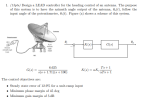 1. (15pts) Design a LEAD controller for the heading control of an antenna. The purpose of this system is to have the azimuth angle output of the antenna, θ。(t), follow the input angle of the potentiometer, θ(t). Figure (a) shows a scheme of this system. Antesna Potentioneter 0i 8. K (s) G(s) Azimuth arglk Desised rimeth angle eput 6.625 Ts +1 G(s) = s(s +1.71) (s +100) The control objectives are: ·Steady state error of 12.9% for a unit-ramp input...
Problem 4) (20 Pts.) A Proportional controller is simply a gain block. In figure below, it...
 Problem 4) (20 Pts.) A Proportional controller is simply a gain block. In figure below, it is the block with gain 2nd order underdamped plant as shown. Kc which is behind the a) Simplify below block diagram to obtain the overall feedback system transfer funion)R(G) b) Choose Kc so that the overall feedback system transfer function G(s) has 50% overshoot due to a step input (called quarter decay ratio tuning) d) The feedback system transfer function Gs)- is faster than...
G) r(t) Figure 1: Feedback control system A pulley and belt transmission has a linearized relationship between the driven pulley angle θ(t) in degrees and the input torque u(t) in Newton meters given...
 G) r(t) Figure 1: Feedback control system A pulley and belt transmission has a linearized relationship between the driven pulley angle θ(t) in degrees and the input torque u(t) in Newton meters given by the following differential equation du(t) A feedback control system (illustrated in Figure 1) needs to be designed such that the closed-loop system is asymptotically stable and such that the following design criteria are met: 1. the gain crossover frequency a should be between and a 2....
4) A unity feedback control system shown in Figure 2 has the following controller and process with the transfer functions: m(60100c Prs(s +10(s+7.5) a) Obtain the open- and closed-loop transfer f...
 4) A unity feedback control system shown in Figure 2 has the following controller and process with the transfer functions: m(60100c Prs(s +10(s+7.5) a) Obtain the open- and closed-loop transfer functions of the system. b) Obtain the stability conditions using the Routh-Hurwitz criterion. e) Setting by trial-and-error some values for Kp, Ki, and Ko, obtain the time response for minimum overshoot and minimum settling time by Matlab/Simulink. Y(s) R(s) E(s) Fig. 2: Unity feedback control system
4) A unity feedback...
4) A unity feedback control system shown in Figure 2 has the following controller and process with the transfer functions: m(60100c Prs(s +10(s+7.5) a) Obtain the open- and closed-loop transfer functions of the system. b) Obtain the stability conditions using the Routh-Hurwitz criterion. e) Setting by trial-and-error some values for Kp, Ki, and Ko, obtain the time response for minimum overshoot and minimum settling time by Matlab/Simulink. Y(s) R(s) E(s) Fig. 2: Unity feedback control system
4) A unity feedback...
Consider the aircraft model shown in Figure 1. We will assume that the aircraft is in steady-crui...
 Consider the aircraft model shown in Figure 1. We will assume that the aircraft is in steady-cruise at constant altitude and velocity; thus, the thrust, drag, weight and lift forces balance each other in the x- and y directions. We will also assume that a change in pitch angle will not change the speed of the aircraft under any circumstance (unrealistic but simplifies the problem a bit). Under these assumptions the longitudinal equations of motion for the aircraft can be...
The parameters are as follows k=10 a=0.50 b=0.3 c=0.6 d=9 w_1=12 w_2=15 Kv=30 A feedback control system (illustrated in Figure 1) needs to be designed such that the closed-loop system is asymptotical...
 The parameters are as follows
k=10 a=0.50 b=0.3 c=0.6 d=9 w_1=12 w_2=15
Kv=30
A feedback control system
(illustrated in Figure 1) needs to be designed such that the
closed-loop system is asymptotically stable and such that the
following design criteria are met:
the gain crossover frequency wc should be between
w1 and w2.
the steady-state error should be zero in response to a unit
step reference.
the velocity constant should be greater than Kv (in
other words, the steady-state unit...
The parameters are as follows
k=10 a=0.50 b=0.3 c=0.6 d=9 w_1=12 w_2=15
Kv=30
A feedback control system
(illustrated in Figure 1) needs to be designed such that the
closed-loop system is asymptotically stable and such that the
following design criteria are met:
the gain crossover frequency wc should be between
w1 and w2.
the steady-state error should be zero in response to a unit
step reference.
the velocity constant should be greater than Kv (in
other words, the steady-state unit...
control system System Description: The figure 1 and 2 below show, respectively, components and block diagram...
 control system
System Description: The figure 1 and 2 below show, respectively, components and block diagram of a motor and the measurements of velocity (via the tacho unit) and position (via the potentiometer). n represents the gearbox ratio between the rotating shaft and the output shaft. The left-hand side of the diagram represents the controller. A reference set point for the rotating shaft is entered in degrees and this is equivalent voltage. The error is calculated by subtracting the measured...
control system
System Description: The figure 1 and 2 below show, respectively, components and block diagram of a motor and the measurements of velocity (via the tacho unit) and position (via the potentiometer). n represents the gearbox ratio between the rotating shaft and the output shaft. The left-hand side of the diagram represents the controller. A reference set point for the rotating shaft is entered in degrees and this is equivalent voltage. The error is calculated by subtracting the measured...
A unity feedback closed loop control system is displayed in Figure 4. (a) Assume that the control...
 Please solve as a MATLAB code.
A unity feedback closed loop control system is displayed in Figure 4. (a) Assume that the controller is given by G (s) 2. Based on the lsim function of MATLAB, calculate and obtain the graph of the response for (t) at. Here a 0.5°/s. Find the height error after 10 seconds, (b) In order to reduce the steady-state error, substitute G (s) with the following controller This is a Proportional-Integral (PI) controller. Repeat part...
Please solve as a MATLAB code.
A unity feedback closed loop control system is displayed in Figure 4. (a) Assume that the controller is given by G (s) 2. Based on the lsim function of MATLAB, calculate and obtain the graph of the response for (t) at. Here a 0.5°/s. Find the height error after 10 seconds, (b) In order to reduce the steady-state error, substitute G (s) with the following controller This is a Proportional-Integral (PI) controller. Repeat part...
Question 4 (a) A feedback control system with a proportional controller is shown in Figure Q4...
 Question 4 (a) A feedback control system with a proportional controller is shown in Figure Q4 (a). (i) Sketch the root locus of the system, (ii) Design the proportional controller (choose the value of K) such that the damping ratio does not exceed 0.5 and the time constant is less than 1 second. [All necessary steps of root locus construction and controller design must be shown). C(s) R(S) + s(s+4)(s + 10) Figure Q4 (a). A feedback control system [11...
 The objective of the controller design in Fig. 1 is to find the
controller Gc(s) such that I.)The closed-loop system is stable
ii.)The output of the system above (y(t)) can track the reference
input r(t) = At (A>0 is any real number). Use the Nyquist plot
and Nyquist criterion to show that: a.)The portional controller
Gc(s)=K can achieve asymptotic tracking of the ramp input r(t)=At
but cannot meet the stability requirement for 0<K<+inf. b.)
Can the PI controller Gc(s)=K(1+10/s) be...
The objective of the controller design in Fig. 1 is to find the
controller Gc(s) such that I.)The closed-loop system is stable
ii.)The output of the system above (y(t)) can track the reference
input r(t) = At (A>0 is any real number). Use the Nyquist plot
and Nyquist criterion to show that: a.)The portional controller
Gc(s)=K can achieve asymptotic tracking of the ramp input r(t)=At
but cannot meet the stability requirement for 0<K<+inf. b.)
Can the PI controller Gc(s)=K(1+10/s) be...
 1. (15pts) Design a LEAD controller for the heading control of an antenna. The purpose of this system is to have the azimuth angle output of the antenna, θ。(t), follow the input angle of the potentiometer, θ(t). Figure (a) shows a scheme of this system. Antesna Potentioneter 0i 8. K (s) G(s) Azimuth arglk Desised rimeth angle eput 6.625 Ts +1 G(s) = s(s +1.71) (s +100) The control objectives are: ·Steady state error of 12.9% for a unit-ramp input...
 Problem 4) (20 Pts.) A Proportional controller is simply a gain block. In figure below, it is the block with gain 2nd order underdamped plant as shown. Kc which is behind the a) Simplify below block diagram to obtain the overall feedback system transfer funion)R(G) b) Choose Kc so that the overall feedback system transfer function G(s) has 50% overshoot due to a step input (called quarter decay ratio tuning) d) The feedback system transfer function Gs)- is faster than...
 G) r(t) Figure 1: Feedback control system A pulley and belt transmission has a linearized relationship between the driven pulley angle θ(t) in degrees and the input torque u(t) in Newton meters given by the following differential equation du(t) A feedback control system (illustrated in Figure 1) needs to be designed such that the closed-loop system is asymptotically stable and such that the following design criteria are met: 1. the gain crossover frequency a should be between and a 2....
 4) A unity feedback control system shown in Figure 2 has the following controller and process with the transfer functions: m(60100c Prs(s +10(s+7.5) a) Obtain the open- and closed-loop transfer functions of the system. b) Obtain the stability conditions using the Routh-Hurwitz criterion. e) Setting by trial-and-error some values for Kp, Ki, and Ko, obtain the time response for minimum overshoot and minimum settling time by Matlab/Simulink. Y(s) R(s) E(s) Fig. 2: Unity feedback control system
4) A unity feedback...
4) A unity feedback control system shown in Figure 2 has the following controller and process with the transfer functions: m(60100c Prs(s +10(s+7.5) a) Obtain the open- and closed-loop transfer functions of the system. b) Obtain the stability conditions using the Routh-Hurwitz criterion. e) Setting by trial-and-error some values for Kp, Ki, and Ko, obtain the time response for minimum overshoot and minimum settling time by Matlab/Simulink. Y(s) R(s) E(s) Fig. 2: Unity feedback control system
4) A unity feedback...
 Consider the aircraft model shown in Figure 1. We will assume that the aircraft is in steady-cruise at constant altitude and velocity; thus, the thrust, drag, weight and lift forces balance each other in the x- and y directions. We will also assume that a change in pitch angle will not change the speed of the aircraft under any circumstance (unrealistic but simplifies the problem a bit). Under these assumptions the longitudinal equations of motion for the aircraft can be...
 The parameters are as follows
k=10 a=0.50 b=0.3 c=0.6 d=9 w_1=12 w_2=15
Kv=30
A feedback control system
(illustrated in Figure 1) needs to be designed such that the
closed-loop system is asymptotically stable and such that the
following design criteria are met:
the gain crossover frequency wc should be between
w1 and w2.
the steady-state error should be zero in response to a unit
step reference.
the velocity constant should be greater than Kv (in
other words, the steady-state unit...
The parameters are as follows
k=10 a=0.50 b=0.3 c=0.6 d=9 w_1=12 w_2=15
Kv=30
A feedback control system
(illustrated in Figure 1) needs to be designed such that the
closed-loop system is asymptotically stable and such that the
following design criteria are met:
the gain crossover frequency wc should be between
w1 and w2.
the steady-state error should be zero in response to a unit
step reference.
the velocity constant should be greater than Kv (in
other words, the steady-state unit...
 control system
System Description: The figure 1 and 2 below show, respectively, components and block diagram of a motor and the measurements of velocity (via the tacho unit) and position (via the potentiometer). n represents the gearbox ratio between the rotating shaft and the output shaft. The left-hand side of the diagram represents the controller. A reference set point for the rotating shaft is entered in degrees and this is equivalent voltage. The error is calculated by subtracting the measured...
control system
System Description: The figure 1 and 2 below show, respectively, components and block diagram of a motor and the measurements of velocity (via the tacho unit) and position (via the potentiometer). n represents the gearbox ratio between the rotating shaft and the output shaft. The left-hand side of the diagram represents the controller. A reference set point for the rotating shaft is entered in degrees and this is equivalent voltage. The error is calculated by subtracting the measured...
 Please solve as a MATLAB code.
A unity feedback closed loop control system is displayed in Figure 4. (a) Assume that the controller is given by G (s) 2. Based on the lsim function of MATLAB, calculate and obtain the graph of the response for (t) at. Here a 0.5°/s. Find the height error after 10 seconds, (b) In order to reduce the steady-state error, substitute G (s) with the following controller This is a Proportional-Integral (PI) controller. Repeat part...
Please solve as a MATLAB code.
A unity feedback closed loop control system is displayed in Figure 4. (a) Assume that the controller is given by G (s) 2. Based on the lsim function of MATLAB, calculate and obtain the graph of the response for (t) at. Here a 0.5°/s. Find the height error after 10 seconds, (b) In order to reduce the steady-state error, substitute G (s) with the following controller This is a Proportional-Integral (PI) controller. Repeat part...
 Question 4 (a) A feedback control system with a proportional controller is shown in Figure Q4 (a). (i) Sketch the root locus of the system, (ii) Design the proportional controller (choose the value of K) such that the damping ratio does not exceed 0.5 and the time constant is less than 1 second. [All necessary steps of root locus construction and controller design must be shown). C(s) R(S) + s(s+4)(s + 10) Figure Q4 (a). A feedback control system [11...
Most questions answered within 3 hours.
-
Where is the error in this code sequence?
String s1 = "Hello";
String s2 = "ello";...
asked 10 months ago -
Financial data for Joel de Paris, Inc., for last year
follow:
Joel de Paris, Inc.
Balance...
asked 10 months ago -
Consider this reaction:
Al2(SO4)3 (aq)+ BaCl3
(aq) Al2Cl6 (aq)- +
3BaSO4(s) . What is the...
asked 10 months ago -
Suppose that Savneet is considering increasing her
recent random sample from 20 car rentals to 40...
asked 10 months ago -
Trucks arrive at an unloading terminal at an average rate of 120
per hour.
Trucks arrive...
asked 10 months ago -
Why are methanol and ethanol completely soluble in water while
octanol is not very little soluble....
asked 10 months ago -
A facilities manager at a university reads in a research report
that the mean amount of...
asked 10 months ago -
When the CuSO4 is rehydrated by adding water to the anhydrous
compound, is this an endothermic...
asked 10 months ago -
A ray of sunlight is passing from diamond into crown glass; the
angle of incidence is...
asked 10 months ago -
A block of mass 0.249 kg is placed on top of a light, vertical
spring of...
asked 10 months ago -
how do the kidneys compensate in the presences of acidosis
a) trigger hyperventilate
b) reserve acid...
asked 10 months ago -
Question 501 pts
The rental rate of capital to the firm increases. Which of the
following...
asked 10 months ago