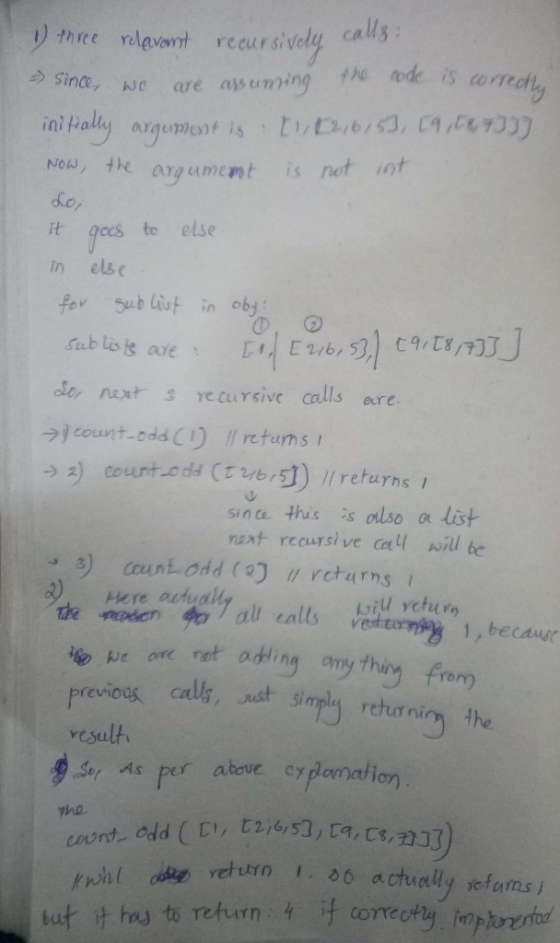
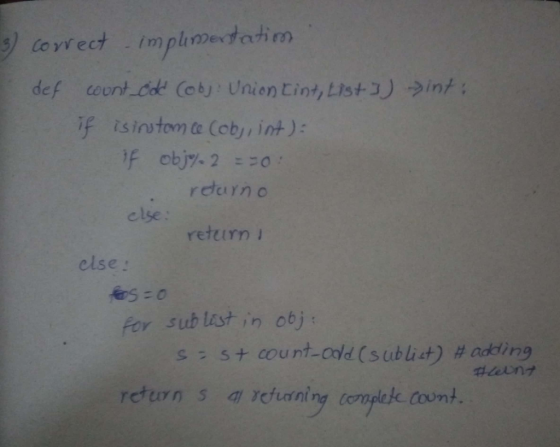
![Read the code for the recursive function count_odd, which operates on a nested list. def count odd (obj: Union int, List]) ->](http://img.homeworklib.com/questions/9b3120a0-27b4-11eb-a3b2-0f6069b1303e.png?x-oss-process=image/resize,w_560)
Please help and show explicitly the solutions - and explanation too !
Homework Answers
Add Answer to:
Please help and show explicitly the solutions - and explanation
too !
Read the code for...
In Python 3 Write a LinkedList class that has recursive implementations of the display, remove, contains,...
In Python 3 Write a LinkedList class that has recursive implementations of the display, remove, contains, insert, and normal_list methods. You may use default arguments and/or helper functions. The file must be named: LinkedList.py Here is what I have for my code so far. The methods I need the recursive implementations for will be bolded: class Node: """ Represents a node in a linked list (parent class) """ def __init__(self, data): self.data = data self.next = None class LinkedList: """...
Please read the problem carefully and answer the 2 questions below code: /***************************************************************** * Program: palindrome.c...
 Please read the problem carefully and answer the 2 questions
below
code:
/*****************************************************************
* Program: palindrome.c
*
* Purpose: implements a recursive function for determining
* if a string is a palindrome
*
* Authors: Steven R. Vegdahl, Tammy VanDeGrift, Martin Cenek
*
*****************************************************************/
#include
#include
#include
/*****************************************************************
* is_palindrome - determines whether a string of characters is a
palindrome
*
* calling sequence:
* result = is_palindrome(str, first_index,
last_index)
*
* parameters -
* str - the string to test
* first_index -...
Please read the problem carefully and answer the 2 questions
below
code:
/*****************************************************************
* Program: palindrome.c
*
* Purpose: implements a recursive function for determining
* if a string is a palindrome
*
* Authors: Steven R. Vegdahl, Tammy VanDeGrift, Martin Cenek
*
*****************************************************************/
#include
#include
#include
/*****************************************************************
* is_palindrome - determines whether a string of characters is a
palindrome
*
* calling sequence:
* result = is_palindrome(str, first_index,
last_index)
*
* parameters -
* str - the string to test
* first_index -...
LANGUAGE IS C++ Lab Ch14 Recursion In this lab, you are provided with startup code which...
LANGUAGE IS C++ Lab Ch14 Recursion In this lab, you are provided with startup code which has six working functions that use looping (for, while, or do loops) to repeat the same set of statements multiple times. You will create six equivalent functions that use recursion instead of looping. Although looping and recursion can be interchanged, for many problems, recursion is easier and more elegant. Like loops, recursion must ALWAYS contain a condition; otherwise, you have an infinite recursion (or...
PYTHON. Continues off another code. I don't understand this. Someone please help! Comment the lines please...
PYTHON. Continues off another code. I don't understand this. Someone please help! Comment the lines please so I can understand LinkedList ADT: class myLinkedList: def __init__(self): self.__head = None self.__tail = None self.__size = 0 def insert(self, i, data): if self.isEmpty(): self.__head = listNode(data) self.__tail = self.__head elif i <= 0: self.__head = listNode(data, self.__head) elif i >= self.__size: self.__tail.setNext(listNode(data)) self.__tail = self.__tail.getNext() else: current = self.__getIthNode(i - 1) current.setNext(listNode(data,...
PYTHON. Continues off another code(other code is below). I don't understand this. Someone please help! Comment...
PYTHON. Continues off another code(other code is below). I don't understand this. Someone please help! Comment the lines please so I can understand. There are short and med files lengths for each the list of names/ids and then search id file. These are the input files: https://codeshare.io/aVQd46 https://codeshare.io/5M3XnR https://codeshare.io/2W684E https://codeshare.io/5RJwZ4 LinkedList ADT to store student records(code is below). Using LinkedList ADT instead of the Python List. You will need to use the Student ADT(code is below) Imports the Student class...
Programming Exercise 11.6 Х + | Instructions fib.py >_ Terminal + iit B 1 def fib(n):...
 Programming Exercise 11.6 Х + | Instructions fib.py >_ Terminal + iit B 1 def fib(n): 2 "*"Returns the nth Fibonacci number. " 3 if n < 3: lil 4 return 1 Modify the recursive Fibonacci function to employ the memoization technique discussed in this chapter. The function creates a dictionary and then defines a nested recursive helper function named memoizedFib You will need to create a dictionary to cache the sum of the fib function. The base case of...
The following Implementation of the Fibonacci function is a correct, but inefficient, def fibonacci(n): if n...
 The following
Implementation of the Fibonacci function is a
correct, but inefficient,
def fibonacci(n):
if n <= 2:
return 1
else:
return fib(n - 1) +
fib(n - 2)
In more details, the
code shown runs very slowly for even relatively small values of
n; it can take minutes or hours to compute even the 40th
or 50th Fibonacci number. The code is inefficient because it makes
too many recursive calls. It ends up recomputing each Fibonacci
number many times....
The following
Implementation of the Fibonacci function is a
correct, but inefficient,
def fibonacci(n):
if n <= 2:
return 1
else:
return fib(n - 1) +
fib(n - 2)
In more details, the
code shown runs very slowly for even relatively small values of
n; it can take minutes or hours to compute even the 40th
or 50th Fibonacci number. The code is inefficient because it makes
too many recursive calls. It ends up recomputing each Fibonacci
number many times....
1) can any one please givem the code for this a) If n is a power...
 1)
can any one please givem the code for this
a) If n is a power of 2, as it is in Figure 9-3, you would merge
pairs of individual entries, starting at the
beginning of the array. Then you would return to the beginning of
the array and merge pairs of twoentry
subarrays. Finally, you would merge one pair of four-entry
subarrays. Notice that the subarrays
in each pair of subarrays contain the same number of entries.
In general,...
1)
can any one please givem the code for this
a) If n is a power of 2, as it is in Figure 9-3, you would merge
pairs of individual entries, starting at the
beginning of the array. Then you would return to the beginning of
the array and merge pairs of twoentry
subarrays. Finally, you would merge one pair of four-entry
subarrays. Notice that the subarrays
in each pair of subarrays contain the same number of entries.
In general,...
PLEASE USE VERY BASIC REGISTERS AND CODE TO DO THE FOLLOWING Objectives: -write assembly language programs...
PLEASE USE VERY BASIC REGISTERS AND CODE TO DO THE FOLLOWING Objectives: -write assembly language programs to: -define a recursive procedure/function and call it. -use syscall operations to display integers and strings on the console window -use syscall operations to read integers from the keyboard. Assignment Description: Implement a MIPS assembly language program that defines "main", and "function1" procedures. The function1 is recursive and should be defined as: function1(n) = (2*n)+9 if n <= 5 =...
I just need to add comment for the code blow. Pleas add comment for each method...
I just need to add comment for the code blow. Pleas add comment for each method and class if comments left out. package exercise01; /*************************************************************************** * <p> This program demonstrates the technique of recursion and includes * recursive methods that are defined for a variety of mathematical * functions. * * <br>A recursive method is one that directly or indirectly calls itself * and must include: * <br>(1) end case: stopping condition * which terminates/ends recursion * <br>(2) reduction:...
 Please read the problem carefully and answer the 2 questions
below
code:
/*****************************************************************
* Program: palindrome.c
*
* Purpose: implements a recursive function for determining
* if a string is a palindrome
*
* Authors: Steven R. Vegdahl, Tammy VanDeGrift, Martin Cenek
*
*****************************************************************/
#include
#include
#include
/*****************************************************************
* is_palindrome - determines whether a string of characters is a
palindrome
*
* calling sequence:
* result = is_palindrome(str, first_index,
last_index)
*
* parameters -
* str - the string to test
* first_index -...
Please read the problem carefully and answer the 2 questions
below
code:
/*****************************************************************
* Program: palindrome.c
*
* Purpose: implements a recursive function for determining
* if a string is a palindrome
*
* Authors: Steven R. Vegdahl, Tammy VanDeGrift, Martin Cenek
*
*****************************************************************/
#include
#include
#include
/*****************************************************************
* is_palindrome - determines whether a string of characters is a
palindrome
*
* calling sequence:
* result = is_palindrome(str, first_index,
last_index)
*
* parameters -
* str - the string to test
* first_index -...
 Programming Exercise 11.6 Х + | Instructions fib.py >_ Terminal + iit B 1 def fib(n): 2 "*"Returns the nth Fibonacci number. " 3 if n < 3: lil 4 return 1 Modify the recursive Fibonacci function to employ the memoization technique discussed in this chapter. The function creates a dictionary and then defines a nested recursive helper function named memoizedFib You will need to create a dictionary to cache the sum of the fib function. The base case of...
 The following
Implementation of the Fibonacci function is a
correct, but inefficient,
def fibonacci(n):
if n <= 2:
return 1
else:
return fib(n - 1) +
fib(n - 2)
In more details, the
code shown runs very slowly for even relatively small values of
n; it can take minutes or hours to compute even the 40th
or 50th Fibonacci number. The code is inefficient because it makes
too many recursive calls. It ends up recomputing each Fibonacci
number many times....
The following
Implementation of the Fibonacci function is a
correct, but inefficient,
def fibonacci(n):
if n <= 2:
return 1
else:
return fib(n - 1) +
fib(n - 2)
In more details, the
code shown runs very slowly for even relatively small values of
n; it can take minutes or hours to compute even the 40th
or 50th Fibonacci number. The code is inefficient because it makes
too many recursive calls. It ends up recomputing each Fibonacci
number many times....
 1)
can any one please givem the code for this
a) If n is a power of 2, as it is in Figure 9-3, you would merge
pairs of individual entries, starting at the
beginning of the array. Then you would return to the beginning of
the array and merge pairs of twoentry
subarrays. Finally, you would merge one pair of four-entry
subarrays. Notice that the subarrays
in each pair of subarrays contain the same number of entries.
In general,...
1)
can any one please givem the code for this
a) If n is a power of 2, as it is in Figure 9-3, you would merge
pairs of individual entries, starting at the
beginning of the array. Then you would return to the beginning of
the array and merge pairs of twoentry
subarrays. Finally, you would merge one pair of four-entry
subarrays. Notice that the subarrays
in each pair of subarrays contain the same number of entries.
In general,...
Most questions answered within 3 hours.
-
Where is the error in this code sequence?
String s1 = "Hello";
String s2 = "ello";...
asked 10 months ago -
Financial data for Joel de Paris, Inc., for last year
follow:
Joel de Paris, Inc.
Balance...
asked 10 months ago -
Consider this reaction:
Al2(SO4)3 (aq)+ BaCl3
(aq) Al2Cl6 (aq)- +
3BaSO4(s) . What is the...
asked 10 months ago -
Suppose that Savneet is considering increasing her
recent random sample from 20 car rentals to 40...
asked 10 months ago -
Trucks arrive at an unloading terminal at an average rate of 120
per hour.
Trucks arrive...
asked 10 months ago -
Why are methanol and ethanol completely soluble in water while
octanol is not very little soluble....
asked 10 months ago -
A facilities manager at a university reads in a research report
that the mean amount of...
asked 10 months ago -
When the CuSO4 is rehydrated by adding water to the anhydrous
compound, is this an endothermic...
asked 10 months ago -
A ray of sunlight is passing from diamond into crown glass; the
angle of incidence is...
asked 10 months ago -
A block of mass 0.249 kg is placed on top of a light, vertical
spring of...
asked 10 months ago -
how do the kidneys compensate in the presences of acidosis
a) trigger hyperventilate
b) reserve acid...
asked 10 months ago -
Question 501 pts
The rental rate of capital to the firm increases. Which of the
following...
asked 10 months ago