when the end of the string is loose or fixed we observe _____ taking place Inference...
when the end of the string is loose or fixed we observe _____ taking place
Inference
Diaaipation
Amplification
I think it is Amplification
Homework Answers
The answer depends on whether the medium is fixed in space or free to move at its end.
Yes, in this case amplification is going on.
Add Answer to:
when the end of the string is loose or fixed we observe _____
taking place
Inference...
1.) 7.) 9.) 11.) 1. How do we know when a chemical reaction is taking place?...
 1.)
7.)
9.)
11.)
1. How do we know when a chemical reaction is taking place? Can you think of an example of how each of the five senses (sight, hearing, taste, touch, smell) All even-numbered Questions and Problems have ans might be used in detecting when a chemical reaction has taken place? 7. What are the substances to the left of the arrow in a chemical equation called? To the right of the arrow? What does the arrow itself...
1.)
7.)
9.)
11.)
1. How do we know when a chemical reaction is taking place? Can you think of an example of how each of the five senses (sight, hearing, taste, touch, smell) All even-numbered Questions and Problems have ans might be used in detecting when a chemical reaction has taken place? 7. What are the substances to the left of the arrow in a chemical equation called? To the right of the arrow? What does the arrow itself...
An elastic string of negligible mass has one end fixed to a ceiling at point A....
 An elastic string of negligible mass has one end fixed to a
ceiling at point A. The other end, point B, which is attached to a
particle of mass 3 kg, is in a position such that it is vertically
below point A, with the distance AB equal to 0.7 m. The mass is
released from rest. If the modulus of elasticity of the string is
35 N and its natural length is 1.3m find i) The distance of the...
An elastic string of negligible mass has one end fixed to a
ceiling at point A. The other end, point B, which is attached to a
particle of mass 3 kg, is in a position such that it is vertically
below point A, with the distance AB equal to 0.7 m. The mass is
released from rest. If the modulus of elasticity of the string is
35 N and its natural length is 1.3m find i) The distance of the...
The length of a string is 150 cm. The string is held fixed at each end....
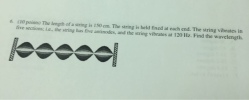 The length of a string is 150 cm. The string is held fixed at each end. The string vibrates in the sections; i.e., the string has five antinodes, and the string vibrates at 120 Hz. Find the wavelength.
From the end of a string (whose other end is firmly attached to the ceiling) we...
From the end of a string (whose other end is firmly attached to the ceiling) we attach a mass m1. Similarly, we attach a mass m2 from the end of a different string. Both strings have equal lengths and the masses are barely in contact when they are hanging freely. We pull out both masses so that they form angles θ1 and θ2, respectively, with their equilibrium (vertical) positions. We then release the masses at the same time so that...
5. Imagine a string that is fixed at both ends (e.g. a guitar string). When plucked, the string forms a standing wave. The vertical displacement u of the string varies with position r and time t. Sup...
 5. Imagine a string that is fixed at both ends (e.g. a guitar string). When plucked, the string forms a standing wave. The vertical displacement u of the string varies with position r and time t. Suppose u(x,t) = 2 sin(nx) sin(mt/2), for 0 x 1 and t 0. Convince yourself of the following: If we freeze the string in time, it will form a sine curve. Alternatively, if we instead focus on a single position, we will see the...
One end of a 1.20-m string is held fixed. The other end is attached to a...
 One end of a 1.20-m string is held fixed. The other
end is attached to a weightless ring that can slide along the
frictionless rod as shown in the diagram.
a.) What are the three longest possible wavelengths
for standing waves on this string (in meters, based on L=1.20)?
One end of a 1.20-m string is held fixed. The other
end is attached to a weightless ring that can slide along the
frictionless rod as shown in the diagram.
a.) What are the three longest possible wavelengths
for standing waves on this string (in meters, based on L=1.20)?
Find the linear mass density of the segment of the string. In our lab we had...
Find the linear mass density of the segment of the string. In our lab we had a string. A portion of it was stretched and on one end was a vibrating thing that created waves in the string. Here's the data. Mass of entire string: 12.43g Mass of segment of string that waves were made on: UNKNOWN Length of entire string: 294.34 cm Length of segment of string that waves were made on: 59.10 cm (when it was unstretched) I...
One end of a 0.80 m string is fixed, the other end is attached to a...
One end of a 0.80 m string is fixed, the other end is attached to a 2.0-kg stone. The stone swings in a vertical circle, passing the bottom point at 10 m/s. What is the radial acceleration of the stone at the top of the circle? (Ans: 86 m/s2)
When we look at the spectra of distant galaxies, we usually observe that these galaxies are...
When we look at the spectra of distant galaxies, we usually observe that these galaxies are redshifted due to the Doppler effect. What does it mean to say the spectra are “redshifted”? What does this tell us about how those galaxies are moving?
A 64.0-kg ice skater is moving at 3.99 m/s when she grabs the loose end of...
A 64.0-kg ice skater is moving at 3.99 m/s when she grabs the loose end of a rope, the opposite end of which is tied to a pole. She then moves in a circle of radius 0.790 m around the pole. (a) Determine the magnitude of the force exerted by the horizontal rope on her arms. kN (b) Compare this force with her weight. Frope W =
 1.)
7.)
9.)
11.)
1. How do we know when a chemical reaction is taking place? Can you think of an example of how each of the five senses (sight, hearing, taste, touch, smell) All even-numbered Questions and Problems have ans might be used in detecting when a chemical reaction has taken place? 7. What are the substances to the left of the arrow in a chemical equation called? To the right of the arrow? What does the arrow itself...
1.)
7.)
9.)
11.)
1. How do we know when a chemical reaction is taking place? Can you think of an example of how each of the five senses (sight, hearing, taste, touch, smell) All even-numbered Questions and Problems have ans might be used in detecting when a chemical reaction has taken place? 7. What are the substances to the left of the arrow in a chemical equation called? To the right of the arrow? What does the arrow itself...
 An elastic string of negligible mass has one end fixed to a
ceiling at point A. The other end, point B, which is attached to a
particle of mass 3 kg, is in a position such that it is vertically
below point A, with the distance AB equal to 0.7 m. The mass is
released from rest. If the modulus of elasticity of the string is
35 N and its natural length is 1.3m find i) The distance of the...
An elastic string of negligible mass has one end fixed to a
ceiling at point A. The other end, point B, which is attached to a
particle of mass 3 kg, is in a position such that it is vertically
below point A, with the distance AB equal to 0.7 m. The mass is
released from rest. If the modulus of elasticity of the string is
35 N and its natural length is 1.3m find i) The distance of the...
 The length of a string is 150 cm. The string is held fixed at each end. The string vibrates in the sections; i.e., the string has five antinodes, and the string vibrates at 120 Hz. Find the wavelength.
 5. Imagine a string that is fixed at both ends (e.g. a guitar string). When plucked, the string forms a standing wave. The vertical displacement u of the string varies with position r and time t. Suppose u(x,t) = 2 sin(nx) sin(mt/2), for 0 x 1 and t 0. Convince yourself of the following: If we freeze the string in time, it will form a sine curve. Alternatively, if we instead focus on a single position, we will see the...
 One end of a 1.20-m string is held fixed. The other
end is attached to a weightless ring that can slide along the
frictionless rod as shown in the diagram.
a.) What are the three longest possible wavelengths
for standing waves on this string (in meters, based on L=1.20)?
One end of a 1.20-m string is held fixed. The other
end is attached to a weightless ring that can slide along the
frictionless rod as shown in the diagram.
a.) What are the three longest possible wavelengths
for standing waves on this string (in meters, based on L=1.20)?
Most questions answered within 3 hours.
-
Where is the error in this code sequence?
String s1 = "Hello";
String s2 = "ello";...
asked 10 months ago -
Financial data for Joel de Paris, Inc., for last year
follow:
Joel de Paris, Inc.
Balance...
asked 10 months ago -
Consider this reaction:
Al2(SO4)3 (aq)+ BaCl3
(aq) Al2Cl6 (aq)- +
3BaSO4(s) . What is the...
asked 10 months ago -
Suppose that Savneet is considering increasing her
recent random sample from 20 car rentals to 40...
asked 10 months ago -
Trucks arrive at an unloading terminal at an average rate of 120
per hour.
Trucks arrive...
asked 10 months ago -
Why are methanol and ethanol completely soluble in water while
octanol is not very little soluble....
asked 10 months ago -
A facilities manager at a university reads in a research report
that the mean amount of...
asked 10 months ago -
When the CuSO4 is rehydrated by adding water to the anhydrous
compound, is this an endothermic...
asked 10 months ago -
A ray of sunlight is passing from diamond into crown glass; the
angle of incidence is...
asked 10 months ago -
A block of mass 0.249 kg is placed on top of a light, vertical
spring of...
asked 10 months ago -
how do the kidneys compensate in the presences of acidosis
a) trigger hyperventilate
b) reserve acid...
asked 10 months ago -
Question 501 pts
The rental rate of capital to the firm increases. Which of the
following...
asked 10 months ago