
Homework Answers

Add Answer to:
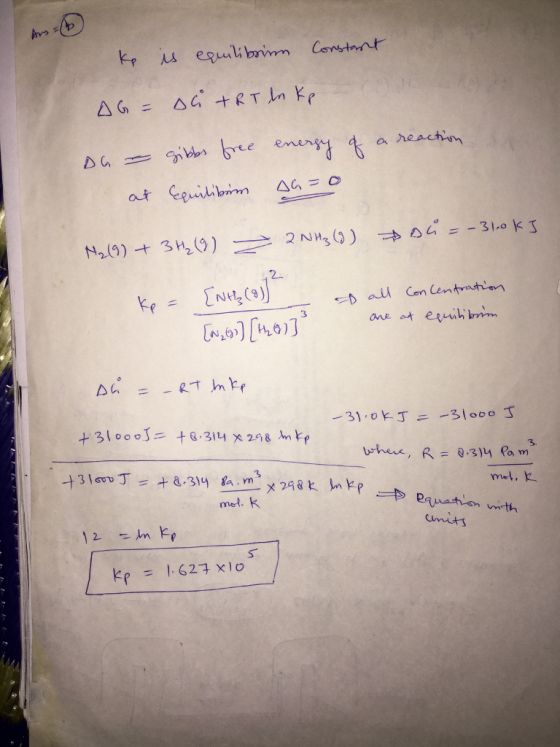
K_p for NH_3 at 25 degree C N_2 (g) + 3 H_2(g) irreversible 2 NH_3 (g),...
For the reaction N_2(g) + 3 H_2(g) rightarrow 2 NH_3(g) Delta G degree = -23.6 kJ...
 For the reaction N_2(g) + 3 H_2(g) rightarrow 2 NH_3(g) Delta G degree = -23.6 kJ and Delta S degree = -198.7 J/K at 345 K and 1 atm. This reaction is (reactant, product) favored under standard conditions at 345 K. The standard enthalpy change for the reaction of 2.30 moles of N_2(g) at this temperature would be kJ. For the reaction 2 H_2O_2(l) rightarrow 2 H_2O(l) + O_2(g) Delta G degree = -236.9 kJ and Delta H degree =...
Calculate S^0 of NH_3(g) for the reaction N_2(g) + 3 H_2(g) rightarrow 2 NH_3(g) using the...
 Calculate S^0 of NH_3(g) for the reaction N_2(g) + 3 H_2(g) rightarrow 2 NH_3(g) using the following data: Delta G_f^0 of NH_3(g) = - 16 kJ/mol Delta H_f^0 of NH_3(g) = - 45.9 kJ/mol S^0 of H_2(g) = 131 J/mol. K S^0 of N_2(g) = 191.5 J/mol. K
For the following equilibrium: N_2(g) + H_2(g) rightarrow NH_3(g) delta H= -386 kJ/mole Predict the direction...
 For the following equilibrium: N_2(g) + H_2(g) rightarrow NH_3(g) delta H= -386 kJ/mole Predict the direction the equilibrium will shift if: N_2 is added? H_2 is removed? NH_3 is added? NH_3 is removed? the volume of the container is decreased? the pressure is increased by adding Argon gas? the reaction is cooled? equal number of moles of H_2 and NH_3 are added? a catalyst is added The equilibrium constant for the following reaction is 5.0 at 400 degree C. CO_(g)...
Given the following standard reduction potentials: H^+ (aq) + 2e^- rightarrow H_2(g) E degree = 0.00...
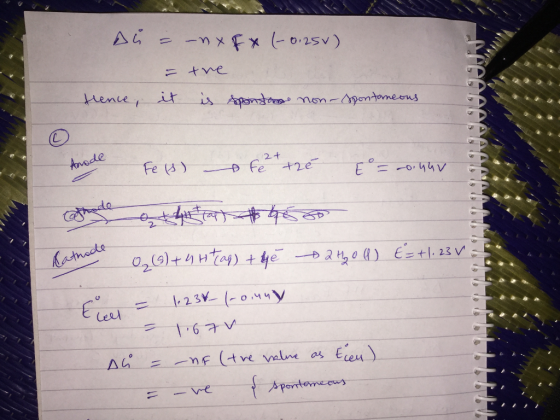
 Given the following standard reduction potentials: H^+ (aq) + 2e^- rightarrow H_2(g) E degree = 0.00 V Fe^3+ (aq) + 2e^- rightarrow Fe(s) E degree = -0.43 V (a) What is the cell potential by combining the above two half-reactions to make a working voltaic cell (same as galvanic cell)? (b) Which species will be oxidized in anode? Write the half-reaction for the anode. (c) Write the overall reaction and balance the chemical equation for this working voltaic cell. (d)...
Given the measured cell potential, E_cell, is -0.3657 V at 25 degree C in the following...
 Given the measured cell potential, E_cell, is -0.3657 V at 25 degree C in the following cell, calculate the H^+ concentration Pt (s)|H_2(g, 0.801 atm)|H^+ (aq, ? M)||Cd^2+ (aq, 1.00 M)|Cd (s) The balanced reduction half-reactions for the cell, and their respective standard reduction potential values, E degree, are as follows. 2H^+ (aq) + 2e^- rightarrow H_2 (g) E degree = 0.00 V Cd^2+ (aq) + 2e^- rightarrow Cd (s) E degree = -0.403 V [H^+] =
The k_eq for the reaction: 2 NO(g) + 2 H_2(g) rightarrow N_2(g) + 2 H_2O(g) is...
 The k_eq for the reaction: 2 NO(g) + 2 H_2(g) rightarrow N_2(g) + 2 H_2O(g) is 650. The concentrations at a given time were measured as NO = 0.1 M, H_2 = 0.05 M, H_2O = 0.1 M, and N_2 = 0.001 M. Is the reaction at equilibrium?
For the following cell, write a balanced equation for the cell reaction and calculate E degree...
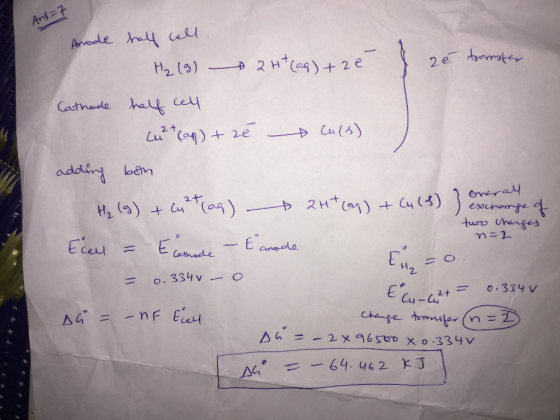
 For the following cell, write a balanced equation for the cell reaction and calculate E degree and Delta G degree at 25 degree C: Pt(s) | H_2(1.0 atm) | H^+(1.00 M) ||Cu^2+(1.00 M)|Cu(s)
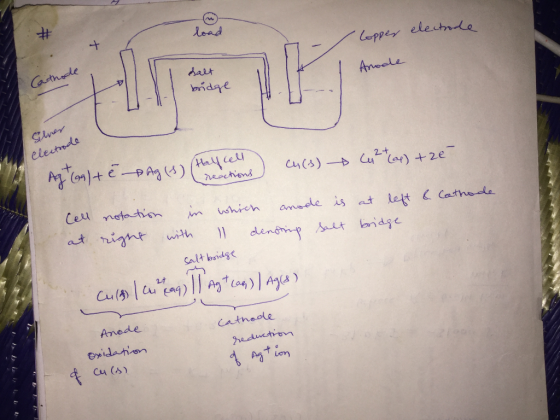
For the following Redox reaction: Co_(s) | CO^+2 (aq) || H_2 (g), 2H^+ (1M)|Pt_(3) draw a...
 For the following Redox reaction: Co_(s) | CO^+2 (aq) || H_2 (g), 2H^+ (1M)|Pt_(3) draw a detailed diagram of the cell (anode, cathode) and show the direction of the flow of electrons. The overall redox rxn: Co_9s) + 2H^+ (aq) rightarrow Co^+2 (aq) + H_2 (g) Calculate the PH of the solution if E_cell = 0.10 when [Co^+2] = 0.45 M, [H_2] = 0.30 M, and PH = -log [H^+]} Detailed calculation with units is a MUST
Use Hess's Law to determine Delta H for the reaction 2 Al(s) + 3 Cl_2(g) rightarrow...
 Use Hess's Law to determine Delta H for the reaction 2 Al(s) + 3 Cl_2(g) rightarrow 2 AlCl_3(s) given: 2 Al(s) + 6 HCl(aq) rightarrow 2 AlCl_3(aq) + 3 H_2(g) Delta H = -1049 kJ HCl(g) rightarrow HCl(aq) Delta H = -74.8 kJ H_2(g) + Cl_2(g) rightarrow 2 HCl(g) Delta H = -185 kJ AlCl_3(s) rightarrow AlCl_3(aq) Delta H = -323 kJ
Chemistry help Calculate delta H degree and Delta G degree following reactions at 25 degree C,...
 Chemistry help
Calculate delta H degree and Delta G degree following reactions at 25 degree C, using thermodynamic data from Appendix C; interpret the signs of Delta H degree and Delta G degree. (18.50) 2PbO(s) + N_2(g) rightarrow 2Pb(s) + 2NO(g) CS_2(I) + 2H_2O(l) rightarrow CO_2(g) + 2H_2S(g)
Chemistry help
Calculate delta H degree and Delta G degree following reactions at 25 degree C, using thermodynamic data from Appendix C; interpret the signs of Delta H degree and Delta G degree. (18.50) 2PbO(s) + N_2(g) rightarrow 2Pb(s) + 2NO(g) CS_2(I) + 2H_2O(l) rightarrow CO_2(g) + 2H_2S(g)
 For the reaction N_2(g) + 3 H_2(g) rightarrow 2 NH_3(g) Delta G degree = -23.6 kJ and Delta S degree = -198.7 J/K at 345 K and 1 atm. This reaction is (reactant, product) favored under standard conditions at 345 K. The standard enthalpy change for the reaction of 2.30 moles of N_2(g) at this temperature would be kJ. For the reaction 2 H_2O_2(l) rightarrow 2 H_2O(l) + O_2(g) Delta G degree = -236.9 kJ and Delta H degree =...
 Calculate S^0 of NH_3(g) for the reaction N_2(g) + 3 H_2(g) rightarrow 2 NH_3(g) using the following data: Delta G_f^0 of NH_3(g) = - 16 kJ/mol Delta H_f^0 of NH_3(g) = - 45.9 kJ/mol S^0 of H_2(g) = 131 J/mol. K S^0 of N_2(g) = 191.5 J/mol. K
 For the following equilibrium: N_2(g) + H_2(g) rightarrow NH_3(g) delta H= -386 kJ/mole Predict the direction the equilibrium will shift if: N_2 is added? H_2 is removed? NH_3 is added? NH_3 is removed? the volume of the container is decreased? the pressure is increased by adding Argon gas? the reaction is cooled? equal number of moles of H_2 and NH_3 are added? a catalyst is added The equilibrium constant for the following reaction is 5.0 at 400 degree C. CO_(g)...
 Given the following standard reduction potentials: H^+ (aq) + 2e^- rightarrow H_2(g) E degree = 0.00 V Fe^3+ (aq) + 2e^- rightarrow Fe(s) E degree = -0.43 V (a) What is the cell potential by combining the above two half-reactions to make a working voltaic cell (same as galvanic cell)? (b) Which species will be oxidized in anode? Write the half-reaction for the anode. (c) Write the overall reaction and balance the chemical equation for this working voltaic cell. (d)...
 Given the measured cell potential, E_cell, is -0.3657 V at 25 degree C in the following cell, calculate the H^+ concentration Pt (s)|H_2(g, 0.801 atm)|H^+ (aq, ? M)||Cd^2+ (aq, 1.00 M)|Cd (s) The balanced reduction half-reactions for the cell, and their respective standard reduction potential values, E degree, are as follows. 2H^+ (aq) + 2e^- rightarrow H_2 (g) E degree = 0.00 V Cd^2+ (aq) + 2e^- rightarrow Cd (s) E degree = -0.403 V [H^+] =
 The k_eq for the reaction: 2 NO(g) + 2 H_2(g) rightarrow N_2(g) + 2 H_2O(g) is 650. The concentrations at a given time were measured as NO = 0.1 M, H_2 = 0.05 M, H_2O = 0.1 M, and N_2 = 0.001 M. Is the reaction at equilibrium?
 For the following cell, write a balanced equation for the cell reaction and calculate E degree and Delta G degree at 25 degree C: Pt(s) | H_2(1.0 atm) | H^+(1.00 M) ||Cu^2+(1.00 M)|Cu(s)
 For the following Redox reaction: Co_(s) | CO^+2 (aq) || H_2 (g), 2H^+ (1M)|Pt_(3) draw a detailed diagram of the cell (anode, cathode) and show the direction of the flow of electrons. The overall redox rxn: Co_9s) + 2H^+ (aq) rightarrow Co^+2 (aq) + H_2 (g) Calculate the PH of the solution if E_cell = 0.10 when [Co^+2] = 0.45 M, [H_2] = 0.30 M, and PH = -log [H^+]} Detailed calculation with units is a MUST
 Use Hess's Law to determine Delta H for the reaction 2 Al(s) + 3 Cl_2(g) rightarrow 2 AlCl_3(s) given: 2 Al(s) + 6 HCl(aq) rightarrow 2 AlCl_3(aq) + 3 H_2(g) Delta H = -1049 kJ HCl(g) rightarrow HCl(aq) Delta H = -74.8 kJ H_2(g) + Cl_2(g) rightarrow 2 HCl(g) Delta H = -185 kJ AlCl_3(s) rightarrow AlCl_3(aq) Delta H = -323 kJ
 Chemistry help
Calculate delta H degree and Delta G degree following reactions at 25 degree C, using thermodynamic data from Appendix C; interpret the signs of Delta H degree and Delta G degree. (18.50) 2PbO(s) + N_2(g) rightarrow 2Pb(s) + 2NO(g) CS_2(I) + 2H_2O(l) rightarrow CO_2(g) + 2H_2S(g)
Chemistry help
Calculate delta H degree and Delta G degree following reactions at 25 degree C, using thermodynamic data from Appendix C; interpret the signs of Delta H degree and Delta G degree. (18.50) 2PbO(s) + N_2(g) rightarrow 2Pb(s) + 2NO(g) CS_2(I) + 2H_2O(l) rightarrow CO_2(g) + 2H_2S(g)
Most questions answered within 3 hours.
-
Where is the error in this code sequence?
String s1 = "Hello";
String s2 = "ello";...
asked 11 months ago -
Financial data for Joel de Paris, Inc., for last year
follow:
Joel de Paris, Inc.
Balance...
asked 11 months ago -
Consider this reaction:
Al2(SO4)3 (aq)+ BaCl3
(aq) Al2Cl6 (aq)- +
3BaSO4(s) . What is the...
asked 11 months ago -
Suppose that Savneet is considering increasing her
recent random sample from 20 car rentals to 40...
asked 11 months ago -
Trucks arrive at an unloading terminal at an average rate of 120
per hour.
Trucks arrive...
asked 11 months ago -
Why are methanol and ethanol completely soluble in water while
octanol is not very little soluble....
asked 11 months ago -
A facilities manager at a university reads in a research report
that the mean amount of...
asked 11 months ago -
When the CuSO4 is rehydrated by adding water to the anhydrous
compound, is this an endothermic...
asked 11 months ago -
A ray of sunlight is passing from diamond into crown glass; the
angle of incidence is...
asked 11 months ago -
A block of mass 0.249 kg is placed on top of a light, vertical
spring of...
asked 11 months ago -
how do the kidneys compensate in the presences of acidosis
a) trigger hyperventilate
b) reserve acid...
asked 11 months ago -
Question 501 pts
The rental rate of capital to the firm increases. Which of the
following...
asked 11 months ago