
Homework Answers
Add Answer to:
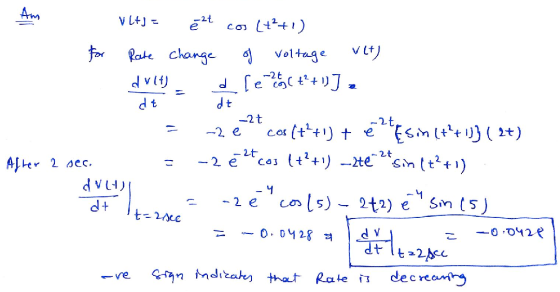
after two seconds? The Voltage across a resistor R is given by V(t)=e. 2t cos(+²+1) How...
An AC source which provides a voltage difference of AV = (1.80 V)cos[2T(60 Hz)t] is connected...
 An AC source which provides a voltage difference of AV = (1.80 V)cos[2T(60 Hz)t] is connected in a sing le loop circuit to a 5.90 resistor (a) What is AVmfor this source? V (b) What is the magnitude of the maximum current through the resistor at any time? A (c) What is Ims? A (d) For a circuit with only a resistor, the current through the circuit will have the same time dependence as the voltage; that is I =...
The voltage across a resistor oscillates sinusodially. The resistor has a value of R and the...
The voltage across a resistor oscillates sinusodially. The resistor has a value of R and the voltage is given by v(t) = Vo sin[wt+a]. Calculate the power dissipated by this resistor over one complete cycle.
suppose vx=2t? and v,-12 t + sin(t) + cos(t) + e-t. If the initial position at...
 suppose vx=2t? and v,-12 t + sin(t) + cos(t) + e-t. If the initial position at t-0 is x-0, y-0, what is the final x position after 2 seconds?
Find IL(t) and the voltage VR(t) across the top 8 ohm resistor. I'm so confused how...
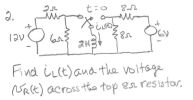 Find IL(t) and the voltage VR(t) across
the top 8 ohm resistor. I'm so confused how to find
VR(t) :'(. I found IL(t) was 0.75
+5.25e-2t . But I'm so lost when it comes to finding
that v? What do I do? :'(
to Find Lit)aud the voltage UR(t) across tto top 80 resistov,
Find IL(t) and the voltage VR(t) across
the top 8 ohm resistor. I'm so confused how to find
VR(t) :'(. I found IL(t) was 0.75
+5.25e-2t . But I'm so lost when it comes to finding
that v? What do I do? :'(
to Find Lit)aud the voltage UR(t) across tto top 80 resistov,
The voltage across a resistor is found to be 1.5 V. It is also found that...
The voltage across a resistor is found to be 1.5 V. It is also found that there is a charge of 2 Coulombs passing through the resistor within 10 seconds. What is the value of the resistor in ohms? Group of answer choices 3 0.75 0.2 7.5
Problem 2. Consider the sinusoidal voltage given by v(t) = 25 cos(400nt + 60°) V. a....
 Problem 2. Consider the sinusoidal voltage given by v(t) = 25 cos(400nt + 60°) V. a. What is the maximum amplitude of the voltage? b. What is the frequency in hertz? c. What is the frequency in radians per seconds? d. What is the phase angle in radians? e. What is the phase angle in degrees? f. What is the period in milliseconds? g. What is the first time after t=0 that v=0?
252 322 6480 0.25 E 4V /12V Question 11 1 pts 11. The voltage v across...
 252 322 6480 0.25 E 4V /12V Question 11 1 pts 11. The voltage v across the capacitor fort > 0 2exp(-2t) [2cos(2t) - sin(2t)] V 2exp(-t) [2cos(2t) - sin(2t)] V 2exp(-t) (cos(2t) - 2sin(2t)] V 2exp(-t) [2cos(5t) - sin(5t)] V
12. A series RC circuit is driven by a periodic square wave voltage V(t) with a period T=0.3 sec. V(t) 0 for t<0. A...
 12. A series RC circuit is driven by a periodic square wave voltage V(t) with a period T=0.3 sec. V(t) 0 for t<0. After t=0, the voltage alternates between 15 V and 0 V. Assume that R-40 , C 150 HF. We will call the voltage across the capacitor and the resistor Ve(t) and Vr(t) respectively (c) The capacitor above is now replaced by an inductor whose inductance is 0.24 H. We call the voltage across the inductor VL(t) Calculate...
Determine the voltage across R2 in the given circuit. (Calculate the direction in radians and round...
 Determine the voltage across R2 in the given circuit. (Calculate the direction in radians and round the final answer to two decimal places.) Given: Kt) = 20 cos(533.33) A, R1 = 9.2 Ω, R2 = 34 Ω, L = 15 mH, and C-117F i() 2 The voltage across R2 in the given circuit is VR2(t) = | cos (533 33 ) V
Use a method of your choice to find the voltage across resistor R1, given that E...
 Use a method of your choice to find the voltage across resistor R1, given that E = 8.7 V, 1-SRC = 2.2 mA, R1 = 8.2 kOhm, R2 = 9.1 kOhm. R1 R2 1
 An AC source which provides a voltage difference of AV = (1.80 V)cos[2T(60 Hz)t] is connected in a sing le loop circuit to a 5.90 resistor (a) What is AVmfor this source? V (b) What is the magnitude of the maximum current through the resistor at any time? A (c) What is Ims? A (d) For a circuit with only a resistor, the current through the circuit will have the same time dependence as the voltage; that is I =...
 suppose vx=2t? and v,-12 t + sin(t) + cos(t) + e-t. If the initial position at t-0 is x-0, y-0, what is the final x position after 2 seconds?
 Find IL(t) and the voltage VR(t) across
the top 8 ohm resistor. I'm so confused how to find
VR(t) :'(. I found IL(t) was 0.75
+5.25e-2t . But I'm so lost when it comes to finding
that v? What do I do? :'(
to Find Lit)aud the voltage UR(t) across tto top 80 resistov,
Find IL(t) and the voltage VR(t) across
the top 8 ohm resistor. I'm so confused how to find
VR(t) :'(. I found IL(t) was 0.75
+5.25e-2t . But I'm so lost when it comes to finding
that v? What do I do? :'(
to Find Lit)aud the voltage UR(t) across tto top 80 resistov,
 Problem 2. Consider the sinusoidal voltage given by v(t) = 25 cos(400nt + 60°) V. a. What is the maximum amplitude of the voltage? b. What is the frequency in hertz? c. What is the frequency in radians per seconds? d. What is the phase angle in radians? e. What is the phase angle in degrees? f. What is the period in milliseconds? g. What is the first time after t=0 that v=0?
 252 322 6480 0.25 E 4V /12V Question 11 1 pts 11. The voltage v across the capacitor fort > 0 2exp(-2t) [2cos(2t) - sin(2t)] V 2exp(-t) [2cos(2t) - sin(2t)] V 2exp(-t) (cos(2t) - 2sin(2t)] V 2exp(-t) [2cos(5t) - sin(5t)] V
 12. A series RC circuit is driven by a periodic square wave voltage V(t) with a period T=0.3 sec. V(t) 0 for t<0. After t=0, the voltage alternates between 15 V and 0 V. Assume that R-40 , C 150 HF. We will call the voltage across the capacitor and the resistor Ve(t) and Vr(t) respectively (c) The capacitor above is now replaced by an inductor whose inductance is 0.24 H. We call the voltage across the inductor VL(t) Calculate...
 Determine the voltage across R2 in the given circuit. (Calculate the direction in radians and round the final answer to two decimal places.) Given: Kt) = 20 cos(533.33) A, R1 = 9.2 Ω, R2 = 34 Ω, L = 15 mH, and C-117F i() 2 The voltage across R2 in the given circuit is VR2(t) = | cos (533 33 ) V
 Use a method of your choice to find the voltage across resistor R1, given that E = 8.7 V, 1-SRC = 2.2 mA, R1 = 8.2 kOhm, R2 = 9.1 kOhm. R1 R2 1
Most questions answered within 3 hours.
-
Where is the error in this code sequence?
String s1 = "Hello";
String s2 = "ello";...
asked 10 months ago -
Financial data for Joel de Paris, Inc., for last year
follow:
Joel de Paris, Inc.
Balance...
asked 10 months ago -
Consider this reaction:
Al2(SO4)3 (aq)+ BaCl3
(aq) Al2Cl6 (aq)- +
3BaSO4(s) . What is the...
asked 10 months ago -
Suppose that Savneet is considering increasing her
recent random sample from 20 car rentals to 40...
asked 10 months ago -
Trucks arrive at an unloading terminal at an average rate of 120
per hour.
Trucks arrive...
asked 10 months ago -
Why are methanol and ethanol completely soluble in water while
octanol is not very little soluble....
asked 10 months ago -
A facilities manager at a university reads in a research report
that the mean amount of...
asked 10 months ago -
When the CuSO4 is rehydrated by adding water to the anhydrous
compound, is this an endothermic...
asked 10 months ago -
A ray of sunlight is passing from diamond into crown glass; the
angle of incidence is...
asked 10 months ago -
A block of mass 0.249 kg is placed on top of a light, vertical
spring of...
asked 10 months ago -
how do the kidneys compensate in the presences of acidosis
a) trigger hyperventilate
b) reserve acid...
asked 10 months ago -
Question 501 pts
The rental rate of capital to the firm increases. Which of the
following...
asked 10 months ago