
Homework Answers


Add Answer to:
Immediately outside a conducting sphere of unknown charge sphere, the potential is 140 V. and radius...
The electric potential immediately outside a charged conducting sphere is 210 V, and 10.0 cm farther...
 The electric potential immediately outside a charged conducting sphere is 210 V, and 10.0 cm farther from the center of the sphere the potential is 160 V (a) Determine the radius of the sphere. 0.076X Your response differs significantly from the correct answer. Rework your solution from the beginning and check each step carefully. cm (b) Determine the charge on the sphere. 1.7 Your response differs from the correct answer by more than 10%. Double check your calculations. nC The...
The electric potential immediately outside a charged conducting sphere is 240 V, and 10.0 cm above...
The electric potential immediately outside a charged conducting sphere is 240 V, and 10.0 cm above the surface of the sphere the potential is 130 V. (a) Determine the radius of the sphere. cm (b) Determine the charge on the sphere. nC The electric potential immediately outside another charged conducting sphere is 260 V, and 10.0 cm above the surface of the sphere the magnitude of the electric field is 360V/m. (c) Determine all possible values for the radius of...
The electric potential immediately outside another charged conducting sphere is 240 V, and 10.0 cm above...
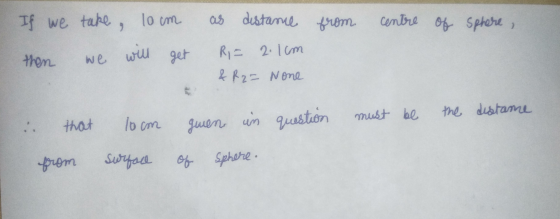
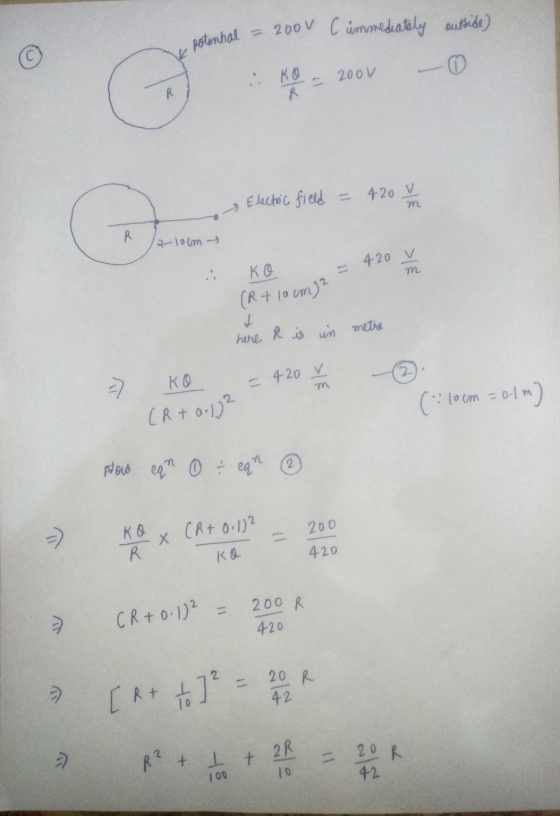
The electric potential immediately outside another charged conducting sphere is 240 V, and 10.0 cm above the surface of the sphere the magnitude of the electric field is 390 V/m. (c) Determine all possible values for the radius of the sphere. (Enter your answers from smallest to largest. If only one value exists, enter "NONE" in the second answer blank.) r1 = cm r2 = cm (d) Determine the charge on the sphere for each value of r. (If only...
The electric potential immediately outside another charged conducting sphere is 220 V, and 10.0 cm above...
The electric potential immediately outside another charged conducting sphere is 220 V, and 10.0 cm above the surface of the sphere the magnitude of the electric field is 440 V/m. a) Determine all possible values for the radius of the sphere. (Enter your answers from smallest to largest. If only one value exists, enter "NONE" in the second answer blank.) r1 = r2 = b) Determine the charge on the sphere for each value of r. (If only one value...
A conducting sphere of radius a is kept at a constant potential V0. A charge q...
A conducting sphere of radius a is kept at a constant potential V0. A charge q is brought at a distance d from the center of the sphere (d > a). Using the method of images: (a) Find the electric potential V (r, θ) in the region r > a. (b) Find the surface charge density on the surface of the sphere. (c) Find the force on the charge q.
A conducting sphere of 2.0 cm radius is charged with some unknown charge such that the...
A conducting sphere of 2.0 cm radius is charged with some unknown charge such that the electric potential 4.0 cm away from its surface is 100 Volts. What is the electric potential at the center of the conductor? If a proton is released at rest just outside the surface, what speed will it have when it's: A) 2.0 cm away from the surface of the conductor? B) Very far from the conductor? Please show ALL work!
A conducting sphere with radius R has total charge Q. (a) Find the relationship between the...
 A conducting sphere with radius R has total charge Q. (a) Find the relationship between the magnitude of the electric field and the electric potential on the surface of the conducting sphere. (Use the following as necessary R, Q, and E for the magnitude of the electric field.) V = (b) For a sphere of radius 77 cm, calculate the maximum surface electric potential at which the surrounding air begins to break down. Take the dielectric strength of (maximum sustainable...
A conducting sphere with radius ? = 5 ?? has a charge ? = 8 ??....
A conducting sphere with radius ? = 5 ?? has a charge ? = 8 ??. It is placed at the center of a neutral conducting shell with inner radius ? = 10 ?? and outer radius ? = 15 ??, as shown in the diagram at right. 4. Let the electric potential be equal to zero at infinity. What are the electric potentials of the inner sphere and outer shell? 5. Sketch a graph of the electric potential as...
A solid conducting sphere has net positive charge and radius R = 0.600 mm. At a...
A solid conducting sphere has net positive charge and radius R = 0.600 mm. At a point 1.20 mm from the center of the sphere, the electric potential due to the charge on the sphere is 24.0 V. Assume that V = 0 at an infinite distance from the sphere. What is the electric potential at the center of the sphere?
A conducting sphere of radius a has a total charge Q on it. A charge q...
A conducting sphere of radius a has a total charge Q on it. A charge q is brought at a distance d from the center of the sphere (d > a). Using the method of images: (a) Find the electric potential V (r, θ) in the region r > a. (b) Find the surface charge density on the surface of the sphere. (c) Find the force on the charge q.
 The electric potential immediately outside a charged conducting sphere is 210 V, and 10.0 cm farther from the center of the sphere the potential is 160 V (a) Determine the radius of the sphere. 0.076X Your response differs significantly from the correct answer. Rework your solution from the beginning and check each step carefully. cm (b) Determine the charge on the sphere. 1.7 Your response differs from the correct answer by more than 10%. Double check your calculations. nC The...
 A conducting sphere with radius R has total charge Q. (a) Find the relationship between the magnitude of the electric field and the electric potential on the surface of the conducting sphere. (Use the following as necessary R, Q, and E for the magnitude of the electric field.) V = (b) For a sphere of radius 77 cm, calculate the maximum surface electric potential at which the surrounding air begins to break down. Take the dielectric strength of (maximum sustainable...
Most questions answered within 3 hours.
-
Where is the error in this code sequence?
String s1 = "Hello";
String s2 = "ello";...
asked 10 months ago -
Financial data for Joel de Paris, Inc., for last year
follow:
Joel de Paris, Inc.
Balance...
asked 10 months ago -
Consider this reaction:
Al2(SO4)3 (aq)+ BaCl3
(aq) Al2Cl6 (aq)- +
3BaSO4(s) . What is the...
asked 10 months ago -
Suppose that Savneet is considering increasing her
recent random sample from 20 car rentals to 40...
asked 10 months ago -
Trucks arrive at an unloading terminal at an average rate of 120
per hour.
Trucks arrive...
asked 10 months ago -
Why are methanol and ethanol completely soluble in water while
octanol is not very little soluble....
asked 10 months ago -
A facilities manager at a university reads in a research report
that the mean amount of...
asked 10 months ago -
When the CuSO4 is rehydrated by adding water to the anhydrous
compound, is this an endothermic...
asked 10 months ago -
A ray of sunlight is passing from diamond into crown glass; the
angle of incidence is...
asked 10 months ago -
A block of mass 0.249 kg is placed on top of a light, vertical
spring of...
asked 10 months ago -
how do the kidneys compensate in the presences of acidosis
a) trigger hyperventilate
b) reserve acid...
asked 10 months ago -
Question 501 pts
The rental rate of capital to the firm increases. Which of the
following...
asked 10 months ago