
Homework Answers
ANSWER:
Add Answer to:
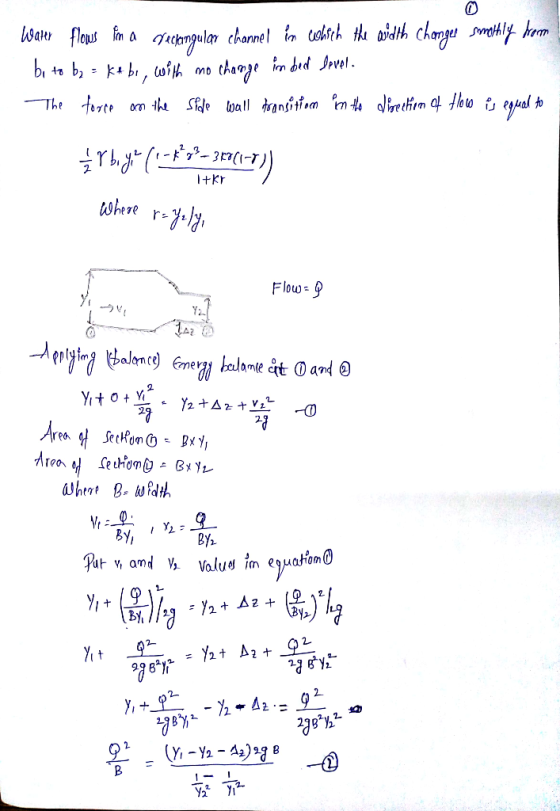
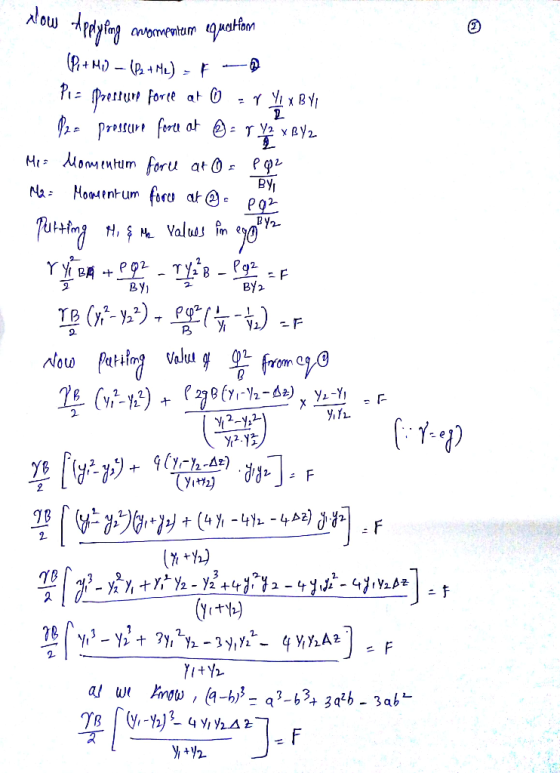
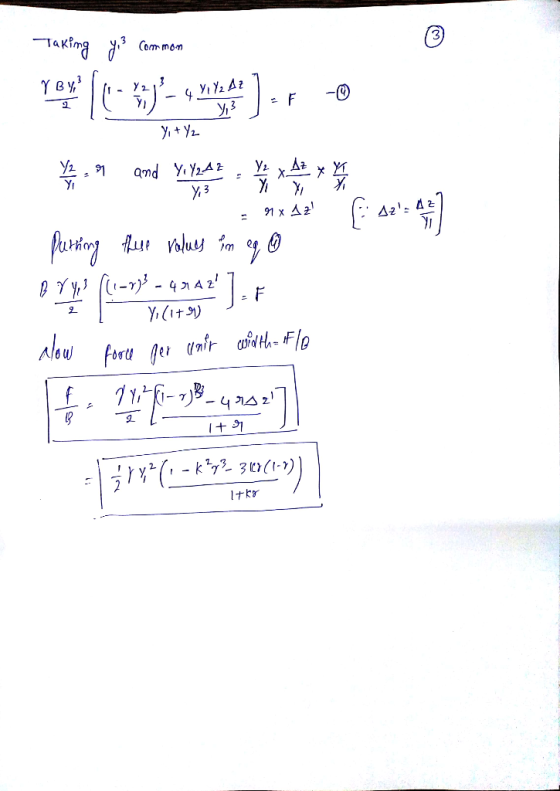
1. Water flows in a rectangular channel in which the width changes smoothly from b, to...
Q1) Consider a rectangular channel with a constant width b, a) Obtain the equation of water...
 Q1) Consider a rectangular channel with a constant width b, a) Obtain the equation of water surface profile (dy/dx) as function of Froude number and channel bottom slope in a channel transition assuming that over a short distance Ax, the energy losses can be neglected. b) Using the equation you have obtained, draw the water surface profile if flow is supercritical and if there is a downward step at the channel bed and show your results on the graph of...
(5) Water flows along a trapezoidal channel with base width B=1.5 m, side slope 1:1 (horizontal...
(5) Water flows along a trapezoidal channel with base width B=1.5 m, side slope 1:1 (horizontal to vertical) and depth D=0.7 m. It is controlled downstream by a sharp crested weir that has a crest height of H=2.4 m above the channel bed and a crest width equal to that of the base width. Calculate the flow rate in the channel (check any assumptions you make).
Water flows at 10.8(103) t/min through a rectangular channel having a width of 6 ft (Figure 1)
 Water flows at 10.8(103) t/min through a rectangular channel having a width of 6 ft (Figure 1) Part A Determine the critical depth of the flow. Part C What is the necessary increase in elevation h of the channel bed to create the depth yB = 4.05 ft?
The discharge Q in a rectangular channel is 6m3 /s. The channel width is 3m and...
The discharge Q in a rectangular channel is 6m3 /s. The channel width is 3m and flow depth is 2m. (i) The channel width is reduced (no change to bed elevation) to 1.5m at a downstream location. What is the flow depth at the constriction? Determine if choking conditions are present. Explain your answer using of a q-y curve. (ii) The channel width is reduced (no change to bed elevation) to 1.0m at a downstream location. Calculate the upstream water...
A rectangular channel having a width of 8m carries a discharge of 18 m3/s at the...
A rectangular channel having a width of 8m carries a discharge of 18 m3/s at the normal depth of 2.25m. (a) What should be the minimum width to which the channel can be contracted smoothly without causing any choking of flow assuming that the bed of the channel is level all through. (b) Compute the critical slope of this new section if n = 0.012. (c) How long should this channel be if there is a drop of 4m. at...
Water flows down a rectangular channel that has a width of 2.2 m, a Manning's n...
 Water flows down a rectangular channel that has a width of 2.2 m, a Manning's n of 0.019 and a slope of 1 in 200. Calculate the discharge in the channel when the depth of flow is 0.5 m, 1.0 m, 2.0 m, and 4.0 m. Plot a graph of depth against discharge and comment on its shape, [10 marks] A wide channel has a Manning's number = 0.021, a longitudinal bed slope of 1:250 and conveys 0.XX m3/s/m of...
Water flows at 11 m3/s in a rectangular channel of width 5 m. The slope of...
 Water flows at 11 m3/s in a rectangular channel of width 5 m. The slope of the channel is 0.001 and the Manning roughness coefficient is equal to 0.035. If the depth of flow at a selected section is 2 m, calculate the upstream depth at 500 m from the selected section using the standard step method
Answer and progress. Water flows at 4.3m/s in a rectangular channel of width 3 m and...
 Answer and progress.
Water flows at 4.3m/s in a rectangular channel of width 3 m and depth of flow 1m. If the channel width is decreased by 0.75m and the bottom of the channel is raised by 0.25m, Find the followings: The discharge per unit width before the constriction q m3/s/m Discharge per unit width at the constriction q" = m/s/m Water depth of flow in the constriction y2 =
Answer and progress.
Water flows at 4.3m/s in a rectangular channel of width 3 m and depth of flow 1m. If the channel width is decreased by 0.75m and the bottom of the channel is raised by 0.25m, Find the followings: The discharge per unit width before the constriction q m3/s/m Discharge per unit width at the constriction q" = m/s/m Water depth of flow in the constriction y2 =
Water (ρ-1000 kg/m3) flows in a rectangular channel over the 1 m drop. If the width...
 Water (ρ-1000 kg/m3) flows in a rectangular channel over the 1 m drop. If the width of the channel is 1.5 m, determine the volumetric flow rate in the channel. Assume water is an ideal fluid. 0.5 m 1 m 2 m Figure 3
Air flows through a Venturi channel with a rectangular cross section. The width of the channel...
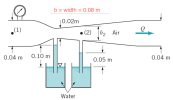 Air flows through a Venturi channel with a rectangular cross
section. The width of the channel is 0.08m ; the height at point
(1) and the exit are 0.04 m. The height at the throat is 0.02
m.
What is the flow rate (Q) at the venturi tube?
b width 0.08 m |0.02m (1) |h2 Air (2) 0.04 m 0.10 m 0.04 m 0.05 m Water
Air flows through a Venturi channel with a rectangular cross
section. The width of the channel is 0.08m ; the height at point
(1) and the exit are 0.04 m. The height at the throat is 0.02
m.
What is the flow rate (Q) at the venturi tube?
b width 0.08 m |0.02m (1) |h2 Air (2) 0.04 m 0.10 m 0.04 m 0.05 m Water
 Q1) Consider a rectangular channel with a constant width b, a) Obtain the equation of water surface profile (dy/dx) as function of Froude number and channel bottom slope in a channel transition assuming that over a short distance Ax, the energy losses can be neglected. b) Using the equation you have obtained, draw the water surface profile if flow is supercritical and if there is a downward step at the channel bed and show your results on the graph of...
 Water flows down a rectangular channel that has a width of 2.2 m, a Manning's n of 0.019 and a slope of 1 in 200. Calculate the discharge in the channel when the depth of flow is 0.5 m, 1.0 m, 2.0 m, and 4.0 m. Plot a graph of depth against discharge and comment on its shape, [10 marks] A wide channel has a Manning's number = 0.021, a longitudinal bed slope of 1:250 and conveys 0.XX m3/s/m of...
 Water flows at 11 m3/s in a rectangular channel of width 5 m. The slope of the channel is 0.001 and the Manning roughness coefficient is equal to 0.035. If the depth of flow at a selected section is 2 m, calculate the upstream depth at 500 m from the selected section using the standard step method
 Answer and progress.
Water flows at 4.3m/s in a rectangular channel of width 3 m and depth of flow 1m. If the channel width is decreased by 0.75m and the bottom of the channel is raised by 0.25m, Find the followings: The discharge per unit width before the constriction q m3/s/m Discharge per unit width at the constriction q" = m/s/m Water depth of flow in the constriction y2 =
Answer and progress.
Water flows at 4.3m/s in a rectangular channel of width 3 m and depth of flow 1m. If the channel width is decreased by 0.75m and the bottom of the channel is raised by 0.25m, Find the followings: The discharge per unit width before the constriction q m3/s/m Discharge per unit width at the constriction q" = m/s/m Water depth of flow in the constriction y2 =
 Water (ρ-1000 kg/m3) flows in a rectangular channel over the 1 m drop. If the width of the channel is 1.5 m, determine the volumetric flow rate in the channel. Assume water is an ideal fluid. 0.5 m 1 m 2 m Figure 3
 Air flows through a Venturi channel with a rectangular cross
section. The width of the channel is 0.08m ; the height at point
(1) and the exit are 0.04 m. The height at the throat is 0.02
m.
What is the flow rate (Q) at the venturi tube?
b width 0.08 m |0.02m (1) |h2 Air (2) 0.04 m 0.10 m 0.04 m 0.05 m Water
Air flows through a Venturi channel with a rectangular cross
section. The width of the channel is 0.08m ; the height at point
(1) and the exit are 0.04 m. The height at the throat is 0.02
m.
What is the flow rate (Q) at the venturi tube?
b width 0.08 m |0.02m (1) |h2 Air (2) 0.04 m 0.10 m 0.04 m 0.05 m Water
Most questions answered within 3 hours.
-
Where is the error in this code sequence?
String s1 = "Hello";
String s2 = "ello";...
asked 10 months ago -
Financial data for Joel de Paris, Inc., for last year
follow:
Joel de Paris, Inc.
Balance...
asked 10 months ago -
Consider this reaction:
Al2(SO4)3 (aq)+ BaCl3
(aq) Al2Cl6 (aq)- +
3BaSO4(s) . What is the...
asked 10 months ago -
Suppose that Savneet is considering increasing her
recent random sample from 20 car rentals to 40...
asked 10 months ago -
Trucks arrive at an unloading terminal at an average rate of 120
per hour.
Trucks arrive...
asked 10 months ago -
Why are methanol and ethanol completely soluble in water while
octanol is not very little soluble....
asked 10 months ago -
A facilities manager at a university reads in a research report
that the mean amount of...
asked 10 months ago -
When the CuSO4 is rehydrated by adding water to the anhydrous
compound, is this an endothermic...
asked 10 months ago -
A ray of sunlight is passing from diamond into crown glass; the
angle of incidence is...
asked 10 months ago -
A block of mass 0.249 kg is placed on top of a light, vertical
spring of...
asked 10 months ago -
how do the kidneys compensate in the presences of acidosis
a) trigger hyperventilate
b) reserve acid...
asked 10 months ago -
Question 501 pts
The rental rate of capital to the firm increases. Which of the
following...
asked 10 months ago