a) If I wanted to set up a controlled breeding experiment to determine the inheritance pattern...
a) If I wanted to set up a controlled breeding experiment to determine the inheritance pattern of the Vermillion eye color in Drosophila and determine if that trait was inherited under the Mendelian Ratio of 3:1, what steps would I need to conduct for the experiment and how would I monitor that experiment and analyze the data? That is, how would I set up that experiment (briefly) and what data am I collecting to analyze and with what statistical test?
b) Describe how to use the Chi-Square statistical analysis for determining if my experimental data fit the mendelian ratio I was testing with my experimental hypothesis.
c) Describe 4 reasons Drosophila are especially useful as model organisms in conducting controlled breeding experiments?
Homework Answers
Solution a
Steps for the experiment
- Selecte pure breeding Drosophila for Vermillion eye color
- Cross the pure breeding Drosophila for Vermillion eye color
- Select the F1 progeny and do selfing
- Count the number of F2 offsprings. - Take total and seperate count of Homozygous dominant, Heterozygous dominant and Homozygous recessive
- You may repeat the above steps - Replications
- We know the expected phenotype ratio is 3:1 (suppose if we got a total of 200 offspings, 150 would show dominant trait and 50 would show recessive trait)
Solution b.
For doing the Chsquare analysis, follow the formula
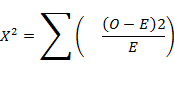
where, O is the observed number of phenotypes and E is the expected number of phenotypes
Suppose in your experiment you got 150 pogenies in the F2 and out of the 200, 80 are Homozygous dominant, 60 are Heterozygous dominant (Total 140 dominants) and 60 are Homozygous recessive, these are the observed observed numbers. By using Chisquare we have to analyse whether there numbers folloe the real (expected) ratio of 3:1 (dominant:recessive)
For example if we follow the above number, the Chisquare analysis will be like this,
|
Phenotype |
Observed |
Expected |
O-E |
(O-E)2 |
(O-E)2/E |
|
Dominant |
140 |
200*(3/4)= 150 |
140-150 = -10 |
100 |
100/150 = 0.67 |
|
Recessive |
60 |
200*(1/4)= 50 |
60-50 = 10 |
100 |
100/50 = 2 |
|
Total |
200 |
Ʃ = 2.67 |
The Chisquare value we obtained is Ʃ = 2.67.
Now we have to compare this Chisquare value (calculated chisquare value) with the tabled Chisquare value (It is a contant value) at 1 degrees of freedom and 0.05 probability level . The tabled value at 1 degrees of freedom and 0.05 probability level is 3.841
calculated chisquare value we obtained is 2.67 and tabled value is 3.841.
Here at 1 degrees of freedom, and 0.05 probability level the calculated value (2.67) of χ² is lesser than tabled value (3.841) Therefore the Null hypothesis is accepted.
Our Null Hypothesis is that 'there is no significant difference in the observed ratio and expected ratio (3:1)' and our re chisquare analysis shows that there is no there is no significant difference in the observed ratio and expected ratio and the experimental results follow Mendelian ratios.
If the calculated value of χ² is greater than tabled value (3.841) we will reject the Null hypothesis and rejection means the results do not follow mendelian ratios.
Solution c
Reasons to use Drosophila as model organism
- Simple and well understood genome
- Short life cycle
- Quick reproduction rate
- Easy to grow under in-vitro conditions
- Drosophila genome is 60% homologous to human genome
Add Answer to:
a) If I wanted to set up a controlled breeding experiment to
determine the inheritance pattern...
2. Set up and complete genetic analysis (problems) involving a testcross to determine an organism's genotype...
 2. Set up and complete genetic analysis (problems) involving a testcross to determine an organism's genotype 3. the use of the rule of multiplication or a Punnett Square to determine probable outcomes 4. and the use of pedigrees to determine how a particular human trait is inherited. 5. Identify situations involving variations on Mendel's laws, including incomplete dominance, codominance, pleiotropy, polygenic inheritance, and epigenetics inheritance 6. Describe how the chromosome theory of inheritance explains linked genes. 7. Explain and describe...
A cross has been set up between a true breeding tall plant producing white flowers and...
 A cross has been set up between a true breeding tall plant producing white flowers and a true breeding short plant producing red flowers. One can be certain that this type of a cross: will result in a 3 red: 1 white ratio will result in all red F_1 flowers cannot produce progeny because the parental phenotypes are different from one another is a monohybrid cross is a dihybrid cross In humans, free earlobes (E) are dominant to attached earlobes...
help!!! Problem Statement: How can concentration changes affect a chemical reaction? I, Data Collection: EXPERIMENT #...
 help!!!
Problem Statement: How can concentration changes affect a chemical reaction? I, Data Collection: EXPERIMENT # 1 : R BG RG B + + Initial Concentration-I 0.6 0.7 0.8 0.9 - 0.13 Concentration Change-C -0.17 - 0,17 0.17 Ending Concentration-E 0.43 0.53 0.97 1.07 Calculate the change in concentration of each of the substances in the reaction. In the space below, draw a plot of the concentration v. time and label the axes. Identify the chemical substance that corresponds to...
help!!!
Problem Statement: How can concentration changes affect a chemical reaction? I, Data Collection: EXPERIMENT # 1 : R BG RG B + + Initial Concentration-I 0.6 0.7 0.8 0.9 - 0.13 Concentration Change-C -0.17 - 0,17 0.17 Ending Concentration-E 0.43 0.53 0.97 1.07 Calculate the change in concentration of each of the substances in the reaction. In the space below, draw a plot of the concentration v. time and label the axes. Identify the chemical substance that corresponds to...
How would I do this problem? Iknow n=1064, and 3/4=.75 but how do I set up...
 How would I do this problem? Iknow n=1064, and 3/4=.75
but how do I set up the rest?
6550 400 5500 15100 9. Genetics Experiment In one of Mendel's experiments with plants, 1064 ofspring con- sisted of 787 plants with long stems. According to Mendel's theory, 3/4 of the offspring plants should have long stems. Assuming that Mendel's proportion of 3/4 is correct, find the probability of getting 787or fewer plants with long stems among 1064 offspring plants. Based on...
How would I do this problem? Iknow n=1064, and 3/4=.75
but how do I set up the rest?
6550 400 5500 15100 9. Genetics Experiment In one of Mendel's experiments with plants, 1064 ofspring con- sisted of 787 plants with long stems. According to Mendel's theory, 3/4 of the offspring plants should have long stems. Assuming that Mendel's proportion of 3/4 is correct, find the probability of getting 787or fewer plants with long stems among 1064 offspring plants. Based on...
Question 1 Tests comparing 2 population means can be: surveys experiments both surveys and experiments Question...
Question 1 Tests comparing 2 population means can be: surveys experiments both surveys and experiments Question 2 If all the experimental units are identical (ex: clones), you will set up the study as: CRD Block Design Question 3 a 2 sample t-test still has which normality assumption(s)? The population is normal or n is greater than 30 both populations are normal or both sample sizes are greater than 30 Question 4 When you block by some variable in a block...
Fun-filled Genetics activity Set Psa plants were particularly well suited for use in Mendel's breeding experiments...
 Fun-filled Genetics activity Set Psa plants were particularly well suited for use in Mendel's breeding experiments for all of the following m e thal Al was show easily terved various in a number of characters, such as a shape and flower color, it is powible to completely control tingshotween different pe plants, it is possible to a large numbers of progeny from any given cross. Dipeas have unusually long generation time, many of the observable characters that vary in pea...
1. A data set that includes the shows on a station during the day would be...
1. A data set that includes the shows on a station during the day would be classified as what type of data? nominal, ordinal, interval, ratio 2. What type of data collection might be best to estimate the amount of time individuals spend socializing? survey, observational, experiment, simulation 3. What type of data collection might be best to study how many books students bring into the media center during finals week? experiment, observational, simulation, survey 4. You need to study...
2) If I flipped a coin five times and it landed heads up each time, what...
 2) If I flipped a coin five times and it landed heads up each time, what is the probability that it will land heads up on the sixth time? 3) If a solar panel manufacturing process has a 3% defect rate, and a random sample of 10 panels is selected, what is the probability that none of the panels in the sample will be defective? 4) You are designing an experiment to determine the effect of temperature, stirring rate, and...
Please I need help with my assignment 1,In a normally distributed data set of how long...
Please I need help with my assignment 1,In a normally distributed data set of how long customers stay in your store, the mean is 31.7 minutes and the standard deviation is 1.9minutes . Within what range would you expect 95% of your customers to stay in your store? a.26.0-37.4 b.30.75-32.7 c.29.8-33.6 d.27.9-35.5 2. You need to study the satisfaction of customers of a specific restaurant. You decide to order food and talk to those customers sitting next to you. This...
How do you write up an interpretation of the results ? I already filled out the...
 How do you write up an interpretation of the results ?
I already filled out the table, however I need help with a
written format of he results of this study.
Please see picture for what has to be included in the write
up.
Problem 6-Write-up . Your written report of the ANOVA results should include the following in a paragraph of text (i.e., NOT a bulleted list): . The name of the statistical test used The variables in the...
How do you write up an interpretation of the results ?
I already filled out the table, however I need help with a
written format of he results of this study.
Please see picture for what has to be included in the write
up.
Problem 6-Write-up . Your written report of the ANOVA results should include the following in a paragraph of text (i.e., NOT a bulleted list): . The name of the statistical test used The variables in the...
 2. Set up and complete genetic analysis (problems) involving a testcross to determine an organism's genotype 3. the use of the rule of multiplication or a Punnett Square to determine probable outcomes 4. and the use of pedigrees to determine how a particular human trait is inherited. 5. Identify situations involving variations on Mendel's laws, including incomplete dominance, codominance, pleiotropy, polygenic inheritance, and epigenetics inheritance 6. Describe how the chromosome theory of inheritance explains linked genes. 7. Explain and describe...
 A cross has been set up between a true breeding tall plant producing white flowers and a true breeding short plant producing red flowers. One can be certain that this type of a cross: will result in a 3 red: 1 white ratio will result in all red F_1 flowers cannot produce progeny because the parental phenotypes are different from one another is a monohybrid cross is a dihybrid cross In humans, free earlobes (E) are dominant to attached earlobes...
 help!!!
Problem Statement: How can concentration changes affect a chemical reaction? I, Data Collection: EXPERIMENT # 1 : R BG RG B + + Initial Concentration-I 0.6 0.7 0.8 0.9 - 0.13 Concentration Change-C -0.17 - 0,17 0.17 Ending Concentration-E 0.43 0.53 0.97 1.07 Calculate the change in concentration of each of the substances in the reaction. In the space below, draw a plot of the concentration v. time and label the axes. Identify the chemical substance that corresponds to...
help!!!
Problem Statement: How can concentration changes affect a chemical reaction? I, Data Collection: EXPERIMENT # 1 : R BG RG B + + Initial Concentration-I 0.6 0.7 0.8 0.9 - 0.13 Concentration Change-C -0.17 - 0,17 0.17 Ending Concentration-E 0.43 0.53 0.97 1.07 Calculate the change in concentration of each of the substances in the reaction. In the space below, draw a plot of the concentration v. time and label the axes. Identify the chemical substance that corresponds to...
 How would I do this problem? Iknow n=1064, and 3/4=.75
but how do I set up the rest?
6550 400 5500 15100 9. Genetics Experiment In one of Mendel's experiments with plants, 1064 ofspring con- sisted of 787 plants with long stems. According to Mendel's theory, 3/4 of the offspring plants should have long stems. Assuming that Mendel's proportion of 3/4 is correct, find the probability of getting 787or fewer plants with long stems among 1064 offspring plants. Based on...
How would I do this problem? Iknow n=1064, and 3/4=.75
but how do I set up the rest?
6550 400 5500 15100 9. Genetics Experiment In one of Mendel's experiments with plants, 1064 ofspring con- sisted of 787 plants with long stems. According to Mendel's theory, 3/4 of the offspring plants should have long stems. Assuming that Mendel's proportion of 3/4 is correct, find the probability of getting 787or fewer plants with long stems among 1064 offspring plants. Based on...
 Fun-filled Genetics activity Set Psa plants were particularly well suited for use in Mendel's breeding experiments for all of the following m e thal Al was show easily terved various in a number of characters, such as a shape and flower color, it is powible to completely control tingshotween different pe plants, it is possible to a large numbers of progeny from any given cross. Dipeas have unusually long generation time, many of the observable characters that vary in pea...
 2) If I flipped a coin five times and it landed heads up each time, what is the probability that it will land heads up on the sixth time? 3) If a solar panel manufacturing process has a 3% defect rate, and a random sample of 10 panels is selected, what is the probability that none of the panels in the sample will be defective? 4) You are designing an experiment to determine the effect of temperature, stirring rate, and...
 How do you write up an interpretation of the results ?
I already filled out the table, however I need help with a
written format of he results of this study.
Please see picture for what has to be included in the write
up.
Problem 6-Write-up . Your written report of the ANOVA results should include the following in a paragraph of text (i.e., NOT a bulleted list): . The name of the statistical test used The variables in the...
How do you write up an interpretation of the results ?
I already filled out the table, however I need help with a
written format of he results of this study.
Please see picture for what has to be included in the write
up.
Problem 6-Write-up . Your written report of the ANOVA results should include the following in a paragraph of text (i.e., NOT a bulleted list): . The name of the statistical test used The variables in the...
Most questions answered within 3 hours.
-
Where is the error in this code sequence?
String s1 = "Hello";
String s2 = "ello";...
asked 10 months ago -
Financial data for Joel de Paris, Inc., for last year
follow:
Joel de Paris, Inc.
Balance...
asked 10 months ago -
Consider this reaction:
Al2(SO4)3 (aq)+ BaCl3
(aq) Al2Cl6 (aq)- +
3BaSO4(s) . What is the...
asked 10 months ago -
Suppose that Savneet is considering increasing her
recent random sample from 20 car rentals to 40...
asked 10 months ago -
Trucks arrive at an unloading terminal at an average rate of 120
per hour.
Trucks arrive...
asked 10 months ago -
Why are methanol and ethanol completely soluble in water while
octanol is not very little soluble....
asked 10 months ago -
A facilities manager at a university reads in a research report
that the mean amount of...
asked 10 months ago -
When the CuSO4 is rehydrated by adding water to the anhydrous
compound, is this an endothermic...
asked 10 months ago -
A ray of sunlight is passing from diamond into crown glass; the
angle of incidence is...
asked 10 months ago -
A block of mass 0.249 kg is placed on top of a light, vertical
spring of...
asked 10 months ago -
how do the kidneys compensate in the presences of acidosis
a) trigger hyperventilate
b) reserve acid...
asked 10 months ago -
Question 501 pts
The rental rate of capital to the firm increases. Which of the
following...
asked 10 months ago