solve for R equivalent?
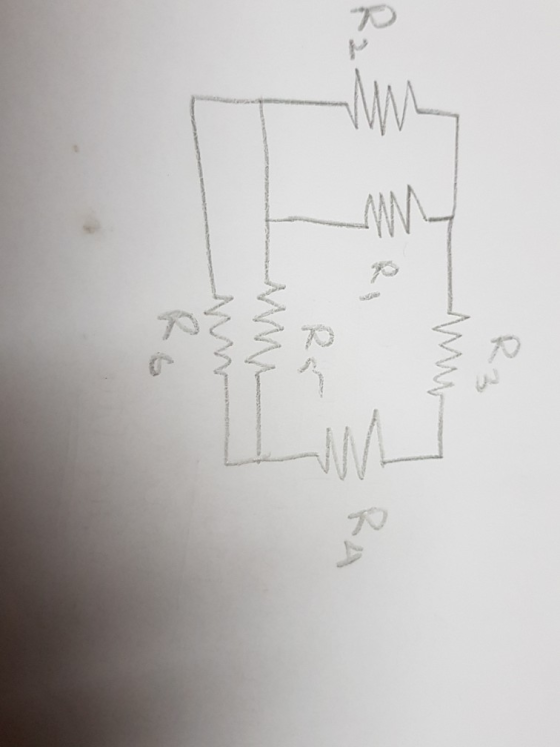
solve for R equivalent?
Homework Answers

For the rectangular equation, write an equivalent polar equation and solve for r. x = 4...
 For the rectangular equation, write an equivalent polar equation and solve for r. x = 4 Or = Ora con la Ora None of these
Solve for the equivalent capacitance, assuming the values of C. A=2.0, B=3.0, C=4.0. If the Req=...
Solve for the equivalent capacitance, assuming the values of C. A=2.0, B=3.0, C=4.0. If the Req= 1/A +1/B+ 1/C=.83 and R=1.2 ohms.
2. (a) Show that (PVQ) + R is not logically equivalent to (P + R) V(Q...
 2. (a) Show that (PVQ) + R is not logically equivalent to (P + R) V(Q + R) using a truth table. (b) Is (PAQ) → R logically equivalent to (P + R) A( Q R )? If so, use a truth table to establish this. If not, show that it is false.
Hi Can you please solve this physics problem. Find the equivalent resistance between points x and...
 Hi Can you please solve this physics problem.
Find the equivalent resistance between points x and y shown in Fig. 31-41. Four of the resistors have equal resistance R, as shown: the '"middle'* resistor has value r notequalto R. (Compare with Problem 10 of Chapter 30.)
Hi Can you please solve this physics problem.
Find the equivalent resistance between points x and y shown in Fig. 31-41. Four of the resistors have equal resistance R, as shown: the '"middle'* resistor has value r notequalto R. (Compare with Problem 10 of Chapter 30.)
Problem #1 Solve for the Thevenin Equivalent for circuit 1 and the Norton Equivalent for circuit...
 Problem #1 Solve for the Thevenin Equivalent for circuit 1 and
the Norton Equivalent for circuit 2 with the following values for
X.
a) X = 9 Ω resistor
b) X = 1 H inductor
c) X = ¼ F capacitor Problem
#2 Place a 4 Ω resistor across the + and – connecters in Problem
#1 and solve for the value of voltage across and the current
through the 4 Ω resistor for each value used for X.
ਲਾਸ...
Problem #1 Solve for the Thevenin Equivalent for circuit 1 and
the Norton Equivalent for circuit 2 with the following values for
X.
a) X = 9 Ω resistor
b) X = 1 H inductor
c) X = ¼ F capacitor Problem
#2 Place a 4 Ω resistor across the + and – connecters in Problem
#1 and solve for the value of voltage across and the current
through the 4 Ω resistor for each value used for X.
ਲਾਸ...
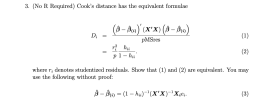
how to show they are equivalent? 3. (No R Required) Cook's distance has the equivalent formulae...
 how to show they are equivalent?
3. (No R Required) Cook's distance has the equivalent formulae (8 – B«)'(x+x)(– B6) Di = (1) pMSres = r? hii p 1 - hii (2) where r; denotes studentized residuals. Show that (1) and (2) are equivalent. You may use the following without proof: Ê - B(i) = (1 - hii)-4(X'X)-X;li. (3)
how to show they are equivalent?
3. (No R Required) Cook's distance has the equivalent formulae (8 – B«)'(x+x)(– B6) Di = (1) pMSres = r? hii p 1 - hii (2) where r; denotes studentized residuals. Show that (1) and (2) are equivalent. You may use the following without proof: Ê - B(i) = (1 - hii)-4(X'X)-X;li. (3)
63. Find the equivalent conductance G then the equivalent resistance R "seen" by the current source...
 63. Find the equivalent conductance G then the equivalent resistance R "seen" by the current source I, in the circuit of Figure P2.63 in terms of the literals R1, R, and g Evaluate when R 1 k2, R2 3 k2, gm= 0.2 mS. and eq eq R 1 9mVx V. + V R2 X Figure P2.63 CHECK: R 10 k2 eq
Show that: (b) (p → q) → r and p →(q → r) are not logically equivalent.
6. Maximum score 3 ( 1 per part).Show that:(b) (p → q) → r and p →(q → r) are not logically equivalent.(c) p ↔ q and ¬ p ↔ ¬ q are logically equivalent.
solve for r 0/10 Correct C 2er; solve for r
 solve for r
0/10 Correct C 2er; solve for r
solve for r
0/10 Correct C 2er; solve for r
What is the equivalent resistance of the resistors in the figure below? R, = 2.0Ω R)...
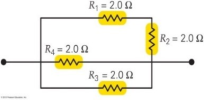 What is the equivalent resistance of the resistors in the figure
below?
R, = 2.0Ω R) = 2.0Ω R4 = 2.0Ω R2 = 2.0Ω
What is the equivalent resistance of the resistors in the figure
below?
R, = 2.0Ω R) = 2.0Ω R4 = 2.0Ω R2 = 2.0Ω
 For the rectangular equation, write an equivalent polar equation and solve for r. x = 4 Or = Ora con la Ora None of these
 2. (a) Show that (PVQ) + R is not logically equivalent to (P + R) V(Q + R) using a truth table. (b) Is (PAQ) → R logically equivalent to (P + R) A( Q R )? If so, use a truth table to establish this. If not, show that it is false.
 Hi Can you please solve this physics problem.
Find the equivalent resistance between points x and y shown in Fig. 31-41. Four of the resistors have equal resistance R, as shown: the '"middle'* resistor has value r notequalto R. (Compare with Problem 10 of Chapter 30.)
Hi Can you please solve this physics problem.
Find the equivalent resistance between points x and y shown in Fig. 31-41. Four of the resistors have equal resistance R, as shown: the '"middle'* resistor has value r notequalto R. (Compare with Problem 10 of Chapter 30.)
 Problem #1 Solve for the Thevenin Equivalent for circuit 1 and
the Norton Equivalent for circuit 2 with the following values for
X.
a) X = 9 Ω resistor
b) X = 1 H inductor
c) X = ¼ F capacitor Problem
#2 Place a 4 Ω resistor across the + and – connecters in Problem
#1 and solve for the value of voltage across and the current
through the 4 Ω resistor for each value used for X.
ਲਾਸ...
Problem #1 Solve for the Thevenin Equivalent for circuit 1 and
the Norton Equivalent for circuit 2 with the following values for
X.
a) X = 9 Ω resistor
b) X = 1 H inductor
c) X = ¼ F capacitor Problem
#2 Place a 4 Ω resistor across the + and – connecters in Problem
#1 and solve for the value of voltage across and the current
through the 4 Ω resistor for each value used for X.
ਲਾਸ...
 how to show they are equivalent?
3. (No R Required) Cook's distance has the equivalent formulae (8 – B«)'(x+x)(– B6) Di = (1) pMSres = r? hii p 1 - hii (2) where r; denotes studentized residuals. Show that (1) and (2) are equivalent. You may use the following without proof: Ê - B(i) = (1 - hii)-4(X'X)-X;li. (3)
how to show they are equivalent?
3. (No R Required) Cook's distance has the equivalent formulae (8 – B«)'(x+x)(– B6) Di = (1) pMSres = r? hii p 1 - hii (2) where r; denotes studentized residuals. Show that (1) and (2) are equivalent. You may use the following without proof: Ê - B(i) = (1 - hii)-4(X'X)-X;li. (3)
 63. Find the equivalent conductance G then the equivalent resistance R "seen" by the current source I, in the circuit of Figure P2.63 in terms of the literals R1, R, and g Evaluate when R 1 k2, R2 3 k2, gm= 0.2 mS. and eq eq R 1 9mVx V. + V R2 X Figure P2.63 CHECK: R 10 k2 eq
 solve for r
0/10 Correct C 2er; solve for r
solve for r
0/10 Correct C 2er; solve for r
 What is the equivalent resistance of the resistors in the figure
below?
R, = 2.0Ω R) = 2.0Ω R4 = 2.0Ω R2 = 2.0Ω
What is the equivalent resistance of the resistors in the figure
below?
R, = 2.0Ω R) = 2.0Ω R4 = 2.0Ω R2 = 2.0Ω
Most questions answered within 3 hours.
-
Where is the error in this code sequence?
String s1 = "Hello";
String s2 = "ello";...
asked 10 months ago -
Financial data for Joel de Paris, Inc., for last year
follow:
Joel de Paris, Inc.
Balance...
asked 10 months ago -
Consider this reaction:
Al2(SO4)3 (aq)+ BaCl3
(aq) Al2Cl6 (aq)- +
3BaSO4(s) . What is the...
asked 10 months ago -
Suppose that Savneet is considering increasing her
recent random sample from 20 car rentals to 40...
asked 10 months ago -
Trucks arrive at an unloading terminal at an average rate of 120
per hour.
Trucks arrive...
asked 10 months ago -
Why are methanol and ethanol completely soluble in water while
octanol is not very little soluble....
asked 10 months ago -
A facilities manager at a university reads in a research report
that the mean amount of...
asked 10 months ago -
When the CuSO4 is rehydrated by adding water to the anhydrous
compound, is this an endothermic...
asked 10 months ago -
A ray of sunlight is passing from diamond into crown glass; the
angle of incidence is...
asked 10 months ago -
A block of mass 0.249 kg is placed on top of a light, vertical
spring of...
asked 10 months ago -
how do the kidneys compensate in the presences of acidosis
a) trigger hyperventilate
b) reserve acid...
asked 10 months ago -
Question 501 pts
The rental rate of capital to the firm increases. Which of the
following...
asked 10 months ago