

Homework Answers
q1) incorrect state ment is rate of reaction increases with decreasing temperature.
q2)
a) fastest reaction is with label 3 (last one) (from left to right) because it is showing more no:of product molecules
slowest reaction is with label 2 (middle one) (from left to right) because it is showing less no:of product molecules
b) left hand side flask (first one) is at high temperature (400c) because it is having more no:of product molecules
right hand side flask (second one) is at low temperature (250c) because it is having less no:of product molecules
q3)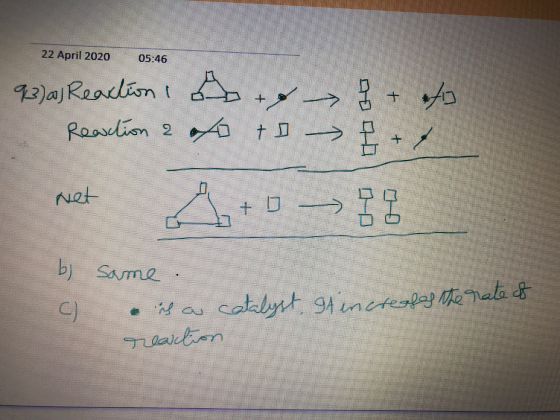
q4)
a) trial 1 rate of the reaction = 27/40 = 6.75 x10^-1 ml/sec
trial 2 rate of the reaction = 80/40 = 2.0 ml/sec
trial 3 rate of the reaction =43 /40 = 1.075ml/sec
b) collisions occur more frequently because concentration is more more no:of molecules are present
c) more energetic collisions occur because when temperature is rised more no:of molecules will get more energy
d) pieces of zinc will have more surface area than strip of zinc greater the surface area higher the rate of reaction
Add Answer to:
please help with- chem lab: Reaction Rates After Thought (1-4d)
THANKS!!
REACTION RATES The After Thought...
Effect of a Catalyst on Reaction Rate: with a lower Ea than for the uncatalyzed reaction....
 Effect of a Catalyst on Reaction Rate: with a lower Ea than for the uncatalyzed reaction. This is shown as the blue path with Ea in the diagram below t a given temperature, a catalyst increases the rate of a reaction by providing a pathway E (RJ) products Reaction Coordinale Since the potential energy barrier is lower in the presence of a catalyst, a greater fraction of the molecules will have sufficient energy to react. Because the reactants and products...
Rates of Chemical Reaction Lab Iodination of Acetone 1- a student made up a reaction mixture...
 Rates of Chemical Reaction Lab
Iodination of Acetone
1- a student made up a reaction mixture
consisting of 10 mL 4 M acetone, 5 mL 1.0 M HCl 10 mL 0.005 M
I2 and 25 mL H2O.
Why is the concentration of iodine so much lower than the other
reactants?
3. How are time and rate related? How are 1/time and
rate related?
4. What does it mean when someone says a reaction is “first
order”?
5. In a...
Rates of Chemical Reaction Lab
Iodination of Acetone
1- a student made up a reaction mixture
consisting of 10 mL 4 M acetone, 5 mL 1.0 M HCl 10 mL 0.005 M
I2 and 25 mL H2O.
Why is the concentration of iodine so much lower than the other
reactants?
3. How are time and rate related? How are 1/time and
rate related?
4. What does it mean when someone says a reaction is “first
order”?
5. In a...
10) Which of the following is always true for the oxidation numbers in an oxidation-reduction reaction?...
 10) Which of the following is always true for the oxidation numbers in an oxidation-reduction reaction? a) The value for the oxidation number for atoms of the element being oxidized must increase as we go from reactants to products b) The initial value for the oxidation number for atoms of the element being oxidized must be positive c) The final value for the oxidation number for atoms of the element being oxidized must be positive d) Both band c e)...
1. The following data were collected at 20 oC for the reaction of bromphenol blue, HBPB2-,...
1. The following data were collected at 20 oC for the reaction of bromphenol blue, HBPB2-, and hydroxide ions, OH-, shown in the equation below HBPB2- + OH- <---> BPB3- + H2O a)What is the rate equation for the reaction? Determination [HBPB2-]0, M [OH-]o, M Rate, M/sec 1 7.22 x 10⁻⁶ 1.00 9.627 x10⁻⁹ 2 7.22 x 10⁻⁶ 0.25 2.490 x10⁻⁹ 3 3.63 x 10⁻⁶ 1.00 4.750 x10- The reaction was run three times with different initial concentrations of the...
please show steps. thanks ! Experiment 19 Gas Stoichiometry and the Gas Laws The relationship between...
 please show steps. thanks !
Experiment 19 Gas Stoichiometry and the Gas Laws The relationship between the physical properties of a gas, and the moles, is given by the “Ideal Gas Law:" PV=nRT where n-number of moles R=the ideal gas constant: 0.0821 atm L mole 'Kor 62.4 L torr molek In this experiment, the theoretical yield of gas, will be compared to the experimental yield. The reaction of aluminum with hydrochloric acid produces hydrogen according to the balanced equation below....
please show steps. thanks !
Experiment 19 Gas Stoichiometry and the Gas Laws The relationship between the physical properties of a gas, and the moles, is given by the “Ideal Gas Law:" PV=nRT where n-number of moles R=the ideal gas constant: 0.0821 atm L mole 'Kor 62.4 L torr molek In this experiment, the theoretical yield of gas, will be compared to the experimental yield. The reaction of aluminum with hydrochloric acid produces hydrogen according to the balanced equation below....
Please help with my Titration lab! I am having difficulty understanding this. Thank you! C. Analyzing...
 Please help with my Titration lab! I am having difficulty
understanding this. Thank you!
C. Analyzing an unknown base - optimizing a method: In this segment you will design your own method for analyzing an unknown base. In the solutions list there are several different concentrations of HCl to choose from. You can also try different sample volumes of the unknown base. Be sure to record these for each trial. Your goal is to find two different combinations of HCI...
Please help with my Titration lab! I am having difficulty
understanding this. Thank you!
C. Analyzing an unknown base - optimizing a method: In this segment you will design your own method for analyzing an unknown base. In the solutions list there are several different concentrations of HCl to choose from. You can also try different sample volumes of the unknown base. Be sure to record these for each trial. Your goal is to find two different combinations of HCI...
Hi please can you answer 4 questions .. thanks for help Factoes hich Infuence The Rates...
 Hi
please can you answer 4 questions .. thanks for help
Factoes hich Infuence The Rates Of Resction Name Date Prelab Question Lab Instructor Lab Section a. List the potential ehemical hazards in this experiment and tell how you wi handle them in order to make this experiment safe for you and others in the laboratory b. List the potential procedural hazards in this experiment and tell how you will handle them in order to make this experiment safe for...
Hi
please can you answer 4 questions .. thanks for help
Factoes hich Infuence The Rates Of Resction Name Date Prelab Question Lab Instructor Lab Section a. List the potential ehemical hazards in this experiment and tell how you wi handle them in order to make this experiment safe for you and others in the laboratory b. List the potential procedural hazards in this experiment and tell how you will handle them in order to make this experiment safe for...
I need help with all three please and thank you! 1. In the following reaction at...
 I need help with all three please and thank you!
1. In the following reaction at equilibrium, what will happen if more CO(g) is added? COC12(g) CO(g) + Cl2(g) A) reaction will shift to the right B) reaction will shift to the left C) nothing will happen D) the equilibrium constant will change E) not enough information given to predict 2. The following reaction is exothermic (with A and B reactants) and at equilibrium. What will happen if heat is...
I need help with all three please and thank you!
1. In the following reaction at equilibrium, what will happen if more CO(g) is added? COC12(g) CO(g) + Cl2(g) A) reaction will shift to the right B) reaction will shift to the left C) nothing will happen D) the equilibrium constant will change E) not enough information given to predict 2. The following reaction is exothermic (with A and B reactants) and at equilibrium. What will happen if heat is...
Please answer and explain the below questions(ignore formatting): Question 1: In order for the outside of...
Please answer and explain the below questions(ignore formatting): Question 1: In order for the outside of your car to react with the oxygen and moisture in the air, there must be a sufficient amount of reactants activation energy products molecules potential energy Question 4: For a given set of reactants, to speed up a reaction process, you could decrease the activation energy. change the reaction pathway. increase the concentration. all of the above. have more collisions in a given time...
i am lost woth Titration, please help... i was able tondo my virtual lab and get...
 i
am lost woth Titration, please help... i was able tondo my virtual
lab and get the data needed... but i dont understand what to do on
the remaining problems! please help!
Experiment 11 part 2 ACID BASE TITRATIONS OBJECTIVES 1. To learn general titration techniques 2. To generate a standardized titrant. 3. To determine the concentration of various acid samples. PROCEDURES - WORK ALONE INTRODUCTION In part 1 you practiced standardizing a titrant: using KHP is a common procedure...
i
am lost woth Titration, please help... i was able tondo my virtual
lab and get the data needed... but i dont understand what to do on
the remaining problems! please help!
Experiment 11 part 2 ACID BASE TITRATIONS OBJECTIVES 1. To learn general titration techniques 2. To generate a standardized titrant. 3. To determine the concentration of various acid samples. PROCEDURES - WORK ALONE INTRODUCTION In part 1 you practiced standardizing a titrant: using KHP is a common procedure...
 Effect of a Catalyst on Reaction Rate: with a lower Ea than for the uncatalyzed reaction. This is shown as the blue path with Ea in the diagram below t a given temperature, a catalyst increases the rate of a reaction by providing a pathway E (RJ) products Reaction Coordinale Since the potential energy barrier is lower in the presence of a catalyst, a greater fraction of the molecules will have sufficient energy to react. Because the reactants and products...
 Rates of Chemical Reaction Lab
Iodination of Acetone
1- a student made up a reaction mixture
consisting of 10 mL 4 M acetone, 5 mL 1.0 M HCl 10 mL 0.005 M
I2 and 25 mL H2O.
Why is the concentration of iodine so much lower than the other
reactants?
3. How are time and rate related? How are 1/time and
rate related?
4. What does it mean when someone says a reaction is “first
order”?
5. In a...
Rates of Chemical Reaction Lab
Iodination of Acetone
1- a student made up a reaction mixture
consisting of 10 mL 4 M acetone, 5 mL 1.0 M HCl 10 mL 0.005 M
I2 and 25 mL H2O.
Why is the concentration of iodine so much lower than the other
reactants?
3. How are time and rate related? How are 1/time and
rate related?
4. What does it mean when someone says a reaction is “first
order”?
5. In a...
 10) Which of the following is always true for the oxidation numbers in an oxidation-reduction reaction? a) The value for the oxidation number for atoms of the element being oxidized must increase as we go from reactants to products b) The initial value for the oxidation number for atoms of the element being oxidized must be positive c) The final value for the oxidation number for atoms of the element being oxidized must be positive d) Both band c e)...
 please show steps. thanks !
Experiment 19 Gas Stoichiometry and the Gas Laws The relationship between the physical properties of a gas, and the moles, is given by the “Ideal Gas Law:" PV=nRT where n-number of moles R=the ideal gas constant: 0.0821 atm L mole 'Kor 62.4 L torr molek In this experiment, the theoretical yield of gas, will be compared to the experimental yield. The reaction of aluminum with hydrochloric acid produces hydrogen according to the balanced equation below....
please show steps. thanks !
Experiment 19 Gas Stoichiometry and the Gas Laws The relationship between the physical properties of a gas, and the moles, is given by the “Ideal Gas Law:" PV=nRT where n-number of moles R=the ideal gas constant: 0.0821 atm L mole 'Kor 62.4 L torr molek In this experiment, the theoretical yield of gas, will be compared to the experimental yield. The reaction of aluminum with hydrochloric acid produces hydrogen according to the balanced equation below....
 Please help with my Titration lab! I am having difficulty
understanding this. Thank you!
C. Analyzing an unknown base - optimizing a method: In this segment you will design your own method for analyzing an unknown base. In the solutions list there are several different concentrations of HCl to choose from. You can also try different sample volumes of the unknown base. Be sure to record these for each trial. Your goal is to find two different combinations of HCI...
Please help with my Titration lab! I am having difficulty
understanding this. Thank you!
C. Analyzing an unknown base - optimizing a method: In this segment you will design your own method for analyzing an unknown base. In the solutions list there are several different concentrations of HCl to choose from. You can also try different sample volumes of the unknown base. Be sure to record these for each trial. Your goal is to find two different combinations of HCI...
 Hi
please can you answer 4 questions .. thanks for help
Factoes hich Infuence The Rates Of Resction Name Date Prelab Question Lab Instructor Lab Section a. List the potential ehemical hazards in this experiment and tell how you wi handle them in order to make this experiment safe for you and others in the laboratory b. List the potential procedural hazards in this experiment and tell how you will handle them in order to make this experiment safe for...
Hi
please can you answer 4 questions .. thanks for help
Factoes hich Infuence The Rates Of Resction Name Date Prelab Question Lab Instructor Lab Section a. List the potential ehemical hazards in this experiment and tell how you wi handle them in order to make this experiment safe for you and others in the laboratory b. List the potential procedural hazards in this experiment and tell how you will handle them in order to make this experiment safe for...
 I need help with all three please and thank you!
1. In the following reaction at equilibrium, what will happen if more CO(g) is added? COC12(g) CO(g) + Cl2(g) A) reaction will shift to the right B) reaction will shift to the left C) nothing will happen D) the equilibrium constant will change E) not enough information given to predict 2. The following reaction is exothermic (with A and B reactants) and at equilibrium. What will happen if heat is...
I need help with all three please and thank you!
1. In the following reaction at equilibrium, what will happen if more CO(g) is added? COC12(g) CO(g) + Cl2(g) A) reaction will shift to the right B) reaction will shift to the left C) nothing will happen D) the equilibrium constant will change E) not enough information given to predict 2. The following reaction is exothermic (with A and B reactants) and at equilibrium. What will happen if heat is...
 i
am lost woth Titration, please help... i was able tondo my virtual
lab and get the data needed... but i dont understand what to do on
the remaining problems! please help!
Experiment 11 part 2 ACID BASE TITRATIONS OBJECTIVES 1. To learn general titration techniques 2. To generate a standardized titrant. 3. To determine the concentration of various acid samples. PROCEDURES - WORK ALONE INTRODUCTION In part 1 you practiced standardizing a titrant: using KHP is a common procedure...
i
am lost woth Titration, please help... i was able tondo my virtual
lab and get the data needed... but i dont understand what to do on
the remaining problems! please help!
Experiment 11 part 2 ACID BASE TITRATIONS OBJECTIVES 1. To learn general titration techniques 2. To generate a standardized titrant. 3. To determine the concentration of various acid samples. PROCEDURES - WORK ALONE INTRODUCTION In part 1 you practiced standardizing a titrant: using KHP is a common procedure...
Most questions answered within 3 hours.
-
Where is the error in this code sequence?
String s1 = "Hello";
String s2 = "ello";...
asked 10 months ago -
Financial data for Joel de Paris, Inc., for last year
follow:
Joel de Paris, Inc.
Balance...
asked 10 months ago -
Consider this reaction:
Al2(SO4)3 (aq)+ BaCl3
(aq) Al2Cl6 (aq)- +
3BaSO4(s) . What is the...
asked 10 months ago -
Suppose that Savneet is considering increasing her
recent random sample from 20 car rentals to 40...
asked 10 months ago -
Trucks arrive at an unloading terminal at an average rate of 120
per hour.
Trucks arrive...
asked 10 months ago -
Why are methanol and ethanol completely soluble in water while
octanol is not very little soluble....
asked 10 months ago -
A facilities manager at a university reads in a research report
that the mean amount of...
asked 10 months ago -
When the CuSO4 is rehydrated by adding water to the anhydrous
compound, is this an endothermic...
asked 10 months ago -
A ray of sunlight is passing from diamond into crown glass; the
angle of incidence is...
asked 10 months ago -
A block of mass 0.249 kg is placed on top of a light, vertical
spring of...
asked 10 months ago -
how do the kidneys compensate in the presences of acidosis
a) trigger hyperventilate
b) reserve acid...
asked 10 months ago -
Question 501 pts
The rental rate of capital to the firm increases. Which of the
following...
asked 10 months ago