give a detailed description of solar and lunar ellipses. Include: a detailed sketch the position of...
Homework Answers
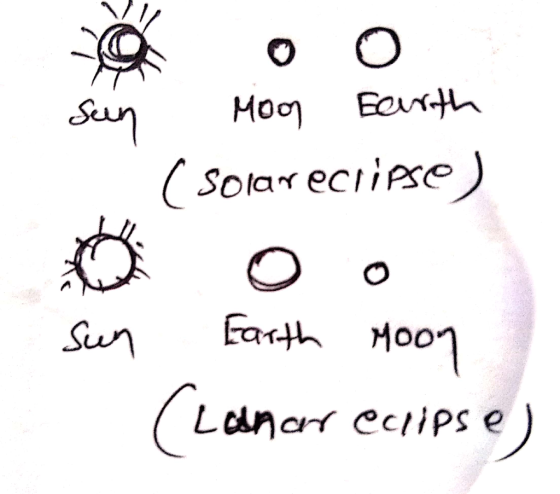
In solar eclipse the moon present between sun and earth. Due to obstruction by moon we cannot able to see sun Ray for a while. This is the solar eclipse. Also we can tell this is the full moon condition but here the alignment is perfectly streight line, that's why every full moon position is not a solar eclipse.
Lunar eclipse occurs when the earth prevents between sun and moon. Here we cannot able to see moon for a while because of obstruction by earth, by which sunlight cannot fall over moon. This is the case for new moon. But during lunar eclipse the positions are perfectly streight line rather than every new moon.
Add Answer to:
give a detailed description of solar and lunar ellipses.
Include:
a detailed sketch
the position of...
For this concept sketch I'd like you to sketch, label, and describe the 8 main phases...
For this concept sketch I'd like you to sketch, label, and describe the 8 main phases of the Moon. For each moon phase you must illustrate what the moon looks like from Earth and also its position relative to the Earth and Sun. Also show which Moon phase occurs during a lunar eclipse and during a solar eclipse, and explain why those eclipses occur at those times.
se 4: Phases of the Moon Everyone has seen the Moon, which is a natural satellite...
 se 4: Phases of the Moon Everyone has seen the Moon, which is a natural satellite that orbits the Earth. As the Moon rotates around the Earth it is exposed to various amounts of light from the Sun. The reason for this is simple, the Moon at night because it is reflecting light produced by the Sun and because the Earth is slightly out of the direct line of sight between the Moon and Sun. If it were not, a...
12) Th Dote CPTUAL Physical Science PRASTICE SRECY Chapter 26: The Solar System Earth-Moon-Sun Al...
 12) Th Dote CPTUAL Physical Science PRASTICE SRECY Chapter 26: The Solar System Earth-Moon-Sun Allgnment 4-3-19 Here we see a shadow on a wall cast by an apple. Note how the rays define the darkest part of the shadow, the umbra, and the lghter part of the shadow, the penumbra The shadows that comprise eclipses of planetary bodies are similarty formed. Below lis a diagram of the Sun Earth, and the orbital path of the Moon (dashed cirdle). One position...
Summary Now that you have completed the experiment, summarize your findings 1. Give a concise explanation...
 Summary Now that you have completed the experiment, summarize your findings 1. Give a concise explanation of the scientific reason for the various phases of the moon. In your explanation, mention the evidence that you gathered through the experiment. Do your results confirm your preliminary prediction? 2. What is a lunar eclipse? Why don't we see a lunar eclipse every month? Developed by Dr. Allyson Sheffield (asheffield@lagcc.cuny.edu) 4 P
Summary Now that you have completed the experiment, summarize your findings...
Summary Now that you have completed the experiment, summarize your findings 1. Give a concise explanation of the scientific reason for the various phases of the moon. In your explanation, mention the evidence that you gathered through the experiment. Do your results confirm your preliminary prediction? 2. What is a lunar eclipse? Why don't we see a lunar eclipse every month? Developed by Dr. Allyson Sheffield (asheffield@lagcc.cuny.edu) 4 P
Summary Now that you have completed the experiment, summarize your findings...
2. On the figure above, draw (if not already pictured) and label th following phases (note:...
 2. On the figure above, draw (if not already pictured) and label th following phases (note: there may be more than one position for a specific phase): e position(s) of the moon during the a. Full Moon b. Quarter Moon c. Gibbous Moon d. Crescent Moon e. New Moon 3. On the figure above, label the phase(s) of the Moon when a lunar eclipse and a solar eclipse can occur. 4. Use the circles below to sketch what the Moon...
2 pts Time Atten 2 Mi Question 1 If the moon only falls partially in the...
 2 pts Time Atten 2 Mi Question 1 If the moon only falls partially in the earth's total shadow what type of eclipse do you get? O partial eclipse total eclipse no eclipse annular eclipse Question 2 2 pts What phase of the moon do you get a solar eclipse? t O new moon full moon O first quarter moon O eclipses are not based on phase U Question 3 2 pts Which phase of moon gives stronger tides, full...
D) Accepting an hypothesis doesn't require experiment. 18. Most ancient cultures made A) unorganized observations of...
 D) Accepting an hypothesis doesn't require experiment. 18. Most ancient cultures made A) unorganized observations of the sky. B) no observations of the sky C) organized observations of the sky. D) more news about the sky. 19. The sidereal day is the time it takes the Earth A) to rotate since before it starts rotating. B) to rotate relative to the Sun. C) to rotate around the Sun D) to rotate relative to the back ground stars. 20. The ecliptic...
c, To the circle shown below draw lines of sight from position x to the edges...
 c, To the circle shown below draw lines of sight from position x to the edges of the circle. Measure the apparent angular size of the circle at position X and reco below. Repeat for position Y apparent angular size at X apparent angular size at Y d. What are two reasons that a celestial ob- ject may have a large apparent angular size? e. Because the sun and moon have the same apparent angular size, we are occasionally able...
Use a pencil to shade in the dark side of the moon in each of these eight moon posi- tions in Figure 26-1. Then shade the circles in Figure 26-2 to show how the moon would appear from Earth at e...
 Use a pencil to shade in the dark side of the moon in each of these eight moon posi- tions in Figure 26-1. Then shade the circles in Figure 26-2 to show how the moon would appear from Earth at each position in its orbit Crescen-) law> pb . FIGURE 2妓&ard do the lunar phases look like from Ealrth 1: What motion of the moon causes the phases we observe from Earth? thel hado amund the cartl 2. Figure 26-1...
1(b) please 2.1 Describing Motion 1. Sketch position-versus-time graphs for the following motions. Include a numerical...
 1(b) please
2.1 Describing Motion 1. Sketch position-versus-time graphs for the following motions. Include a numerical scale on both axes with units that are reasonable for this motion. Some numerical information is give in the problems. For other quantities, make reasonable estimates. Note: A sketched graph is hand-drawn, rather than laid out with a ruler. Even so, a sketch mu be neat, accurate, and include axis labels. ume that al Sun b. A student walks slowly to the bus stop,...
1(b) please
2.1 Describing Motion 1. Sketch position-versus-time graphs for the following motions. Include a numerical scale on both axes with units that are reasonable for this motion. Some numerical information is give in the problems. For other quantities, make reasonable estimates. Note: A sketched graph is hand-drawn, rather than laid out with a ruler. Even so, a sketch mu be neat, accurate, and include axis labels. ume that al Sun b. A student walks slowly to the bus stop,...
 se 4: Phases of the Moon Everyone has seen the Moon, which is a natural satellite that orbits the Earth. As the Moon rotates around the Earth it is exposed to various amounts of light from the Sun. The reason for this is simple, the Moon at night because it is reflecting light produced by the Sun and because the Earth is slightly out of the direct line of sight between the Moon and Sun. If it were not, a...
 12) Th Dote CPTUAL Physical Science PRASTICE SRECY Chapter 26: The Solar System Earth-Moon-Sun Allgnment 4-3-19 Here we see a shadow on a wall cast by an apple. Note how the rays define the darkest part of the shadow, the umbra, and the lghter part of the shadow, the penumbra The shadows that comprise eclipses of planetary bodies are similarty formed. Below lis a diagram of the Sun Earth, and the orbital path of the Moon (dashed cirdle). One position...
 Summary Now that you have completed the experiment, summarize your findings 1. Give a concise explanation of the scientific reason for the various phases of the moon. In your explanation, mention the evidence that you gathered through the experiment. Do your results confirm your preliminary prediction? 2. What is a lunar eclipse? Why don't we see a lunar eclipse every month? Developed by Dr. Allyson Sheffield (asheffield@lagcc.cuny.edu) 4 P
Summary Now that you have completed the experiment, summarize your findings...
Summary Now that you have completed the experiment, summarize your findings 1. Give a concise explanation of the scientific reason for the various phases of the moon. In your explanation, mention the evidence that you gathered through the experiment. Do your results confirm your preliminary prediction? 2. What is a lunar eclipse? Why don't we see a lunar eclipse every month? Developed by Dr. Allyson Sheffield (asheffield@lagcc.cuny.edu) 4 P
Summary Now that you have completed the experiment, summarize your findings...
 2. On the figure above, draw (if not already pictured) and label th following phases (note: there may be more than one position for a specific phase): e position(s) of the moon during the a. Full Moon b. Quarter Moon c. Gibbous Moon d. Crescent Moon e. New Moon 3. On the figure above, label the phase(s) of the Moon when a lunar eclipse and a solar eclipse can occur. 4. Use the circles below to sketch what the Moon...
 2 pts Time Atten 2 Mi Question 1 If the moon only falls partially in the earth's total shadow what type of eclipse do you get? O partial eclipse total eclipse no eclipse annular eclipse Question 2 2 pts What phase of the moon do you get a solar eclipse? t O new moon full moon O first quarter moon O eclipses are not based on phase U Question 3 2 pts Which phase of moon gives stronger tides, full...
 D) Accepting an hypothesis doesn't require experiment. 18. Most ancient cultures made A) unorganized observations of the sky. B) no observations of the sky C) organized observations of the sky. D) more news about the sky. 19. The sidereal day is the time it takes the Earth A) to rotate since before it starts rotating. B) to rotate relative to the Sun. C) to rotate around the Sun D) to rotate relative to the back ground stars. 20. The ecliptic...
 c, To the circle shown below draw lines of sight from position x to the edges of the circle. Measure the apparent angular size of the circle at position X and reco below. Repeat for position Y apparent angular size at X apparent angular size at Y d. What are two reasons that a celestial ob- ject may have a large apparent angular size? e. Because the sun and moon have the same apparent angular size, we are occasionally able...
 Use a pencil to shade in the dark side of the moon in each of these eight moon posi- tions in Figure 26-1. Then shade the circles in Figure 26-2 to show how the moon would appear from Earth at each position in its orbit Crescen-) law> pb . FIGURE 2妓&ard do the lunar phases look like from Ealrth 1: What motion of the moon causes the phases we observe from Earth? thel hado amund the cartl 2. Figure 26-1...
 1(b) please
2.1 Describing Motion 1. Sketch position-versus-time graphs for the following motions. Include a numerical scale on both axes with units that are reasonable for this motion. Some numerical information is give in the problems. For other quantities, make reasonable estimates. Note: A sketched graph is hand-drawn, rather than laid out with a ruler. Even so, a sketch mu be neat, accurate, and include axis labels. ume that al Sun b. A student walks slowly to the bus stop,...
1(b) please
2.1 Describing Motion 1. Sketch position-versus-time graphs for the following motions. Include a numerical scale on both axes with units that are reasonable for this motion. Some numerical information is give in the problems. For other quantities, make reasonable estimates. Note: A sketched graph is hand-drawn, rather than laid out with a ruler. Even so, a sketch mu be neat, accurate, and include axis labels. ume that al Sun b. A student walks slowly to the bus stop,...
Most questions answered within 3 hours.
-
Where is the error in this code sequence?
String s1 = "Hello";
String s2 = "ello";...
asked 11 months ago -
Financial data for Joel de Paris, Inc., for last year
follow:
Joel de Paris, Inc.
Balance...
asked 11 months ago -
Consider this reaction:
Al2(SO4)3 (aq)+ BaCl3
(aq) Al2Cl6 (aq)- +
3BaSO4(s) . What is the...
asked 11 months ago -
Suppose that Savneet is considering increasing her
recent random sample from 20 car rentals to 40...
asked 11 months ago -
Trucks arrive at an unloading terminal at an average rate of 120
per hour.
Trucks arrive...
asked 11 months ago -
Why are methanol and ethanol completely soluble in water while
octanol is not very little soluble....
asked 11 months ago -
A facilities manager at a university reads in a research report
that the mean amount of...
asked 11 months ago -
When the CuSO4 is rehydrated by adding water to the anhydrous
compound, is this an endothermic...
asked 11 months ago -
A ray of sunlight is passing from diamond into crown glass; the
angle of incidence is...
asked 11 months ago -
A block of mass 0.249 kg is placed on top of a light, vertical
spring of...
asked 11 months ago -
how do the kidneys compensate in the presences of acidosis
a) trigger hyperventilate
b) reserve acid...
asked 11 months ago -
Question 501 pts
The rental rate of capital to the firm increases. Which of the
following...
asked 11 months ago