Combustion
i Propane (C3H8) is combusted in a furnace. Dry exhaust volumetric analysis show CO2%= 16%; CO% = 1%; SO2% = 0.5%; O2% = 3% and the balance in N2. Calculate:
I. Actual and stoichiometric A/F ratios.
II. Equivalence ratio (Φ)
Homework Answers
Request Answer!
We need at least 9 more requests to produce the answer.
1 / 10 have requested this problem solution
The more requests, the faster the answer.
Combustion
v> An unknown fuel (CnHmSp) is combusted in a furnace. Dry exhaust volumetric analysis show CO2%= 16%; CO% = 1%; SO2% = 0.5%; O2% = 3% and the balance in N2. Calculate: I. The chemical formula for the fuel. II. Greenhouse emissions. III. Actual A/F ratio. IV. Excess air %.
Consider the combustion of propane (C3H8) in air to form CO2 and H2O. (a) How much...
Consider the combustion of propane (C3H8) in air to form CO2 and H2O. (a) How much O2 (g) is needed per gram of propane? (b) What is the concentration of H2O (%, volume) in the exhaust if a stoichiometric amount of dry air (assume 20% O2 and 80% N2, by volume) is used?
3. A rich fuel-air ratio of propane in burned in an internal combustion engine. The analysis...
 3. A rich fuel-air ratio of propane in burned in an internal combustion engine. The analysis exhaust gas by the exhaust analyzer shows that CO2 = 17%, C3H8=0.5%, with the rest being N2 and some traces of H20. For this case Calculate: a) Write the balanced chemical equation for propane b) Compute air-fuel ratio and equivalence ratio when the ideal AFR is 14.8 ran
Problem 4 A fuel gas has a composition by volume of: 50% H2 , 6% CO2,...
 Problem 4 A fuel gas has a composition by volume of: 50% H2 , 6% CO2, 4% N2 , 40% CO. The dry exhaust gas analysis (% by volume) of the actual combustion process indicates 9.2% CO2, 0% CO, some O2. Recall that for gases, volumetric composition is the same as molar composition. (a) What air/gas ratio (by volume) is required for stoichiometric combustion? (m? air/ m² fuel gas) (b) What air/gas ratio (by volume) has actually been used? (m’...
A natural gas fuel consists of the following volumetric composition: Methane, CH4: 92.5 % Ethane, C2H6:...
A natural gas fuel consists of the following volumetric composition: Methane, CH4: 92.5 % Ethane, C2H6: 3.7 % Propane, C3H8: 0.8 % Nitrogen, N2: 3 % (a) Write out the complete combustion equations for all the combustible constituents individually. (b) Calculate the stoichiometric air to fuel (A/F) ratio on a volume basis. (c) Determine the wet volumetric analysis of the combustion products. (d) Find the dry volumetric analysis of the combustion products.
Combustion
1. Coal (C135H96O9NS) is combusted in a furnace at atmospheric pressure. Calculate: I. Stoichiometric A/F ratio using the A/F s law. II. Write the fuel stoichiometric reaction mole and mass. III. Write the full reaction for actual combustion with 20% excess air. IV. Greenhouse emissions. V. Water vapor mass and dewpoint.
22. (10 points) Consider propane (C3H8) combustion in air with an equivalence ratio of products of this combustion are CO2, H20, 02 and N2 0.8. The reaction . Give the balanced chemical reaction, and...
 22. (10 points) Consider propane (C3H8) combustion in air with an equivalence ratio of products of this combustion are CO2, H20, 02 and N2 0.8. The reaction . Give the balanced chemical reaction, and el ratio (A/F ratio); Percent theoretical air (%TA); Percent excess Air (GE ). late the Air-to-fu
22. (10 points) Consider propane (C3H8) combustion in air with an equivalence ratio of products of this combustion are CO2, H20, 02 and N2 0.8. The reaction . Give the...
22. (10 points) Consider propane (C3H8) combustion in air with an equivalence ratio of products of this combustion are CO2, H20, 02 and N2 0.8. The reaction . Give the balanced chemical reaction, and el ratio (A/F ratio); Percent theoretical air (%TA); Percent excess Air (GE ). late the Air-to-fu
22. (10 points) Consider propane (C3H8) combustion in air with an equivalence ratio of products of this combustion are CO2, H20, 02 and N2 0.8. The reaction . Give the...
Thermodynamics 6. A certain natural gas has the following volumetric analysis: 65 percent CH4, 8 percent...
 Thermodynamics
6. A certain natural gas has the following volumetric analysis: 65 percent CH4, 8 percent H2, 18 percent N2, 3 percent O2, and 6 percent CO2. This gas is now burned completely with the stoichiometric amount of dry air. What is the air-fuel ratio for this combustion process, and the equivalence ratio?
Thermodynamics
6. A certain natural gas has the following volumetric analysis: 65 percent CH4, 8 percent H2, 18 percent N2, 3 percent O2, and 6 percent CO2. This gas is now burned completely with the stoichiometric amount of dry air. What is the air-fuel ratio for this combustion process, and the equivalence ratio?
A mixture of propane and butane is fed into a furnace where i is mixed with...
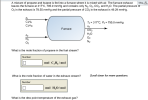 A mixture of propane and butane is fed into a furnace where i is mixed with air. The furnace exhaustMap leaves the furnace at 317°C, 795.0 mmHg and contains only N2-02-CO2, and H2O. The partial pressure O2 in the exhaust is 78.55 mmHg and the partial pressure of CO2 in the exhaust is 49.29 mmHg. 1 C3Hs C4H10 T3-317℃, P3-795.0 mmHg n3 CO2 H20 02 Furnace n2 O2 What is the mole fraction of propane in the fuel stream? Number...
1.f) Methane gas (CH4) enters a combustion chamber at a rate of 3 kg/sec at a...
 1.f) Methane gas (CH4) enters a combustion chamber at a rate of 3 kg/sec at a temperature of 25 °C. A 200% theoretical air is supplied at a temperature of 400K. At the middle of methane combustion process (i.e., after 50% of methane gas is burnt), liquid propane (C3H8) at 25°C is injected at a rate that produces neither CO nor O2 in the flue gases. Assume steady state and adiabatic process at 1 atm, calculate the following i. The...
 3. A rich fuel-air ratio of propane in burned in an internal combustion engine. The analysis exhaust gas by the exhaust analyzer shows that CO2 = 17%, C3H8=0.5%, with the rest being N2 and some traces of H20. For this case Calculate: a) Write the balanced chemical equation for propane b) Compute air-fuel ratio and equivalence ratio when the ideal AFR is 14.8 ran
 Problem 4 A fuel gas has a composition by volume of: 50% H2 , 6% CO2, 4% N2 , 40% CO. The dry exhaust gas analysis (% by volume) of the actual combustion process indicates 9.2% CO2, 0% CO, some O2. Recall that for gases, volumetric composition is the same as molar composition. (a) What air/gas ratio (by volume) is required for stoichiometric combustion? (m? air/ m² fuel gas) (b) What air/gas ratio (by volume) has actually been used? (m’...
 22. (10 points) Consider propane (C3H8) combustion in air with an equivalence ratio of products of this combustion are CO2, H20, 02 and N2 0.8. The reaction . Give the balanced chemical reaction, and el ratio (A/F ratio); Percent theoretical air (%TA); Percent excess Air (GE ). late the Air-to-fu
22. (10 points) Consider propane (C3H8) combustion in air with an equivalence ratio of products of this combustion are CO2, H20, 02 and N2 0.8. The reaction . Give the...
22. (10 points) Consider propane (C3H8) combustion in air with an equivalence ratio of products of this combustion are CO2, H20, 02 and N2 0.8. The reaction . Give the balanced chemical reaction, and el ratio (A/F ratio); Percent theoretical air (%TA); Percent excess Air (GE ). late the Air-to-fu
22. (10 points) Consider propane (C3H8) combustion in air with an equivalence ratio of products of this combustion are CO2, H20, 02 and N2 0.8. The reaction . Give the...
 Thermodynamics
6. A certain natural gas has the following volumetric analysis: 65 percent CH4, 8 percent H2, 18 percent N2, 3 percent O2, and 6 percent CO2. This gas is now burned completely with the stoichiometric amount of dry air. What is the air-fuel ratio for this combustion process, and the equivalence ratio?
Thermodynamics
6. A certain natural gas has the following volumetric analysis: 65 percent CH4, 8 percent H2, 18 percent N2, 3 percent O2, and 6 percent CO2. This gas is now burned completely with the stoichiometric amount of dry air. What is the air-fuel ratio for this combustion process, and the equivalence ratio?
 A mixture of propane and butane is fed into a furnace where i is mixed with air. The furnace exhaustMap leaves the furnace at 317°C, 795.0 mmHg and contains only N2-02-CO2, and H2O. The partial pressure O2 in the exhaust is 78.55 mmHg and the partial pressure of CO2 in the exhaust is 49.29 mmHg. 1 C3Hs C4H10 T3-317℃, P3-795.0 mmHg n3 CO2 H20 02 Furnace n2 O2 What is the mole fraction of propane in the fuel stream? Number...
 1.f) Methane gas (CH4) enters a combustion chamber at a rate of 3 kg/sec at a temperature of 25 °C. A 200% theoretical air is supplied at a temperature of 400K. At the middle of methane combustion process (i.e., after 50% of methane gas is burnt), liquid propane (C3H8) at 25°C is injected at a rate that produces neither CO nor O2 in the flue gases. Assume steady state and adiabatic process at 1 atm, calculate the following i. The...
Most questions answered within 3 hours.
-
Where is the error in this code sequence?
String s1 = "Hello";
String s2 = "ello";...
asked 10 months ago -
Financial data for Joel de Paris, Inc., for last year
follow:
Joel de Paris, Inc.
Balance...
asked 10 months ago -
Consider this reaction:
Al2(SO4)3 (aq)+ BaCl3
(aq) Al2Cl6 (aq)- +
3BaSO4(s) . What is the...
asked 10 months ago -
Suppose that Savneet is considering increasing her
recent random sample from 20 car rentals to 40...
asked 10 months ago -
Trucks arrive at an unloading terminal at an average rate of 120
per hour.
Trucks arrive...
asked 10 months ago -
Why are methanol and ethanol completely soluble in water while
octanol is not very little soluble....
asked 10 months ago -
A facilities manager at a university reads in a research report
that the mean amount of...
asked 10 months ago -
When the CuSO4 is rehydrated by adding water to the anhydrous
compound, is this an endothermic...
asked 10 months ago -
A ray of sunlight is passing from diamond into crown glass; the
angle of incidence is...
asked 10 months ago -
A block of mass 0.249 kg is placed on top of a light, vertical
spring of...
asked 10 months ago -
how do the kidneys compensate in the presences of acidosis
a) trigger hyperventilate
b) reserve acid...
asked 10 months ago -
Question 501 pts
The rental rate of capital to the firm increases. Which of the
following...
asked 10 months ago