
Homework Answers
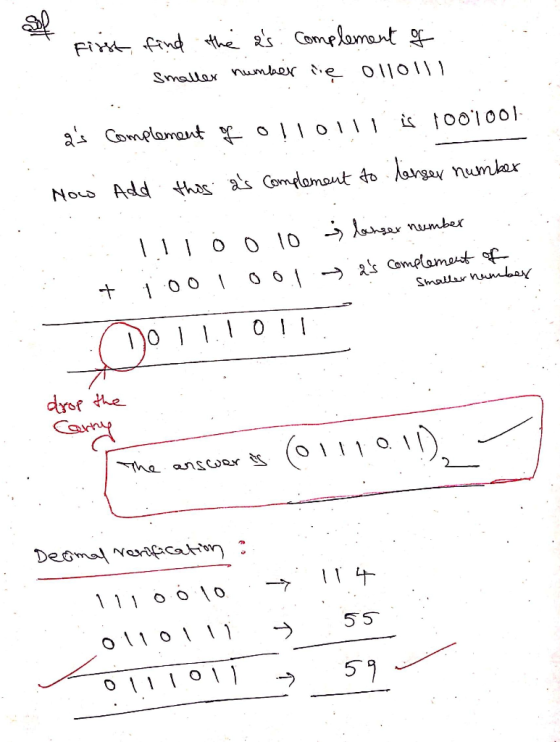
7. Using 8 bits, subtract 52-35 using 2's complement.
 7. Using 8 bits, subtract 52-35 using 2's complement.
Using 8-bit 2’s complement math, Subtract 17 from 8 (8-17)
Using 8-bit 2’s complement math, Subtract 17 from 8 (8-17)
(a) Subtract (78) in base 10 from (97) in base 10 using 2's complement arithmetic ,...
(a) Subtract (78) in base 10 from (97) in base 10 using 2's complement arithmetic , (b) Divide the number (221) in base 10 and (17) in base 10 by converting the original decimal number to its 8-bit equivalent using straight binary.
Please show work/explanation too! 34. Subtract the following signed binary numbers as shown using 2's complement...
 Please show work/explanation too!
34. Subtract the following signed binary numbers as shown using 2's complement arithmetic. a) 01110101 - 00111011 b ) 00110101 - 00001011 C) 01101111 - 00010001
Please show work/explanation too!
34. Subtract the following signed binary numbers as shown using 2's complement arithmetic. a) 01110101 - 00111011 b ) 00110101 - 00001011 C) 01101111 - 00010001
6. Using 8-bits, subtract 81-92 using one's complement.
 6. Using 8-bits, subtract 81-92 using one's complement.
Add the following unsigned binary numbers: 01110101 + 00111011 Subtract the following binary numbers using 2's...
Add the following unsigned binary numbers: 01110101 + 00111011 Subtract the following binary numbers using 2's Complement 01110101 - 00111011 SHOW STEPS
16. Design a logic circuit which will add/subtract/complement 2-digit BCD numbers. You are given ...
 16. Design a logic circuit which will add/subtract/complement 2-digit BCD numbers. You are given 1-digit BCD adders, imultiplexers, 9's complement units. There will be two control signal ADD and C: When ADD-1, C-0 the circuit will perform addition, when ADD-0, C 0 the circuit will perform subtraction, when C Complements of inputs are not available. You can use logic levels 1 and 0. Use a minimum nümber of additional gätes. the circuit will find the 9's complement of the input...
Q4) A) Write the complement (also known as inverse complement) of the sequence below indicating its...
Q4) A) Write the complement (also known as inverse complement) of the sequence below indicating its directionality-5’-ACGGGCATTAGACATCCACGGAAATTCGCAG B)Mark the recognition site(s) in this sequence for the restriction enzyme FokI which recognizes the sequence GGATG
Q1) Convert the following negative decimal numbers to 8 bit binary using the 2’s complement (show...
Q1) Convert the following negative decimal numbers to 8 bit binary using the 2’s complement (show the steps): a) -39 b) -127 Q2) Solve the following subtraction problems using 2's complement representation. (Show the steps using 8-bits) a) 19 – 87 b) 89 – 5 Q3) Convert the following numbers into scientific notation: (Note: to show ten raised to the power of n, you can type as 10^n) a) 654.345 b) 0.000000324235 c) 25600000000000 Q4) Convert the following numbers out...
Subtraction using 1’s and 2’s complement a. 673 – 76 b. 87 – 534
Subtraction using 1’s and 2’s complement a. 673 – 76 b. 87 – 534
 7. Using 8 bits, subtract 52-35 using 2's complement.
 Please show work/explanation too!
34. Subtract the following signed binary numbers as shown using 2's complement arithmetic. a) 01110101 - 00111011 b ) 00110101 - 00001011 C) 01101111 - 00010001
Please show work/explanation too!
34. Subtract the following signed binary numbers as shown using 2's complement arithmetic. a) 01110101 - 00111011 b ) 00110101 - 00001011 C) 01101111 - 00010001
 6. Using 8-bits, subtract 81-92 using one's complement.
 16. Design a logic circuit which will add/subtract/complement 2-digit BCD numbers. You are given 1-digit BCD adders, imultiplexers, 9's complement units. There will be two control signal ADD and C: When ADD-1, C-0 the circuit will perform addition, when ADD-0, C 0 the circuit will perform subtraction, when C Complements of inputs are not available. You can use logic levels 1 and 0. Use a minimum nümber of additional gätes. the circuit will find the 9's complement of the input...
Most questions answered within 3 hours.
-
Where is the error in this code sequence?
String s1 = "Hello";
String s2 = "ello";...
asked 10 months ago -
Financial data for Joel de Paris, Inc., for last year
follow:
Joel de Paris, Inc.
Balance...
asked 10 months ago -
Consider this reaction:
Al2(SO4)3 (aq)+ BaCl3
(aq) Al2Cl6 (aq)- +
3BaSO4(s) . What is the...
asked 10 months ago -
Suppose that Savneet is considering increasing her
recent random sample from 20 car rentals to 40...
asked 10 months ago -
Trucks arrive at an unloading terminal at an average rate of 120
per hour.
Trucks arrive...
asked 10 months ago -
Why are methanol and ethanol completely soluble in water while
octanol is not very little soluble....
asked 10 months ago -
A facilities manager at a university reads in a research report
that the mean amount of...
asked 10 months ago -
When the CuSO4 is rehydrated by adding water to the anhydrous
compound, is this an endothermic...
asked 10 months ago -
A ray of sunlight is passing from diamond into crown glass; the
angle of incidence is...
asked 10 months ago -
A block of mass 0.249 kg is placed on top of a light, vertical
spring of...
asked 10 months ago -
how do the kidneys compensate in the presences of acidosis
a) trigger hyperventilate
b) reserve acid...
asked 10 months ago -
Question 501 pts
The rental rate of capital to the firm increases. Which of the
following...
asked 10 months ago