

Homework Answers
Add Answer to:
Solution to this please I have an important homework
4) A compressed gas cylinder contains 1.00x10...
8. If you have a 3.0 L cylinder of compressed air that contains 2.0 g of O2, and 8.0 g of N2, then at room temperature (...
8. If you have a 3.0 L cylinder of compressed air that contains 2.0 g of O2, and 8.0 g of N2, then at room temperature (assume 298 K), what would be the total pressure in the tank (in atm), and the pressures of O2, and of N2 (also in atm) separately? 1. A guage on a compressed gas cylinder in a hospital reads 2.200 E3 psi (pounds per square inch). (1.00 atm = 14.7 psi). Express this pressure in...
At a temperature of 20.0 °C, a compressed gas cylinder contains 10.0 L of carbon dioxide...
At a temperature of 20.0 °C, a compressed gas cylinder contains 10.0 L of carbon dioxide gas and the pressure gauge reads 2.0*10⌃5 Pa. How many moles of gas does the cylinder contain? (A) 0.82 mol (B) 12.0 mol (C) 821 mol (D) 8.2*10⌃4 mol (E) 1.20*10⌃4 mol
Please explain the process of solving the problem. 16) A gas cylinder contains only the gases...
Please explain the process of solving the problem. 16) A gas cylinder contains only the gases radon, nitrogen, and helium. The radon has a pressure of 222 torr while the nitrogen has a pressure of 446 torr. If the total pressure inside the container is 771 torr, what is the pressure (in atm) that is due to the helium? 17) What is the temperature (in degrees C) of 2.48 moles of gas stored in a 30.0 L container at 1559...
Consider a piston-cylinder device (system) that contains 0.06 m3 of air at 300 kPa and 125...
Consider a piston-cylinder device (system) that contains 0.06 m3 of air at 300 kPa and 125 ̊C. (a) If the volume of air in the device increases to 0.15 m3 while the pressure remains constant, determine the work done by the system during the process. (b) If as a result of heat transfer to the surrounding, the pressure and temperature in the device drop to 240 kPa and 55 ̊C, respectively, and the piston is held such that the volume...
questions 4 and 5 please explain 4. A cylinder with a piston originally contains 5.0 L...
 questions 4 and 5 please explain
4. A cylinder with a piston originally contains 5.0 L of He gas at a temperature of 310 K. When the gas is cooled the piston moves and the new volume is 2.4 L. What is the final temperature of the gas assuming that pressure and the number of moles of He remains constant? 5. What volume, in L, is occupied by 10.0 g N, at 30.0°C and a pressure of 385 mm Hg?
questions 4 and 5 please explain
4. A cylinder with a piston originally contains 5.0 L of He gas at a temperature of 310 K. When the gas is cooled the piston moves and the new volume is 2.4 L. What is the final temperature of the gas assuming that pressure and the number of moles of He remains constant? 5. What volume, in L, is occupied by 10.0 g N, at 30.0°C and a pressure of 385 mm Hg?
ME 372: Homework# 4 a) Argon, considered as an ideal gas, is compressed through an isentropic...
 ME 372: Homework# 4 a) Argon, considered as an ideal gas, is compressed through an isentropic process (1-2s) in a single stage compressor as shown in figure below isentropic From inlet (1) where the pressure and temperature are (200 kpa) and (27o c) respectively to exit (2s) where the pressure is (2000 kpa ) . If (k= 1.667 ) and ( R = 0.2081 kJ/kg. k ) a.1) determine the specific work (Wis) done by the compressor on Argon along...
A cylinder contains 9.8 moles of ideal gas, initially at a temperature of 119°C. The cylinder is provided with a frictio...
A cylinder contains 9.8 moles of ideal gas, initially at a temperature of 119°C. The cylinder is provided with a frictionless piston, which maintains a constant pressure of 7.4 × 10⁵ Pa on the gas. The gas is cooled until its temperature has decreased to 27°C. For the gas CV = 14.41 J/mol ∙ K, and the ideal gas constant R = 8.314 J/mol · K. (a) Find the work done by (or on) the gas during this process. Is...
cylinder with a moveable piston contains 0.77 mol of gas and has a volume of 339...
 cylinder with a moveable piston contains 0.77 mol of gas and has a volume of 339 mL. Part A What will its volume be it an additional 0.25 mol of gas is added to the cylinder? (Hint: The final number of moles is the sum of the initial number and the amount added.) Express your answer to two significant figures and include the appropriate unit PIA O v. Value Units Submitmesuest Answer Submit Request Answer Review I Constants 1 Periodic...
4. A piston-cylinder device contains 0.8 kg and 1 m' of an ideal gas whose molar...
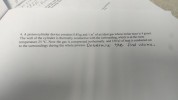 4. A piston-cylinder device contains 0.8 kg and 1 m' of an ideal gas whose molar mass is 4 g/mol. The wall of the cylinder is thermally conductive with the surrounding, which is at the room temperature 25 °C. Now th e gas is compressed isothermally, and 150 kJ of heat is conducted out to the surroundings during the whole process. Deternine the firal volu me.
A cylinder contains 1.2 moles of ideal gas, initially at a temperature of 116°C. The cylinder...
 A cylinder contains 1.2 moles of ideal gas, initially at a temperature of 116°C. The cylinder is provided with a frictionless piston, which maintains a constant pressure of 6.4 x 10⁵ Pa on the gas. The gas is cooled until its temperature has decreased to 27°C. For the gas Cy= 11.65 J/mol K, and the ideal gas constant R = 8.314 J/mol K. Part A Find the work done by (or on the gas during this process. Express your answer...
 questions 4 and 5 please explain
4. A cylinder with a piston originally contains 5.0 L of He gas at a temperature of 310 K. When the gas is cooled the piston moves and the new volume is 2.4 L. What is the final temperature of the gas assuming that pressure and the number of moles of He remains constant? 5. What volume, in L, is occupied by 10.0 g N, at 30.0°C and a pressure of 385 mm Hg?
questions 4 and 5 please explain
4. A cylinder with a piston originally contains 5.0 L of He gas at a temperature of 310 K. When the gas is cooled the piston moves and the new volume is 2.4 L. What is the final temperature of the gas assuming that pressure and the number of moles of He remains constant? 5. What volume, in L, is occupied by 10.0 g N, at 30.0°C and a pressure of 385 mm Hg?
 ME 372: Homework# 4 a) Argon, considered as an ideal gas, is compressed through an isentropic process (1-2s) in a single stage compressor as shown in figure below isentropic From inlet (1) where the pressure and temperature are (200 kpa) and (27o c) respectively to exit (2s) where the pressure is (2000 kpa ) . If (k= 1.667 ) and ( R = 0.2081 kJ/kg. k ) a.1) determine the specific work (Wis) done by the compressor on Argon along...
 cylinder with a moveable piston contains 0.77 mol of gas and has a volume of 339 mL. Part A What will its volume be it an additional 0.25 mol of gas is added to the cylinder? (Hint: The final number of moles is the sum of the initial number and the amount added.) Express your answer to two significant figures and include the appropriate unit PIA O v. Value Units Submitmesuest Answer Submit Request Answer Review I Constants 1 Periodic...
 4. A piston-cylinder device contains 0.8 kg and 1 m' of an ideal gas whose molar mass is 4 g/mol. The wall of the cylinder is thermally conductive with the surrounding, which is at the room temperature 25 °C. Now th e gas is compressed isothermally, and 150 kJ of heat is conducted out to the surroundings during the whole process. Deternine the firal volu me.
 A cylinder contains 1.2 moles of ideal gas, initially at a temperature of 116°C. The cylinder is provided with a frictionless piston, which maintains a constant pressure of 6.4 x 10⁵ Pa on the gas. The gas is cooled until its temperature has decreased to 27°C. For the gas Cy= 11.65 J/mol K, and the ideal gas constant R = 8.314 J/mol K. Part A Find the work done by (or on the gas during this process. Express your answer...
Most questions answered within 3 hours.
-
Where is the error in this code sequence?
String s1 = "Hello";
String s2 = "ello";...
asked 10 months ago -
Financial data for Joel de Paris, Inc., for last year
follow:
Joel de Paris, Inc.
Balance...
asked 10 months ago -
Consider this reaction:
Al2(SO4)3 (aq)+ BaCl3
(aq) Al2Cl6 (aq)- +
3BaSO4(s) . What is the...
asked 10 months ago -
Suppose that Savneet is considering increasing her
recent random sample from 20 car rentals to 40...
asked 10 months ago -
Trucks arrive at an unloading terminal at an average rate of 120
per hour.
Trucks arrive...
asked 10 months ago -
Why are methanol and ethanol completely soluble in water while
octanol is not very little soluble....
asked 10 months ago -
A facilities manager at a university reads in a research report
that the mean amount of...
asked 10 months ago -
When the CuSO4 is rehydrated by adding water to the anhydrous
compound, is this an endothermic...
asked 10 months ago -
A ray of sunlight is passing from diamond into crown glass; the
angle of incidence is...
asked 10 months ago -
A block of mass 0.249 kg is placed on top of a light, vertical
spring of...
asked 10 months ago -
how do the kidneys compensate in the presences of acidosis
a) trigger hyperventilate
b) reserve acid...
asked 10 months ago -
Question 501 pts
The rental rate of capital to the firm increases. Which of the
following...
asked 10 months ago