According to Newton’s laws of motion, for the same amount of unbalanced force which object will...
According to Newton’s laws of motion, for the same amount of unbalanced force which object will have the least acceleration? 18 kg object 7 kg object 25 kg object 10 kg object
Homework Answers
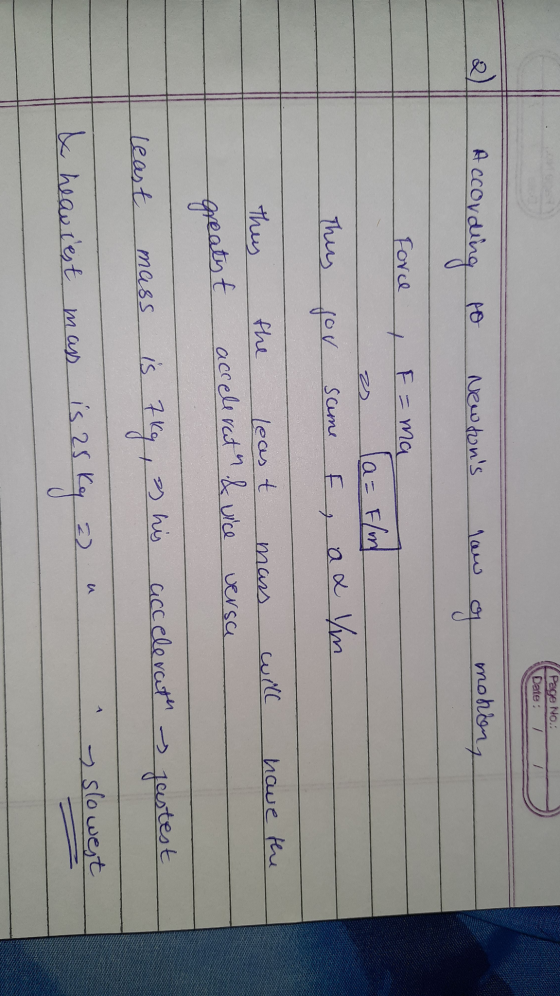
Feel free to ask doubts in the comment section below and give it a thumbs up if you liked the answer. Have a good day
Add Answer to:
According to Newton’s laws of motion, for the same amount of
unbalanced force which object will...
1))) According to Newton’s laws, an object will remain stationary or move at constant velocity unless...
1))) According to Newton’s laws, an object will remain stationary or move at constant velocity unless acted by a force. If a force (F) is applied, the object will accelerate according to F=m·a, where “m” is the mass of the object and “a” is its acceleration. The unit of force is the Newton (N), N is kg·m/sec a) Consider a stationary object with a mass of 5 Kg, acted on by a force of 10 N. What is its acceleration?...
Newton’s Third Law of motion states that more force is required to move a larger object...
Newton’s Third Law of motion states that more force is required to move a larger object and less force to a smaller. Is it true or false
1. Newton’s Laws and damped simple harmonic motion A particle of mass m = 5 moves...
1. Newton’s Laws and damped simple harmonic motion A particle of mass m = 5 moves in a straight line on a horizontal surface. It is subject to the following forces: an attractive force in the direction of the fixed origin O with magnitude 40 times the instantaneous distance from O a damping force due to friction which is 20 times the instantaneous speed the force due to gravity the normal force. The particle starts from rest at a distance...
1) Which term best describes an object's resistance to a change in motion A) Force B)...
 1) Which term best describes an object's resistance to a change in motion A) Force B) Inertia C) Acceleration D) Resistance 2) Two skaters, Cathy and Mike, are standing on a frozen pond. Mike has twice the mass as Cathy. If Mike pushes to the left on Cathy, what can be said about the forces and accelerations on each person? A) Cathy experiences a force and acceleration to the left, while Mike experiences an equal force in the opposite direction....
Problem 4: sig.gif?tid=2N74-D1-D6-44-AC90-13475 Given Newton’s First Law of Motion, what do we reasonably expect an object to do given the following scenarios?
 Problem 4: Given Newton’s First Law of Motion, what do we reasonably expect an object to do given the following scenarios?Part (a) An object sits at rest with no unbalanced forces or torques acting upon it. What do we expect this object to do? Part (b) An object is traveling with a constant velocity with no unbalanced forces or torques acting upon it. What do we expect this object to do? Part (c) An object sits at rest with an unbalanced force acting upon it. What...
Newton's Laws of Motion 12. The diagram below shows a horizontal 8.0-newton force applied to a...
 Newton's Laws of Motion 12. The diagram below shows a horizontal 8.0-newton force applied to a 4.0-kilogram block on a frictionless table. 4.0 kg F8.0 N Frictionless Table What is the magnitude of the block's acceleration? 13. Two forces are applied to a 2.0-kilogram block on a frictionless horizontal surface, as shown in the diagram below. F, -2.0 N F2-8.0 N 2.0 kg Frictionless Surface What is the acceleration of the block? What additional force, when applied to the object...
1) A 100 Newton force acts on an object to the right at the same time...
1) A 100 Newton force acts on an object to the right at the same time a second force of 180 N acts to the left. Calculate the net, or resultant force on the object. Give the answer rounded to 1 decimal place and remember that forces in the +x direction are positive and forces in the -x direction are negative. 2) Calculate the acceleration of a 18 kg mass, if a 100 N force acts to the right and...
(b) For an object in uniform circular motion, derive the expression which relates centripetal force to...
 (b) For an object in uniform circular motion, derive the expression which relates centripetal force to speed. (5 marks] (c) A person swings an object around in a circle on the end of a steel wire, at a constant speed completing one revolution every 1.9 s. The object has a mass of 1.75 kg. The radius of the circle is 2.3 m. (i) Draw a diagram indicating the direction of the following vectors: velocity, centripetal acceleration, centripetal force. [3 marks]...
Which of the following are Newton's laws of motion? Select all that apply. Question options: A...
 Which of the following are Newton's laws of motion? Select all that apply. Question options: A object in equilibrium will remain so unless acted upon by an outside force. The normal force on a body equals mass times gravity (N=m*g) For every action, there is an equal and opposite reaction The sum of external forces on a body equals mass times acceleration (F= m*a)
A block (425‐kg) is sitting on a ramp, which is angled 25.0‐degrees above the horizontal. A rope...
A block (425‐kg) is sitting on a ramp, which is angled 25.0‐degrees above the horizontal. A rope pulls up the ramp with 275N and another rope pulls horizontally at 175N. The coefficient of static friction is 0.855. The coefficient of kinetic friction is 0.655. a. Draw a free‐body diagram for this case. Make sure to indicate a coordinate system. b. Write out Newton’s 2nd Laws, once for each dimension. c .Determine the acceleration of the block. d. Pick one force from your free‐body...
 1) Which term best describes an object's resistance to a change in motion A) Force B) Inertia C) Acceleration D) Resistance 2) Two skaters, Cathy and Mike, are standing on a frozen pond. Mike has twice the mass as Cathy. If Mike pushes to the left on Cathy, what can be said about the forces and accelerations on each person? A) Cathy experiences a force and acceleration to the left, while Mike experiences an equal force in the opposite direction....
 Problem 4: Given Newton’s First Law of Motion, what do we reasonably expect an object to do given the following scenarios?Part (a) An object sits at rest with no unbalanced forces or torques acting upon it. What do we expect this object to do? Part (b) An object is traveling with a constant velocity with no unbalanced forces or torques acting upon it. What do we expect this object to do? Part (c) An object sits at rest with an unbalanced force acting upon it. What...
 Newton's Laws of Motion 12. The diagram below shows a horizontal 8.0-newton force applied to a 4.0-kilogram block on a frictionless table. 4.0 kg F8.0 N Frictionless Table What is the magnitude of the block's acceleration? 13. Two forces are applied to a 2.0-kilogram block on a frictionless horizontal surface, as shown in the diagram below. F, -2.0 N F2-8.0 N 2.0 kg Frictionless Surface What is the acceleration of the block? What additional force, when applied to the object...
 (b) For an object in uniform circular motion, derive the expression which relates centripetal force to speed. (5 marks] (c) A person swings an object around in a circle on the end of a steel wire, at a constant speed completing one revolution every 1.9 s. The object has a mass of 1.75 kg. The radius of the circle is 2.3 m. (i) Draw a diagram indicating the direction of the following vectors: velocity, centripetal acceleration, centripetal force. [3 marks]...
 Which of the following are Newton's laws of motion? Select all that apply. Question options: A object in equilibrium will remain so unless acted upon by an outside force. The normal force on a body equals mass times gravity (N=m*g) For every action, there is an equal and opposite reaction The sum of external forces on a body equals mass times acceleration (F= m*a)
Most questions answered within 3 hours.
-
Where is the error in this code sequence?
String s1 = "Hello";
String s2 = "ello";...
asked 10 months ago -
Financial data for Joel de Paris, Inc., for last year
follow:
Joel de Paris, Inc.
Balance...
asked 10 months ago -
Consider this reaction:
Al2(SO4)3 (aq)+ BaCl3
(aq) Al2Cl6 (aq)- +
3BaSO4(s) . What is the...
asked 10 months ago -
Suppose that Savneet is considering increasing her
recent random sample from 20 car rentals to 40...
asked 10 months ago -
Trucks arrive at an unloading terminal at an average rate of 120
per hour.
Trucks arrive...
asked 10 months ago -
Why are methanol and ethanol completely soluble in water while
octanol is not very little soluble....
asked 10 months ago -
A facilities manager at a university reads in a research report
that the mean amount of...
asked 10 months ago -
When the CuSO4 is rehydrated by adding water to the anhydrous
compound, is this an endothermic...
asked 10 months ago -
A ray of sunlight is passing from diamond into crown glass; the
angle of incidence is...
asked 10 months ago -
A block of mass 0.249 kg is placed on top of a light, vertical
spring of...
asked 10 months ago -
how do the kidneys compensate in the presences of acidosis
a) trigger hyperventilate
b) reserve acid...
asked 10 months ago -
Question 501 pts
The rental rate of capital to the firm increases. Which of the
following...
asked 10 months ago